

Residential Block Management: What RMCs Should Expect
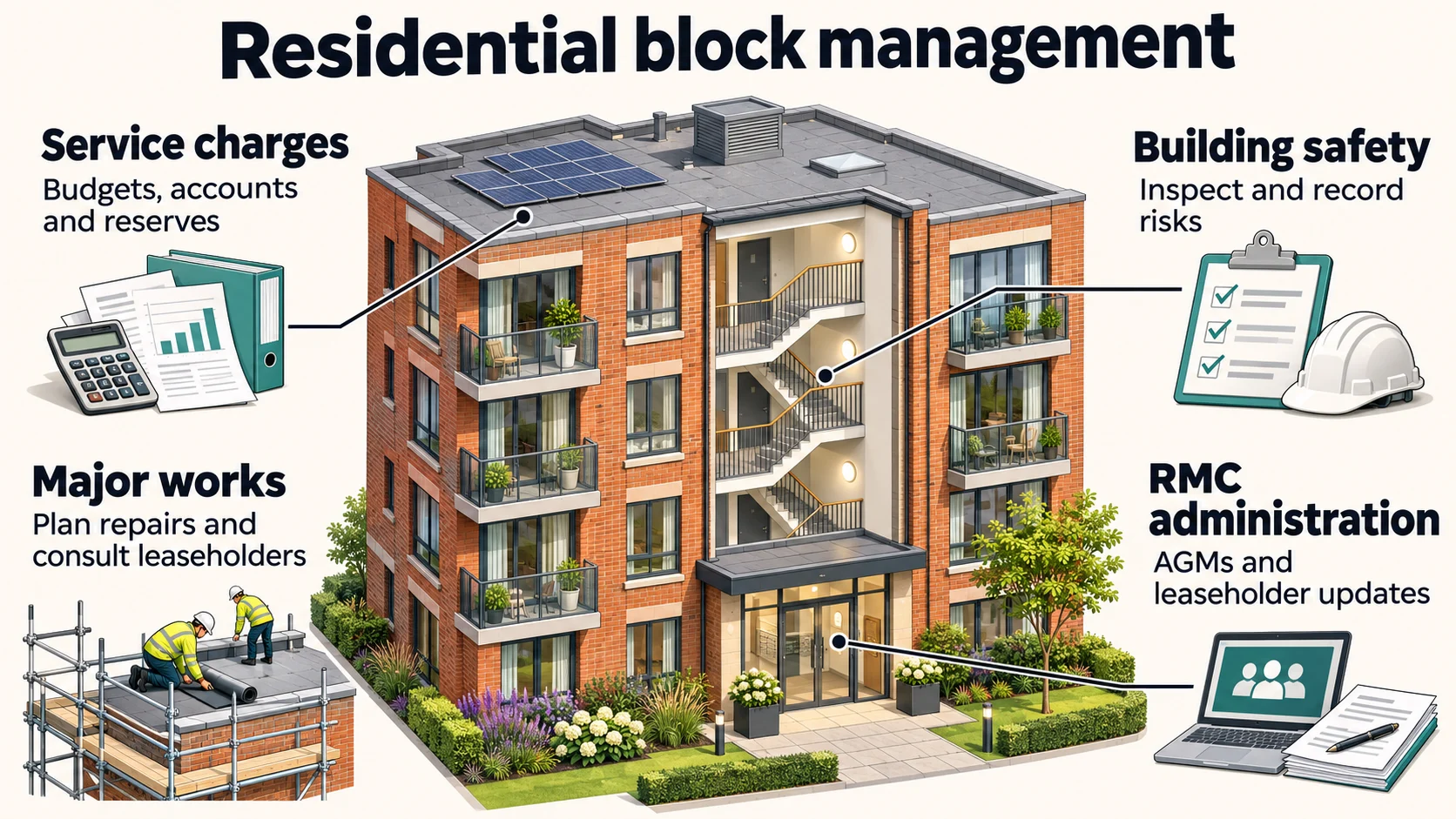
Serving as a director of a resident management company carries real statutory duties. Those duties cover communal property, safety standards and collective finances. Professional residential block management supplies the administrative structure, regulatory oversight and technical execution that communal schemes require. Directors must balance lease enforcement, major works planning and statutory compliance. Appointing a specialist managing agent shifts the operational burden away from volunteers. Directors still keep fiduciary control over long-term building strategy.
Every development runs under its own lease covenants, maintenance requirements and budgetary demands. Effective apartment block management must reflect those differences rather than apply a generic template. So how can volunteer directors confirm that their agent meets industry benchmarks, complies with building safety law and manages communal funds transparently?
Key Takeaways
- Block management covers communal structure, shared services and statutory compliance, whilst lettings management deals with individual tenancies under the Housing Act 1988.
- The RICS Service Charge Residential Management Code sets professional standards for budgeting, procurement, client accounts and annual service charge accounting.
- Section 20 consultation applies to qualifying works costing any leaseholder more than £250, and failure caps recovery unless the tribunal grants dispensation.
- Where an RMC is the Accountable Person for a higher-risk building, it carries Building Safety Act duties that no agent can assume.
- Section 20B of the Landlord and Tenant Act 1985 bars recovery of costs not demanded or notified within eighteen months.
Core Operational Competencies for Residential Developments
Professional block governance requires competence across several technical disciplines. RMC directors should assess prospective agents against statutory standards rather than general promises of property administration. The table below sets out seven primary operational areas within residential developments. Each row pairs the area with its governing standard and its core governance requirement.
A failure in any single area can expose leaseholder funds to loss. It can also place directors in breach of their duties as company officers. Structured oversight keeps procurement, accounting, fire safety inspections and leaseholder communications transparent throughout the year. In practice, we find that agents who report against each area give boards far clearer control.
| Operational Area | Primary Statutory Standard | Core Governance Requirement |
|---|---|---|
| Operational AreaFinancial Stewardship | Primary Statutory StandardLandlord and Tenant Acts 1985 and 1987 | Core Governance RequirementService charge funds held on statutory trust in designated client accounts |
| Operational AreaMajor Works Consultation | Primary Statutory StandardSection 20, Landlord and Tenant Act 1985 | Core Governance RequirementStatutory notices for qualifying works costing any leaseholder over £250 |
| Operational AreaBuilding Safety Compliance | Primary Statutory StandardBuilding Safety Act 2022 | Core Governance RequirementGolden thread, safety case and occurrence reporting for higher-risk buildings |
| Operational AreaEvacuation Planning | Primary Statutory StandardFire Safety (Residential Evacuation Plans) (England) Regulations 2025 | Core Governance RequirementPerson-centred fire risk assessments and residential PEEPs in buildings in scope |
| Operational AreaFire Risk Assessment | Primary Statutory StandardRegulatory Reform (Fire Safety) Order 2005 | Core Governance RequirementRecorded assessment of common parts, structure, external walls and flat entrance doors |
| Operational AreaAccounts Inspection | Primary Statutory StandardSection 22, Landlord and Tenant Act 1985 | Core Governance RequirementLeaseholder access to accounts, receipts and supporting documents |
| Operational AreaProfessional Practice | Primary Statutory StandardRICS Service Charge Residential Management Code | Core Governance RequirementProportionate reserve planning and transparent management fee structures |
Block Management Versus Lettings Management
Distinctions in Operational Scope
Residential block management focuses on the physical fabric, communal infrastructure and statutory compliance of an entire building. Lettings management handles the relationship between an individual landlord and a tenant occupying a single flat. The two disciplines share a building but serve different legal interests, different clients and different statutory regimes.
A letting agent arranges tenancy agreements, vets tenants, prepares inventories and coordinates repairs inside a private flat. An RMC managing agent oversees communal corridors, roof replacements, lift maintenance, communal electrical safety and building insurance renewals. Conflating the two often leads to weak communal administration and misallocated service charge costs. It can also leave structural liabilities unmanaged for years.
Legal and Financial Frameworks Compared
Lettings management operates under the Housing Act 1988 and, since 1 May 2026, the Renters’ Rights Act 2025. Block governance operates under long-leasehold law, principally the Landlord and Tenant Act 1985. Company law and fire safety legislation sit alongside it. Each framework imposes distinct duties, deadlines and financial controls on the appointed agent.
A letting manager processes monthly rent and protects tenancy deposits. A block manager prepares service charge budgets, collects reserve fund contributions and issues formal statutory demands. Leaseholders hold long-term proprietary interests in their homes. Their buildings therefore need planned preventative maintenance programmes, not the reactive repairs typical of short-term tenancies.
Professional Standards and the RICS Code Benchmark
Mandatory Accounting Principles for Communal Funds
The RICS Service Charge Residential Management Code is the professional benchmark for managing agents in England and Wales. It carries statutory approval under section 87 of the Leasehold Reform, Housing and Urban Development Act 1993. The Code requires service charge money to sit in designated client accounts, separate from the agent’s own funds.
Under the Code, agents must issue clear annual budgets well before each financial year begins. Section 21 of the Landlord and Tenant Act 1985 entitles leaseholders to a written summary of costs. Where more than four dwellings contribute, a qualified accountant must certify that summary. These safeguards protect directors against allegations of misappropriation or negligence.
First-tier Tribunal Evidentiary Weight
The First-tier Tribunal (Property Chamber) considers compliance with the RICS Code when it assesses whether service charges are reasonable. A breach of the Code is not itself an offence. Tribunals nevertheless treat non-compliance as persuasive evidence that the agent incurred costs unreasonably or managed the building below an acceptable standard.
Agents who follow the Code closely give directors a documented audit trail for every spending decision. That record protects recovery rights under section 19 of the Landlord and Tenant Act 1985. Section 19 limits recoverable costs to those reasonably incurred for works or services of a reasonable standard. In practice, a clear tender file often settles a challenge before it reaches a hearing.
Did You Know?
From 1 April 2027, the Leasehold and Freehold Reform Act 2024 introduces a prescribed future demand notice. It covers service charge costs not demanded within eighteen months. Prescribed service charge demands, accounts and annual reports follow for private landlords from 1 November 2027.
Financial Stewardship and Statutory Accounting Rules
The Eighteen-Month Cost Recovery Restriction
Section 20B of the Landlord and Tenant Act 1985 limits recovery of communal expenditure to a strict eighteen-month window. If an agent incurs a cost but neither demands it nor serves written notice within that period, leaseholders have no liability to pay. The rule applies however genuine the expenditure was.
Poor bookkeeping can damage an RMC’s liquidity through this rule alone. Late contractor invoices and delayed year-end reconciliations regularly push genuine costs outside the window. Competent agents run rolling expenditure reviews throughout the year. They issue demands or formal section 20B notices well before any deadline expires.
Reserve Fund Governance and Long-Term Capital Planning
Reserve funds provide capital for the cyclical replacement of high-value components such as roofs, external render and communal lifts. Effective agents prepare planned preventative maintenance schedules, typically spanning ten to twenty-five years. These schedules project future capital needs and set contribution levels within what the lease permits the RMC to collect.
Section 42 of the Landlord and Tenant Act 1987 places service charge contributions on statutory trust. Agents should keep reserves in designated accounts and credit any interest to the fund. Clear reporting shows leaseholders how reserves accrue and how future programmes will protect property values. Well-funded reserves also reduce the risk of sudden emergency levies.
Landlord Exit Strategies and Options
Section 20 Consultation Rules for Major Works
Statutory Financial Limits Triggering Consultation
Section 20 of the Landlord and Tenant Act 1985 requires formal consultation before the landlord commits to qualifying works or long-term agreements. It applies when works will cost any single leaseholder more than £250. It also applies to agreements over twelve months costing any leaseholder more than £100 in an accounting year.
If consultation is defective, the landlord can recover no more than £250 per leaseholder unless the tribunal grants dispensation under section 20ZA. Consider a thirty-unit building with an unconsulted £90,000 roof replacement. The RMC could recover only £7,500 in total. Directors would then face an £82,500 shortfall that threatens the company’s solvency.
The Three Formal Procedural Stages
Consultation for qualifying works follows three stages: a notice of intention, a statement of estimates and, where required, a notice of reasons. The notice of intention describes the works and explains why they are necessary. It invites written observations and contractor nominations within a thirty-day consultation period.
The statement of estimates sets out at least two estimates, one from a contractor wholly unconnected with the landlord. It makes the estimates available for inspection and opens a further thirty-day period for observations. If the RMC does not appoint the lowest bidder or a leaseholder nominee, it must serve a notice of reasons. That notice must follow within twenty-one days of entering the contract.
The Railton-Meeks Compliance Audit Tool
Check Your Compliance & Protect Your Portfolio
Accountable Person Duties Under the Building Safety Act 2022
Higher-Risk Building Thresholds and Accountability
The Building Safety Act 2022 defines a higher-risk building as one at least 18 metres high or with at least seven storeys. It must also contain at least two residential units. Where an RMC holds the repairing obligation for common parts, the company becomes an Accountable Person for the building.
These statutory duties sit with the RMC and cannot pass to a managing agent by contract. The agent can carry out the day-to-day work, but the company remains answerable to the Building Safety Regulator. Directors should therefore minute how they oversee compliance. In our experience, boards that review safety reports quarterly spot gaps far earlier.
Golden Thread and Safety Case Obligations
The Principal Accountable Person must register the building with the Building Safety Regulator and prepare a safety case report. That report explains how the Accountable Persons identify and control major fire and structural hazards. Accountable Persons must also keep the golden thread, a digital record of accurate and current building information.
Further duties include a mandatory occurrence reporting system for safety events. A resident engagement strategy must explain how residents can take part in safety decisions. The regulator can also call the building in for a building assessment certificate. Missing records or weak resident engagement will surface quickly at that assessment.
Airbnb Alternative for Short Let Management across Manchester and Cheshire
Fire Safety Duties in Multi-Occupied Blocks
Residential Evacuation Plans from April 2026
The Fire Safety (Residential Evacuation Plans) (England) Regulations 2025 came into force on 6 April 2026. They apply to buildings with two or more sets of domestic premises that are at least 18 metres high or seven storeys. They also cover buildings above 11 metres that operate a simultaneous evacuation strategy.
Responsible persons must offer person-centred fire risk assessments to residents who may struggle to self-evacuate. Where needed, they must agree residential personal emergency evacuation plans with those residents. Responsible persons must share relevant plan information with the fire and rescue service, typically through the secure information box. A building emergency evacuation plan must sit alongside these individual plans.
Fire Risk Assessments and Fire Door Checks
The Regulatory Reform (Fire Safety) Order 2005 requires a suitable and sufficient fire risk assessment of the common parts. The Fire Safety Act 2021 confirmed that this assessment extends to the structure, external walls and flat entrance doors. Since October 2023, every responsible person must record the full assessment in writing.
The Fire Safety (England) Regulations 2022 add specific duties for buildings above 11 metres. Responsible persons must check communal fire doors, including self-closers, at least every three months. They must also use best endeavours to check flat entrance doors annually. These checks preserve the compartmentation that a stay-put strategy depends upon.
Instant Rental & Block Valuation
Get Your Valuation & Know Your Market Value
Leaseholder Relations and Corporate RMC Administration
Transparent Information Flow and Dispute Avoidance
Consistent, transparent communication is the strongest defence against service charge disputes and tribunal litigation. Professional managing agents maintain structured channels for every leaseholder. Many provide online portal access to maintenance logs, accounts, insurance certificates and major works updates. Leaseholders who can see the evidence rarely need to challenge it formally.
Service charges sometimes rise because of utility inflation or insurance revaluations. Competent managers explain those increases with transparent cost breakdowns before demands go out. Prompt handling of communal enquiries, noise complaints and parking issues supports community harmony. It also keeps routine residential queries separate from formal company business.
Company Secretarial Duties and Annual General Meetings
An RMC is a company limited by guarantee or by shares, with filing obligations under the Companies Act 2006. Managing agents commonly provide company secretarial support. That support covers statutory registers, confirmation statements, annual accounts and changes of directors at Companies House. Missed filings carry penalties and can trigger strike-off action.
Agents also run Annual General Meetings by circulating notices, preparing financial packs, validating proxy forms and recording minutes. Sound administration keeps the RMC in good legal standing. If the Registrar dissolves the company, its property passes to the Crown as bona vacantia. That outcome can leave the freehold and communal assets without an owner able to manage them.
HMO Specialist Yield & Tax Calculator
Calculate Your Yield & Offset New Tax Burdens
Final Thoughts
Competent residential block management demands proficiency across property law, fire safety standards, procurement procedure and company administration. Volunteer directors cannot reasonably master the Building Safety Act 2022 or Section 20 procedure without qualified guidance. An experienced agent working to the RICS Code protects both the building and the directors.
Transparent financial planning, active risk control and clear communication turn communal developments into well-funded communities. Boards that hold their agents to statutory benchmarks protect property values and resident safety. They also secure the long-term integrity of their buildings.
Railton-Meeks Landlord Assistance
Frequently Asked Questions
A:
Residential block management looks after the shared parts of a building, such as the roof, corridors, lifts and fire safety systems. It operates under long-leasehold law and covers service charges, major works and statutory compliance for the whole block. Lettings management deals with one flat and the relationship between its landlord and tenant. It covers tenant referencing, rent collection, deposits and repairs inside that flat, mainly under the Housing Act 1988 and the Renters' Rights Act 2025.
A:
Consultation applies whenever qualifying works will cost any single leaseholder more than £250 through the service charge. It also applies before the landlord enters a long-term agreement lasting more than twelve months that will cost any leaseholder over £100 in an accounting year. Typical examples include roof replacements, external redecoration and multi-year lift maintenance contracts. Without proper consultation, the landlord can usually recover only the threshold amount unless the First-tier Tribunal grants dispensation.
A:
No. Where the RMC is the Accountable Person for a higher-risk building, the legal duties stay with the company. A managing agent can carry out much of the practical work. That includes maintaining the golden thread, coordinating the safety case report and running occurrence reporting. However, the RMC remains answerable to the Building Safety Regulator. Directors should therefore oversee the agent closely, review safety reports regularly and record their decisions in board minutes.
A:
Under Section 20B of the Landlord and Tenant Act 1985, leaseholders generally do not have to pay a cost demanded more than eighteen months after the RMC incurred it. The exception applies where, within those eighteen months, the leaseholders received written notice of the cost and of their future liability to contribute. Without that notice, the RMC loses the right to recover the money. The shortfall then falls on the company and its remaining funds.
A:
The RICS Service Charge Residential Management Code sets out the standards expected of residential managing agents. The First-tier Tribunal takes it into account when deciding whether service charges were reasonable. Agents who follow the Code keep service charge money in protected client accounts, consult properly and keep clear records. That evidence helps the RMC defend its charges in a dispute. It also gives leaseholders confidence that their money is in safe hands.
