

Block Management Companies in Manchester: What to Expect
Choosing between block management companies in Manchester demands close scrutiny of statutory competence and financial discipline. Resident management company directors and freeholders carry substantial legal responsibilities under fast-changing property legislation. Historic mill conversions in Castlefield and high-rise towers in Salford Quays each present distinct challenges. A competent agent builds operational structures that protect property values and keep every communal area compliant.
A managing agent oversees major works administration, statutory fire assessments and long-term capital planning. Appointing an external company does not transfer the board’s statutory responsibility for governance and compliance. So which operational competencies, legal safeguards and service standards should owners demand from a block manager in Greater Manchester?
Key Takeaways
- Service charge accounting should follow the RICS Code, with every cost demanded within the eighteen-month limit set by Section 20B.
- Correct Section 20 consultation keeps major works costs above £250 per leaseholder recoverable without seeking dispensation from the First-tier Tribunal.
- Where an RMC is the Accountable Person under the Building Safety Act 2022, appointing a managing agent does not transfer its legal accountability.
- Since April 2026, blocks of eighteen metres or more, or over eleven metres with simultaneous evacuation, need residential evacuation plans.
- A structured sixty-day handover secures the transfer of financial records, keys, building safety files and live insurance policies between managing agents.
Core Duties in Modern Residential Block Administration
Professional block management balances accounting rigour, statutory compliance and active maintenance coordination. Managing agents act for freeholders and resident management company directors. Their role is to preserve the building fabric, manage shared expenditure and protect leaseholder safety. The scope runs from daily communal upkeep to statutory filings with national regulators.
Each duty carries distinct statutory obligations and benchmarks set by UK legislation and recognised professional codes. Knowing these areas lets directors assess performance objectively and spot operational gaps early. The table below sets out the primary management responsibilities. It pairs each one with its legal framework and standard delivery method.
| Operational Area | Statutory Framework | Standard Delivery Method |
|---|---|---|
| Operational AreaFinancial Stewardship | Statutory FrameworkLandlord and Tenant Acts 1985 and 1987 | Standard Delivery MethodRICS-compliant budgeting and ring-fenced trust accounts |
| Operational AreaMajor Works | Statutory FrameworkSection 20, Landlord and Tenant Act 1985 | Standard Delivery MethodStatutory consultation notices and competitive contractor tendering |
| Operational AreaBuilding Safety | Statutory FrameworkBuilding Safety Act 2022 | Standard Delivery MethodGolden thread records and safety case reports for higher-risk buildings |
| Operational AreaFire Evacuation | Statutory FrameworkFire Safety (Residential Evacuation Plans) (England) Regulations 2025 | Standard Delivery MethodPerson-centred fire risk assessments and building evacuation plans |
| Operational AreaFire Doors | Statutory FrameworkFire Safety (England) Regulations 2022 | Standard Delivery MethodQuarterly communal door checks and annual flat entrance door checks |
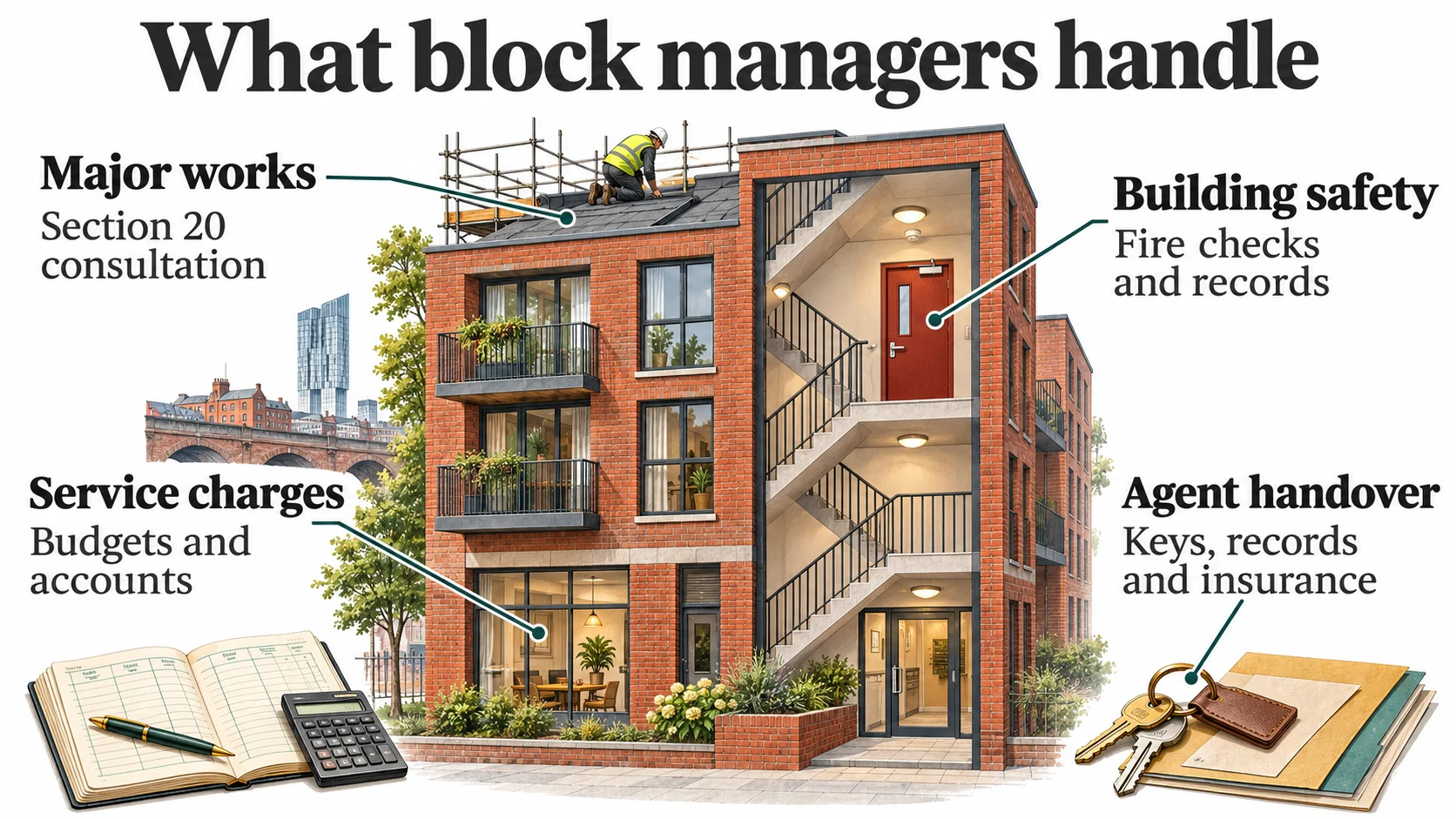
Service Charge Budgeting and Year-End Accounting
RICS Code Standards for Annual Budgeting
Annual service charge budgets need detailed preparation before each financial year begins. They must comply with the RICS Service Charge Residential Management Code. Block managers base projections on actual historical spend, anticipated contract increases and routine maintenance schedules. Accurate forecasting prevents mid-year deficits and emergency top-up demands.
Rigorous service charge management avoids unbudgeted shortfalls and volatile levy adjustments. In practice, we review every supplier contract for cleaning, grounds upkeep, lift maintenance and communal utilities. Transparent budget packs reach leaseholders before the financial year starts. That early visibility builds confidence and supports constructive relationships across the development.
Statutory Accounts and the Eighteen-Month Rule
Sections 18 and 19 of the Landlord and Tenant Act 1985 limit service charges to costs reasonably incurred. Works and services must also meet a reasonable standard. Where the lease requires it, an independent accountant certifies the annual accounts. Full documentation must support every expenditure item claimed from leaseholders.
The eighteen-month rule under Section 20B of the same Act sets a critical boundary. Costs incurred more than eighteen months before a demand become unrecoverable unless leaseholders received a written notification in time. Professional agents run strict accounting calendars to demand every cost promptly. Missed deadlines leave the RMC or freeholder funding the gap.
Reserve Funds and Long-Term Capital Maintenance
Trust Status and Reserve Fund Separation
Reserve funds protect leaseholders against sudden capital demands by accumulating contributions over multi-year cycles. Professional block managers hold these monies in ring-fenced client trust accounts. Those accounts sit entirely apart from operating balances and the agent’s own corporate funds. This separation delivers financial protection and clear interest reporting.
Section 42 of the Landlord and Tenant Act 1987 treats service charge contributions as trust funds. That status protects communal money if an agency becomes insolvent. Regular bank reconciliations let directors track fund growth against projected component lifecycles. Transparent balance reporting also simplifies year-end accounting and any future handover.
Planned Preventative Maintenance Programmes
A planned preventative maintenance programme schedules structural repairs, external redecoration, lift overhauls and plant replacement across a ten-year horizon. Experienced block managers inspect routinely to identify deterioration early. They commission specialist surveyor reports to forecast realistic capital expenditure. This approach reduces costly emergency call-outs and unplanned levies.
Anticipating capital repairs protects the building fabric before serious failures appear. Managers balance reserve contributions against forecast outgoings, smoothing annual leaseholder bills. From experience across Didsbury, Castlefield and MediaCityUK, proactive planning preserves asset values. It also spares owners the financial shock of unexpected major works.
Did You Know?
Since 27 January 2026, the Building Safety Regulator has operated as a standalone body sponsored by the Ministry of Housing, Communities and Local Government. It previously sat within the Health and Safety Executive. Its powers over higher-risk building registration and enforcement transferred in full to the new body.
Section 20 Consultations for Major Capital Works
Thresholds for Qualifying Works and Long-Term Agreements
Section 20 of the Landlord and Tenant Act 1985 requires consultation before qualifying works costing any leaseholder more than £250. The same duty applies to qualifying long-term agreements lasting over twelve months. These agreements trigger consultation where any leaseholder’s contribution exceeds £100 in an accounting period.
Getting the process wrong caps recovery at £250 per leaseholder for qualifying works. Consider a £95,000 roof replacement across a twenty-unit block. Without valid consultation, the landlord can recover only £5,000. The remaining £90,000 falls on the RMC or freeholder, which can threaten the company’s solvency. The government consulted on higher thresholds in 2025, but the current figures still apply.
Statutory Notice Stages in Section 20 Consultation
Section 20 consultation demands precise administration across distinct statutory notice stages. Block managers first serve a notice of intention describing the works and inviting contractor nominations. A notice of estimates follows, setting out at least two quotations. Managers must also serve a notice of reasons where the contract goes to neither the lowest nor a nominated bidder.
The first two notices each open a thirty-day period for leaseholder observations. Managers must consider every written representation and respond with documented reasons. Urgent works sometimes cannot wait for the full timetable. In those cases, the landlord may apply to the First-tier Tribunal for dispensation under Section 20ZA, supported by clear evidence.
Landlord Exit Strategies and Options
Higher-Risk Building Duties Under the Building Safety Act
Criteria for Higher-Risk Buildings
The Building Safety Act 2022 sets two height tests for higher-risk buildings. A building qualifies at eighteen metres or more, or with at least seven storeys. It must also contain at least two residential units. Meeting either height test places the building under the oversight of the Building Safety Regulator.
Manchester city centre, Salford Quays and nearby regeneration zones hold high concentrations of higher-risk buildings. Allowing residents to occupy an unregistered higher-risk building is a criminal offence. Managing agents help boards keep registration details current and respond to regulator directions on time. Missed updates create avoidable enforcement risk for the Accountable Person.
Safety Cases and Golden Thread Records
Accountable Persons for occupied higher-risk buildings must keep golden thread information in digital form. This includes structural drawings, fire strategies and maintenance logs held in an accessible common data environment. Managing agents compile and update these records. They also help prepare the safety case report and coordinate building safety audits.
The duties extend to a resident engagement strategy and a mandatory occurrence reporting system. Where an RMC is the Accountable Person, that legal accountability stays with the company and cannot pass to the agent. Directors can face personal liability if an offence involves their consent, connivance or neglect. Agents run the technical workflows and give the board documented evidence of compliance.
The Railton-Meeks Compliance Audit Tool
Check Your Compliance & Protect Your Portfolio
Fire Safety Duties and Statutory Evacuation Planning
Residential Evacuation Plans Since April 2026
The Fire Safety (Residential Evacuation Plans) (England) Regulations 2025 came into force on 6 April 2026. They apply to blocks of eighteen metres or seven storeys and above. They also cover buildings over eleven metres with a simultaneous evacuation strategy. Responsible Persons must complete person-centred fire risk assessments for residents who need help to evacuate.
Where residents agree, managers prepare residential personal emergency evacuation plans and a whole-building evacuation plan. Key information goes to the local fire and rescue service. In high-rise blocks, managers also place it in the secure information box. Regular reviews keep mobility details accurate whilst protecting residents’ personal data.
Regular Inspections of Communal Fire Doors
The Fire Safety (England) Regulations 2022 set fire door duties for residential buildings over eleven metres. Responsible Persons must check communal fire doors at least every three months. They must also use best endeavours to check flat entrance doors at least annually. Inspections confirm that self-closers, intumescent seals and frames remain effective.
Defective fire doors allow rapid smoke spread and undermine compartmentation during a fire. Property managers log every finding in digital records and issue prompt repair instructions. Broken closers and damaged frames receive priority attention. Robust door oversight supports compliance with the Regulatory Reform (Fire Safety) Order 2005.
Airbnb Alternative for Short Let Management across Manchester and Cheshire
Leaseholder Communication and Corporate Governance
Annual General Meetings and Transparent Reporting
Effective RMC governance depends on structured communication and well-run shareholder meetings. Block managers prepare compliant AGM notices, circulate proxy forms and record detailed minutes. Every step follows the company’s articles of association. Leaseholders then understand expenditure decisions and director elections, which strengthens trust in the board.
Clear communication reduces leaseholder friction and improves collection rates. Online portals give residents access to balances, service charge demands and maintenance updates. That openness creates a constructive working relationship. Modern block administration balances company secretarial compliance with responsive everyday customer service.
Tribunal Preparation and Formal Dispute Handling
Disputes over service charge reasonableness or lease covenants fall within the jurisdiction of the First-tier Tribunal (Property Chamber). Professional managing agents keep transparent, audit-ready expenditure trails. They handle early leaseholder queries objectively. This approach often resolves tension locally before it escalates into formal legal proceedings.
Under Section 24 of the Landlord and Tenant Act 1987, leaseholders can apply for a tribunal-appointed manager. Experienced managers keep contracts, tender documents and invoices ready for legal scrutiny. Thorough records demonstrate that the board acted reasonably. Documented compliance also helps protect directors against personal liability claims.
Instant Rental & Block Valuation
Get Your Valuation & Know Your Market Value
Contractor Procurement and Handover Transitions
Contractor Vetting and Insurance Verification
Competent block managers apply robust procurement standards to every communal maintenance and major repair contract. Each contractor must hold verified public liability insurance and relevant health and safety accreditation. Pricing should rest on a clear scope of work. Arbitrary cost-plus markups have no place in a defensible tender.
Vetted regional contractors respond quickly across Greater Manchester postcodes during mechanical or plumbing emergencies. Managing agents keep preferred-supplier rosters for routine work. Substantial projects still go to competitive tender. Transparent selection gives leaseholders quality workmanship at objectively reasonable market prices.
Structured Timelines for the Professional Handover
Moving block administration from an incumbent agent or self-managed arrangement typically follows a structured sixty-day framework. The incoming agent secures verified account balances, leaseholder ledgers, compliance certificates and plant service records. Keys and live building insurance schedules transfer at the same time. This sequencing keeps day-to-day operations running without interruption.
A systematic intake audit exposes historic financial discrepancies, deferred maintenance and missing compliance documents early. The incoming manager reconciles opening arrears and writes to every resident with introduction details. For higher-risk buildings, the golden thread records must also transfer intact. Clear onboarding lays the foundation for disciplined, transparent estate management.
HMO Specialist Yield & Tax Calculator
Calculate Your Yield & Offset New Tax Burdens
Final Thoughts
Choosing between block management companies in Manchester means testing technical credentials, regulatory diligence and accounting transparency. Directors who insist on statutory codes and proactive maintenance protect their developments from costly shortfalls. Strong governance keeps communal properties structurally sound and financially resilient. That resilience holds across decades of changing market conditions.
Regulatory oversight of building safety and leasehold administration continues to deepen. Effective block management now functions as essential risk management. Boards that set clear communication channels and rigorous compliance routines build stable communities and secure long-term asset value.
Railton-Meeks Landlord Assistance
Frequently Asked Questions
A:
Under the Building Safety Act 2022, a higher-risk building contains at least two residential units. It must also be at least eighteen metres tall or have at least seven storeys. Meeting either height test brings the building within the scope of the Building Safety Regulator. Registration with the regulator is a legal requirement. Its Accountable Person must then prepare a safety case report. They must also run a mandatory occurrence reporting system and keep golden thread information current.
A:
In an RMC-run higher-risk building, the company itself is usually the Accountable Person under the Building Safety Act 2022. The duty sits with the company, not with individual directors personally. However, directors can face personal liability where an offence involves their consent, connivance or neglect. Managing agents can carry out daily safety tasks and regulatory filings for the board. The legal accountability stays with the RMC and cannot pass to the agent.
A:
The golden thread is the digital record of a higher-risk building's safety information throughout its life. It covers drawings, fire strategies, structural reports, material specifications and maintenance records. The Accountable Person must keep this information accurate, secure and up to date. Managing agents usually maintain the records day to day. Key details must reach the regulator, fire and rescue service and residents when required. A complete golden thread also makes any change of managing agent far smoother.
A:
Section 20 of the Landlord and Tenant Act 1985 requires consultation before qualifying works costing any leaseholder more than £250. It also applies to qualifying long-term agreements lasting over twelve months. Those agreements need consultation where any leaseholder pays more than £100 in an accounting period. The managing agent must serve the statutory notices in the correct order. Leaseholders get thirty days to comment at both the intention and estimates stages.
A:
If the landlord fails to follow Section 20, the recoverable amount for qualifying works falls to £250 per leaseholder. The cap applies however much the works actually cost. Take a £95,000 roof replacement across twenty flats. Without valid consultation, only £5,000 is recoverable, leaving a £90,000 shortfall. The RMC or freeholder must absorb that gap unless the First-tier Tribunal grants dispensation. Dispensation is never guaranteed, and the tribunal may attach conditions.
