
HMO Management in Manchester: An Investor's Checklist
Operating multi-let property investments requires rigorous oversight, especially across competitive Northern hubs with strict regulatory environments. Effective HMO management in Manchester demands a precise understanding of local authority mandates, planning restrictions, and statutory licensing standards. Investors targeting high-density shared housing must maintain complete visibility over asset compliance from acquisition through ongoing tenancy administration. By aligning operational processes with Manchester City Council guidelines, landlords safeguard asset values and secure sustained rental returns across diverse urban postcodes.
Professional landlords face escalating operational liabilities, from mandatory fire risk assessments to shifting energy efficiency benchmarks. Balancing tenant turnover across student, hospital, and corporate demographics requires meticulous financial planning and active supervision. Are you confident that your Manchester shared property portfolio meets every statutory licensing condition whilst maintaining optimal yields across every let room?
Key Takeaways
- Manchester’s city-wide Article 4 Direction means converting any family home into a shared house requires full planning permission.
- A new mandatory HMO licence for five occupants costs £1,321 in Manchester, combining an £865 administration fee and a £456 grant fee.
- Lawful Development Certificates confirming established shared use protect market value in suburbs where new planning consents are hard to secure.
- Statutory minimum bedroom sizes are 6.51 square metres for one adult and 10.22 square metres for two adults.
- Student and hospital demand supports indicative gross yields of 8.0 to 8.5 per cent across core M14 rental streets.
Regulatory Standards for Manchester HMO Assets
Manchester City Council enforces stringent compliance thresholds across all shared properties within its boundary. Operational success depends on securing the correct statutory permissions before marketing individual rooms to prospective tenants. Investors must treat licensing criteria, planning documentation, and space standards as fundamental asset safeguards rather than optional administrative processes.
Failing to maintain lawful HMO status introduces civil penalties alongside significant capital depreciation. The table below outlines the core regulatory thresholds, mandatory costs, and statutory benchmarks that every Manchester multi-let owner must track continuously. Together, they preserve portfolio compliance and tenant safety.
| Benchmark Category | Statutory Standard | Operational Requirement |
|---|---|---|
| Benchmark CategoryPlanning Class | Statutory StandardUse Class C4 (three to six occupants) or Sui Generis (seven or more) | Operational RequirementCity-wide Article 4 compliance |
| Benchmark CategoryMandatory Licence Fee | Statutory Standard£1,321 for five occupants | Operational RequirementLicence granted for up to five years |
| Benchmark CategorySingle Room Space | Statutory Standard6.51 square metres | Operational RequirementMinimum floor area for one adult |
| Benchmark CategoryDouble Room Space | Statutory Standard10.22 square metres | Operational RequirementMinimum floor area for two adults |
| Benchmark CategoryFire Detection | Statutory StandardGrade D interlinked mains-wired alarms | Operational RequirementEscape routes and higher-risk rooms |
| Benchmark CategoryFire Doors | Statutory StandardFD30 self-closing assemblies | Operational RequirementProtected escape routes, typically in three-storey HMOs |
Pre-Purchase Planning Verification and Lawful Use
Article 4 Planning Controls
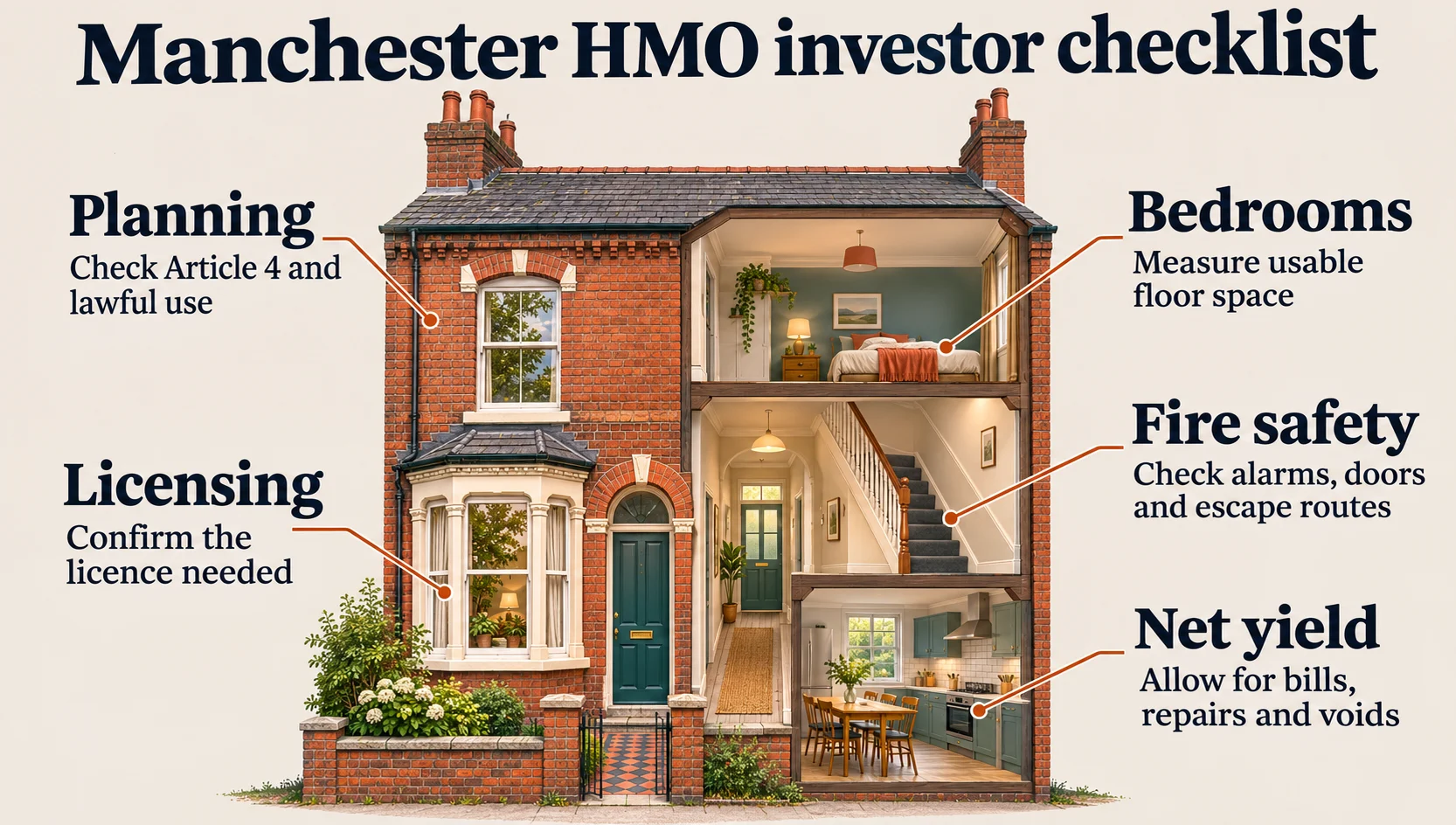
Manchester City Council enforces a city-wide Article 4 Direction that removes permitted development rights for shared housing conversions. Any change from a Class C3 family home to a Class C4 house in multiple occupation requires full planning approval. Investors must therefore verify existing planning consent before completing any acquisition.
Development history must demonstrate uninterrupted lawful shared occupancy. Prospective buyers cannot rely on informal letting track records when evaluating older shared properties. Without planning permission or proof of established use, the council can issue an enforcement notice requiring the HMO use to cease. In practice, we find that planning gaps surface most often during conveyancing searches, whilst renegotiation is still possible.
Lawful Development Certificates
A Lawful Development Certificate for an existing use formally confirms that a property operates lawfully as an established shared home. The certificate protects landlords from planning enforcement action over that use. Acquiring an unconsented HMO without this certification exposes investors to serious capital write-downs if the council later challenges the use.
Properties with established lawful status represent protected assets across high-density student and professional rental zones. Losing that status can sharply reduce market value, because the property reverts to family-home pricing. Conveyancers should inspect historical tenancy agreements, council tax records, utility bills, and electoral register entries. These records demonstrate continuous qualifying use.
Mandatory Licensing Criteria and Application Costs
Statutory Five-Occupant Licensing Fees
Manchester sets its mandatory HMO licence fee at £1,321 for a property housing five occupants from two or more households. The fee combines an £865 administration charge with a £456 grant fee, rising with occupancy. The council assesses property standards, management arrangements, and applicant suitability before approving any licence.
Experienced property management companies coordinate the technical submissions required to secure licence approval without avoidable delays. Applications require floor plans, current gas and electrical safety certificates, and evidence of planning consent where applicable. Since 1 May 2026, operating a licensable HMO without a licence can attract a civil penalty of up to £40,000. Manchester may also issue a shorter licence where a property has a history of non-compliance.
Selective Licensing Zones
Manchester does not currently operate an additional licensing scheme for smaller shared houses with three or four occupants. Instead, the council runs selective licensing in designated neighbourhoods. These schemes cover privately rented homes within each boundary, whether the property is a single let or a smaller shared house.
Recent designations include parts of Moss Side, Longsight, Cheetham, and Crumpsall, each running for five years. A full selective licence currently costs £964, with a lower fee for early applications. A property that needs a mandatory HMO licence does not also need a selective licence, but smaller shared houses inside a designated area do. Letting without a licence inside an active designation carries the same penalties as a mandatory breach.
Did You Know?
Manchester’s Article 4 Direction has applied to the whole city since 8 October 2011. Because the Direction alone creates the need for permission, the council charges no planning fee for an application to change a family home into a small HMO.
Fire Safety Systems and Risk Mitigation
Grade D Alarm Architecture
Fire precautions in shared houses are typically assessed against the national LACORS housing fire safety guidance. This usually requires Grade D interlinked, mains-wired detection with integral battery backup. Smoke alarms protect escape routes and higher-risk rooms, whilst heat detectors cover kitchens. Interlinking ensures any triggered sensor alerts every occupant simultaneously.
Early warning systems prevent fatal entrapment during overnight fires in shared housing. A competent electrician should commission the system before the tenancy starts and issue a certificate confirming correct installation. Routine inspections must confirm that every alarm sounds correctly and that tenants have not disabled or covered any detector.
Fire Doors and Escape Routes
Doors onto the protected escape route in three-storey shared houses should generally be FD30 fire doors with effective self-closing devices. Intumescent strips and smoke seals stop fire and smoke spreading into hallways during an evacuation. In lower-risk two-storey houses, the fire risk assessment determines the required door standard.
A written fire risk assessment is compulsory for the common parts of every HMO under the Regulatory Reform (Fire Safety) Order 2005. Landlords must keep escape corridors clear of bicycles, personal belongings, and combustible rubbish. Managing agents typically check door closers during quarterly inspections and review internal door integrity annually.
Landlord Exit Strategies and Options
Habitable Space Standards and Amenity Provisions
Minimum Usable Bedroom Dimensions
Mandatory licence conditions set a minimum floor area of 6.51 square metres for a bedroom used by one adult. Rooms accommodating two adults must provide at least 10.22 square metres. Any floor area where the ceiling height falls below 1.5 metres cannot count towards these statutory calculations.
Manchester housing officers measure rooms during licensing inspections, so accurate floor plans matter from the outset. Rooms below the statutory minimums cannot serve as sleeping accommodation. Overcrowding breaches licence conditions, leaving owners exposed to enforcement action and rent repayment orders of up to 24 months’ rent.
Communal Kitchen and Bathroom Ratios
Shared houses require cooking, food storage, and washing facilities proportionate to the licensed number of occupants. Manchester’s published HMO standards set the exact ratios. Kitchens need adequate worktops, food cupboards, refrigeration, and cookers. Bathrooms must supply constant hot water and mechanical extraction to control moisture levels.
Insufficient facilities accelerate wear on fixtures and fuel tension among unrelated occupants. As a common benchmark, additional cookers, sinks, and bathrooms become necessary once occupancy exceeds five people. Durable, well-maintained sanitary installations reduce reactive repair costs. They also support compliance with the Housing Health and Safety Rating System.
The Railton-Meeks Compliance Audit Tool
Check Your Compliance & Protect Your Portfolio
Demographic Profiles and Tenant Selection
Student Housing Dynamics
Greater Manchester hosts more than 120,000 students, creating concentrated demand for shared housing along established academic routes. The Wilmslow Road corridor through Fallowfield and Withington sees intense leasing activity each autumn for the following academic year. Ground 4A allows landlords of qualifying student HMOs to align possession with the academic cycle.
Council-commissioned evidence published in April 2026 estimates a shortfall of around 16,000 purpose-built student beds. That gap sustains demand for private shared houses. Investors benefit from predictable academic schedules and parental guarantors. Since 1 May 2026, however, landlords cannot require more than one month’s rent before a tenancy begins. Dedicated HMO investor support helps landlords plan annual leasing windows around these rules.
Healthcare and Young Professional Markets
The Oxford Road Corridor and its hospitals generate year-round demand from doctors, nurses, and medical researchers. Shared houses in Rusholme and Longsight offer accessible homes close to Manchester Royal Infirmary and Saint Mary’s Hospital. Professional sharers expect quality finishes, dedicated study space, and reliable high-speed broadband.
Working professionals and medical staff seek stable living environments away from typical undergraduate noise. Vetting applications on affordability, employment, and previous landlord references protects household cohesion. Professional housemates often stay for several years, reducing turnover costs and stabilising long-term yields.
Airbnb Alternative for Short Let Management across Manchester and Cheshire
Utility Cost Management and Tariffs
Bills-Inclusive Pricing Strategy
Offering bills-inclusive rents remains an essential marketing strategy for attracting both students and mobile young professionals to Manchester shared houses. Packaging council tax, water, broadband, gas, and electricity into a single monthly charge simplifies budgeting for occupants. Landlords must calculate inclusive pricing using rigorous seasonal energy consumption forecasts.
Energy market volatility can rapidly erode operating margins if landlords fail to implement structured utility frameworks. Tenancy agreements should incorporate reasonable fair-usage clauses that define maximum consumption caps for gas and electricity. Transparent allowances protect landlords from unconstrained heating use. They also give tenants clarity over any excess utility surcharges.
Smart Metering and Conservation Controls
Installing smart thermostats, tamper-proof boiler controllers, and individual thermostatic radiator valves prevents excessive heating waste throughout colder winter months. Networked heating monitors allow property managers to configure automated schedules and stop tenants leaving central heating running continuously. Efficient controls protect operating margins without compromising tenant warmth.
Upgrading thermal efficiency also prepares properties for the confirmed EPC C minimum, which applies to all private tenancies from 1 October 2030. Improving loft insulation, replacing draughty seals, and maintaining condensing boilers keeps utility expenditure within established rental inclusions. Continuous background heating and controlled ventilation also keep damp and mould risks in check.
Instant Rental & Block Valuation
Get Your Valuation & Know Your Market Value
Financial Performance and Postcode Yield Analysis
Prime Investment Postcodes
The M14 postcode covering Fallowfield and Rusholme delivers indicative gross yields of 8.0 to 8.5 per cent for well-run shared houses. High tenant density, a structural student bed shortfall, and steady hospital workforce demand protect capital values. Correctly converted terraced houses generate predictable cash flow.
Secondary professional corridors such as Levenshulme in M19 deliver gross yields between 5.5 and 7.0 per cent, attracting graduates priced out of prime suburbs. In contrast, higher-value districts like Didsbury in M20 yield around 4.0 to 5.0 per cent. These appeal to investors prioritising capital preservation over cash generation.
Net Yield Optimisation and Operational Outgoings
Calculating realistic net returns requires factoring in licensing overheads, regular compliance inspections, elevated property wear, and comprehensive utility allowances. Gross headline returns appear attractive, yet operational outgoings for shared housing substantially exceed single-family rental expenses. Meticulous preventative maintenance and disciplined arrears management protect net profitability from erosion.
Sinking funds should cover certificate renewals, electrical safety testing at least every five years, and annual gas safety checks. Engaging experienced property management companies keeps void periods short and ensures arrears receive attention within 24 hours. High presentation and operational standards support strong occupancy and sustained rental growth.
HMO Specialist Yield & Tax Calculator
Calculate Your Yield & Offset New Tax Burdens
Final Thoughts
Successful HMO management in Manchester requires a rigorous, compliance-led operational framework that protects both tenant welfare and long-term profitability. From verifying Article 4 planning legality to meeting licensing fees and fire safety standards, every operational layer demands active oversight. Investors who build robust administrative routines and enforce statutory space benchmarks protect their portfolios against escalating enforcement risk.
As regulatory standards across the private rented sector continue to tighten, proactive stewardship distinguishes high-performing shared assets from non-compliant holdings. Safe, well-equipped, and efficiently managed shared homes secure tenant retention, protect capital equity, and deliver dependable multi-let yields across Manchester’s residential market.
Railton-Meeks Landlord Assistance
Frequently Asked Questions
A:
Yes. Manchester's Article 4 Direction covers the whole city, so converting a family home into a small shared house always needs planning permission, even for three occupants. Full planning approval is required for any change of use from Class C3 to Class C4. Applications in dense residential suburbs face strict scrutiny. Existing properties with a Lawful Development Certificate confirming established HMO use are therefore highly valuable assets.
A:
Manchester City Council charges £1,321 for a new mandatory licence covering five occupants from two or more households, with higher fees for larger properties. Applications require floor plans, gas and electrical safety certificates, and evidence of planning consent where applicable. Licences can run for up to five years. The council may issue a shorter licence where there is a history of non-compliance. Operating without a required licence can attract a civil penalty of up to £40,000.
A:
Under mandatory licence conditions, a bedroom used by one adult must offer a minimum floor area of 6.51 square metres. Bedrooms used by two adults require at least 10.22 square metres. Any floor area where the ceiling height falls below 1.5 metres cannot count towards these measurements. Rooms that fail to meet these thresholds cannot be used as sleeping accommodation, and overcrowding can lead to enforcement action.
A:
Licensed shared houses typically need a Grade D interlinked, mains-wired fire alarm system. Smoke alarms protect escape routes and higher-risk rooms, with heat detectors in kitchens. Doors onto protected escape routes in three-storey houses generally need to be FD30 fire doors with working self-closers. Landlords must also keep a written fire risk assessment for the common parts. Regular inspections keep escape routes completely clear of obstructions.
A:
Gross yields for well-managed shared houses in M14, including Fallowfield and Rusholme, typically range from 8.0 to 8.5 per cent, although these figures are indicative rather than guaranteed. Performance is sustained by an estimated shortfall of around 16,000 purpose-built student beds. Year-round demand from healthcare workers along the Oxford Road hospital corridor adds further support. Net returns are lower once licensing, compliance, utilities, and maintenance costs are deducted.
