

Right to Manage: How Leaseholders Take Control
Leaseholders across England often face rising service charges, slow repairs and opaque accounts from freeholder-appointed agents. The Right to Manage gives them a statutory route to take over building management. They do not need to buy the freehold or prove landlord fault. Flat owners form a dedicated company, then control maintenance, budgets, insurance and contractor selection.
The route rewards precision. Defective notices, missed dates or an unverified membership list can sink a claim at tribunal and waste months of volunteer effort. Reforms in force since March 2025 have also widened eligibility and changed who pays the landlord’s costs. So how do leaseholders run a claim that survives scrutiny and then manage the block well?
Key Takeaways
- The Right to Manage lets qualifying leaseholders take over building management without proving landlord fault, paying a premium or buying the freehold.
- Since 3 March 2025, buildings with up to fifty per cent non-residential internal floor space can qualify, up from twenty-five per cent previously.
- Qualifying tenants of at least half of the total flats in the building must be RTM company members when the claim notice is given.
- Landlords can only dispute a claim on statutory grounds, and the First-tier Tribunal decides whether the company was entitled to acquire the right.
- After acquisition, the RTM company carries service charge, Section 20 consultation and, in higher-risk buildings, Building Safety Act duties.
Right to Manage Process Timeline and Statutory Deadlines
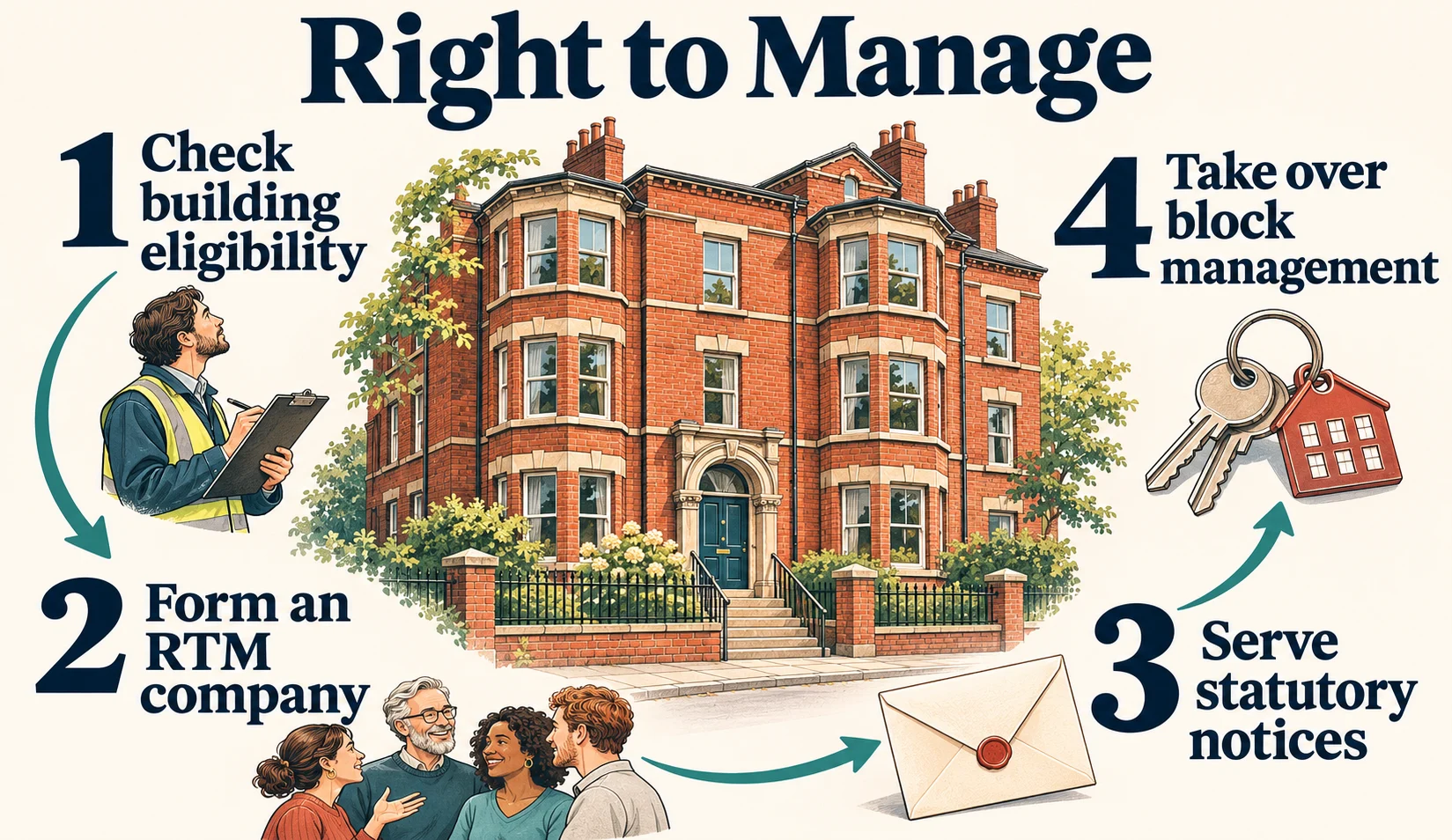
The Right to Manage process runs on fixed statutory intervals set by the Commonhold and Leasehold Reform Act 2002. Each notice starts a clock, and each clock limits what the next step can do. A date specified one day short of the statutory minimum can defeat the claim notice. The company must then start again with fresh notices.
In practice, we find steering committees work best when they plot every date before serving anything. The table below sets out the core stages and minimum periods. It assumes the landlord engages with the claim. Where a counter-notice disputes entitlement, the tribunal stage adds several months before management actually changes hands.
| Claim Stage | Statutory Requirement | Prescribed Timeframe |
|---|---|---|
| Claim StageNotice of Invitation to Participate | Statutory RequirementGiven to every qualifying tenant who is not a member and has not agreed to join | Prescribed TimeframeAt least 14 days before the claim notice |
| Claim StageClaim Notice | Statutory RequirementGiven to each landlord, other lease parties and any Part 2 manager, with copies to all qualifying tenants | Prescribed TimeframeCounter-notice date not earlier than one month after the claim notice |
| Claim StageCounter-Notice | Statutory RequirementLandlord admits or disputes the company’s entitlement | Prescribed TimeframeBy the date specified in the claim notice |
| Claim StageTribunal Application | Statutory RequirementCompany applies to the First-tier Tribunal where entitlement is disputed | Prescribed TimeframeWithin two months of the counter-notice |
| Claim StageAcquisition Date (undisputed) | Statutory RequirementManagement functions transfer to the RTM company | Prescribed TimeframeAt least three months after the counter-notice date |
| Claim StageAcquisition Date (after tribunal) | Statutory RequirementTransfer follows a determination in the company’s favour | Prescribed TimeframeThree months after the determination becomes final |
Building Eligibility Rules for a Right to Manage Claim
Self-Contained Buildings and Qualifying Tenants
A claim can cover a self-contained building or a self-contained part of a building. The premises must contain at least two flats held by qualifying tenants. Qualifying tenants must also hold at least two-thirds of all flats. A qualifying tenant usually holds a long lease originally granted for more than twenty-one years.
Self-contained parts need careful analysis. A part qualifies only where it forms a vertical division capable of independent redevelopment. Its services must also run independently, or be capable of doing so. Some premises are excluded outright. These include certain converted buildings with a resident landlord and no more than four units. Premises where a local housing authority is the immediate landlord of any qualifying tenant are also excluded. We always check the title, lease plans and any shared plant before committing members to costs.
Non-Residential Limit After the 2025 Reforms
Mixed-use blocks face a floor space test. From 3 March 2025, the Leasehold and Freehold Reform Act 2024 raised the non-residential limit from twenty-five to fifty per cent. Premises now qualify unless non-residential parts exceed half the total internal floor area, excluding common parts. Many previously excluded blocks can now bring a claim.
This change matters across city-centre schemes in Manchester and Salford, where ground-floor retail and offices are common. Organisers should commission a measured survey rather than rely on marketing brochures. Floor areas drive eligibility, and landlords frequently test them. A survey prepared before notices go out removes the most common factual ground of dispute.
RTM Company Formation and Internal Governance
Prescribed Articles and Company Name
Leaseholders must incorporate a private company limited by guarantee at Companies House before serving any notice. Its articles must state that its object is acquiring and exercising the right to manage. The company takes the prescribed model articles for RTM companies. Any inconsistent provision in its articles has no legal effect.
The model articles style the name as the building name followed by RTM Company Limited. Membership is open to qualifying tenants and, from the acquisition date, landlords under leases of the premises. Each member’s liability is limited to a nominal guarantee of one pound. That narrow object keeps the company focused on the building and nothing else.
Director Duties and Internal Controls
Directors of an RTM company owe the general duties set out in the Companies Act 2006. They must act within the company’s powers, exercise independent judgement and avoid conflicts of interest. Most serve as unpaid volunteers. They still carry legal responsibility for budgets, filings, records and communications with members and leaseholders.
In practice, we find disputes between owners cause more damage than landlords do. Clear internal rules prevent that. Boards should fix spending authority limits, reserve fund policies and a standard method for member communications. Confirmation statements and annual accounts must reach Companies House on time. Minutes should record every significant decision and the reasons behind it.
Did You Know?
Under section 83 of the Commonhold and Leasehold Reform Act 2002, a person authorised by an RTM company can access any part of the premises where reasonable in connection with the claim. The company must give the occupier at least ten days’ notice.
Membership Thresholds and the Notice of Invitation
Fifty Per Cent Membership Threshold
When the claim notice is given, the RTM company’s members must include qualifying tenants of at least half the total flats in the premises. The test counts every flat, not only those held by qualifying tenants. In a twenty-flat block, members must hold at least ten flats between them.
Where premises contain only two flats, both qualifying tenants must be members. Investor ownership complicates recruitment. In districts such as Salford Quays, overseas or corporate landlords own many flats. Organisers should obtain official copies of each register from HM Land Registry. Those copies confirm the current owner and any address for service before anyone signs up.
Notice of Invitation to Participate
Before claiming, the company must give a notice of invitation to participate to every qualifying tenant who is not a member. Tenants who have already agreed to join do not need one. The notice must follow the prescribed form. At least fourteen days must pass between the last invitation and the claim notice.
The prescribed form explains the company’s objects, says where members can inspect the articles and warns about potential liabilities. A wrong address, or a single missed tenant, invites a counter-notice and a dispute. Directors should cross-check the register of members against Land Registry titles. They should also keep proof of posting or delivery for every notice.
Landlord Exit Strategies and Options
Claim Notice Service and Landlord Counter-Notices
Claim Notice Contents and Service
The claim notice goes to each landlord under the leases and any other party to the leases. It also goes to any manager appointed under Part 2 of the Landlord and Tenant Act 1987. Every qualifying tenant must receive a copy. The notice must use the prescribed form and specify two key dates.
The first date is the deadline for counter-notices. It cannot be earlier than one month after the claim notice is given. The second is the intended acquisition date, at least three months after that deadline. Tribunals have rejected claims where these dates fell short by a single day. We recommend building in a margin of several days for postal delays.
Grounds for a Landlord Counter-Notice
A landlord may admit the claim or allege that the company was not entitled to acquire the right on the relevant date. Doubts about leaseholders’ competence are not a ground. Valid challenges focus on statutory matters such as eligibility, exclusions, membership numbers and defects in the notices themselves.
If no counter-notice arrives by the specified deadline, the right transfers on the acquisition date in the claim notice. The same applies where every counter-notice admits entitlement. A disputing counter-notice changes the timetable. The company must then decide quickly whether to apply to the tribunal or withdraw and serve fresh notices.
The Railton-Meeks Compliance Audit Tool
Check Your Compliance & Protect Your Portfolio
First-tier Tribunal Applications and Claim Costs
Tribunal Determinations on Entitlement
Where a counter-notice disputes entitlement, the company may apply to the First-tier Tribunal (Property Chamber) within two months. Without that application, or written agreement from the landlord, the claim cannot succeed. The tribunal then decides whether the company was entitled to acquire the right on the relevant date.
Hearings focus on statutory compliance, not on past service quality or management performance. The tribunal decides many disputes on the papers. If the company succeeds, the acquisition date falls three months after the determination becomes final. Any appeal to the Upper Tribunal can extend that period considerably.
Costs After the Leasehold and Freehold Reform Act 2024
Since 3 March 2025, an RTM company and its members are generally not liable for costs others incur because of a claim notice. Parliament repealed the former provisions that made the company pay the landlord’s reasonable costs. Lease terms that try to shift those costs back onto leaseholders have no effect.
Exceptions remain. The company pays reasonable costs of complying with a section 82 information request. Where a claim notice is withdrawn or lapses, the tribunal can order costs if the company acted unreasonably. Landlords also cannot recover these non-litigation costs through the service charge. Careful preparation therefore protects members from the remaining exposure.
Airbnb Alternative for Short Let Management across Manchester and Cheshire
Management Handover and Service Charge Funds
Acquisition Date and Records Transfer
On the acquisition date, management functions under the leases pass from the landlord to the RTM company. These cover services, repairs, maintenance, improvements, insurance and management. The landlord keeps the freehold reversion but loses those functions. Functions relating to re-entry or forfeiture stay with the landlord.
Existing management contracts trigger their own notices. The outgoing manager must notify contractors, and the company can require the documents and information it reasonably needs. In multi-storey Greater Manchester developments, directors should also secure keys, fobs, access codes and plant rooms before handover. Gaps here cause the most avoidable service interruptions.
Uncommitted Service Charges and Bank Accounts
Section 94 requires the landlord, or other relevant party, to pay accrued uncommitted service charges to the RTM company on the acquisition date. These are funds collected but not yet committed to spending. Where the amount remains undetermined on that day, payment must follow as soon as reasonably practicable.
Leaseholders’ contractual duty to pay service charges continues unchanged. The company should open a designated client account, with separate reserve fund designation, before the acquisition date. Section 42 of the Landlord and Tenant Act 1987 treats service charge funds as trust money. The tribunal decides any dispute over the uncommitted balance.
Instant Rental & Block Valuation
Get Your Valuation & Know Your Market Value
Ongoing Compliance and RTM Company Management
Section 20 Consultation and Service Charge Rules
As the party now managing the building, the RTM company must consult under section 20 of the Landlord and Tenant Act 1985. Consultation applies to qualifying works costing any leaseholder more than £250. It also applies to long-term agreements costing any leaseholder over £100 in an accounting period.
The standard procedure runs in stages, starting with a notice of intention and a thirty-day observation period. Failure to consult caps recovery at £250 per leaseholder for works, unless the tribunal grants dispensation. Dispensation is often available, but the application costs time and money. Directors should treat the consultation timetable as part of every capital works plan.
Professional Managing Agents and Higher-Risk Buildings
Most RTM boards appoint a professional managing agent for day-to-day operations. Legal responsibility stays with the company, but the agent handles budgets, demands, contractor procurement and lease enforcement. Agents should work to the RICS Service Charge Residential Management Code. That benchmark gives volunteer directors a recognised standard to measure performance against.
Some blocks are higher-risk buildings under the Building Safety Act 2022. These stand at least eighteen metres high or have at least seven storeys, with two or more residential units. An RTM company with repairing obligations for common parts becomes an accountable person. Where it holds the structure and exterior obligations, it usually becomes the principal accountable person. That role carries registration, safety case reports, golden thread information and resident engagement duties.
HMO Specialist Yield & Tax Calculator
Calculate Your Yield & Offset New Tax Burdens
Final Thoughts
The Right to Manage gives leaseholders real control over budgets, contractors and repair priorities without the cost of buying the freehold. The 2025 reforms have widened eligibility and removed most cost exposure. Success still depends on accurate membership records, correctly dated notices and a committee prepared to see the process through.
Control also brings accountability. Directors inherit service charge obligations, Section 20 consultation and, in taller blocks, Building Safety Act duties. Boards that plan the handover, secure competent support and keep disciplined records will protect every leaseholder’s investment for years to come.
Railton-Meeks Landlord Assistance
Frequently Asked Questions
A:
The Right to Manage is a statutory right under the Commonhold and Leasehold Reform Act 2002. It lets qualifying long leaseholders take over management of their building from the landlord. Leaseholders do not need to prove mismanagement or pay any premium. They form an RTM company and serve the prescribed notices. Once the right transfers, they control services, repairs, insurance and service charge budgets. The landlord keeps ownership of the freehold.
A:
The premises must be a self-contained building, or self-contained part, with at least two flats held by qualifying tenants. Qualifying tenants must hold at least two-thirds of all flats, usually under leases originally granted for more than twenty-one years. Since 3 March 2025, non-residential parts can make up to half the internal floor area, excluding common parts. Some premises remain excluded, including certain converted buildings with a resident landlord.
A:
A freeholder cannot refuse a claim simply because they oppose it or want to keep management income. They may serve a counter-notice alleging that the company was not entitled to acquire the right. Typical grounds involve eligibility, exclusions, membership numbers or defective notices. The company can then apply to the First-tier Tribunal within two months. If the company wins, it acquires management three months after the decision becomes final.
A:
Since 3 March 2025, the RTM company and its members are generally not liable for the landlord's costs arising from a claim notice. Landlords also cannot recover those costs through the service charge. Limited exceptions apply. The company pays reasonable costs of supplying information it requests before the claim. The tribunal can also order costs where a claim notice is withdrawn or lapses and the company acted unreasonably.
A:
A higher-risk building is at least eighteen metres high or has at least seven storeys, with at least two residential units. Under the Building Safety Act 2022, an RTM company with repairing obligations for common parts becomes an accountable person. It often becomes the principal accountable person. Its duties then include registration with the Building Safety Regulator, safety case reports, golden thread records and a resident engagement strategy. Legal accountability stays with the company even where an agent helps.
