

Rent Collection Services for Landlords in Manchester.
Managing rental payments efficiently is vital for maintaining steady cash flow and protecting long-term investment returns. Professional rent collection services for landlords provide a structured framework to automate incoming tenant transfers. These services issue monthly financial statements and handle communication when payment arrears occur. Rather than chasing delayed transfers manually, property owners gain administrative clarity. This operational support is valuable as compliance tightens across the private rented sector, making accurate financial tracking essential for tax reporting.
Many property owners remain unclear about what an automated payment service includes and how it differs from full management. Selecting the wrong service tier can leave operational gaps or create unnecessary fee expenditure. How does a rent collection service work in practice, and what specific procedures protect your monthly rental yield when payments are late?
Key Takeaways
- Rent collection services automate monthly tenant payment processing, issue detailed statement records, and monitor accounts daily to identify missing transfers quickly.
- Professional managing agents enforce structured payment schedules while providing financial documentation required for Making Tax Digital compliance starting in April 2026.
- Stand-alone collection packages focus purely on payment handling and arrears chasing, leaving physical property maintenance and safety inspections to the owner.
- Early arrears intervention within twenty-four hours prevents missed transfers from accumulating into significant debts before statutory possession thresholds are reached.
- Landlords in Manchester must align payment tracking with regional licensing rules and evolving Renters Rights Act regulations to protect rental revenue legally.
Rent Collection Packages Versus Full Property Management
Professional rent collection services operate alongside comprehensive management models to offer distinct operational boundaries and fee structures. Selecting the right service level depends on whether a landlord prefers handling physical maintenance independently or delegating all daily tasks to an agent. Clear service agreements ensure property owners maintain proper oversight while protecting monthly income.
Evaluating key operational differences helps property owners balance administrative control against direct management responsibility. The table below outlines core operational features, typical fee structures, and specific statutory duties included across primary letting agency service tiers operating within the UK private rented sector.
| Service Tier | Core Financial & Administrative Responsibilities | Typical Fee Range |
|---|---|---|
| Rent Collection Only | Rent logging, issuing digital statements, daily arrears tracking, initial tenant payment reminders | 4% – 7% + VAT |
| Rent Collection & Tenant Find | Tenant referencing, tenancy agreement setup, deposit protection, monthly rent collection, basic arrears chasing | 6% – 9% + VAT |
| Full Property Management | Complete rent handling, maintenance triage, safety inspections, legal compliance, full tenant communication | 10% – 15% + VAT |
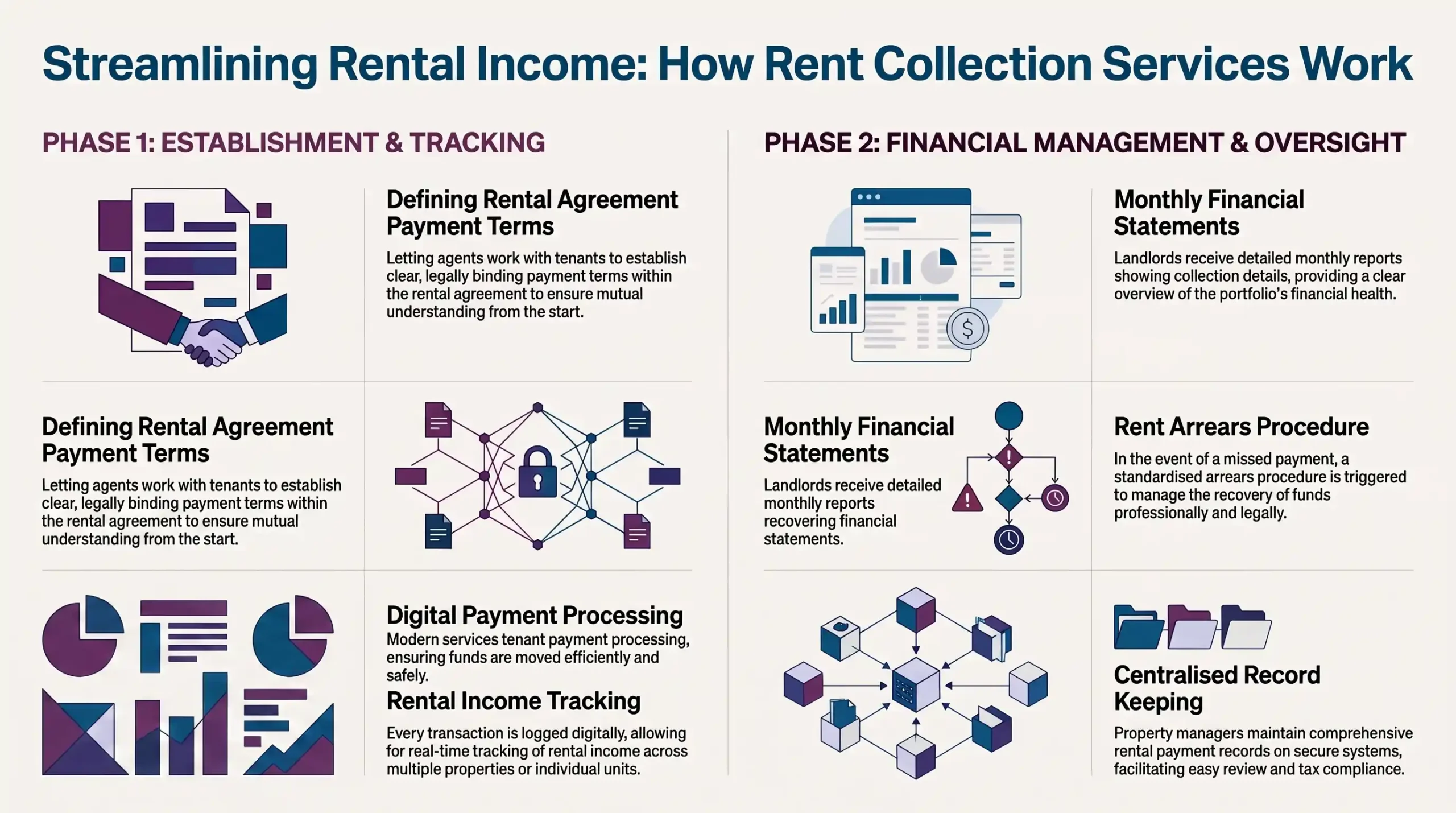
Operational Mechanics of Professional Rent Collection
Direct Payment Processing and Automated Accounting
Professional rent collection services process monthly tenant payments through automated banking networks to ensure immediate fund verification. So, how does a rent collection service work when managing daily tenant transfers? Managing agents establish designated client accounts to hold incoming rental funds securely before transferring balances directly to the landlord.
Automated systems reconcile bank transfers against specific tenancy records every morning. When a tenant sets up a standing order, funds land directly into a ring-fenced client account governed by strict Client Money Protection rules. Once cleared, the software automatically deducts agreed management commission and forwards the net payment directly to your nominated bank account within a specified schedule.
Financial Reporting and Statement Generation
Transparent financial accounting requires letting agents to issue itemised monthly statements alongside every transferred payment. These statements record full rental revenue, breakdown agency commission fees, and list any approved expense deductions. Clear financial statements simplify end-of-year tax assessments and ensure complete visibility across single properties or large portfolios.
Digital statements provide essential documentation that integrates seamlessly into digital accounting software. Managing agents transmit these reports via landlord portals, allowing owners to view income trends, historic payment records, and tax summaries instantly. This paperless tracking eliminates manual ledger entries, reducing administrative burdens while maintaining precise audit trails for revenue authorities.
Differences Between Rent Collection and Property Management
Scope of Administrative Responsibilities
Selecting between a rent collection service and full property management dictates how hands-on a landlord must remain daily. A standalone collection agreement focuses strictly on income processing, ledger tracking, and initial payment chasing. Physical property maintenance, safety certificate renewals, and tenant queries remain the direct responsibility of the property owner.
For landlords who possess established trade contacts and local proximity, outsourcing payment handling provides financial security without paying full management fees. The agent monitors incoming transfers and flags delays immediately, whilst the owner retains complete control over maintenance contractors, periodic property visits, and tenancy renewals.
Maintenance Handling and Tenant Relations
Full property management includes complete oversight of tenant communications, maintenance triage, and statutory safety compliance. Under a rent-collection-only agreement, tenants report repair issues, damp problems, or structural defects directly to the landlord. This operational boundary ensures emergency property repairs receive prompt attention without agency intervention.
Managing maintenance directly requires landlords to maintain active relationships with qualified engineers and contractors. While this reduces overall agent commissions, property owners must remain accessible to address urgent issues like heating failures within statutory timeframes. Combining self-managed maintenance with professional rent tracking balances low management costs against personal time investment.
Did You Know?
Under the Renters’ Rights Act, the mandatory threshold for evicting a tenant based on rent arrears under Ground 8 increases from two months to three months of arrears, whilst the required statutory notice period doubles from two weeks to four weeks.
Arrears Procedures and Early Payment Interventions
Automated Chasing Systems and Immediate Notifications
Effective rent collection relies on rapid automated detection systems that flag overdue accounts within twenty-four hours of a missed deadline. Early intervention prevents minor payment oversights from escalating into prolonged rental arrears. Professional agents issue polite digital reminders immediately, establishing prompt communication with tenants to resolve bank transfer delays.
Automated chasing workflows utilise multi-channel communications, combining SMS, email, and formal phone calls. If a payment remains outstanding after several days, the managing agent reaches out directly to understand whether the delay stems from technical banking issues or genuine financial hardship. Documenting every interaction creates a formal audit trail necessary for subsequent legal steps.
Statutory Possession Thresholds and Legal Escalation
When rental arrears persist, managing agents implement formal escalation steps governed by UK housing legislation. Landlords must follow strict statutory procedures before issuing formal possession notices under Ground 8 of Section 8. Maintaining continuous payment logs ensures that accurate evidence is available if court proceedings become necessary to recover unpaid debt.
Detailed arrears logs substantiate legal claims when serving statutory notices. With possession grounds requiring three months of arrears under current legislation, professional representation prevents procedural errors that could invalidate court filings. Collection agents provide structured payment plans where appropriate, attempting to recover outstanding balances amicably before initiating costly court action.
The Railton-Meeks Compliance Audit Tool
Check Your Compliance & Protect Your Portfolio
Mandatory Financial Compliance and Making Tax Digital
Digital Recordkeeping Requirements for Landlords
HMRC Making Tax Digital regulations require property owners earning over fifty thousand pounds to maintain digital financial records. Professional rent collection platforms produce compatible digital statements that export directly into approved accounting software. Standardised digital records streamline quarterly tax submissions while reducing administrative errors across property investments.
Transitioning to digital tax filing makes paper receipts and manual spreadsheets obsolete. Dedicated client portals categorise every financial transaction automatically, generating accurate income summaries for tax returns. Working with a compliant collection agent ensures that all gross rental receipts, commission deductions, and allowable expenses align perfectly with statutory accounting standards.
Deposit Protection Protocols and Statutory Documentation
Managing rental income involves strict adherence to deposit protection rules and prescribed information service deadlines. Landlords must register tenancy deposits with a government-approved scheme within thirty days of receipt. Managing agents oversee this statutory administration, safeguarding funds and issuing mandatory legal notices to protect landlords from compensation claims.
Failure to protect deposits correctly or serve prescribed information within thirty days prevents landlords from using statutory possession notices. Rent collection services complete pre-tenancy financial compliance impeccably before landlords issue keys. Professional handling provides solid legal backing, and official deposit certificates and photographic inventories support any disputes at tenancy end.
Railton-Meeks offers four landlord service tiers across Manchester and Cheshire
Fee Structures and Cost Considerations for Landlords
Percentage-Based Commissions and Fixed Fee Models
Property owners must understand how agencies calculate fees to evaluate net rental yields accurately. Most rent collection packages operate on a percentage-based commission model, typically charging between four and seven percent of gross monthly rent. Alternatively, fixed fee structures provide predictable costs regardless of monthly fluctuations in overall rental prices.
Percentage-based fees mean management costs adjust automatically if rent levels change during tenancy renewals. Fixed fees suit higher-value rental properties where a flat rate delivers better value than percentage charges. Landlords should compare initial setup fees, lease renewal charges, and monthly processing rates across potential managing agents before committing to long-term service agreements.
Deductions, Maintenance Funds, and Additional Expenses
Clear contractual terms prevent unexpected administrative fees from reducing net monthly rental revenues. Agency agreements specify how the agent deducts fees from gross rent before net funds reach the landlord. Transparent agencies detail all potential ancillary costs, including tenant setup fees, statement re-issuance charges, and legal notice costs within written terms.
Some collection agreements allow landlords to establish small float funds to cover emergency maintenance or safety certificates. Monthly statements itemise these deductions, keeping all property expenditure consolidated in one report. Landlords who review fee schedules understand exactly which services basic monthly charges include, as opposed to premium bolt-on options.
Instant Rental & Block Valuation
Get Your Valuation & Know Your Market Value
Tenancy Compliance under the Renters’ Rights Act
Abolition of Section 21 and Section 8 Adjustments
The Renters’ Rights Act fundamentally changes how landlords create and end tenancies. With Section 21 no-fault evictions abolished, landlords must rely entirely on specific Section 8 grounds for possession. Maintaining accurate rent payment histories provides essential court evidence when seeking possession based on serious rental arrears.
Transitioning to mandatory periodic tenancies means fixed-term contracts automatically roll month-to-month. Under updated possession rules, mandatory Ground 8 claims require three months of arrears instead of two, alongside extended four-week notice periods. Rent collection services provide digital payment records that prove arrear thresholds conclusively during court applications.
Mandatory Notifications and Tenant Term Agreements
New rental framework rules mandate specific written statements of terms and statutory tenant information sheets. Failure to serve these required legal documents carries severe civil financial penalties. Professional managing agents distribute compliance notifications correctly, ensuring property owners meet legal standards while collecting monthly rent without operational interruption.
Statutory rules also prohibit rental bidding wars, requiring landlords to advertise homes at fixed rates without accepting higher offers. Documenting rent payment records from day one ensures complete transparency under statutory periodic tenancies. Working with structured collection services shields landlords against procedural missteps that trigger local authority civil fines.
Rent Collection Options for Manchester Portfolios
Postcode Yield Variations and Local Market Demands
Managing rental investments across Manchester requires tailoring collection strategies to specific postcode dynamics. High-yielding student areas like Fallowfield generate robust returns through multi-occupancy lets, whereas suburbs like Didsbury attract long-term professional families. Tailored rent collection systems adapt payment schedules to reflect student term dates or monthly corporate salaries.
For landlords in Manchester managing HMO assets in M14 or professional apartments in M4, rent collection services streamline multi-tenant transfers. Automated systems track individual room payments within shared houses, identifying non-paying tenants quickly without disturbing compliant housemates. Local yield variations demand precise financial tracking to maximise overall portfolio performance.
Licensing Requirements and Local Authority Enforcement
Regional licensing schemes operating across Manchester City Council mandate strict management oversight for private rented properties. Selective licensing zones require comprehensive financial and operational records to maintain valid operating licences. Professional agents maintain audit-ready ledgers, helping landlords demonstrate compliance during local authority inspections and regulatory checks.
Selective and additional licensing rules enforce strict standards regarding tenant management and fit-and-proper person status. Failure to maintain compliant rent tracking and tenancy documents can lead to civil penalties up to thirty thousand pounds. Outsourcing rent collection provides documented proof of professional administration, protecting local portfolio owners against enforcement action.
HMO Specialist Yield & Tax Calculator
Calculate Your Yield & Offset New Tax Burdens
Final Thoughts
Outsourcing rental income management provides property owners with structured financial accounting, automated chasing workflows, and total regulatory peace of mind. Engaging professional rent collection services for landlords streamlines administrative tasks while protecting cash flow against unexpected tenant delays. By automating daily ledgers and generating detailed statements, landlords maintain complete visibility over their monthly returns while ensuring full compliance with digital tax mandates.
As legal obligations expand across the private rented sector, establishing systematic payment processing becomes an essential aspect of successful portfolio management. Evaluating fee structures, service scope, and local market requirements enables property owners to select an administration package that balances cost efficiency against risk reduction. A structured approach to income collection safeguards rental yields while supporting long-term investment growth.
Frequently Asked Questions
A:
When a tenant misses a rental payment, professional rent collection services initiate automated chasing procedures within twenty-four hours. The agent contacts the tenant via email, text message, and telephone to determine the reason for delay. If the issue persists, the agent serves formal legal written notices in accordance with statutory arrears timelines. The agent maintains detailed payment records throughout the process to provide clear evidence should formal court proceedings become necessary under Section 8 possession grounds.
A:
Most letting agencies process and transfer cleared rental funds within three to five working days of receipt from the tenant. The funds are initially received into a ring-fenced client money account governed by statutory protection rules. Once the payment clears banking checks, the agent deducts agreed commission fees and remits the net balance directly into the landlord's designated bank account, accompanied by an itemised monthly financial statement.
A:
Yes, standalone rent collection packages are specifically designed for landlords who prefer to oversee physical repairs and property maintenance independently. Under this agreement, the managing agent handles payment processing, statement issuance, and arrears chasing, while all maintenance reports, safety certificate renewals, and contractor communications remain under the direct control of the property owner. This approach offers a cost-effective balance between administrative support and self-management.
A:
Yes, letting agency fees and rent collection commissions are generally classed as allowable operating expenses for income tax purposes. Property owners can deduct these administrative costs from gross rental revenue when calculating net taxable property profits. With the implementation of HMRC Making Tax Digital requirements, the itemised statements provided by collection services offer transparent documentation to support quarterly reporting and annual tax self-assessments.
A:
Rent collection focuses purely on financial administration, including receiving payments, chasing arrears, issuing monthly statements, and transferring net funds. Full property management encompasses all these financial tasks plus physical property upkeep, emergency maintenance triage, routine property inspections, tenancy renewals, and tenant communication. Rent collection is ideal for hands-on landlords with local contacts, whereas full management suits hands-off investors seeking comprehensive oversight.
