

Landlord and Tenant Act 1987: Defining Materially Different.
Under the landlord and tenant act 1987, residential freeholders proposing to dispose of their property must first offer qualifying leaseholders the right to acquire it. This statutory pre-emption right prevents landlords from secretly transferring assets without giving tenants the opportunity to purchase on identical terms. Failing to understand how negotiations after serving notice affect legal rights can lead to severe civil and criminal penalties for building owners and buyers alike.
What happens when a landlord agrees a sale to an external buyer on terms that vary from those originally offered to leaseholders? A primary challenge in block management is determining whether post-notice variations make a transaction legally distinct. When do altered contractual terms require serving a fresh Section 5 notice to prevent severe legal consequences?
Key Takeaways
- The right of first refusal under Section 5 requires freeholders to offer qualifying leaseholders the opportunity to purchase the freehold before selling externally.
- Selling a property on terms materially different from those offered in the original Section 5 notice constitutes an unlawful disposal under residential property legislation.
- Price reductions, revised deposit structures, deferred payment terms, or changed asset boundaries invariably trigger the statutory requirement to serve a fresh offer notice.
- Landlords who execute unlawful disposals face criminal prosecution resulting in substantial fines, alongside civil claims from leaseholders enforcing statutory clawback rights.
- Qualifying tenants can force incoming purchasers to transfer the freehold asset to them on the exact terms agreed with the external third party.
Key Differences Between Original Section 5 Offers and External Terms
The Section 5 procedure strictly limits how freeholders can sell residential property to external third parties. A transaction becomes unlawful if the final terms negotiated with a buyer are more favourable than those presented in the original offer notice served on qualifying leaseholders.
Evaluating variations in contract terms requires comparing original notice details against external sale agreements. The table below outlines common contractual alterations, their legal classification under statutory rules, and the required compliance action freeholders must undertake before exchange.
| Proposed Contractual Variation | Statutory Classification | Required Compliance Action |
|---|---|---|
| Price Reduction (e.g., lower sale price agreed) | Materially Different | Serve fresh Section 5 notice at lower price |
| Deferred Payment / Seller Finance | Materially Different | Serve fresh Section 5 notice detailing new payment terms |
| Removal of Retained Land / Ancillary Rights | Materially Different | Serve fresh Section 5 notice reflecting modified asset scope |
| Minor Administrative Completion Date Adjustment | Not Materially Different | Proceed with sale, provided main terms remain unchanged |
| Change of Buyer Entity / Assignee | Not Materially Different | Proceed with sale, provided commercial terms match original offer |
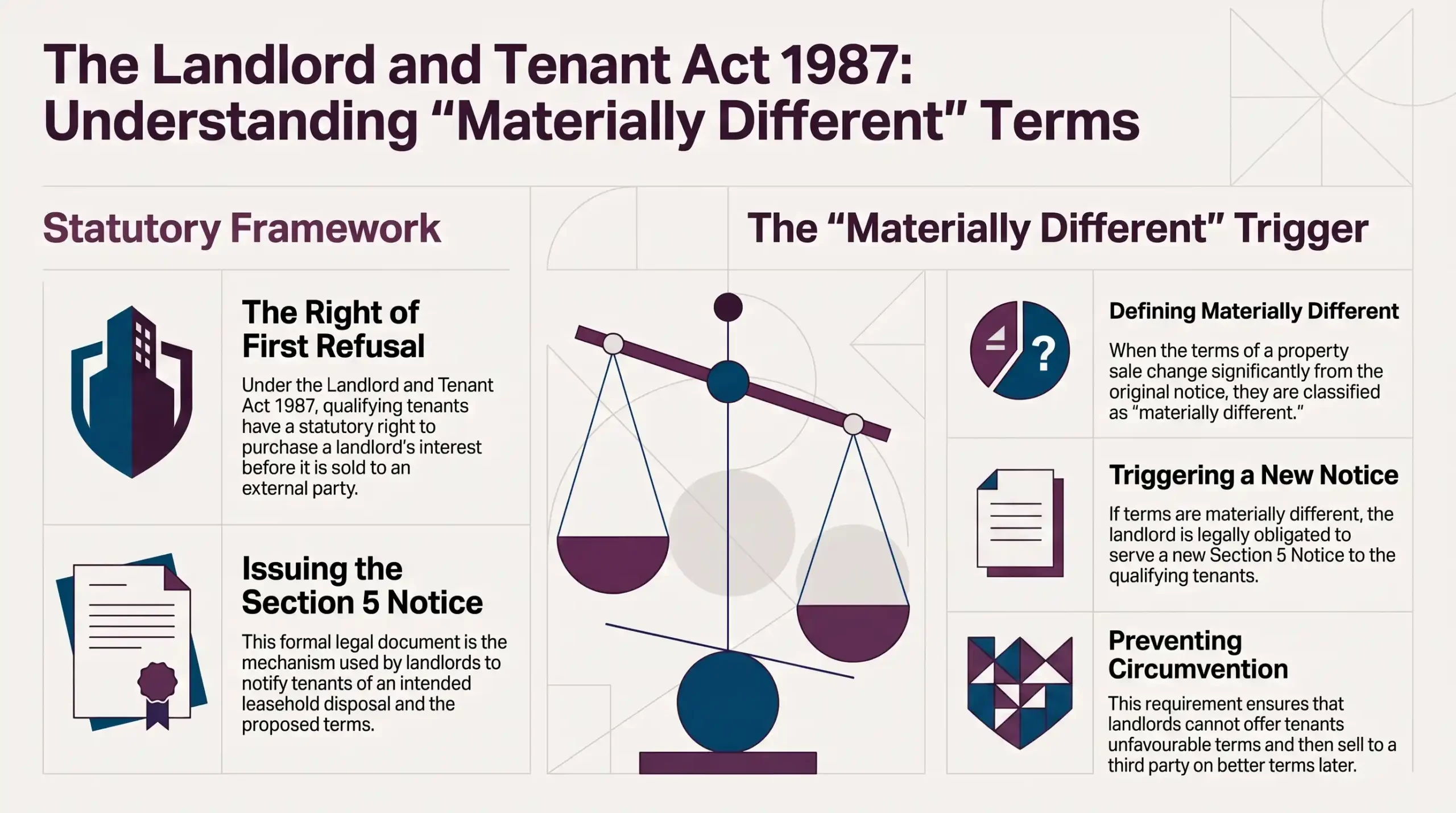
The Statutory Framework for the Right of First Refusal
Origins and Purpose of Section 5 Notices
Section 5 of the Act creates a statutory obligation for landlords planning to sell their freehold interest. Freeholders must offer qualifying leaseholders the right of first refusal under Section 5 before completing an external transfer. This mechanism protects residential flat owners by giving them priority to purchase the building.
The legal duty prevents freeholders from selling buildings covertly behind closed doors. Landlords must serve a formal Section 5 notice setting out proposed transaction terms. Qualifying leaseholders receive a statutory period to accept the offer and nominate an acquiring entity. If leaseholders decline or fail to meet deadlines, the landlord can sell externally. However, the external sale must strictly match or exceed the terms rejected by tenants.
Types of Disposals Covered Under the Act
The statutory regime applies to most voluntary disposals of a landlord’s interest in residential premises. It covers freehold sales, long lease grants, and transfers of rights across communal areas. Disposals executed through public auctions follow specialised procedural rules, but the core principle of leaseholder pre-emption remains fully intact.
Certain specific transactions fall outside the scope of Section 5. Exempt disposals include transfers to associated companies held for over two years, family gifts, and compulsory purchase acquisitions. Transfers resulting from insolvency proceedings or court orders also enjoy statutory exemption. Landlords and Resident Management Company directors must confirm whether a proposed transaction constitutes a relevant disposal before proceeding.
Criteria for Qualifying Tenants and Eligible Buildings
Building Eligibility and Premises Thresholds
A building falls under the Act if it contains at least two residential flats held by qualifying tenants. Additionally, non-residential elements like commercial shops must not exceed fifty percent of the total internal floor area. Excluding shared stairwells and communal corridors from commercial calculations ensures accurate assessment of statutory eligibility.
Mixed-use properties require careful architectural floor area surveys before serving notices. Where commercial space exceeds the fifty percent threshold, the right of first refusal does not apply. Similarly, single purpose-built houses split into separate flats require careful analysis. If the statutory thresholds are met, the freeholder cannot sell any part of the premises without triggering the notice process.
Qualifying Tenant Status and Exclusions
Qualifying tenants are leaseholders occupying flats under long leases granted originally for over twenty-one years. To qualify, leaseholders must collectively represent more than fifty percent of the total residential flats within the building. Commercial tenants, assured shorthold tenants, and leaseholders owning three or more flats in the block are excluded.
The rule excluding multiple flat owners prevents commercial investors from dominating leaseholder votes. When calculating qualifying percentages, property managers must count the number of eligible flats rather than individual owners. A Section 5 notice served on an incorrect tenant mix renders the offer legally invalid. Accurate lease audits protect freeholders against costly procedural mistakes.
Did You Know?
Under the Landlord and Tenant Act 1987, a freeholder who fails to serve a Section 5 notice before disposing of a residential property commits a summary criminal offence liable to a fine up to level 5 on the standard scale, currently uncapped in England.
Legal Parameters Governing Materially Different Terms
Statutory Meaning of Materially Different
Contract terms are materially different if they offer an external buyer more favourable commercial conditions than those served on leaseholders. The comparison evaluates price reductions, extended completion dates, flexible payment terms, or changed asset structures. Any alteration that makes purchasing the asset easier or cheaper for a third party satisfies this threshold.
The statutory purpose is preventing freeholders from frustrating leaseholder pre-emption rights. Landlords cannot deter leaseholders with inflated prices or restrictive terms, only to lower those demands for an external buyer. English courts assess material difference objectively from a commercial standpoint. Minor cosmetic edits to contract wording do not trigger new notices, but economic or structural shifts always do.
Comparison Between Offered Terms and Contract Terms
Assessing contract terms requires side-by-side comparison between the original Section 5 offer and the draft sale agreement. Solicitors examine whether the final purchase price, deposit requirements, or completion obligations offer better terms to the third party. If any provision grants the external purchaser a tangible advantage, the statutory rule is breached.
Courts scrutinise both headline figures and underlying legal covenants. For example, offering a buyer deferred payment arrangements effectively lowers the present value of the purchase price. Similarly, agreeing to pay buyer conveyancing costs or indemnifying environmental liabilities represents a financial concession. Freeholders must treat external contract terms as strictly capped by the original notice served on leaseholders.
The Railton-Meeks Compliance Audit Tool
Check Your Compliance & Protect Your Portfolio
Key Commercial Triggers That Require Fresh Notices
Purchase Price Adjustments and Financial Discounts
A reduction in purchase price represents the most common trigger requiring a fresh Section 5 notice. If an external buyer renegotiates price following survey findings or market changes, the landlord cannot simply accept the lower figure. Freeholders must re-offer the property to qualifying tenants at the revised lower price before proceeding.
Even small percentage price adjustments represent material variations under case law. Freeholders often assume minor discounts negotiated after valuation reports are acceptable without re-serving. This assumption is legally incorrect and exposes the transaction to clawback claims. Leaseholders must be given the opportunity to match any reduced figure that the freeholder is willing to accept from an outside investor.
Alterations to Property Boundaries and Appurtenant Rights
Modifying the physical boundaries or appurtenant rights included in a sale creates materially different transaction terms. Retaining commercial spaces, parking bays, or garden plots previously included in the Section 5 notice alters the asset’s scope. Removing or adding land interests requires serving a new offer notice accurately defining the revised property boundaries.
Varying rights over communal spaces or airspace development rights similarly modifies the underlying commercial deal. If a landlord decides to keep roof spaces for future development while selling the remaining freehold, the property offered is fundamentally altered. Qualifying leaseholders must receive an updated notice reflecting exact redline boundaries and rights attached to the revised title.
Railton-Meeks offers four landlord service tiers across Manchester and Cheshire
Procedural Timelines and Pre-Emption Mechanics
Initial Notice Periods and Acceptance Windows
Serving a Section 5 notice initiates strict statutory timelines that freeholders and leaseholders must follow. Freeholders must grant qualifying leaseholders at least two months from notice service to consider the offer. If leaseholders accept, they receive an additional two months to nominate their acquiring entity and submit formal legal details.
Once the nominated body details are submitted, the freeholder has two months to provide a draft contract. Contract exchange must occur within two months of contract approval, followed by completion within agreed statutory limits. Missing any statutory deadline can cause the notice process to lapse. Both parties must track procedural dates carefully using specialised block management software.
The Five-Month Disposal Window and Price Restrictions
If qualifying tenants reject an offer notice or fail to respond within statutory timeframes, a protected disposal window opens. The freeholder gains five months to complete an external sale to a third party. However, the external transaction price cannot fall below the figure originally offered to qualifying leaseholders.
If the five-month protected window expires without completing exchange, the freeholder’s right to sell externally lapses completely. Any subsequent attempt to sell requires issuing a new Section 5 notice, resetting statutory timers. Furthermore, negotiating a sale during the window on more favourable terms voids the protection immediately, requiring a fresh offer notice.
Instant Rental & Block Valuation
Get Your Valuation & Know Your Market Value
Consequences of Non-Compliance and Legal Liability
Criminal Offences and Enforcement Penalties
Failing to comply with Section 5 notice requirements constitutes a summary criminal offence under British housing law. Freeholders who complete unlawful disposals without serving proper notices face prosecution in the Magistrates’ Court. Directors of corporate freeholders can face personal criminal liability if offences occur with their consent or through neglect.
Fines imposed upon conviction are unlimited under current English sentencing guidelines. Local housing authorities or affected leaseholders can initiate criminal prosecutions against non-compliant landlords. Beyond financial penalties, criminal convictions create permanent reputational damage and disrupt future real estate activities. Professional property managers must establish rigorous safeguards to prevent unauthorised disposals.
Breach Impact on Transaction Validity
An unlawful disposal completed without serving compliant notices remains legally binding at Land Registry level initially. However, completing a transaction under materially different terms creates immediate civil vulnerability for the incoming purchaser. Leaseholders can enforce statutory remedies that overturn the transaction and compel title transfer to their nominated purchasing company.
The legal defect attaches directly to the property title following completion. External buyers cannot claim bona fide purchaser status if statutory notices were omitted or flawed. Consequently, lenders frequently refuse mortgage finance for blocks where historic Section 5 compliance remains unproven. Rigorous title checking during conveyancing is essential to identify potential statutory breaches.
Statutory Clawback Rights and Buyer Due Diligence
Leaseholder Enforcement and Property Reconstitution
Section 12A of the Act grants qualifying leaseholders powerful statutory clawback rights against non-compliant purchasers. Leaseholders can serve information notices requiring buyers to disclose exact transaction terms and sale contracts. Once details are confirmed, qualifying tenants can force the new owner to transfer the freehold on identical commercial terms.
The buyer receives no compensation beyond the purchase price originally paid to the freeholder. Furthermore, the purchaser must absorb lost legal fees, stamp duty land tax, and administrative costs incurred during the acquisition. Statutory clawback rights must be exercised within strict timeframes following discovery of the unlawful sale. Leaseholders should act quickly upon discovering an unannounced freehold transfer.
Purchaser Protection and Conveyancing Checks
Prospective buyers of residential freeholds must conduct rigorous due diligence regarding Section 5 compliance before exchanging contracts. Conveyancing solicitors must inspect historical Section 5 notices, proof of service records, and leaseholder rejection evidence. Verifying that contract terms strictly match served notices protects buyers against future statutory clawback claims.
Where price reductions or contract variations occur during conveyancing, buyers should require the freeholder to re-serve notices. Accepting an uncompliant discount creates severe legal risks for the purchaser post-completion. Indemnity insurance policies cannot remedy intentional statutory breaches or defeat leaseholder clawback rights. Ensuring absolute statutory adherence before completion is the only secure pathway for freeholders and buyers.
HMO Specialist Yield & Tax Calculator
Calculate Your Yield & Offset New Tax Burdens
Final Thoughts
Complying with the landlord and tenant act 1987 is essential for freeholders, property buyers, and management directors undertaking residential property disposals. Ensuring that external contract terms strictly match those served in initial offer notices prevents severe legal disputes. Freeholders must recognise that renegotiating commercial terms with external buyers requires issuing a fresh notice to maintain compliance.
Establishing robust pre-sale auditing processes ensures seamless conveyancing while protecting property transactions from civil clawback claims and criminal penalties. Both sellers and prospective buyers benefit from conducting thorough contract reviews prior to exchange. Proper understanding of statutory obligations preserves property values and fosters positive governance across residential leasehold blocks.
Frequently Asked Questions
A:
Terms are materially different when an external buyer receives more favourable commercial conditions than those originally offered to qualifying leaseholders. This includes reductions in purchase price, lower deposit requirements, deferred payment arrangements, or altered property boundaries. If a freeholder grants an external buyer any financial or structural advantage not extended to tenants in the original offer notice, the landlord must issue a fresh Section 5 notice. Failing to re-offer the revised terms to qualifying leaseholders renders any subsequent external sale unlawful under residential property legislation.
A:
No, a freeholder cannot accept a lower purchase price from an external buyer without re-offering the property to qualifying leaseholders first. If tenants reject the original Section 5 offer or allow the notice period to lapse, the landlord gains a five-month window to sell externally. However, the external sale price must strictly match or exceed the figure quoted in the original notice. Agreeing to any price reduction with a third party during negotiations constitutes a material variation, requiring the freeholder to serve a fresh notice reflecting the lower figure.
A:
Selling a residential block without serving a compliant Section 5 notice is a summary criminal offence under British property law. Freeholders and corporate directors face prosecution and unlimited court fines upon conviction. In addition to criminal sanctions, leaseholders enjoy statutory clawback rights under Section 12A of the Act. Leaseholders can force the incoming third-party purchaser to sell the freehold to their nominated company on the exact terms agreed with the non-compliant freeholder, effectively unwinding the transaction.
A:
When a fresh Section 5 notice is served due to materially different terms, the full statutory timeline resets. Qualifying leaseholders receive a fresh window of at least two months from the date of service to consider the updated offer. If the requisite majority accepts, leaseholders gain an additional two months to nominate their acquiring entity. Freeholders cannot shorten these statutory timeframes, regardless of previous negotiations or prior rejections under earlier offer notices.
A:
Prospective purchasers must instruct conveyancing solicitors to review all historical Section 5 documentation prior to contract exchange. Solicitors should inspect copies of served offer notices, certificates of posting or proof of service, and official responses from qualifying leaseholders. Buyers must compare the draft contract terms directly against the original notice details to ensure price, deposit, boundaries, and completion conditions align perfectly. Securing written confirmation of statutory compliance prevents post-completion clawback claims by qualifying leaseholders.
