

Property Management Services for Landlords in Manchester.
Professional Manchester property management services are becoming essential for property owners responding to sweeping regulatory changes across the North West rental market. Private landlords now face strict administrative demands, tighter fire safety standards, and rigorous licensing enforcement from local authorities. Operating a successful residential portfolio requires proactive oversight, clear operational frameworks, and deep regional knowledge. Professional oversight protects capital values whilst ensuring consistent monthly rental yields across diverse housing assets.
Managing residential properties effectively requires navigating complex statutory obligations, tenant communications, and reactive maintenance needs without incurring costly legal penalties. Landlords must evaluate whether their current administrative processes provide adequate protection against compliance risks and unnecessary property void periods. How can property owners select a management framework that protects investment yields whilst keeping properties fully compliant with evolving regional regulations?
Key Takeaways
- The Renters Rights Act 2026 abolishes no-fault evictions and converts fixed shorthold tenancies into periodic agreements across the residential rental market.
- Manchester City Council enforces city-wide Article 4 directions requiring full planning permission to convert family homes into multi-occupancy HMO properties.
- Mandatory Making Tax Digital rules taking effect in April 2026 require digital quarterly income recording for landlords earning over fifty thousand pounds.
- New energy efficiency standards mandate that all private rental dwellings achieve an EPC rating of grade C or higher by October 2030.
- Awaab’s Law enforces strict statutory timelines requiring emergency hazard repairs to commence within twenty-four hours of receiving initial tenant notification.
Key Operational Frameworks for Local Property Compliance
Managing rental properties in Greater Manchester involves navigating distinct statutory requirements across tenant onboarding, building safety, and financial reporting. Property owners must track critical regulatory milestones to avoid civil penalties and maintain smooth operations. The following table highlights core regulatory requirements, implementation deadlines, and compliance actions necessary for active residential portfolios.
Understanding these operational obligations allows property owners to benchmark their current setup against legislative standards. Proactive planning ensures that property operations align with local authority expectations while safeguarding monthly rental returns. Reviewing these benchmark criteria helps landlords evaluate where professional management intervention yields the highest operational benefit.
| Regulatory Domain | Statutory Deadline | Core Compliance Action |
|---|---|---|
| Renters Rights Act Transition | 1 May 2026 | Serve government information sheet and update tenancy terms to periodic status. |
| Making Tax Digital (MTD) | 6 April 2026 | Implement compatible digital accounting software for quarterly financial submissions. |
| Fire Safety Evacuation (PEEPs) | 6 April 2026 | Conduct person-centred fire risk assessments for residents in eligible blocks. |
| EPC Grade C Target | 1 October 2030 | Retrofit insulation and heating systems to achieve fabric performance thresholds. |
| Awaab’s Law Hazard Mitigation | Immediate Enforcement | Initiate emergency repairs within 24 hours and investigate damp within 14 days. |
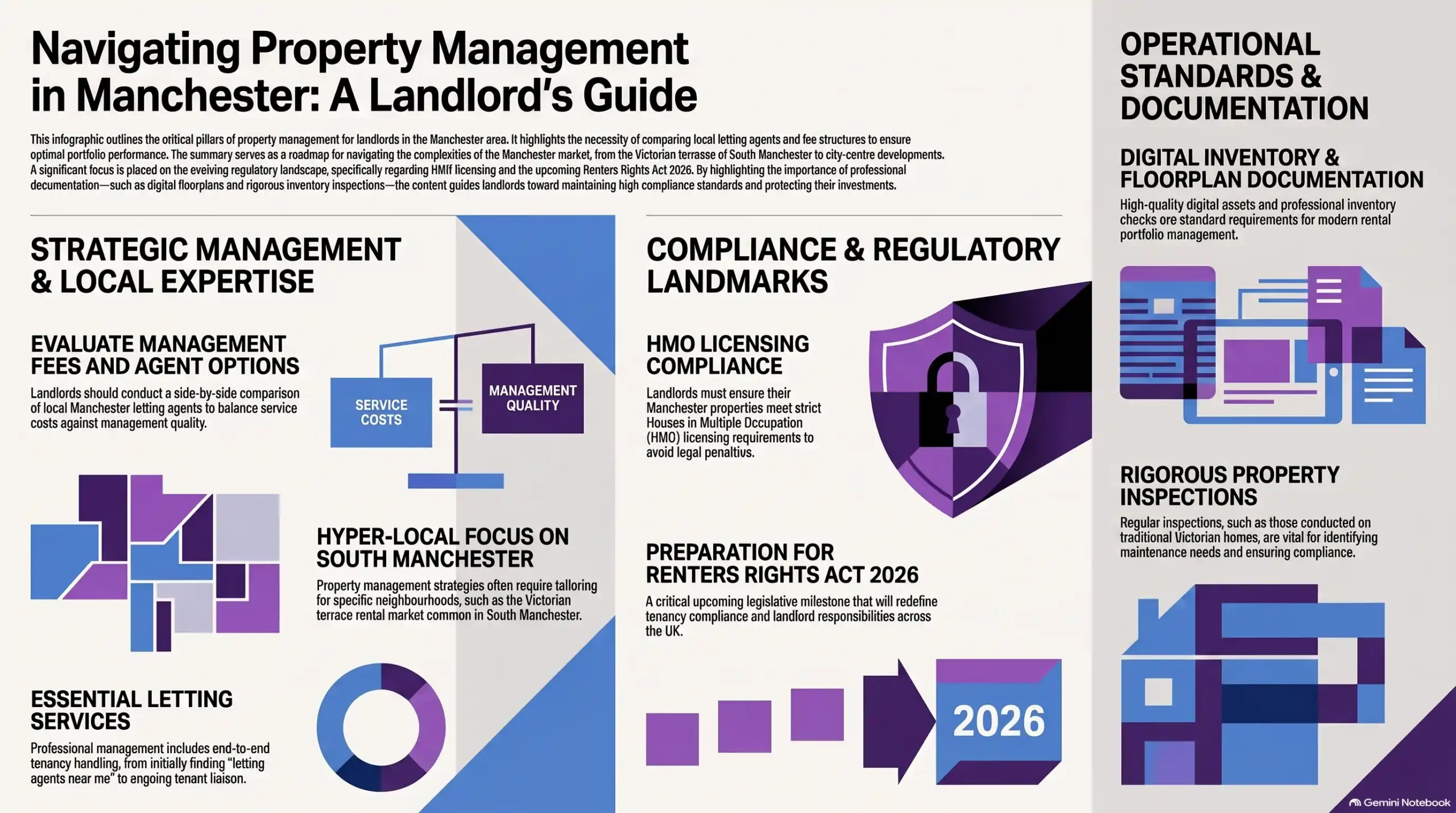
Legal Compliance Frameworks and Statutory Duties
Renters Rights Act Compliance Strategies
The Renters Rights Act introduces fundamental changes to how tenancies operate across England. Fixed-term Assured Shorthold Tenancies convert automatically into periodic agreements on 1 May 2026. Landlords can no longer serve no-fault notices, shifting all possession claims to revised statutory grounds under Section 8.
Under the new framework, landlords must establish valid statutory grounds to regain possession of a property. Ground 1 allows repossession for personal or family occupation with four months’ notice, though it cannot be invoked during the initial twelve months of a tenancy. Ground 8 requires three months of rent arrears instead of two, with notice periods doubling to four weeks. Additionally, student HMO properties benefit from Ground 4A, permitting possession alignment with academic cycles between June and September. Preparing for these transitions requires thorough file audits and revised tenancy documentation.
Mandatory Notifications and Eviction Notice Revisions
Landlords must issue mandatory documentation to all existing tenants by 31 May 2026. This obligation includes distributing a government information sheet detailing rights under periodic tenancies. Failure to serve these official notices correctly exposes property owners to severe civil penalties of up to seven thousand pounds per breach.
Transitioning away from Section 21 demands meticulous record keeping and clear communication. Pre-existing Section 21 notices served on or before 30 April 2026 remain enforceable only if court proceedings commence before 31 July 2026 or within six months of service. After these transitional cutoffs, expired notices become invalid, forcing landlords onto the Section 8 path. Furthermore, bidding wars are explicitly banned under the updated legislation. Properties must be advertised at a fixed rental figure, and accepting offers above the published price triggers immediate regulatory enforcement.
Licensing Enforcement across Manchester Postcodes
Article 4 Planning Restrictions and Lawful Use
Manchester City Council maintains a strict city-wide Article 4 Direction affecting multi-occupancy housing. Property owners cannot convert single-family C3 dwellings into small C4 HMOs under permitted development. Changing property use requires full planning permission, with council policy H11 routinely refusing applications in high-density areas.
Maintaining proof of historical HMO use is essential for long-term capital protection. Properties operating as shared homes before Article 4 restrictions must hold a valid Certificate of Lawful Use. Losing grandfathered planning status can reduce property valuations by twenty to thirty percent. Larger HMOs housing seven or more occupants fall under the Sui Generis planning class, requiring mandatory planning consent regardless of location. Professional managers audit planning histories to preserve these crucial property rights against enforcement action.
Mandatory and Selective Licensing Operations
Operating multi-occupancy or selective rental homes in Manchester requires active statutory licences. Mandatory HMO licensing applies city-wide to properties containing five or more occupants from multiple households. Local authorities inspect room dimensions, fire doors, interlinked smoke alarms, and waste storage facilities to ensure standard safety compliance.
Selective licensing schemes cover all private residential rentals within designated improvement zones, such as Moss Side, Rusholme, and Levenshulme. Single-adult bedrooms must measure at least 6.51 square metres, whilst double rooms require 10.22 square metres. Fire safety rules enforce Grade D interlinked detection systems and FD30-rated fire doors with self-closing devices. Operating an unlicensed rental property or breaching licence conditions carries financial risks, including civil penalty fines up to thirty thousand pounds.
Did You Know?
Accepting a rent offer above the advertised price in Manchester is illegal under the Renters Rights Act, exposing property owners to civil penalties of up to £7,000 per violation.
Operational Asset Management and Proactive Maintenance
Maintenance Triage and Preventive Repairs
Effective property management relies on swift maintenance triage and structured repair protocols. Initial digital troubleshooting resolves simple tenant queries without sending out contractors. Structured planned preventative maintenance schedules reduce emergency repair expenses by identifying boiler wear, roof damage, and plumbing vulnerabilities before major failures occur.
Utilising dedicated in-house tradespeople provides distinct financial advantages over relying on expensive emergency contractor networks. Vetted trade partners maintain consistent service standards for annual gas safety certifications, electrical safety tests, and routine joinery. Detailed photographic inventories taken before tenancy commencement establish clear physical baseline conditions. This thorough documentation proves critical when assessing end-of-tenancy wear against tenant damage during deposit resolution procedures.
Damp Inspections and Awaab’s Law Timelines
Awaab’s Law mandates strict statutory response times for handling reported moisture and mould hazards in private rentals. Property managers must inspect reported damp issues within fourteen days and issue written investigation summaries. Emergency hazards like total heating loss require active remedial works to start within twenty-four hours.
Routine property inspections conducted every six months include dedicated moisture risk audits to identify early ventilation issues. Installing humidistat-controlled extractor fans in kitchens and bathrooms mitigates condensation buildup before structural damage develops. Aligning property standards with the Decent Homes Standard ensures that rental homes remain free from Category 1 hazards. Proactive environmental control protects tenant health whilst insulating property owners from regulatory enforcement.
The Railton-Meeks Compliance Audit Tool
Check Your Compliance & Protect Your Portfolio
Financial Stewardship and Making Tax Digital Standards
Digital Accounting for HMRC Compliance
Making Tax Digital rules taking effect on 6 April 2026 alter financial record-keeping for private rental landlords. Property owners with gross rental incomes exceeding fifty thousand pounds must log income and expenses digitally. Quarterly updates must be submitted to HMRC using fully compatible accounting software.
Modern management platforms streamline digital tax compliance by generating itemised financial statements compatible with HMRC software integrations. Digital ledger systems record rental payments, maintenance invoices, and management fees in real time. This automated oversight reduces administrative overhead for portfolio owners while preventing manual bookkeeping errors. Structured financial stewardship ensures landlords remain compliant with changing UK tax frameworks without operational disruption.
Zero-Tolerance Rent Arrears Controls
Protecting rental income demands robust arrears tracking and automated payment monitoring. Since mandatory possession grounds require three full months of outstanding rent arrears, early intervention prevents balance accumulation. Automated chasing protocols flag late payments within twenty-four hours to maintain consistent cash flow across portfolios.
Comprehensive tenant vetting reinforces income stability prior to contract signing. Professional referencing evaluates credit histories, employment tenure, and rent-to-income affordability ratios to minimise default risks. All tenant deposits must be placed within a government-approved protection scheme within thirty statutory days, accompanied by served Prescribed Information. Transparent financial management protects landlord capital whilst building positive, professional relationships with incoming tenants.
Railton-Meeks offers four landlord service tiers across Manchester and Cheshire
Energy Efficiency and Environmental Upgrades
EPC Rating C Deadlines and Investment Caps
Government decarbonisation targets mandate that all private rental properties in England achieve an Energy Performance Certificate rating of grade C by 1 October 2030. This unified target applies to existing agreements and new tenancies alike, removing previous phased implementation proposals across the sector.
To prevent unmanageable retrofitting expenses, a financial cost cap of ten thousand pounds including VAT applies per property. Any qualifying energy improvements implemented after October 2025 count toward this spending threshold. If a dwelling fails to reach grade C after cap expenditure, landlords can register a ten-year statutory exemption. Securing an EPC C rating under existing assessment rules before October 2029 grants a ten-year compliance window under legacy rules.
Dual Metric Evaluation and Retrofitting Options
Updated assessment standards introducing dual-metric evaluations take effect in October 2026. Buildings will be assessed on fabric energy performance alongside heating efficiency or smart energy readiness. Landlords can access government grants through the Warm Homes Plan to fund insulation and heat pump installations.
Targeted insulation projects substantially improve building energy ratings without requiring total heating overhauls. The Great British Insulation Scheme offers subsidised cavity wall and loft insulation for qualifying residential dwellings. Improving building fabric reduces energy bills for occupants, lowering void risks and enhancing property marketability. Strategic green upgrades protect long-term capital value whilst keeping rental properties fully compliant with national environmental benchmarks.
Instant Rental & Block Valuation
Get Your Valuation & Know Your Market Value
Area Yields and Strategic Postcode Intelligence
High Yield Student and Healthcare Corridors
South Manchester postcodes generate varying gross rental yields based on tenant demographics and local housing density. Fallowfield and Rusholme in M14 achieve high gross returns between 8.1% and 11.0%, driven by university student demand and medical staff at nearby hospitals.
Hulme and Old Trafford in M15 and M16 deliver yields ranging from 6.5% to 8.5%, supported by corporate expansion and graduate retention. Salford Quays M50 averages returns between 6.1% and 7.6%, benefiting from tech sector employment at MediaCity. Traditional terraced stock in M13 and M19 offers attractive cash flow without high apartment service charges, making suburban multi-occupancy lets highly resilient investment assets.
Capital Preservation in Suburban Markets
Suburban South Manchester and Cheshire enclaves offer capital growth and long-term tenant stability. Prime locations like Didsbury M20 generate yields between 4.0% and 5.5%, whereas Cheshire postcodes such as Wilmslow SK9 yield between 3.0% and 4.5% alongside high equity preservation.
High-value areas attract corporate executives and professional families who prioritise proximity to top schools and transport links. Properties in Chorlton and Didsbury experience swift tenant placement and minimal void periods. While gross yields are lower than in student corridors, capital appreciation and low tenant turnover maintain total investment performance. Balancing high-yield urban assets with stable suburban holdings builds a resilient, diversified property portfolio.
Selecting and Evaluating Local Managing Agents
Key Questions for Agency Assessment
Choosing an effective management partner requires evaluating operational processes rather than focusing solely on initial commission rates. Landlords should inquire how agents handle maintenance triage, manage mandatory licensing, track rent arrears, and prepare client accounts for upcoming HMRC tax reporting deadlines.
Proximity alone does not guarantee superior service quality. Landlords searching for letting agents near me for landlords must assess an agency’s regulatory competence and digital infrastructure. Asking specific questions about Section 8 possession procedures, Awaab’s Law inspection protocols, and contractor trade networks reveals true management capability. A capable agency provides clear administrative oversight, safeguarding property assets from regulatory penalties and cash flow disruptions.
Management Agreement Terms and Service Breakdown
Reviewing property management agreements ensures complete transparency regarding agent responsibilities, fee structures, and termination notice periods. Contracts must clearly define included day-to-day administrative duties alongside potential additional fees for legal disclosures, statutory licence applications, tenancy renewals, and court representation support.
Understanding termination terms prevents unexpected exit costs when changing service providers. Standard contracts outline clear notice periods and client money protection guarantees. Landlords in Manchester should verify that client funds reside in ring-fenced accounts protected by recognised professional bodies. Transparent fee breakdowns and robust operational standards build lasting trust between property owners and their appointed management representatives.
HMO Specialist Yield & Tax Calculator
Calculate Your Yield & Offset New Tax Burdens
Final Thoughts
Navigating evolving legislation, strict local licensing, and digital accounting rules requires structured administrative oversight. Choosing professional Manchester property management services helps landlords in Manchester maintain legal compliance, protect capital value, and secure consistent monthly returns across expanding residential portfolios.
Proactive management transforms regulatory obligations into operational stability. Portfolio owners who audit property files, implement digital compliance systems, and maintain high building standards remain well-positioned to maximise rental yields in a dynamic housing market.
Frequently Asked Questions
A:
The Renters Rights Act 2026 abolishes fixed-term Assured Shorthold Tenancies, converting all tenancies into periodic rolling agreements from 1 May 2026. Section 21 no-fault evictions are eliminated, requiring landlords to rely on expanded statutory Section 8 grounds to regain possession. Tenants can terminate agreements with two months' notice at any time, while landlords must issue mandatory government information sheets to all existing tenants by 31 May 2026.
A:
Manchester City Council operates a city-wide Article 4 Direction that removes permitted development rights for converting family homes into small multi-occupancy properties. Full planning permission is required to operate an HMO for three or more occupants. Applications in saturated student areas like Fallowfield are strictly evaluated under Policy H11, making existing properties with valid Certificates of Lawful Use highly valuable protected assets across the regional market.
A:
Awaab's Law mandates strict statutory response times for handling reported moisture and damp hazards in rental dwellings. Property managers must initiate investigations into persistent damp or mould within fourteen days and deliver a written report to occupants within three days of inspection. Emergency hazards that present immediate health or safety risks, such as total winter heating failure, require remedial works to commence within twenty-four hours.
A:
Starting 6 April 2026, Making Tax Digital rules require property owners earning over fifty thousand pounds in gross rental income to maintain digital accounting records. Landlords must submit quarterly digital updates of income and expenditure to HMRC using compatible software platforms. Professional property management systems provide integrated financial statements that simplify digital record keeping and ensure full compliance with updated statutory reporting requirements.
A:
All private rented homes across England and Wales must achieve an Energy Performance Certificate rating of grade C or higher by 1 October 2030. The government has established a ten thousand pound financial spending cap per property for qualifying energy retrofits. Landlords can register ten-year statutory exemptions if dwellings cannot reach grade C after cap expenditure, while grants remain available via the Warm Homes Plan.
About The Author
Tara Meeks MARLA - Managing Director & Founder, Railton-Meeks Property Management
HMO licensing · Compliance strategy · Renters’ Rights Act 2026 · Building Safety Act 2022 · Property acquisition · Refurbishment & development · Block management · South Manchester investment.
Tara Meeks is the founder and Managing Director of Railton-Meeks Property Management Limited, a Didsbury-based agency she established in 2006 to manage her own residential investment portfolio. With over 20 years’ experience as a landlord, developer, and ARLA-qualified letting professional, Tara leads the agency’s “Compliance & Yield Guardian” strategy across South Manchester and Cheshire.
Tara’s career in property began in the mid-1990s, long before she formalised the agency that bears her name. Having personally navigated the practical realities of buy-to-let acquisition, HMO conversion, refurbishment, tenant vetting, and full-cycle property development, she founded Railton-Meeks as a vehicle to bring that landlord-side perspective to other Manchester investors. The agency has grown organically through referral, with a significant portion of original 2006 clients still on the books today.
As a Member of ARLA Propertymark (MARLA), Tara holds the industry’s recognised qualification for residential lettings and property management, and the agency operates under Propertymark’s Client Money Protection scheme. Her professional focus in 2026 is the Renters’ Rights Act transition — particularly the May 2026 periodic-tenancy switch and the abolition of Section 21 — and the operational shift this demands from landlords accustomed to the old AST framework.
Tara is responsible for client onboarding, portfolio strategy, HMO licensing applications under Manchester City Council’s Article 4 directions, and the agency’s relationships with Resident Management Companies and Freeholders requiring Building Safety Act 2022 compliance. She is also active in property acquisition advisory, having helped numerous landlords source, refurbish, and stabilise income-producing assets across the M14, M19, M20, and M21 postcodes.
She remains, above all, a working landlord. The vision she set out at founding — “to keep Railton-Meeks as a small family business, ensuring personal attention and exceeding clients’ expectations” — is the operating principle of the agency twenty years on.
Credentials
- ARLA Propertymark Member (MARLA)
- Director, Railton-Meeks Property Management Limited (Companies House 08242540)
- 20+ years’ active landlord experience
- HMO, Article 4, and Sui Generis licensing specialist
- Property acquisition and refurbishment advisor
