

Letting Agents in Didsbury and Didsbury Property Management.
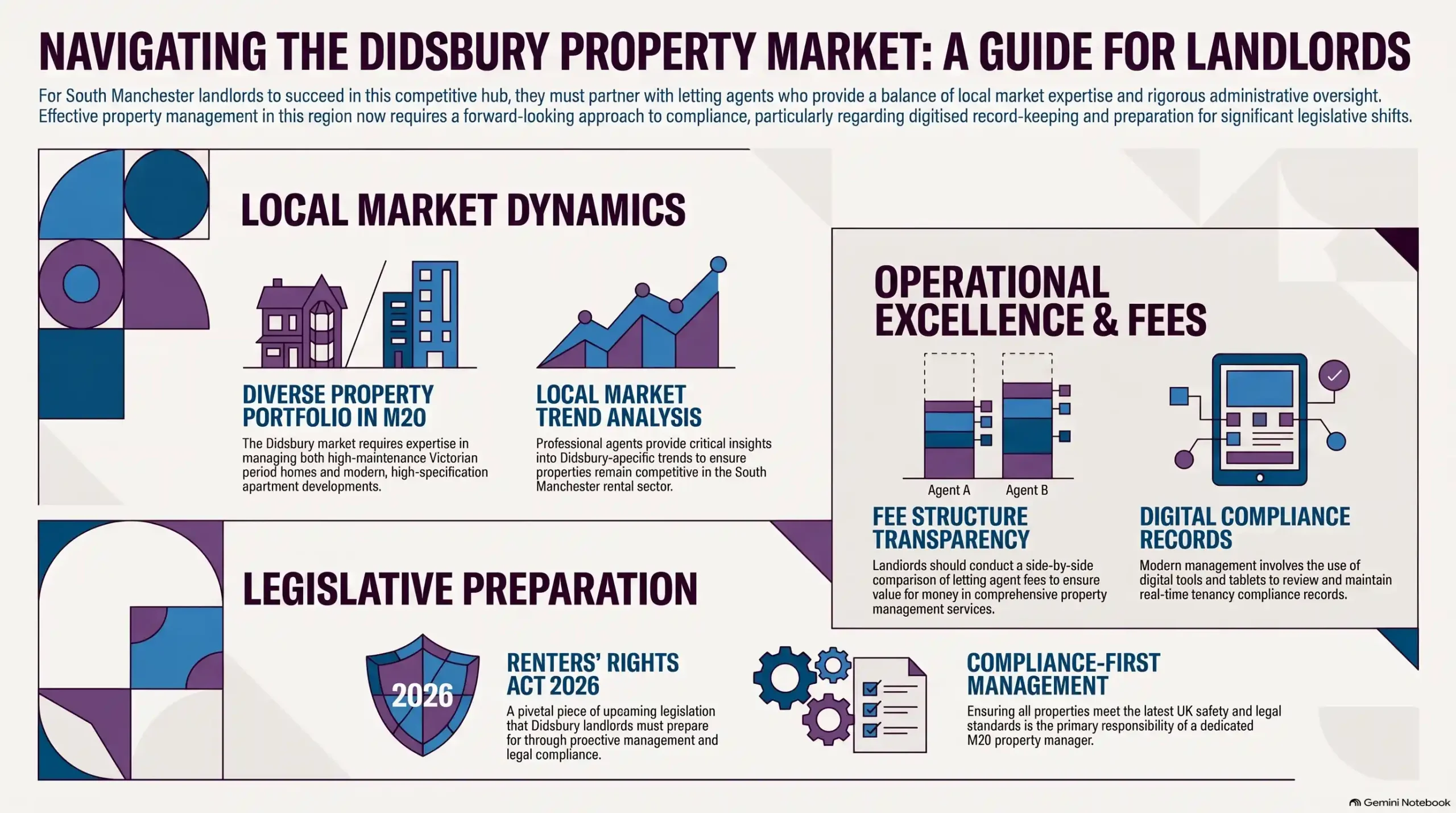
Managing private residential assets in South Manchester requires navigating significant statutory shifts alongside distinct local demand dynamics. Choosing qualified letting agents Didsbury landlords rely upon is no longer simply about securing tenants; it is about protecting asset yield and ensuring strict legislative compliance. Didsbury remains a high-value enclave within the M20 postcode, attracting established professionals, academic staff, and growing families who expect high residential standards. To maintain profitability, property owners must understand how local expertise directly mitigates operational and legal risks.
With major statutory changes reshaping tenancy structures, financial reporting, and energy standards across England, traditional management approaches are rapidly becoming obsolete. Landlords face tightening margins and increased regulatory scrutiny from local authorities. How can property owners in Didsbury effectively safeguard their rental returns whilst ensuring complete operational compliance in an evolving regulatory market?
Key Takeaways
- Didsbury property yields average between four and five point five percent, requiring proactive management strategies to preserve net income against rising regulatory costs.
- The Renters Rights Act abolishes no-fault evictions from May 2026, forcing South Manchester landlords to rely strictly on expanded, evidence-based possession grounds.
- Local Conservation Area restrictions in M20 mandate careful planning when executing mandatory energy efficiency retrofits to meet impending national housing standards.
- Strict rental bidding bans enforce advertised pricing compliance, making accurate valuation essential to avoid statutory civil penalties reaching seven thousand pounds.
- Effective property management in South Manchester integrates digital safety records, streamlined repair triage, and rigorous tenant referencing to eliminate costly void periods.
Didsbury Rental Market Performance Metrics
Understanding the micro-district dynamics across the M20 postcode area allows landlords to align management strategies with specific tenant profiles. Didsbury features distinct sub-markets ranging from professional apartments to sprawling family homes. Evaluating yields, tenant demographics, and typical rental values enables property owners to set realistic expectations for occupancy, capital growth, and ongoing maintenance requirements.
The table below provides a comprehensive comparative analysis of key property sectors across the Didsbury landscape. It highlights crucial performance indicators, typical tenant profiles, and expected rental ranges relevant to professional property owners. Reviewing these benchmark figures helps landlords evaluate operational returns against local market standards.
| Sub-District | Primary Tenant Profile | Average Gross Yield | Typical Rental Range |
|---|---|---|---|
| West Didsbury (Burton Rd) | Young Professionals & Creatives | 4.5% – 5.5% | £1,450 – £1,750 pcm |
| Didsbury Village | Senior Executives & Corporate Lets | 4.0% – 4.8% | £1,600 – £1,900 pcm |
| East Didsbury | Long-Term Families & Academic Staff | 4.2% – 5.0% | £1,500 – £1,800 pcm |
| M20 Professional HMOs | Healthcare Workers & Postgraduates | 6.5% – 7.8% | £650 – £800 pcm (per room) |
Didsbury Private Rented Market Performance
Micro-Market Variations Across M20 Postcodes
Didsbury comprises distinct micro-markets that demand tailored property management strategies. West Didsbury attracts high-earning young professionals who prioritise lifestyle amenities along Burton Road. Conversely, Didsbury Village and East Didsbury appeal to senior executives and long-term families seeking access to top-rated school catchments and established transport links.
Aligning management practices with these demographic nuances is critical for sustaining rental growth. Properties located near transport hubs command premium rents, yet high tenant expectations require rapid response times for maintenance queries. Experienced M20 letting agents adapt marketing channels and lease management to fit these specific tenant profiles, minimising turnover costs.
Capital Preservation Versus Cash Flow Optimisation
Investing in South Manchester property generally represents a long-term capital preservation strategy rather than a high-yield play. Average entry prices in Didsbury exceed national averages, compressing gross returns to between four and five percent. Landlords must focus on minimising void periods and protecting asset condition to maximise total investment returns.
Cash flow optimisation in lower-yield enclaves requires rigorous financial stewardship. Professional managers achieve this by conducting regular market rent reviews within statutory windows and implementing preventative maintenance programs. By preventing minor structural defects from escalating into major repairs, owners preserve both capital value and net operational income.
Legislative Reforms and Compliance Standards for Landlords
Section 21 Abolition Changes Possession Grounds
The implementation of the Renters Rights Act fundamentally changes how tenancies are structured and concluded. The complete removal of Section 21 no-fault evictions forces landlords to rely entirely on specific statutory grounds under Section 8. Consequently, maintaining comprehensive, contemporaneous records of tenancy breaches and communication becomes mandatory for legal possession proceedings.
All existing fixed-term Assured Shorthold Tenancies convert automatically to periodic agreements. Tenants gain the legal right to end agreements with two months’ notice at any point. To mitigate turnover risks, landlords must establish rigorous pre-tenancy vetting procedures and ensure that all required statutory notices and information sheets are correctly served.
Mandatory Tenant Notifications and Penalty Protection
Statutory compliance under updated housing legislation requires absolute precision regarding document service to avoid severe financial penalties. Landlords must provide existing tenants with official government information sheets detailing their updated rights. Failing to deliver required written statements or serving invalid documentation can trigger civil fines of up to seven thousand pounds per breach.
Compliance extends beyond written notices to include strict rules on rental advertising and bidding. Housing providers can no longer invite or accept rental offers above the published price. Engaging professional administrative oversight ensures that every marketing campaign and tenancy document strictly adheres to statutory requirements, shielding owners from enforcement actions.
Did You Know?
Under statutory housing rules, accepting an uninvited rental offer above the advertised price or failing to provide mandatory tenancy information sheets can result in local authority civil penalties of up to £7,000 per violation.
Property Management Standards That Protect Landlords
Proactive Maintenance and Repair Triage Systems
Effective Didsbury property management relies on proactive repair triage to control operational expenditures. Utilising qualified local tradespeople and initial phone diagnostic assessments prevents unnecessary out-of-hours callouts. Establishing planned preventative maintenance routines protects high-value heating systems, roofing structures, and building envelopes from costly emergency failures during peak winter months.
Prompt maintenance handling directly enhances tenant satisfaction, which supports longer tenancy lengths. Under Awaab’s Law standards, landlords face legal timeframes to investigate and resolve damp or mould hazards. Systematic damp and mould audits conducted during routine inspections protect structural integrity whilst keeping properties compliant with evolving safety thresholds.
Rigorous Tenant Vetting and Financial Stewardship
Securing reliable occupants requires comprehensive vetting protocols that go far beyond basic credit checks. Robust referencing evaluates employment stability, verified landlord histories, and strict rent-to-income ratios. Incorporating detailed digital inventories with high-resolution photographic evidence ensures that deposit protection requirements are fully satisfied before handover occurs.
Financial management also demands seamless preparation for Making Tax Digital reporting mandates. Digital accounting tools provide clear, itemised statements that integrate with accounting platforms, simplifying tax compliance. Automated rent collection systems immediately flag minor payment delays, enabling swift intervention before arrears reach statutory eviction thresholds.
The Railton-Meeks Compliance Audit Tool
Check Your Compliance & Protect Your Portfolio
Fee Structures and Service Model Comparisons
Full Management Versus Let-Only Options
Choosing between comprehensive management and let-only services depends on a landlord’s available time, technical knowledge, and regulatory exposure. Full management transfers the administrative burden of legal compliance, emergency repairs, and ongoing tenant communications to specialists. Let-only services suit experienced owners who prefer handling daily operational duties independently.
Given the complexity of modern property law, self-management carries increasing operational risk. Missing a single statutory certificate renewal can invalidate possession claims or lead to substantial fines. Full management offers an ongoing compliance shield, ensuring that safety inspections, rent reviews, and tenancy documentation remain up to date year-round.
Agent Commission Rates and Hidden Costs
Landlords evaluating professional agency fees must scrutinise fee structures to accurately calculate net returns. Management fees typically operate as a percentage of monthly rental income, covering core administration and rent collection. Understanding additional charges for tenancy renewals, inventory preparation, and dispute handling prevents unexpected reductions in rental yields.
Transparent pricing models clearly outline what services are included within the primary management percentage. Landlords should review contractor markup policies and compliance renewal fees before signing terms of business. Value is determined by an agent’s ability to prevent voids, maintain property values, and ensure strict legal compliance.
Railton-Meeks offers four landlord service tiers across Manchester and Cheshire
Energy Efficiency Standards and Green Retrofitting
EPC Mandates for Victorian Properties
The private rented sector faces mandatory targets requiring residential properties to achieve an Energy Performance Certificate rating of C or higher. In Didsbury, where solid-wall Victorian terraces are prevalent, meeting these energy targets requires strategic planning. Implementing phased insulation upgrades prevents sudden financial expenditure whilst improving space-heating efficiency.
Upgrading period properties requires balancing thermal performance with architectural preservation. Landlords who secure an EPC C rating before regulatory deadlines benefit from extended compliance windows. Energy-efficient homes also enjoy superior market demand from eco-conscious tenants, command higher rental values, and experience reduced void risk across South Manchester.
Government Grants and Statutory Cost Caps
Statutory frameworks include specific financial caps to protect property owners from uncapped retrofitting expenditures. The national cost cap limits mandatory energy improvement spending to ten thousand pounds per property. Utilising available government grants, such as insulation funding, helps landlords bridge the cost gap without exceeding individual capital budgets.
Strategic planning involves auditing current energy performance reports to identify cost-effective improvements. Simple measures like upgrading loft insulation, fitting smart controls, and installing humidistat-controlled extractor fans deliver immediate performance gains. Experienced agents guide owners toward eligible grant schemes to maximise retrofitting efficiency.
Instant Rental & Block Valuation
Get Your Valuation & Know Your Market Value
HMO Regulations and Planning Constraints in South Manchester
Article 4 Directions and Planning Permission Constraints
Converting standard residential properties into Houses in Multiple Occupation across Manchester is restricted by city-wide Article 4 Directions. Landlords cannot automatically convert family homes into shared houses without full planning permission. In areas near Didsbury and Withington, strict concentration policies mean new applications face high refusal rates.
Protecting existing multi-occupancy assets requires maintaining robust evidence of continuous lawful use. Losing grandfathered C4 planning status severely reduces asset flexibility and market valuation. Professional property managers conduct thorough planning audits to verify that historical occupation records remain fully documented for municipal inspections.
Minimum Amenity and Licensing Standards
Operating multi-occupancy properties in M20 demands strict adherence to local council licensing conditions and safety standards. Requirements mandate specific minimum bedroom floor areas, fire-rated door assemblies, interlinked smoke alarms, and adequate waste storage facilities. Non-compliance can lead to civil financial penalties or prosecution by enforcement officers.
Local authority inspections evaluate safety management, fire risk assessments, and room dimensions. Properties failing to meet physical standards may receive restricted temporary licences or face licence refusals. Establishing regular safety audits ensures that emergency lighting, fire doors, and electrical systems remain fully compliant with statutory codes.
Agent Selection Criteria for Didsbury Landlords
Local Expertise and Industry Accreditations
Selecting professional letting agents Didsbury property owners trust requires evaluating local market experience alongside statutory accreditations. Agents operating in South Manchester must hold mandatory client money protection membership, belong to an approved redress scheme, and maintain recognised industry qualifications to ensure total financial and legal safety.
Local knowledge directly impacts tenancy pricing accuracy and void prevention. Agents steeped in the M20 area understand micro-location demand, such as proximity to Metrolink stops or Burton Road’s leisure amenities. This specialised insight allows property managers to position rentals effectively, ensuring competitive pricing and attracting stable, long-term tenants.
Compliance-Led Asset Management Priorities
Modern property management demands an uncompromising focus on compliance to protect landlords from evolving regulatory liabilities. Selecting an agent who prioritises digital record-keeping, rigorous safety certifications, and proactive legal updates safeguards portfolio value. Landlords benefit from transparent communication channels and comprehensive reporting that simplify tax and regulatory audits.
A compliance-led agent acts as a protective shield for private residential portfolios. By systematically tracking gas safety renewals, electrical testing dates, and legislative amendments, professional managers prevent operational lapses. Partnering with a dedicated specialist ensures long-term asset security, consistent rental yields, and peace of mind.
HMO Specialist Yield & Tax Calculator
Calculate Your Yield & Offset New Tax Burdens
Final Thoughts
Successfully managing residential investments in South Manchester requires combining precise local insight with an unyielding commitment to legal compliance. Partnering with professional letting agents Didsbury landlords rely on ensures that properties remain competitive, fully compliant with statutory changes, and optimised for long-term rental performance across the M20 area.
As housing regulations become increasingly technical, proactive property management transitions from an operational expense into a vital yield-protection strategy. Landlords who invest in thorough tenant vetting, energy retrofitting, and robust legal documentation will consistently protect their rental income and maintain capital preservation in an evolving property landscape.
Frequently Asked Questions
A:
Gross rental yields in Didsbury typically range between 4.0% and 7.8%, depending on property type and precise location within the M20 postcode. Standard family homes and apartments in West Didsbury and Didsbury Village generally sit between 4.0% and 5.5%, whilst professional HMOs can reach 6.5% to 7.8%. Whilst these figures sit below high-density student areas such as Fallowfield, Didsbury offers strong capital stability, consistently low void rates, and sustained demand from high-earning professionals and long-term families seeking established, well-connected neighbourhoods.
A:
The Renters Rights Act abolishes Section 21 no-fault evictions from May 2026, converting existing fixed-term Assured Shorthold Tenancies into rolling periodic agreements. Landlords must rely on expanded Section 8 grounds to regain possession, supported by comprehensive, contemporaneous records of any tenancy breaches. The Act also bans rental bidding above the advertised price and requires landlords to serve mandatory government information sheets to all existing tenants. Failing to comply with these notification and advertising requirements can trigger civil penalties of up to £7,000 per breach.
A:
Rental properties across M20 must currently meet Minimum Energy Efficiency Standards, with national targets requiring an Energy Performance Certificate rating of C or higher by 2030. Didsbury's prevalence of solid-wall Victorian terraces means many properties require phased insulation and heating upgrades to reach this threshold. Mandatory improvement spending is capped at £10,000 per property under the national cost cap, and landlords can offset expenditure using available government grant funding, such as insulation schemes, provided the works are planned strategically ahead of regulatory deadlines.
A:
Yes. Manchester City Council enforces a city-wide Article 4 Direction that removes permitted development rights for converting family homes into Houses in Multiple Occupation. Full planning permission is required for any such conversion, and applications within South Manchester, including areas near Didsbury and Withington, face strict concentration policies that result in high refusal rates. Landlords holding existing HMOs with grandfathered C4 planning status must maintain robust evidence of continuous lawful use, as losing this status significantly reduces both asset flexibility and market valuation.
A:
Professional property management ensures strict compliance with rapidly changing housing legislation, including the Renters Rights Act, energy efficiency mandates, and HMO licensing requirements. Experienced agents handle repair triage efficiently, conduct thorough tenant referencing, and maintain digital safety records that satisfy local authority inspections. This level of oversight mitigates operational and legal risks that individual landlords may struggle to track alone. In practice, dedicated management reduces costly void periods, protects long-term capital value, and gives landlords confidence that statutory obligations are being met consistently throughout the tenancy.
