

Landlord Services in Manchester: Fully Managed Lettings.
Managing private rental assets in Greater Manchester demands dedicated operational oversight and thorough regulatory compliance. Property owners seeking comprehensive landlord services in Manchester face a rapidly shifting legal landscape. This includes statutory changes under the Renters’ Rights Act 2026 and city-wide licensing mandates. Modern property management requires technical expertise across tenancy administration, preventative repairs, and financial stewardship. Selecting a management framework tailored to specific portfolio structures remains essential for protecting rental yields and avoiding regulatory penalties. It also helps maintain consistent long-term occupancy across diverse suburban and urban postcodes.
Landlords must decide whether self-management, tenant-find solutions, or full oversight aligns best with their operational capacity and investment objectives. Balancing statutory duties against daily maintenance demands creates significant pressure for portfolio investors and remote property owners alike. How do fully managed lettings deliver legal protection, financial stability, and operational efficiency across the Manchester rental market?
Key Takeaways
- Fully managed lettings transfer day-to-day legal, operational, and maintenance obligations from property owners to professional agents, protecting asset value and reducing landlord stress.
- The Renters’ Rights Act 2026 replaces fixed-term contracts with periodic tenancies and eliminates Section 21 notices, requiring strict, evidence-based possession procedures under Section 8.
- Manchester enforces city-wide Article 4 planning directions alongside mandatory, additional, and selective licensing schemes, imposing civil penalties up to £30,000 for non-compliance.
- Proactive maintenance triage and HD digital inventories mitigate repair costs, ensure Awaab’s Law compliance, and secure deposit claims during tenancy transitions.
- Making Tax Digital mandates quarterly digital income reporting from April 2026 for landlords earning over £50,000, making integrated management software essential for accounting accuracy.
Service Level Comparisons for Property Owners
Selecting the appropriate management model depends on an investor’s available time, geographic proximity, and regulatory expertise. Modern letting options range from simple tenant sourcing to comprehensive administrative, legal, and operational oversight. Evaluating the core features of each service level helps landlords align their operational strategy with portfolio growth targets. This comparison also reflects each landlord’s risk tolerance.
The comparison below outlines the core responsibilities, legal liabilities, and administrative duties. These duties apply across self-managed, tenant-find, and fully managed service models. Property owners can evaluate which structure provides the necessary compliance safeguards. This helps protect financial interests across rental assets in Greater Manchester.
| Service Feature | Self-Managed | Tenant Find Only | Fully Managed Lettings |
|---|---|---|---|
| Tenant Sourcing & Referencing | Landlord handles | Agent handles | Agent handles |
| Rent Collection & Arrears Chasing | Landlord handles | Landlord handles | Agent handles (Automated) |
| Statutory Compliance & Licensing | Landlord liability | Landlord liability | Agent managed & protected |
| Emergency Maintenance & Triage | Landlord on-call | Landlord handles | Agent 24/7 coordination |
| Periodic Inspections & Inventories | Landlord handles | Single initial inventory | Agent HD digital audits |
| Section 8 & Legal Notices | Landlord prepares | Not included | Agent prepares & enforces |
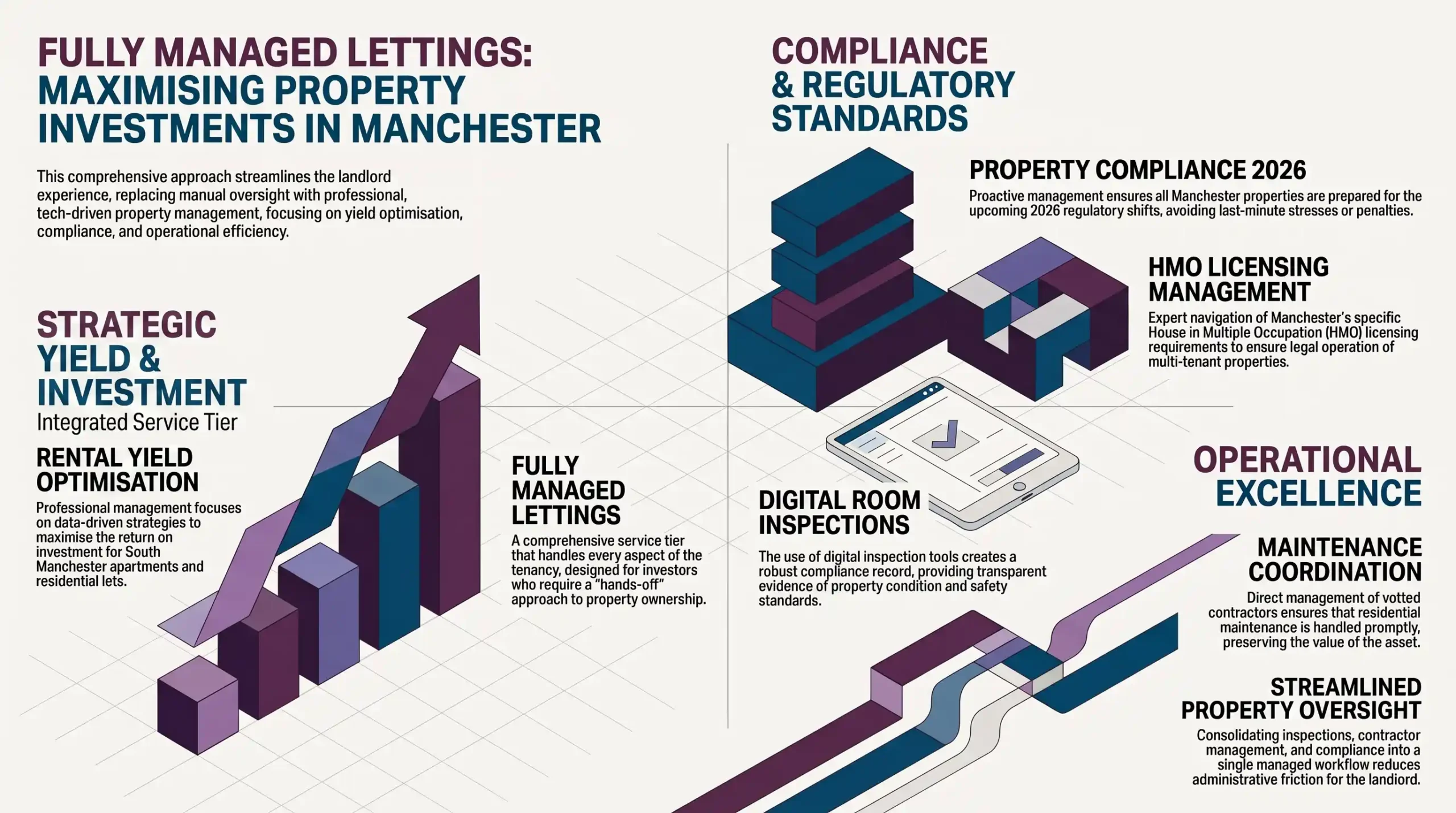
Core Components of Fully Managed Lettings
Comprehensive Tenant Sourcing and Vetting
Professional tenant sourcing establishes the baseline for a secure and profitable tenancy. Managing agents conduct rigorous identity checks, income verification, employment referencing, and credit scoring to evaluate tenant suitability. Assessing rent-to-income ratios before contract execution ensures long-term affordability and minimises default risks. It also establishes clear contractual expectations before handing over property keys.
Beyond standard credit checks, professional vetting includes mandatory Right to Rent verification to ensure compliance with Home Office regulations. Detailed reference checks consult previous landlords regarding payment history and property care. In high-demand zones such as Ancoats and Salford Quays, thorough screening filters applications efficiently. This secures high-calibre corporate and graduate tenants while mitigating financial exposure.
Continuous Rent Collection and Financial Oversight
Systematic rent collection ensures consistent cash flow whilst maintaining precise accounting records for portfolio owners. Fully managed lettings utilise automated payment tracking systems that flag late payments within twenty-four hours. Rapid notification enables property managers to contact tenants immediately. Agents then establish structured payment plans before minor delays escalate into substantial rental arrears.
Financial management extends to handling security deposits in accordance with statutory requirements. Agents register tenant deposits within government-approved schemes within the mandatory thirty-day window and serve Prescribed Information to prevent financial penalties. Landlords receive detailed monthly financial statements showing gross receipts, itemised maintenance deductions, and net payouts. This simplifies record-keeping for personal accounting and tax filing.
Legal Frameworks and Tenancy Reforms
Abolition of Section 21 and Periodic Tenancies
The Renters’ Rights Act 2026 fundamentally restructures residential tenancy agreements by eliminating Section 21 no-fault evictions. All fixed-term Assured Shorthold Tenancies convert into Assured Periodic Tenancies, allowing tenants to terminate contracts with two months’ notice. Landlords must rely on statutory Section 8 grounds, requiring robust legal documentation and verified evidence.
To regain possession under the revised Section 8 framework, landlords must meet specific mandatory grounds. These include selling the property (Ground 1A) or moving family members in (Ground 1). Notice periods for rent arrears under Ground 8 increase to four weeks, requiring a minimum arrear threshold of three months. Managing agents ensure tenancy files retain precise communications, inspection reports, and payment logs. This documentation proves necessary to succeed in tribunal or court proceedings.
Mandatory Notifications and Bidding Regulations
Statutory compliance requires landlords to issue official government information sheets to all existing tenants by specified deadlines. Furthermore, new legislation prohibits rental bidding wars, requiring properties to be advertised at fixed prices. Accepting offers above the advertised rate triggers severe civil penalties, making professional guidance vital for establishing compliant rental values.
Failure to deliver mandatory information sheets by May 2026 can result in local authority fines reaching £7,000 per breach. Managed letting services integrate automated compliance distribution into their administrative workflows, confirming digital delivery and maintaining proof of service. Agents also enforce transparent marketing pricing across portal listings, safeguarding property owners from inadvertent breaches during competitive letting cycles.
Did You Know?
The Renters’ Rights Act requires landlords to provide existing tenants with the official Government Information Sheet by 31 May 2026. Failure to do so can result in local council civil penalties of up to £7,000 per property.
Local Licensing and Article 4 Regulations
Article 4 Directions and Planning Permissions
Manchester City Council enforces a city-wide Article 4 Direction. This removes permitted development rights for converting family dwellings into multi-occupancy homes. Landlords must obtain full planning permission to establish houses in multiple occupation, even for three residents. Applications in student-dense corridors face strict concentration checks under local Policy H11 planning controls.
Losing or failing to establish a Certificate of Lawful Use for established HMOs can diminish property capital values. Values can fall by twenty to thirty percent. Fully managed lettings include comprehensive planning audits to preserve grandfathered use rights in areas like Fallowfield and Withington. Managing agents maintain historical tenancy records, utility bills, and council tax records, defending lawful C4 status against local authority challenges.
Mandatory, Additional, and Selective Licensing
Operating rental properties in Manchester requires navigating three distinct licensing tiers based on property size, location, and occupancy profile. Mandatory HMO licensing applies city-wide for five or more occupants. Selective licensing separately enforces mandatory registration for all private lets in designated improvement zones like Moss Side and Levenshulme.
Licensing standards dictate strict physical requirements. These include FD30 fire doors, Grade D interlinked smoke alarm systems, and precise minimum bedroom sizes. Operating without a valid licence exposes landlords to civil penalties up to £30,000 or Rent Repayment Orders. Specialist landlord property management services handle the complete application process, schedule council inspections, and implement required safety upgrades.
The Railton-Meeks Compliance Audit Tool
Check Your Compliance & Protect Your Portfolio
Maintenance Management and Structural Care
In-House Triage and Preventative Repairs
Efficient maintenance coordination relies on initial issue triage to eliminate unnecessary contractor call-out fees for simple tenant queries. When repairs are required, managing agents dispatch trusted, qualified tradespeople to conduct cost-effective remedies. Planned preventative maintenance schedules identify structural vulnerabilities early, preventing minor roof or plumbing defects from becoming costly emergency repairs.
Utilising preferred contractor networks secures competitive pricing on mandatory safety certifications. These include annual Gas Safety CP12 inspections, Electrical Installation Condition Reports, and Energy Performance Certificates. Managed services coordinate property access directly with occupants, eliminating administrative delays. Centralised repair logs keep landlords informed of expenditure, protecting operational margins while keeping properties in full working order.
Damp, Mould, and Awaab’s Law Compliance
Awaab’s Law now extends to the private rented sector, creating strict statutory timeframes. These cover investigating and repairing damp and mould hazards. Emergency hazards require action within twenty-four hours, whilst damp investigations must commence within fourteen days. Managing agents conduct proactive moisture assessments during routine inspections to identify ventilation issues promptly.
Preventing structural damp involves auditing mechanical ventilation, installing humidistat-controlled extractor fans, and educating tenants on property heating practices. Routine six-monthly property inspections generate high-definition digital reports with photographic evidence, proving proactive maintenance oversight. Detailed documentation shields landlords from tenant claims. It also helps ensure rental homes remain free from Category 1 health hazards under the Decent Homes Standard.
Railton-Meeks offers four landlord service tiers across Manchester and Cheshire
Financial Management and Tax Compliance
Making Tax Digital Software Integration
Her Majesty’s Revenue and Customs requires landlords earning over £50,000 in gross rental income to submit digital quarterly returns. This requirement starts in April 2026. Fully managed lettings provide digitised accounting infrastructure that exports itemised income and expenditure data directly into Making Tax Digital compliant software. This ensures accurate tax reporting without administrative overhead.
Digital financial tracking records every income transaction, contractor invoice, and management fee in real time. Landlords access dedicated online portals to review year-to-date statements, simplifying year-end self-assessment calculations. Streamlined accounting minimises professional book-keeping expenses and reduces accounting errors. This gives portfolio investors clear visibility over their net returns and tax liabilities.
Deposit Protection and Inventory Standards
Protecting landlord financial interests during tenancy endings requires comprehensive evidence collected prior to tenant move-in. Fully managed lettings utilise high-definition photographic and video inventory reports that detail property conditions down to minor surface marks. Precise initial documentation forms the legal basis for defending deposit deductions against fair wear and tear claims.
In a periodic tenancy regime without Section 21 evictions, clear evidence becomes essential. It supports resolving dispute adjudications under government-approved deposit schemes. Agents handle deposit registration, serve statutory Prescribed Information within thirty days, and manage end-of-tenancy check-out inspections. Professional negotiation resolves deposit allocation fairly, ensuring funds are recovered promptly for damage or unapproved alterations.
Instant Rental & Block Valuation
Get Your Valuation & Know Your Market Value
Energy Efficiency Standards and Retrofitting
The 2030 EPC Grade C Target
Government energy efficiency mandates require private rented homes across England and Wales to achieve an Energy Performance Certificate rating of C or higher. This target applies from October 2030. Managed lettings guide landlords through energy assessments, identifying cost-effective insulation, heating, and glazing upgrades that raise ratings. These upgrades must stay within the £10,000 government investment cap.
Securing an EPC C rating before October 2029 unlocks legacy compliance protection. This preserves certificate validity for up to ten years under transition rules. Agents conduct energy portfolio audits across traditional Victorian terraced housing stock in Chorlton and Didsbury. Identifying priority retrofitting works early prevents sudden capital outflows. It also enhances tenant comfort and lowers space heating requirements.
Grant Funding and Environmental Upgrades
Transitioning rental stock to modern environmental standards requires leveraging available government grant schemes to offset capital expenditure. Landlords can utilise funding mechanisms such as the Great British Insulation Scheme and Boiler Upgrade Grants. Managing agents identify eligible properties, coordinate grant applications, and oversee contractor installations without disrupting active tenancies.
Upgrading heating systems to heat pumps or installing loft and cavity wall insulation improves property desirability. This attracts eco-conscious renters and commands premium rental rates. Furthermore, higher energy efficiency ratings reduce tenant utility expenses. This boosts tenant retention and stabilises long-term rental income across competitive Greater Manchester letting districts.
Postcode Performance and Yield Strategies
High-Yield Suburban and Student Markets
Maximising rental returns in Greater Manchester relies on tailoring property management strategies to micro-market yields and tenant demographics. High-intensity student and healthcare zones in M14 and M13 deliver gross yields reaching eight to eleven percent. Fully managed lettings maintain high occupancy in multi-occupancy assets through specialised student cycle letting and prompt renewal management.
Managing student HMOs requires specialised knowledge of academic booking cycles. These cycles begin as early as November for the following September intake. Agents handle rapid turnover, joint tenancy agreements, and guarantor verifications. High-yield cash flow from properties in Fallowfield and Rusholme offsets higher operational wear. This holds true provided property managers enforce active maintenance schedules and strict licensing compliance.
Capital Preservation in Suburban Enclaves
Suburban enclaves such as Didsbury, Chorlton, and Hale present capital preservation opportunities with lower tenant turnover and lower yield volatility. High-earning professional families and corporate tenants in M20 and WA15 prioritise high-specification finishes, local school catchments, and reliable property maintenance. This generates stable long-term yields between four and six percent.
In prime suburban districts, managing agents focus on tenant retention, premium presentation, and preventative maintenance to protect capital values. Minimising void periods between tenancies ensures net returns remain robust even in lower-gross-yield postcodes. Professional management protects period architectural features, implements high-end fixture updates, and ensures total compliance with evolving tenancy regulations.
HMO Specialist Yield & Tax Calculator
Calculate Your Yield & Offset New Tax Burdens
Final Thoughts
Navigating statutory obligations, local licensing rules, and ongoing maintenance requires structured operational oversight. Engaging dedicated landlord services in Manchester protects rental income and reduces administrative burdens. This keeps property portfolios fully compliant with evolving legislative frameworks.
As tenancy legislation becomes increasingly technical, a proactive management model matters more than ever. It helps ensure property investments remain secure, profitable, and resilient against market changes.
Frequently Asked Questions
A:
A fully managed lettings package handles all operational, administrative, and legal aspects of property management. This includes tenant sourcing, comprehensive credit and Right to Rent checks, tenancy creation, and deposit protection. Managing agents also coordinate routine rent collection, arrears management, periodic property inspections, and day-to-day maintenance repairs using qualified contractors. Additionally, agents manage statutory compliance obligations, including safety certificates, HMO licensing, and legal notice service under the Renters' Rights Act 2026. This shields landlords from legal liability and operational stress.
A:
Manchester City Council operates strict licensing frameworks. These include mandatory HMO licensing for properties housing five or more occupants and selective licensing in designated improvement zones. Furthermore, a city-wide Article 4 Direction restricts converting family homes into HMOs without full planning permission. Operating an unlicensed rental property or breaching planning conditions can result in civil penalties of up to £30,000. Rent Repayment Orders may also apply. Managed service providers conduct compliance audits to ensure properties hold valid licences and meet mandatory fire, amenity, and safety standards.
A:
The Renters' Rights Act 2026 abolishes Section 21 no-fault evictions. It also converts fixed-term Assured Shorthold Tenancies into Assured Periodic Tenancies. Landlords seeking possession must prove specific statutory grounds under Section 8. These grounds include selling the property, reoccupying for personal use, or rent arrears. The mandatory rent arrears threshold under Ground 8 increases to three months, with notice periods extended to four weeks. Managing agents maintain detailed inspection logs, communications, and rent accounting to ensure possession applications stand up in court.
A:
Awaab's Law mandates strict statutory deadlines for resolving damp, mould, and emergency hazards in private rental properties. Emergency hazards, such as total heating failure during winter or dangerous electrical faults, must be addressed within twenty-four hours. Significant hazards like damp and mould require investigation within fourteen days. A written report to tenants must follow within three days. Fully managed lettings provide twenty-four-seven maintenance triage and rapid contractor deployment. This ensures compliance with these statutory timeframes and prevents property decay.
A:
From April 2026, Her Majesty's Revenue and Customs requires landlords earning over £50,000 in gross rental income to keep digital financial records. Landlords must also submit quarterly updates using compatible software. Managing agents provide structured accounting systems that automatically log rental income, management fees, and itemised maintenance expenses. This digital infrastructure integrates directly into Making Tax Digital compliant accounting tools. It helps landlords maintain accurate records, reduce end-of-year accounting overhead, and avoid statutory non-compliance penalties.
About The Author
Tara Meeks MARLA - Managing Director & Founder, Railton-Meeks Property Management
HMO licensing · Compliance strategy · Renters’ Rights Act 2026 · Building Safety Act 2022 · Property acquisition · Refurbishment & development · Block management · South Manchester investment.
Tara Meeks is the founder and Managing Director of Railton-Meeks Property Management Limited, a Didsbury-based agency she established in 2006 to manage her own residential investment portfolio. With over 20 years’ experience as a landlord, developer, and ARLA-qualified letting professional, Tara leads the agency’s “Compliance & Yield Guardian” strategy across South Manchester and Cheshire.
Tara’s career in property began in the mid-1990s, long before she formalised the agency that bears her name. Having personally navigated the practical realities of buy-to-let acquisition, HMO conversion, refurbishment, tenant vetting, and full-cycle property development, she founded Railton-Meeks as a vehicle to bring that landlord-side perspective to other Manchester investors. The agency has grown organically through referral, with a significant portion of original 2006 clients still on the books today.
As a Member of ARLA Propertymark (MARLA), Tara holds the industry’s recognised qualification for residential lettings and property management, and the agency operates under Propertymark’s Client Money Protection scheme. Her professional focus in 2026 is the Renters’ Rights Act transition — particularly the May 2026 periodic-tenancy switch and the abolition of Section 21 — and the operational shift this demands from landlords accustomed to the old AST framework.
Tara is responsible for client onboarding, portfolio strategy, HMO licensing applications under Manchester City Council’s Article 4 directions, and the agency’s relationships with Resident Management Companies and Freeholders requiring Building Safety Act 2022 compliance. She is also active in property acquisition advisory, having helped numerous landlords source, refurbish, and stabilise income-producing assets across the M14, M19, M20, and M21 postcodes.
She remains, above all, a working landlord. The vision she set out at founding — “to keep Railton-Meeks as a small family business, ensuring personal attention and exceeding clients’ expectations” — is the operating principle of the agency twenty years on.
Credentials
- ARLA Propertymark Member (MARLA)
- Director, Railton-Meeks Property Management Limited (Companies House 08242540)
- 20+ years’ active landlord experience
- HMO, Article 4, and Sui Generis licensing specialist
- Property acquisition and refurbishment advisor
