

UK Rental Property Management for Overseas Landlords
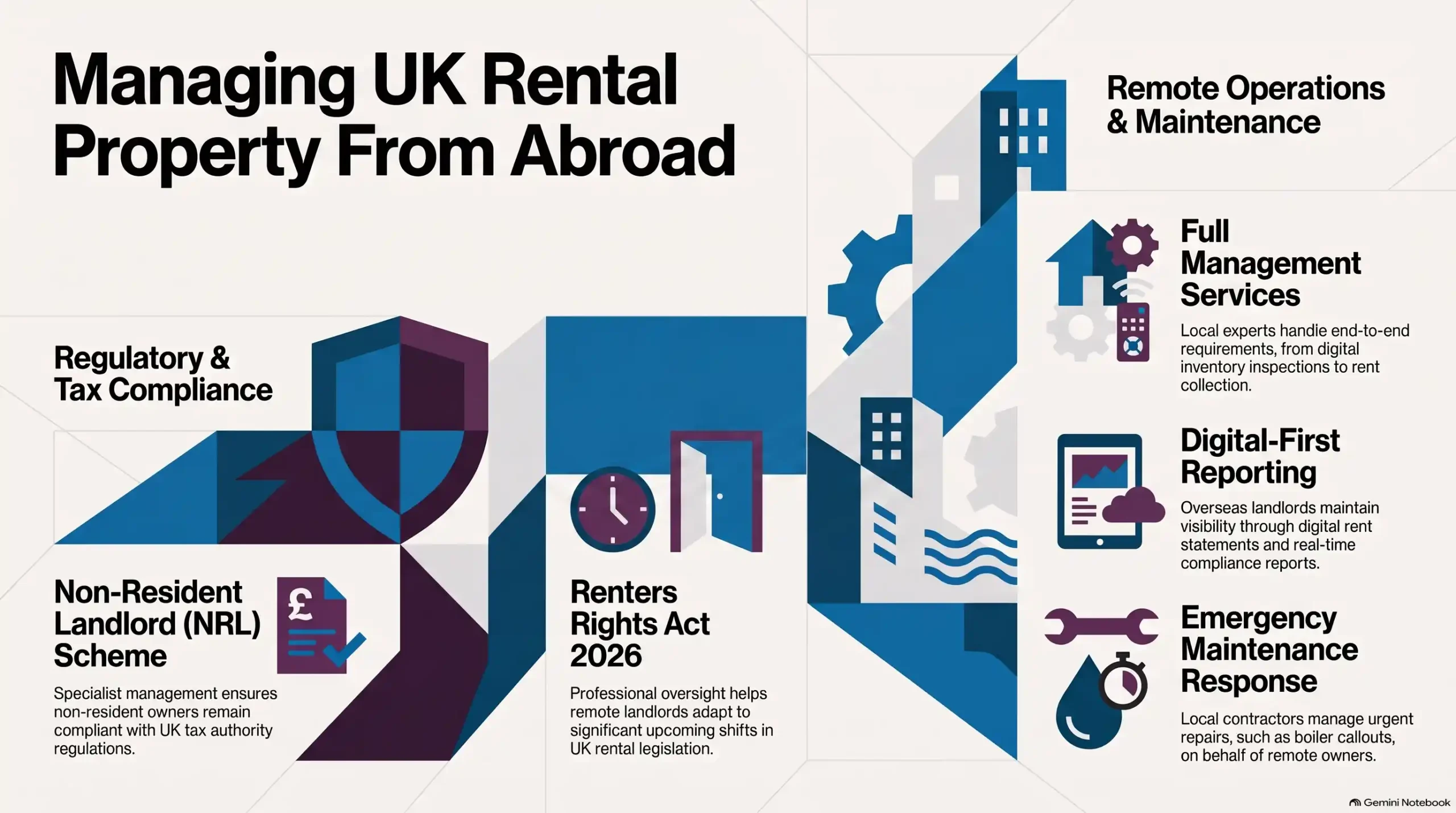
Owning UK property from abroad delivers capital growth and steady rental returns. Remote oversight, however, brings distinct legal and operational risks. Professional property management for overseas landlords keeps statutory compliance, maintenance and tenant communication running without delay. The Renters’ Rights Act took effect on 1 May 2026. International owners now need rigorous local representation to avoid civil penalties.
Inspections, emergency repairs and statutory notices span several time zones. Delays follow, and non-compliance often follows with them. Overseas investors need firm systems for rent collection, Non-Resident Landlord Scheme tax, and possession procedure. So how can an international owner stay compliant, protect yield and run daily tenancy operations from thousands of miles away?
Key Takeaways
- A local managing agent responds to tenant emergencies at once, meeting the 24-hour repair mandate under UK housing standards.
- Overseas landlords must register with HMRC under the Non-Resident Landlord Scheme to receive gross rent without automatic tax deductions.
- The Renters’ Rights Act abolishes Section 21 evictions, so documented evidence now decides possession claims brought under Section 8.
- Digital rent statements help non-resident owners meet Making Tax Digital duties from April 2026 on gross income above £50,000.
- Full management services shield international investors from enforcement penalties whilst holding rental yield steady across a remote UK portfolio.
Remote Self-Management Compared With Full Management
Managing a UK rental property from abroad creates obligations that a local landlord rarely faces. Non-resident owners deal with tighter repair deadlines, layered licensing rules and strict HMRC withholding. A dedicated UK representative absorbs that administrative load. In practice, we find the gap between the two models shows up fastest during an out-of-hours emergency.
The table below sets direct remote oversight against a full management service. It covers emergency repair response, tax administration, service of legal notices, inspection evidence and certificate tracking. Overseas owners should weigh each row against their own tolerance for risk. Distance rarely forgives a missed statutory deadline.
| Operational Area | Remote Self-Management | Full Management Service |
|---|---|---|
| Emergency Repairs | Delay across time zones; contractor sourcing difficulty | Local 24/7 triage and in-house trade dispatch |
| NRLS Tax Handling | Tenant must withhold 20% tax unless approval granted | Agent collects gross rent under HMRC approval status |
| Possession Notices | High risk of invalid service across borders | Professional service compliant with Section 8 rules |
| Inspection Audits | Requires travel or unverified third-party checks | Scheduled digital photographic and video inventories |
| Compliance Filings | Landlord tracks CP12, EICR, EPC and licences manually | Automated tracking and renewal of statutory safety records |
Legal Obligations Under the Renters’ Rights Act
Abolition of Section 21 No-Fault Evictions
The Renters’ Rights Act abolished Section 21 no-fault evictions on 1 May 2026. Landlords must now prove a specific statutory ground to regain possession. Overseas owners therefore need rigorous record-keeping to support a Section 8 claim. Paper notices posted from abroad no longer carry the reliability courts expect.
Before May 2026, Section 21 let landlords recover a property without stating grounds. Claims now rest on grounds such as Ground 1 for personal occupation or Ground 1A for sale. Notice periods for both run to four months. Ground 8 rent arrears claims require three months of debt rather than two, with notice doubled to four weeks. Local representation keeps notices and court papers procedurally sound.
Shift to Assured Periodic Tenancies
Fixed-term Assured Shorthold Tenancies converted automatically into Assured Periodic Tenancies on 1 May 2026. Each agreement now rolls month to month from inception. Tenants may leave at any point by serving two months’ notice. Local agents update tenancy paperwork and absorb sudden tenant turnover on behalf of non-resident owners.
Existing contracts did not require manual redrafting, since conversion happened by statute. Contractual break clauses became void immediately. Landlords also had to issue a government information sheet to every existing tenant by 31 May 2026. Failure to serve required statutory notices triggers civil penalties of up to £7,000. Managing agents distribute these notices digitally and log delivery.
Financial and Taxation Rules for Non-Resident Owners
HMRC Non-Resident Landlord Scheme Registration
The Non-Resident Landlord Scheme obliges UK letting agents or tenants to deduct basic rate tax before paying an overseas owner. Landlords approved by HMRC receive gross rental payments instead. Managing agents handle the quarterly returns and annual certificates, which keeps taxation administration predictable for international portfolio holders.
Without HMRC approval under form NRL1, the agent must withhold 20% tax on net rental earnings. That deduction applies after allowable maintenance expenses. Once HMRC approves an application, the agent pays gross rent with no deduction at source. The landlord still files an annual Self Assessent return to settle the personal liability correctly.
Making Tax Digital Compliance for Overseas Investors
Making Tax Digital for Income Tax became mandatory on 6 April 2026. It applies to landlords with gross annual property income above £50,000. Non-resident owners must file quarterly digital updates through approved software. Professional managers supply entegrated financial statements, which simplifies reporting from any overseas location.
Digital record-keeping means income and expenditure sit in electronic form rather than an annual paper spreadsheet. Managing agents log every invoice, callout and fee as it occurs. Monthly statement data feeds straight into tax software, which cuts accounting overheads for overseas clients. The method also reduces transposition errors ahead of HMRC deadlines.
Did You Know?
Under the Renters’ Rights Act, rental bidding above the advertised price is banned. A landlord or letting agent who invites or accepts a higher bid faces a civil penalty of up to £7,000 per breach. Local housing authorities enforce it.
Property Maintenance and Emergency Repair Protocols
Triage Systems and In-House Contractor Networks
Remote maintenance oversight across time zones drives up unnecessary callout charges and slows repairs. Property managers use video triage to resolve minor faults by phone before any contractor travels. Access to a vetted in-house trade network then delivers fast, cost-controlled repair work for owners based overseas.
Triage removes routine callouts such as tripped circuit breakers or low boiler pressure. Where physical work is needed, an established local network secures competitive rates across gas, electrical and plumbing trades. Planned preventative programmes flag ageing infrastructure early. Catching a failing boiler or roof leak in advance avoids emergency surcharges.
Awaab’s Law Hazards and Emergency Repair Deadlines
Awaab’s Law sets binding timescales for damp, mould and emergency hazards in private rented homes. Managing agents must begin emergency repairs within 24 hours and investigate structural hazards within 14 days. Local representation delivers that response promptly, which limits legal liability and council enforcement action against the owner.
Under the extended Decent Homes Standard, total heating failure or a severe electrical fault demands intervention within 24 hours. After a damp report, written investigation findings must reach the tenant within three days of inspection. Local managers fit humidistat extractor fans and run ventilation audits. That work protects the building fabric and satisfies environmental health standards.
The Railton-Meeks Compliance Audit Tool
Check Your Compliance & Protect Your Portfolio
Statutory Safety Certifications and Property Inspections
Automated Renewal of Core Safety Certificates
UK letting legislation requires current certification for gas safety, electrical installations and energy performance in every residential rental. Overseas landlords carry real legal exposure once a certificate lapses unnoticed. Managing agents run automated tracking systems, coordinate contractor access, and keep each property continuously compliant without owner involvement.
Gas Safety Certificates (CP12) renew annually, whilst Electrical Installation Condition Reports (EICR) run on a five-year cycle. Energy Performance Certificates stay valid for ten years but need monitoring ahead of legislative change. Managing agents store digital copies centrally. Agents issue certificates to tenants before the tenancy starts, which prevents later invalidation of possession notices.
Routine Physical Inspections and Digital Audits
Regular inspections supply hard evidence on property condition and tenant compliance with the tenancy terms. Local agents run scheduled bi-annual visits using high-definition video and photographic reporting software. Detailed digital reports give overseas owners full visibility of asset condition with no need for international travel.
High-definition inventories separate fair wear and tear from tenant-caused damage. With no-fault eviction gone, meticulous condition logs now serve as primary evidence in deposit disputes and damage claims. Inspections also catch early structural movement, minor plumbing leaks or unauthorised occupiers. Spotting these early protects capital value over a long hold.
Railton-Meeks offers four landlord service tiers across Manchester and Cheshire
Tenant Vetting and Rent Guarantee Mechanisms
Comprehensive Tenant Referencing and Right to Rent
Thorough referencing remains the foundation of risk control for any overseas investor seeking stable rental income. Managing agents complete statutory Right to Rent checks alongside detailed financial verification. Rigorous income-to-rent affordability testing shields non-resident landlords from default risk and the cost of possession proceedings.
Right to Rent verification requires original identity documents checked in person or through approved digital identity technology. Professional referencing assesses employment stability, credit history and previous landlord references. Clear affordability thresholds keep rent below 35% of gross income. That discipline supports long-term tenancy sustainability and steadier yield.
Zero-Tolerance Rent Arrears Management
Mandatory eviction grounds for rent arrears now require three full months of unpaid rent. Automated tracking flags a missed payment within 24 hours and triggers immediate contact protocols. Rapid intervention stops a minor payment delay from escalating into a serious loss for a landlord based overseas.
Notice periods under Ground 8 doubled from two weeks to four under the 2026 rules. Automated SMS and email reminders prompt swift resolution before arrears breach the statutory threshold. Full management services often bundle legal expenses insurance and rent guarantee cover. Those protections keep monthly income flowing throughout a lengthy Section 8 possession process.
Instant Rental & Block Valuation
Get Your Valuation & Know Your Market Value
Houses in Multiple Occupation and Local Licensing
Planning Barriers and Article 4 Directions
Conversion of a standard family home into a House in Multiple Occupation runs into complex local planning restrictions. Many UK cities operate city-wide Article 4 Directions that strip permitted development rights for multi-occupancy conversion. Managing agents run local planning audits to protect existing lawful use certificates for overseas investors.
In an Article 4 area, moving a dwelling from C3 to C4 use requires full planning permission. Councils often refuse applications in high-density HMO zones to manage concentration. Loss of lawful use status can cut market value by up to 30%. Managing agents audit historical tenancy records closely to preserve planning rights and asset value.
Licensing Tiers and Safety Standards
Shared rental property requires compliance with Mandatory, Additional or Selective licensing schemes enforced by the local council. Mandatory HMO licensing applies nationally where five or more unrelated tenants share a property. Local agents manage the licence application and any required safety upgrades, preventing civil penalties that reach £30,000.
HMO amenity standards set minimum bedroom sizes. A single adult requires 6.51 square metres and a double occupancy room requires 10.22 square metres. Fire safety demands Grade D interlinked smoke detection and FD30 fire doors with self-closers. Managing agents oversee Fire Risk Assessments and council inspections. That groundwork secures multi-year licences for remote owners.
Energy Efficiency and Retrofitting Requirements
Warm Homes Plan and the 2030 EPC Target
The UK Warm Homes Plan requires every private rented property to reach EPC C or higher. The deadline is 1 October 2030. A single target replaces the earlier phased deadlines and covers existing as well as new tenancies. Managing agents build structured retrofit roadmaps to keep overseas portfolios compliant.
A property reaching EPC C before October 2029 secures legacy compliance until the certificate expires. That ten-year protection shields owners from mid-term changes to the standard. Professional managers identify cost-effective upgrades early, such as loft insulation and LED lighting. Timely work prevents sudden capital outlay or an unlettable void as 2030 approaches.
Dual-Metric Standards and Minimum Cost Caps
Updated EPC assessment rules apply a dual-metric framework. It measures building fabric performance alongside heating system efficiency or smart readiness. Government policy caps mandatory landlord energy improvement spend at £10,000 per property. Managing agents pursue available grant funding to minimise out-of-pocket cost for international property owners.
The £10,000 cap covers all qualifying energy works undertaken from late 2025 onward. Where the target remains unmet after the cap is reached, the landlord may register a ten-year exemption. Managing agents use schemes such as the Great British Insulation Scheme to subsidise insulation work. Net yield holds up whilst the required upgrades complete.
HMO Specialist Yield & Tax Calculator
Calculate Your Yield & Offset New Tax Burdens
Final Thoughts
Remote ownership of a UK asset demands constant adaptation to shifting law, tax duty and tenant care standards. A specialist providing property management for overseas landlords covers every statutory requirement, from emergency maintenance through to NRLS reporting. Expert local oversight turns an administrative burden into a reliable, high-performing holding.
The Renters’ Rights Act and Making Tax Digital are both now in force. Structured operational support is no longer optional for non-resident investors. Professional management protects capital growth, removes void risk and holds compliance steady across every asset. Reviewing operational arrangements now secures long-term income stability.
Frequently Asked Questions
A:
UK law does not strictly require an overseas landlord to appoint a managing agent. Operating remotely, though, creates real legal and operational exposure. A landlord living abroad must provide a UK address for service of notices. That duty sits in Section 48 of the Landlord and Tenant Act 1987. Without a local contact, meeting 24-hour emergency repair mandates or completing Right to Rent checks becomes near impossible. A professional agent fulfills those duties and shields the owner from penalties.
A:
Under the Non-Resident Landlord Scheme, HMRC requires letting agents or tenants to withhold 20% basic rate tax. The deduction happens before funds go abroad. An overseas landlord can apply on form NRL1 to receive gross rental income instead. Once approved, the landlord reports earnings annually through Self Assessment and deducts allowable expenses to calculate the net liability. Managing agents run the NRLS administration and supply accurate annual statements for international filing.
A:
The Act abolished Section 21 no-fault evictions on 1 May 2026. Landlords must now prove a specific statutory ground under Section 8 to regain possession. Tenancies converted automatically to month-to-month assured periodic terms, which ended fixed-term agreements. Landlords also had to issue government information sheets by 31 May 2026 or face fines of up to £7,000. Rental bidding wars are banned. Local agents serve notices correctly and keep the tenancy evidence courts require.
A:
Professional managing agents run 24/7 emergency response protocols and video triage to address urgent faults at once. Under Awaab's Law, hazards such as boiler failure or a severe leak require intervention within 24 hours. Local managers dispatch vetted contractors without waiting for approval from a different time zone. Pre-agreed expenditure limits let agents resolve critical issues quickly. The owner receives a digital record of the work and its cost.
A:
Under the UK Warm Homes Plan, every private rented property must reach EPC C or higher by 1 October 2030. The target covers existing and new tenancies alike. Landlord contributions towards energy improvements are capped at £10,000 per property, including VAT. A property reaching EPC C before October 2029 gains legacy compliance until the certificate expires. Managing agents coordinate assessments, access insulation grants and plan retrofit works to hold compliance steady.
