

Professional Property Management for First Time Landlords
Buy-to-let ownership still rewards patience, but the statutory burden has grown sharply. Professional property management gives new investors a structured framework for compliance, rent protection and repair coordination. It also removes the administrative load that catches most owners out during the first year. Early oversight stops small paperwork errors turning into enforceable civil penalties.
Legal duties, tenant communication, maintenance and quarterly tax reporting rarely fit around a full-time job. A missed safety check or an unprotected deposit carries real financial consequences. So which level of delegation actually protects your rental income and your legal position?
Key Takeaways
- Professional property management gives first time landlords structured support across referencing, statutory compliance, repair coordination and quarterly financial reporting duties.
- The Renters’ Rights Act 2026 replaces fixed-term tenancies with assured periodic terms and raises the arrears eviction threshold to three months.
- Annual gas checks, five-yearly electrical reports and a valid energy certificate remain non-negotiable statutory duties before any property is let.
- Landlords in Manchester running HMOs face city-wide Article 4 planning controls alongside mandatory, additional or selective licensing requirements.
- Making Tax Digital requires landlords earning above fifty thousand pounds to file quarterly rental income updates from April 2026.
Letting Service Tiers and Where Responsibility Sits
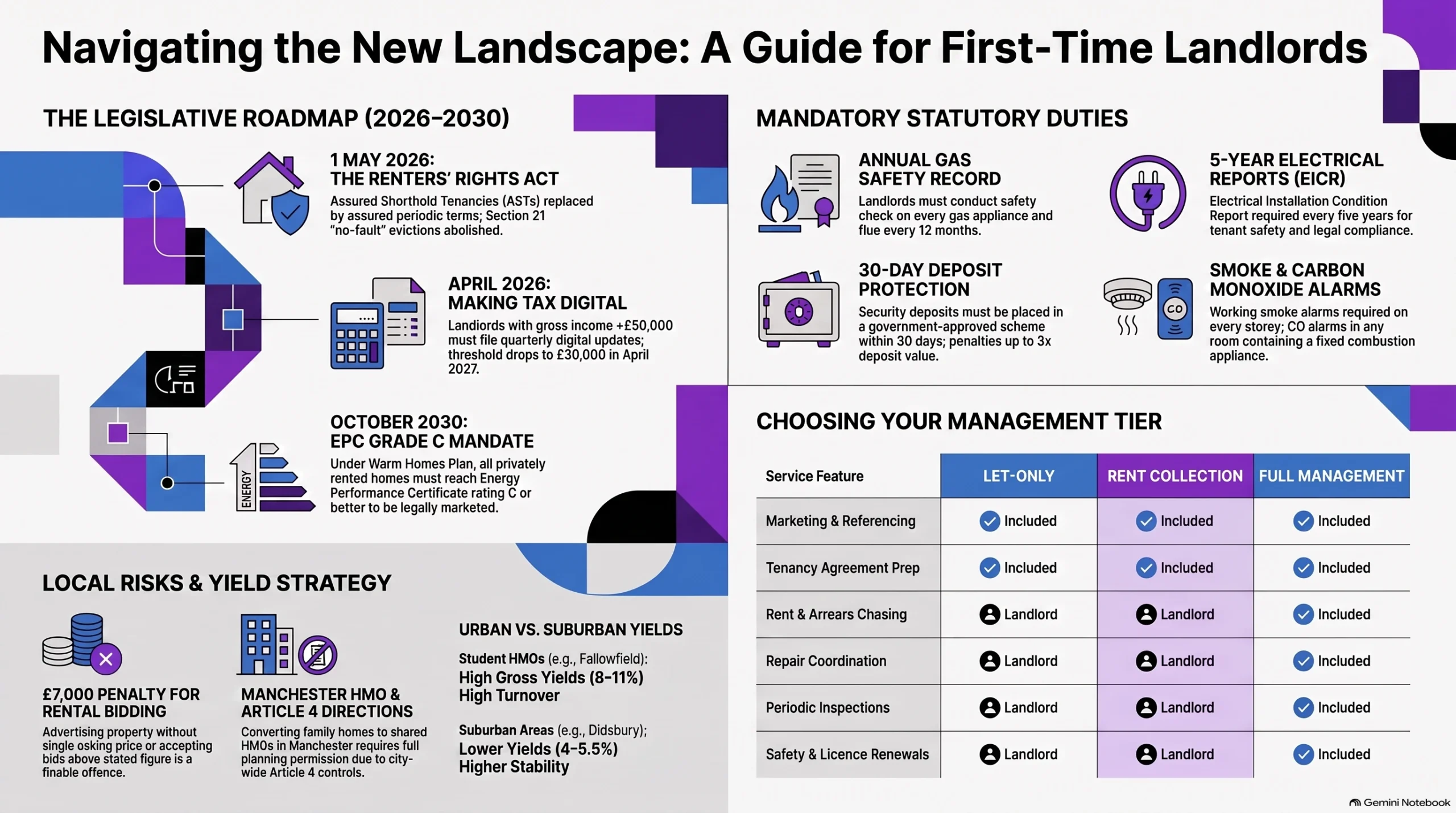
Service level determines how much statutory and operational risk stays with the owner. First time landlords should decide early whether to handle tenant contact, repairs and compliance renewals directly. That decision shapes the workload for the entire tenancy. The table below sets out how duties divide across the three standard agency tiers.
Delegation moves administrative duties to practitioners who track legislative change as a matter of routine. Fee structures deserve assessment against the coverage actually provided, not the headline percentage. In practice, we find that owners underestimate the time absorbed by compliance renewals and out-of-hours repair calls.
| Service Feature | Let-Only | Rent Collection | Full Management |
|---|---|---|---|
| Marketing, viewings and referencing | Included | Included | Included |
| Tenancy agreement preparation | Included | Included | Included |
| Rent collection and arrears chasing | Landlord | Included | Included |
| Repair coordination and out-of-hours calls | Landlord | Landlord | Included |
| Periodic property inspections | Landlord | Landlord | Included |
| Safety certificate and licence renewals | Landlord | Landlord | Included |
Legislative Compliance Under the Renters’ Rights Act 2026
Assured Periodic Tenancies Replace Fixed Terms
The Renters’ Rights Act 2026 converts every assured shorthold tenancy into an assured periodic term from 1 May 2026. Section 21 no-fault possession ends on the same date. Landlords must instead prove a statutory Section 8 ground. Tenants may leave at any point on two months notice.
Ground 1 covers a landlord moving back in. Ground 1A covers a sale. Both demand four months notice and rule out use during the first twelve months of a tenancy. Ground 8 rent arrears rise from two months to three. In practice, we find that accurate tenancy records decide whether a possession claim succeeds.
Statutory Documents Landlords Must Serve
Every existing tenant must receive the official government information sheet by 31 May 2026. New agreements starting after 1 May 2026 require a written statement of terms before the tenancy begins. Missing either deadline exposes the landlord to a civil penalty. Local authorities enforce these duties directly.
Rental adverts must now state a single asking figure. Bidding above that figure is banned outright. Accepting a higher offer triggers a civil penalty of up to seven thousand pounds. Professional property management keeps these disclosures on a fixed schedule, so nothing arrives late or drops out of the file.
Tenant Vetting and Deposit Protection
Referencing and Right to Rent Checks
Tenant vetting decides most of the risk in a letting. Referencing covers income verification, affordability testing, credit history and previous landlord conduct. A statutory Right to Rent check confirms the applicant may legally reside in the United Kingdom. Original documents or a Home Office share code satisfy that duty.
Rent-to-income ratios show whether a tenant can absorb the payment alongside living costs. We keep copies of every identity check on file for the length of the tenancy. That record forms the only defence against a Home Office civil penalty. Automated referencing flags employment gaps and adverse credit before an offer proceeds.
Deposit Schemes and Inventory Evidence
A security deposit must sit in a government-approved scheme within thirty days of receipt. Prescribed information goes to the tenant in the same window. Without Section 21, the check-out inventory becomes the primary evidence in any dispute. Photographic and video records should carry a date and cover every room.
Late protection blocks possession and can cost up to three times the deposit. A condition report taken before move-in fixes the state of fixtures, fittings and decoration. Adjudicators compare that report against the check-out findings. Clear evidence turns a damage claim into an award.
Did You Know?
Under the Housing Act 2004, a tenancy deposit must sit in an approved scheme within thirty days of receipt. The prescribed information carries the same deadline. A court can order the landlord to repay between one and three times the deposit value where either duty fails.
Maintenance Coordination and Safety Certification
Gas, Electrical and Energy Certificates
Safety certification is a statutory duty, not a matter of good practice. A Gas Safety Record covers every gas appliance and flue on an annual cycle. An Electrical Installation Condition Report runs on a five-year cycle. A valid Energy Performance Certificate must exist before the property reaches the market.
Copies must reach the tenant before move-in. Renewal dates slip easily across a growing portfolio. We track them on a single compliance calendar with automated reminders. Smoke alarms belong on every storey, and a carbon monoxide alarm in any room holding a fixed combustion appliance.
Damp, Mould and Decent Homes Duties
Awaab’s Law extends fixed repair timescales into the private rented sector. Emergency hazards require work to start within twenty-four hours. Significant damp or mould demands a formal investigation within fourteen days. The Decent Homes Standard separately requires the property to stay free of Category 1 hazards.
Six-monthly inspections catch ventilation faults before they become disrepair claims. Humidistat extractor fans in kitchens and bathrooms control moisture at source. From experience across the sector, most mould cases begin with a blocked or disconnected vent. Prompt intervention protects tenant health and keeps enforcement officers away.
The Railton-Meeks Compliance Audit Tool
Check Your Compliance & Protect Your Portfolio
HMO Operations and Local Licensing Rules
Article 4 Directions and Planning Permission
An Article 4 Direction removes permitted development rights across a defined area. Where one applies, converting a C3 family home into a C4 house in multiple occupation requires full planning permission. Refusal rates run high in saturated student districts. Enforcement action can follow years after the conversion.
Landlords in Manchester operate under a city-wide Article 4 Direction. Applications for new HMOs in dense student areas face restrictive concentration policy. Existing lawful use needs proof through unbroken tenancy logs and historic council tax records. A Certificate of Lawful Use protects resale value and belongs in the pre-purchase checklist.
Licensing Tiers and Fire Safety Standards
Three licensing tiers operate across England: mandatory HMO, additional and selective. Any HMO housing five or more people from two or more households needs a mandatory licence. Additional schemes capture smaller shared houses. Selective schemes cover all private rentals inside a designated council improvement area.
Licensed properties must meet minimum room sizes and enhanced fire standards. That usually means Grade D interlinked alarms and FD30 fire doors on escape routes. Councils inspect and issue civil penalties of up to thirty thousand pounds for unlicensed operation. Licence applications, fire risk assessments and waste provision sit within full management.
Railton-Meeks offers four landlord service tiers across Manchester and Cheshire
Financial Records and Making Tax Digital
Quarterly Digital Reporting Duties
Making Tax Digital for Income Tax starts on 6 April 2026. Landlords with gross property income above fifty thousand pounds must keep digital records. They must also file quarterly updates through compatible software. The threshold falls to thirty thousand pounds in April 2027, then lower again the following year.
Annual paper returns no longer satisfy the requirement. Itemised monthly statements from a managing agent feed straight into cloud accounting platforms. Repair invoices, compliance costs and agency fees fall into categories as they occur. Clean digital records cut accountancy fees and remove the risk of a late filing penalty.
Rent Collection and Arrears Control
Cash flow depends on early intervention rather than legal action. Mandatory Ground 8 now requires three full months of unpaid rent before a claim can start. That exposure runs longer than most new investors expect. Automated payment tracking flags a missed instalment within twenty-four hours.
Direct debit collection removes most payment friction. A reminder goes out on the first day of default. Structured repayment plans resolve the majority of arrears without court involvement. When operating in this area, we find early contact recovers far more than formal notices served weeks later.
Instant Rental & Block Valuation
Get Your Valuation & Know Your Market Value
Energy Efficiency and Retrofit Planning
EPC Grade C Deadline in 2030
The Warm Homes Plan requires every privately rented home to reach an Energy Performance Certificate rating of C or better by October 2030. Insulation, glazing and heating upgrades carry most of that improvement. Lower running costs also widen the tenant pool. Non-compliant properties cannot legally reach the market.
A property certified at Grade C before October 2029 keeps that rating until the certificate expires. Victorian terraced stock in South Manchester usually needs cavity or internal wall insulation first. Boiler replacement follows. Scheduling the work during a void period avoids tenant disruption and lost rent.
Grant Funding and Statutory Cost Caps
Government guidance sets a spending cap of ten thousand pounds per property towards the Grade C target. Qualifying works completed after October 2025 count towards that cap. An exemption applies once the cap is reached and the rating remains below C. Evidence of spend belongs on the register.
The Great British Insulation Scheme subsidises loft and wall measures for eligible properties. For homes valued under one hundred thousand pounds, the cap reduces to ten per cent of property value. A managing agent can match available grants to the works schedule. Careful timing around void periods keeps yield intact.
Local Market Strategy and Yield Performance
Suburban and Urban Yield Comparison
Yield and capital growth rarely peak in the same postcode. Dense urban and student corridors produce higher gross yields but demand intensive oversight. Suburban family areas return less on paper. They also carry shorter voids, longer tenancies and steadier capital appreciation across a full investment cycle.
Student HMO zones such as Fallowfield typically show gross yields between eight and eleven per cent. Suburban areas such as Didsbury sit nearer four to five and a half per cent. The trade-off is turnover. Local demand knowledge by postcode matters more than headline city averages.
Service Levels and Agency Fee Structures
The right service tier depends on distance from the asset, available time and technical knowledge. A let-only package suits an experienced local owner who can attend call-outs. Full management suits remote or first-time investors. Rent collection sits between the two and covers arrears chasing only.
Fee comparisons must include renewal charges, inspection fees and compliance administration. Headline percentages hide these extras. Ask for a written schedule of every chargeable event before signing. Contract length and notice terms deserve the same scrutiny as the management fee itself.
HMO Specialist Yield & Tax Calculator
Calculate Your Yield & Offset New Tax Burdens
Final Thoughts
Modern buy-to-let ownership demands systematic compliance, disciplined tenant vetting and planned maintenance. Professional property management supplies the practitioner knowledge required to protect yield whilst meeting every statutory obligation. Structured oversight keeps tenancy paperwork, safety certification and rent collection running from the first day of the letting.
The Renters’ Rights Act 2026, Making Tax Digital and the 2030 energy target all land within a short window. Owners who build reporting systems and compliance calendars now will absorb those changes without disruption to rental income.
Frequently Asked Questions
A:
A let-only service covers marketing, viewings, referencing and preparation of the tenancy agreement. Once the tenant moves in, the landlord resumes responsibility for rent collection, repairs, inspections and compliance renewals. Full management continues throughout the tenancy. The agent handles rent collection, arrears chasing, emergency repairs, safety certificate renewals, periodic inspections and all tenant communication. Rent collection sits between the two tiers, covering payment handling and arrears chasing without maintenance or inspection duties.
A:
Section 21 no-fault possession ends, and every assured shorthold tenancy becomes an assured periodic term. Possession now requires a statutory Section 8 ground. Ground 1 covers moving back in and Ground 1A covers a sale. Both need four months notice and cannot apply during the first twelve months. The Ground 8 arrears threshold rises from two months to three. Rental bidding above the advertised figure is banned and carries a civil penalty.
A:
Three documents are mandatory. A Gas Safety Record covers every gas appliance and flue on an annual cycle. An Electrical Installation Condition Report runs on a five-year cycle. A valid Energy Performance Certificate must exist before marketing begins. Smoke alarms belong on every storey, plus a carbon monoxide alarm in any room holding a fixed combustion appliance. Copies of the gas record and energy certificate must reach the tenant before move-in.
A:
An Article 4 Direction removes permitted development rights across a defined area. Where one applies, converting a C3 family dwelling into a C4 house in multiple occupation requires full planning permission. Manchester operates a city-wide direction, and applications in saturated student areas often fail. Buyers of existing multi-let properties should verify lawful use through a Certificate of Lawful Use or unbroken occupancy evidence. Without it, enforcement action and reduced resale value both become realistic outcomes.
A:
Making Tax Digital for Income Tax begins on 6 April 2026 for landlords with gross property income above fifty thousand pounds. Those affected must keep digital records and submit quarterly updates through compatible software. The threshold drops to thirty thousand pounds in April 2027 and lower again the year after. Gross income counts before expenses, so many single-property owners will qualify sooner than expected. Monthly agent statements that export to cloud accounting simplify each submission.
