

Residential Property Management in Manchester Explained
Professional residential property management Manchester services give owners the framework needed to stay compliant and protect yield. Letting a home across Greater Manchester now involves far more than rent collection. Landlords carry legal duties covering licensing, energy standards and reformed possession rules. A compliant portfolio demands technical precision, planned maintenance and disciplined financial records.
Statutory change has widened the gap between basic letting duties and full operational stewardship. Owners need agents who meet local authority standards and defend long-term rental income. What service standards, legal protections and operating protocols should private landlords expect from professional management in Manchester?
Key Takeaways
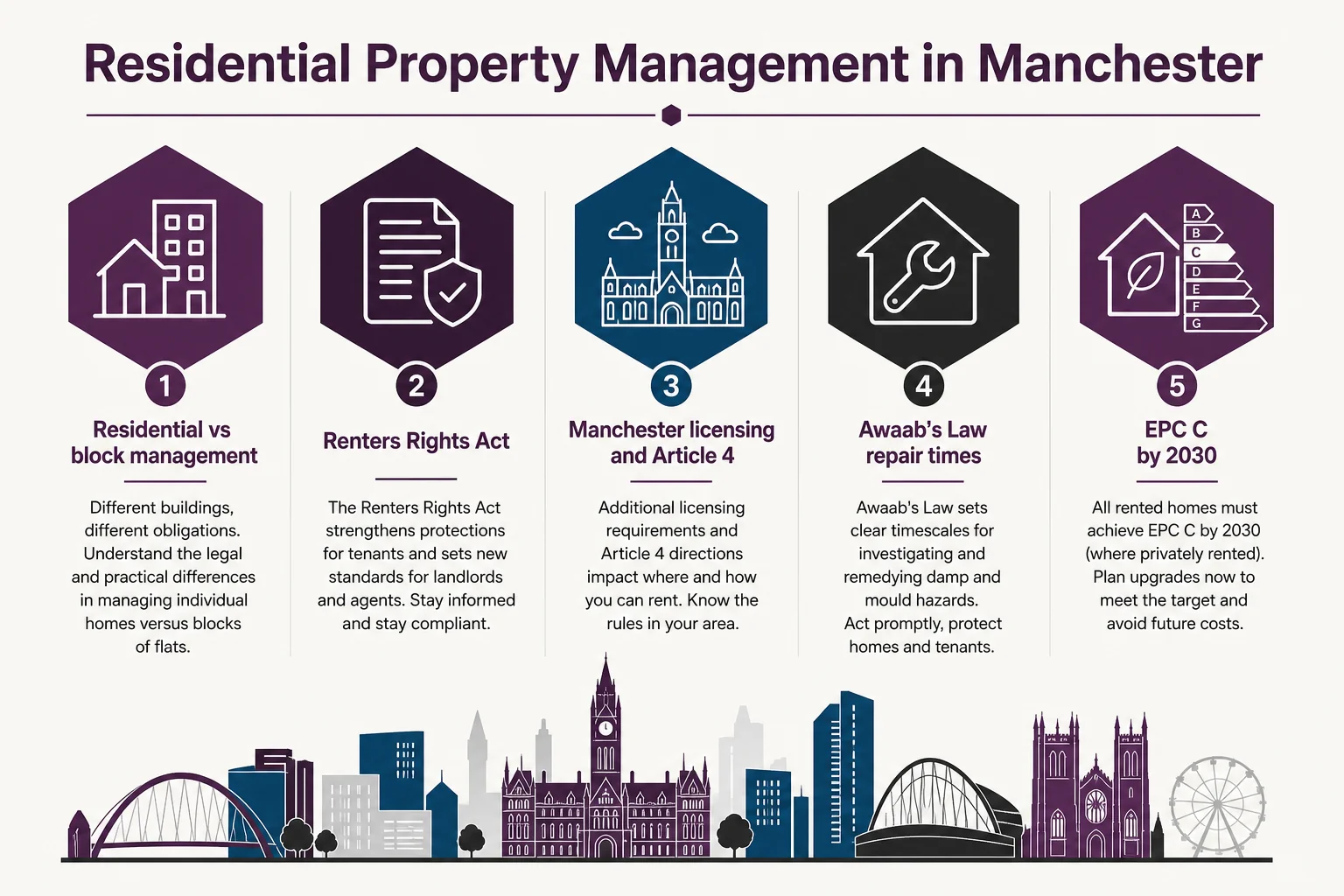
- Residential management covers individual tenancies and internal compliance, whereas block management covers shared building structures, communal areas and leasehold obligations.
- The Renters’ Rights Act replaces fixed terms with periodic tenancies, abolishes Section 21 eviction and tightens the mandatory Section 8 possession grounds.
- Manchester City Council operates a city-wide Article 4 Direction alongside tiered licensing, requiring planning checks and amenity compliance for multi-occupancy homes.
- Awaab’s Law requires emergency repairs to start within 24 hours and formal investigation within 14 days for damp, mould and structural hazards.
- Landlords must reach an EPC band C by October 2030 under Warm Homes Plan targets, subject to a ten thousand pound cost cap.
Management Service Types Across Manchester Properties
Choosing an agent starts with a clear view of service scope. Residential management covers individual tenant relationships, legal compliance and internal repairs. Block management covers structural integrity, communal facilities and service charge accounts. The two disciplines answer to different clients under different statutes, so the distinction matters before any instruction is signed.
The table below sets out the operational differences between individual tenancy services and structural block oversight. Landlords and resident management directors can weigh these baseline duties against their own holdings. In practice, mixed portfolios often need both arrangements running side by side within the same development.
| Service Category | Residential Management | Block Management |
|---|---|---|
| Primary Focus | Individual tenancies and internal unit care | Whole building fabric and communal areas |
| Legal Client | Individual landlord or property owner | Freeholder or Resident Management Company |
| Primary Regulation | Renters’ Rights Act and Housing Act 2004 | Building Safety Act 2022 and Fire Safety Regulations |
| Key Maintenance | Gas safety, EICR, boiler and internal repairs | Lifts, roofs, fire doors and communal grounds |
| Financial Operations | Rent collection and deposit protection | Service charge collection and reserve funds |
Residential Management and Block Oversight Compared
Scope of Individual Tenancy Management
Residential tenancy management centres on the contractual relationship between a landlord and a tenant in a single dwelling. The service covers rent collection, deposit protection, pre-tenancy referencing and internal repairs. Managers also confirm that each home meets current safety regulation. Accountability sits with one named owner rather than a wider building.
In managed lettings Manchester, internal compliance demands meticulous execution. Managers arrange annual gas safety inspections and Electrical Installation Condition Reports. They handle daily tenant contact and coordinate reactive repairs inside the demise. Renewals and periodic inspections protect rental yield. From experience across the sector, unit condition falls away quickly once inspections lapse.
Structural Duties Within Block Care
Block management maintains the structural integrity and communal infrastructure of multi-unit residential buildings. Managing agents act for freeholders or Resident Management Companies rather than individual buy-to-let landlords. Core duties cover communal health and safety, building insurance and service charge administration. Leaseholders fund that work through a formal annual budget.
The Building Safety Act 2022 and the Fire Safety Regulations add further statutory duties. Block managers hold the digital golden thread of safety data for higher-risk residential blocks. They arrange quarterly fire door checks and communal lift servicing. Service charge funds sit in designated trust accounts under RICS accounting codes.
Statutory Compliance Duties for Manchester Landlords
Tenancy Reforms Under the Renters’ Rights Act
The Renters’ Rights Act restructures how tenancies are created and ended across England. Section 21 no-fault eviction is abolished, so possession now requires a stated statutory ground. Fixed-term assured shorthold tenancies convert automatically into periodic tenancies. Tenants may leave at any stage by serving two months’ notice.
Possession claims now rest on expanded mandatory Section 8 grounds. Ground 1A permits recovery where a landlord intends to sell. Ground 8 raises the arrears threshold to three full months with four weeks’ notice. Landlords must also issue the government information sheet and written terms. Failure invites civil financial penalties.
Health and Safety Enforcement Standards
Statutory safety standards demand continuous oversight from landlords and managing agents. Every let property needs a current Energy Performance Certificate, a five-year electrical report and an annual gas safety record. Missing paperwork exposes owners to local authority enforcement. It also invalidates possession notices at the point they matter most.
Sound Manchester rental property management logs safety records digitally and renews them before expiry. Managers also oversee smoke alarms, heat detectors in kitchens and FD30 fire doors. Systematic compliance keeps prosecution risk low. It also gives tenants visible confidence in the standard of the property.
Did You Know?
Under the Renters’ Rights Act, landlords must serve a mandatory government information sheet on existing tenants. Missing the statutory deadline can trigger a civil penalty of up to £7,000 from the local housing authority.
Financial Administration and Revenue Protection
Digital Tax Records and Financial Stewardship
Financial stewardship now depends on digital accounting infrastructure across private rental portfolios. HMRC requires digital records and quarterly updates under Making Tax Digital for landlords above set income thresholds. Professional agencies supply automated statements that feed into compatible software. Owners then see the net position without rebuilding figures by hand.
Accurate reporting lets landlords track net yield whilst staying tax compliant. Agencies register deposits with a government-approved scheme inside the statutory 30-day window. Prescribed information must be served correctly. That step protects owners from tenant claims and strengthens their position in deposit adjudication at the end of a tenancy.
Rent Collection and Arrears Mitigation
Reliable rent collection depends on automated tracking that flags a missed payment date within twenty-four hours. Early contact stops a minor banking glitch turning into serious arrears. Managers set clear payment protocols from the outset. They also issue structured legal notices promptly when a balance remains outstanding.
Ground 8 sets the mandatory possession threshold at three months of arrears. Proactive debt management therefore carries real commercial weight. Automated systems send reminders by text and email immediately after a missed due date. Managers can then agree a realistic payment plan or start recovery before the balance becomes unmanageable.
The Railton-Meeks Compliance Audit Tool
Check Your Compliance & Protect Your Portfolio
Maintenance Protocols and Asset Preservation
Planned Maintenance and Triage Procedures
Proactive maintenance protects the physical asset and controls running costs for buy-to-let investors. Triage protocols assess each repair request on receipt. Many faults resolve over the phone without a contractor visit. Separating urgent structural defects from simple operational queries removes a great deal of unnecessary call-out expense.
Established relationships with local trades secure competitive rates for heating, plumbing and electrical work. Planned preventative maintenance programmes flag ageing plant, roof wear or falling boiler efficiency during inspections. Small defects fixed early avoid emergency surcharges. They also extend the working life of expensive installations.
Damp and Mould Duties Under Awaab’s Law
Awaab’s Law sets strict statutory timeframes for damp, mould and other environmental hazards in rented homes. Emergency hazards that threaten resident safety require works to start within twenty-four hours. Managers must investigate a reported damp problem within fourteen days. Written findings then follow within three working days.
Periodic inspections should include humidity readings and ventilation checks. Humidistat-controlled extractor fans in kitchens and bathrooms maintain adequate air exchange. In practice, we find most mould reports trace back to blocked or disconnected ducting. Early intervention shields landlords from enforcement and keeps homes healthy.
Railton-Meeks offers four landlord service tiers across Manchester and Cheshire
Manchester HMO and Selective Licensing Rules
Article 4 Directions and Planning Restrictions
Manchester City Council operates a city-wide Article 4 Direction covering houses in multiple occupation. Owners cannot rely on permitted development rights to convert a family home into a small HMO. Full planning permission is required instead. Applications face assessment under local concentration policy, including Policy H11.
A valid Certificate of Lawful Use matters for existing shared homes in Fallowfield, Withington and similar student areas. Losing lawful planning status can cut asset value sharply. Management audits check historical tenancy records. That evidence protects established planning rights across multi-occupancy holdings.
Licence Tiers and Property Safety Standards
Shared and private rental properties in Manchester fall under mandatory, additional or selective licensing. Mandatory HMO licensing applies city-wide where five or more occupants form two or more households. Selective schemes require every private landlord inside a designated improvement area to hold a valid licence.
Licensed properties must meet strict amenity and fire safety criteria. Single bedrooms must measure at least 6.51 square metres and double rooms at least 10.22 square metres. Interlinked Grade D alarms, FD30 doors and a documented fire risk assessment are mandatory. Civil penalties reach £30,000.
Instant Rental & Block Valuation
Get Your Valuation & Know Your Market Value
Tenant Sourcing, Vetting and Retention Strategies
Compliant Marketing and Rental Bidding Bans
Property advertising must follow the fair marketing rules governing the private rented sector. Agents and landlords cannot invite or accept offers above the advertised rent. Listings must state an exact monthly figure. Vague phrasing such as offers over or price on application is no longer permitted.
Accurate pricing attracts strong applicants without triggering a regulatory breach. Accepting an unprompted higher offer carries a civil penalty of up to £7,000. Full management draws on hyper-local evidence across Didsbury, Ancoats and Salford Quays. Correct pricing sets a lawful rent and keeps void periods short.
Rigorous Vetting and Pre-Tenancy Inventories
Thorough applicant referencing remains the primary defence against default and property damage. Checks cover employment history, credit record, previous landlord references and rent-to-income affordability. Statutory Right to Rent verification must be completed and recorded. That work happens before keys change hands or contracts are signed.
High-definition photographic and video inventories record baseline condition before move-in. Under periodic tenancies, that evidence is the only reliable route to recovering repair costs from a deposit. Detailed check-in reports also smooth the handover. Tenants understand the expected standard from the first day.
Energy Performance Standards and Retrofit Planning
Decarbonisation Deadlines Ahead of 2030
The Warm Homes Plan sets a binding deadline for privately rented homes to reach EPC band C by October 2030. Landlords should review current certificates now and identify the fabric and heating work required. Early upgrades protect future marketability. They also support tenant retention across competitive local markets.
Properties reaching band C under existing assessment methods before October 2029 gain ten-year legacy compliance. Moving a South Manchester Victorian terrace from band D to band C cuts tenant energy bills measurably. Lower running costs support longer tenancies. Stable occupancy protects the income behind the investment.
Cost Caps and Available Grant Funding
Energy efficiency rules include a cost cap of ten thousand pounds per property. That limit protects landlords from open-ended improvement spending. Where ten thousand pounds fails to lift a rating to band C, owners can register a ten-year exemption. Qualifying measures funded since late 2025 count toward the cap.
Government funding under the Warm Homes Plan can offset retrofit costs. The Boiler Upgrade Scheme grants substantial sums toward heat pump installation. The Great British Insulation Scheme supports loft and cavity wall work. Matching eligible properties to the right grant keeps landlord capital outlay to a minimum.
HMO Specialist Yield & Tax Calculator
Calculate Your Yield & Offset New Tax Burdens
Final Thoughts
Rental property demands a structured, professional approach to compliance and tenancy administration. Sound residential property management Manchester services deliver that discipline across safety rules, licensing schemes and tenancy law. Professional oversight protects rental income, shortens void periods and preserves the physical condition of the asset.
Regulation continues to tighten and the energy deadline moves closer each year. Landlords who audit their compliance position early absorb those changes with far less disruption. Portfolios aligned to the coming standards hold their value and keep reliable tenants in place.
Frequently Asked Questions
A:
Residential property management covers individual tenancy contracts, internal repairs, rent collection and safety compliance within a single rental unit. Block management covers the building structure, communal areas, shared safety systems and service charge budgets. Residential managers act for buy-to-let landlords. Block managers act for freeholders or Resident Management Companies. An owner letting a flat inside a managed development often needs both services, because neither one covers the duties of the other.
A:
Fixed-term assured shorthold tenancies convert automatically into periodic tenancies. Landlords can no longer serve a Section 21 no-fault notice. Possession now requires a specific statutory ground under Section 8, supported by evidence. Landlords must also serve the mandatory government information sheet on existing tenants and supply formal written terms. Missing documentation exposes owners to civil financial penalties from the local housing authority, so record keeping matters more than it did before.
A:
Manchester City Council operates a city-wide Article 4 Direction. That removes permitted development rights for converting a family home into a house in multiple occupation. Owners must obtain full planning permission before letting to three or more unrelated occupants. Applications face scrutiny under local concentration guidance, including Policy H11. An existing HMO should hold a Certificate of Lawful Use, which evidences continuous operational history and protects the commercial value of the asset.
A:
Awaab's Law requires landlords to investigate reported hazards such as severe damp and mould within fourteen days. Written findings must follow within three working days of that inspection. Where a hazard presents an emergency threat to health or safety, repair works must start within twenty-four hours. Managers reduce that risk through regular moisture audits and properly specified mechanical ventilation, which keeps a property inside statutory housing standards year round.
A:
The Warm Homes Plan requires every privately rented property in England to reach EPC band C by October 2030. A statutory cost cap of ten thousand pounds per property applies to the required works. Properties reaching band C before October 2029 under current assessment rules qualify for ten-year legacy compliance. Grant funding, including the Boiler Upgrade Scheme, can offset heating upgrade costs and reduce the capital a landlord commits.
