

Property Portfolio Management for Manchester Landlords
A second rental property is an asset. A sixth is a business. Effective property portfolio management is what separates the two. Once you hold several tenancies, the admin stops being incidental. Compliance deadlines stack up. Repairs compete for attention. Landlords across South Manchester now carry statutory duties on every single unit they own.
Without centralised records, small failures compound quickly. Repairs slip. Certificates expire unnoticed. Notices get served on the wrong form. So how should a growing portfolio be structured to protect both rental income and capital value?
Key Takeaways
- Centralised administrative systems cut operating overheads and hold statutory compliance steady across every property in an expanding rental portfolio.
- Rental reform removes no-fault eviction, so meticulous digital evidence now underpins every possession claim a landlord intends to bring.
- Planned preventative maintenance and remote triage reduce emergency callout spend and protect long-term net yields across mixed housing stock.
- Private rented homes must reach an EPC rating of C by October 2030, subject to a capped spending obligation.
- South Manchester splits into distinct micro-markets, and yield strategy should differ sharply between student corridors and suburban family belts.
Operational Benchmarks for a Growing Rental Portfolio
Portfolio work divides into four operational domains. Each has its own statutory clock and its own failure cost. In practice, we find landlords rarely fail on effort. They fail because records sit in four places at once. Clear benchmarks fix that, and they make performance measurable across every property held.
The table below sets the working standard for each domain. It contrasts the habits typical of a single-property landlord with the systems needed at portfolio scale. Use it as a gap analysis. Any row where your current practice matches the middle column is a row worth addressing first.
| Operational Area | Single-Property Habit | Portfolio Standard |
|---|---|---|
| Legislative Compliance | Manual document tracking and reactive notice service | Central compliance register with dated renewal alerts |
| Maintenance | Ad-hoc contractor quotes and emergency repairs | Triage protocol plus planned preventative schedules |
| Financial Reporting | Paper receipts and one annual tax scramble | Digital quarterly statements aligned to Making Tax Digital |
| Tenancy Administration | Fragmented files and inconsistent referencing | Standardised digital inventories and uniform vetting |
| Safety Certification | Renewals chased after expiry | Rolling gas, electrical and fire records held centrally |
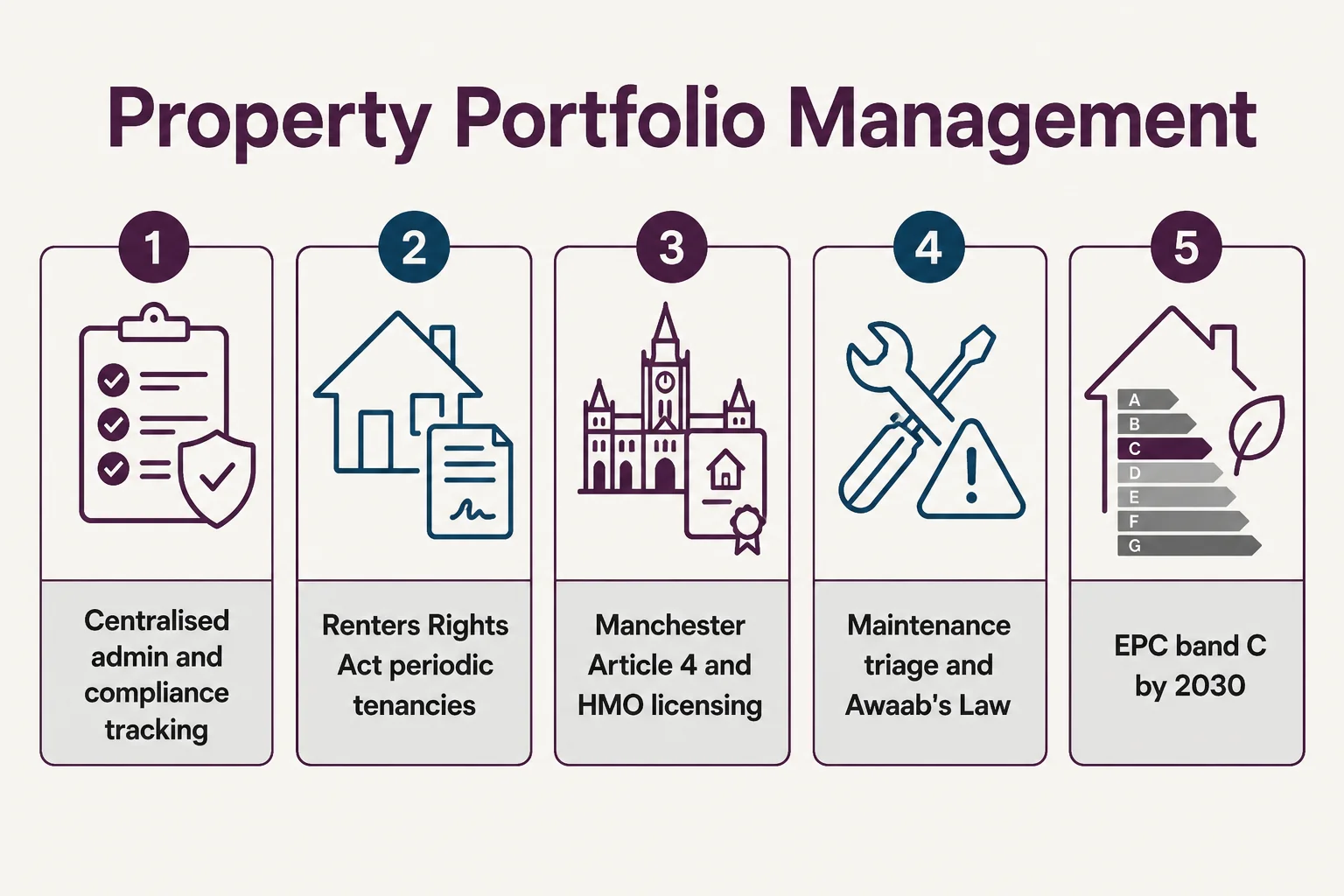
Legislative Safeguards Under Modern Rental Reform
Assured Periodic Tenancies Transition
Rental reform ends the fixed-term assured shorthold tenancy. Every private tenancy becomes periodic and rolls month to month. Tenants may leave on two months’ notice at any point. That single change reshapes void planning across a portfolio. Tenancy paperwork must be reissued so that each unit reflects the periodic structure correctly.
From experience across the sector, the transition exposes weak document control first. Landlords with template agreements stored locally struggle to update them at scale. A central template library solves this. Version each agreement, date it, and log which property received which issue. That log becomes evidence if a tenancy is later disputed.
Possession Grounds and Eviction Procedures
No-fault eviction has gone. Possession now depends on proving a statutory ground under Section 8. Every claim rests on documented evidence rather than on notice alone. Rent arrears grounds carry a longer notice period and a higher arrears threshold. Rigid rent tracking is therefore no longer optional for portfolio landlords.
Specialist grounds still exist for particular stock. Purpose-aligned student lets retain a possession route tied to the academic cycle, which matters in Fallowfield and Rusholme. The practical risk is procedural, not legal. Serve the wrong form, or miss a prescribed date, and the claim fails at the first hearing.
HMO Licensing Rules in South Manchester
Article 4 Planning Regulations
Manchester City Council operates a city-wide Article 4 Direction. Permitted development rights for multi-occupancy conversion have been withdrawn. Turning a family home into shared housing now needs full planning permission, whatever the occupant count. Historic Lawful Development Certificates therefore carry real value and should be audited on acquisition.
Local policy applies concentration tests in dense student areas. Applications fail where the surrounding stock is already heavily converted. Evidence of continuous multi-occupancy use is what protects lawful status. Lose that status and the property reverts to family-home valuation, which can strip a substantial share of its capital value.
Statutory Licensing Tiers and Safety Standards
Three licensing tiers apply across Greater Manchester. Mandatory licensing covers any HMO housing five or more people from two or more households. Additional and selective schemes vary by ward and change on renewal. Portfolio landlords must therefore track licence type, expiry and conditions property by property.
Licence conditions bite hardest on physical standards. Minimum bedroom dimensions are prescribed in law. Fire doors must be FD30 rated and correctly hung. Detection must be interlinked and specified to the right grade. Waste provision is inspected too, and it is a common reason for a licence condition breach.
Did You Know?
Local housing authorities in England can impose a civil penalty of up to £30,000 per offence, as an alternative to prosecution, where a landlord operates an unlicensed House in Multiple Occupation or breaches a licence condition. A Rent Repayment Order may also require up to twelve months of rent to be repaid.
Maintenance Triage and Proactive Cost Control
Planned Preventative Maintenance Frameworks
Reactive repair is the most expensive way to run a portfolio. Planned preventative maintenance moves spend from emergencies to scheduled work. Routine inspection catches boiler wear, failed pointing and roof damage early. Component life extends. Tenant satisfaction holds up. Budget certainty improves, which matters most when several properties age together.
Contractor relationships do the heavy lifting here. A small vetted panel gives consistent quality and transparent pricing across every address. Rates improve with volume. Response times improve with familiarity. Keep a rolling record of works per property, because that record also supports disrepair defence and end-of-tenancy deposit claims.
Moisture Control and Damp Prevention
Awaab’s Law extends to the private rented sector and imposes fixed statutory timescales. Emergency hazards demand action within twenty-four hours. Formal written investigation must conclude within fourteen days. Those clocks run whether or not a landlord is available. Continuous mechanical extraction in kitchens and bathrooms remains the most reliable preventative measure.
Build moisture checks into every periodic visit. Photograph cold spots, window reveals and behind-furniture zones. Date the images. Early remediation protects the building fabric and removes the health risk to tenants. It also closes off the most common route to a disrepair claim under statutory housing health standards.
The Railton-Meeks Compliance Audit Tool
Check Your Compliance & Protect Your Portfolio
Financial Administration and Digital Accounting Requirements
Digital Tax Records and Quarterly Returns
Making Tax Digital for Income Tax applies to landlords above a gross rental income threshold of £50,000. Records must be kept digitally. Returns are submitted quarterly through compatible software. Paper receipts and standalone spreadsheets no longer satisfy the requirement. Portfolio landlords should migrate before the deadline rather than at it.
Good software does more than file returns. It categorises income and expenditure per property automatically. That produces a per-unit profitability view, which most landlords have never had. Weak performers become visible. Refinancing decisions and disposal decisions both improve once the numbers sit at property level rather than portfolio level.
Rent Arrears Control and Deposit Stewardship
Net yield is protected by speed, not severity. Automated flagging identifies a missed payment within twenty-four hours. A prompt, courteous reminder resolves most cases before arrears build. Escalation should follow a fixed written sequence. Deposits must reach an authorised scheme within thirty days of receipt, without exception.
Prescribed information must be served correctly at the same time. Get this wrong and possession claims become vulnerable months later. Photographic inventories completed before occupancy establish the baseline condition. Time-stamped images and a signed schedule remain the strongest evidence available at deposit adjudication when tenant damage is disputed.
Railton-Meeks offers four landlord service tiers across Manchester and Cheshire
Energy Performance and Green Transition Roadmaps
Energy Performance Target Timelines
Government policy requires privately rented homes in England to reach an Energy Performance Certificate rating of C by October 2030. New tenancies face the standard first. Landlords achieving a C rating under current metrics before October 2029 gain a protected compliance position lasting ten years from that assessment date.
Timing matters more than most landlords expect. Installer capacity tightens as any deadline nears, and prices rise with it. Fabric-first work delivers the most reliable rating movement. Insulation, draught-proofing and glazing improvements come before heating technology. Sequence the portfolio by current rating and tackle the weakest properties first.
Retrofitting Expenditure and Financial Caps
The proposed framework caps required spending at £10,000 per property. Qualifying improvement work completed from October 2025 counts towards that cap. Where a property still falls short after capped expenditure, a statutory exemption can be registered. Registration is not automatic, and supporting evidence must be retained for inspection.
Grant funding reduces the net cost considerably. The Great British Insulation Scheme supports cavity wall and loft measures for eligible properties. Heat pumps and solar arrays carry longer paybacks but improve marketability. In competitive lettings markets, a strong EPC now shortens void periods as well as satisfying the regulator.
Instant Rental & Block Valuation
Get Your Valuation & Know Your Market Value
South Manchester Micro-Market Strategic Investment
High-Yield Student Corridors
Fallowfield and Rusholme continue to deliver gross yields in the region of eight to eleven percent. Student volume and campus proximity keep voids close to zero. The trade-off is intensity. Lettings run to the academic calendar, turnover is annual, and marketing windows open far earlier than in the general market.
Planning restriction has turned licensed stock into a constrained asset class in M14. New conversions are effectively blocked, so existing HMOs hold a scarcity premium. Compete on specification rather than price. High-quality finishes, reliable broadband and inclusive bill packages sustain occupancy and support premium room rates year after year.
Capital Preservation Suburban Belts
Didsbury and Chorlton behave differently. Gross yields typically sit between four and five percent. Capital appreciation carries the return instead. Professional families take longer tenancies and turnover costs stay low. Proximity to strong schools and Metrolink stations underpins rental values through wider market softening.
Service expectation is higher in this segment. Tenants notice slow responses and poor finish quality, and they move. Preserving yield in M20 and M21 depends on avoiding voids. Reference carefully, respond quickly, and keep preventative maintenance visible. Long tenancies, not high rents, drive the returns here.
Block Oversight and Building Safety Obligations
Digital Golden Thread Safety Records
Higher-risk residential buildings must hold a live digital record of structural and fire safety information. The golden thread covers floor plans, material specifications, inspection reports and cladding assessments. Records must stay current rather than being assembled at inspection. Real-time updating is the only approach that survives regulatory scrutiny.
Resident Management Company directors carry personal liability for safety failures. That risk is often underestimated by leaseholder directors serving voluntarily. A complete digital safety file protects them directly. It also removes friction from leasehold sales, where conveyancers now request building safety information as a matter of course.
Service Charge Transparency and Account Auditing
Service charge accounting is governed by statute and by an approved code of practice. Demands must be itemised and properly presented. Costs become irrecoverable if they are not formally demanded within eighteen months of being incurred. Client money must be held in a designated, ring-fenced trust account throughout.
Transparency prevents most disputes before they start. Publish the budget, the actuals and the reserve fund position each year. Fire door inspections and personal emergency evacuation plan assessments should run to a fixed schedule. Document each one, because block safety obligations are judged on records rather than intent.
HMO Specialist Yield & Tax Calculator
Calculate Your Yield & Offset New Tax Burdens
Final Thoughts
Property portfolio management is an operating discipline, not an administrative afterthought. Centralised records, planned maintenance and per-property reporting protect income and capital together. The regulatory direction of travel is clear. Requirements tighten, evidence standards rise, and informal systems fail first.
Build the structure whilst the portfolio is still small enough to change easily. Audit lawful use and licensing status now. Sequence energy upgrades by current rating. Migrate financial records to compatible software ahead of the deadline. Each step taken early costs less than the same step taken under pressure.
Frequently Asked Questions
A:
The difference is systems rather than scale. Single-property letting can survive on memory and paperwork. Portfolio management depends on centralised records, standardised tenant vetting and a shared compliance calendar covering every unit. Maintenance is coordinated across addresses, which improves contractor rates and response times. Reporting runs at property level, so weak performers become visible early. The result is lower administrative cost, fewer compliance failures and a clearer view of where returns are actually generated across the whole portfolio.
A:
Fixed-term assured shorthold tenancies are replaced by periodic tenancies that roll monthly. No-fault eviction is abolished, so possession requires a proven statutory ground under Section 8. Notice periods and arrears thresholds have both changed. Landlords must issue updated written information to existing tenants and follow tighter rules on rental advertising. Practically, the burden shifts to evidence. Detailed digital records of rent, condition and correspondence now determine whether a possession claim succeeds at hearing.
A:
Manchester operates a city-wide Article 4 Direction, so converting a family home into shared housing needs full planning permission. Existing HMOs depend on established lawful use, usually evidenced by a Lawful Development Certificate. If that status cannot be demonstrated, the property may only be valued and let as a single dwelling. That reduces both income and capital value sharply. Planning due diligence should therefore sit alongside survey and legal checks on every HMO acquisition.
A:
Landlords above the gross rental income threshold must keep digital records and submit quarterly updates through compatible software. Paper receipts and standalone spreadsheets no longer meet the standard. The practical effect is a shift from annual reconstruction to continuous record-keeping. Expenses are captured as they occur and allocated to the correct property. Most landlords find this improves visibility rather than adding work, because per-property profitability becomes measurable for the first time across the portfolio.
A:
Privately rented homes in England are expected to reach an Energy Performance Certificate rating of C by October 2030, with new tenancies affected first. Properties achieving a C rating under current metrics before October 2029 hold that position for ten years. Required spending is capped at £10,000 per property, and qualifying work from October 2025 counts towards the cap. Where a property still falls short, a statutory exemption can be registered with supporting evidence retained.
