

Tenant Finder Service Versus Fully Managed Lettings
Choosing between letting models shapes the profitability, daily workload, and statutory liability of every residential property investor. Selecting a tenant finder service allows landlords to secure qualified occupants whilst retaining day-to-day administrative and physical control over the tenancy. However, escalating statutory obligations, including periodic tenancy conversions, deposit requirements, and stringent safety standards, demand operational precision. Landlords must evaluate whether their available time and regulatory knowledge justify handling ongoing tenancies without professional management intervention.
Operating private rental properties requires balancing operational costs against direct exposure to financial penalties and tenancy disputes. Property owners often struggle to identify where a let-only instruction ends and where their personal responsibilities begin. Does your portfolio profile suit a one-off placement, or does full management provide essential long-term security?
Key Takeaways
- A tenant find option delivers marketing, viewings, and referencing, leaving day-to-day property repairs and rent collection entirely to the self-managing landlord.
- Fully managed contracts provide comprehensive operational oversight, protecting property owners against severe statutory penalties through continuous regulatory and safety supervision.
- Self-managing landlords must independently navigate major legal obligations, including deposit protection timescales, mandatory information service, and new Section 8 possession grounds.
- Let-only arrangements suit experienced landlords with flexible schedules, whilst multi-property portfolios and remote investors benefit from continuous professional oversight.
- Letting properties in South Manchester demands micro-market knowledge regarding selective licensing, Article 4 directions, and strict local HMO amenity standards.
Key Differences Between Tenant Find and Full Management
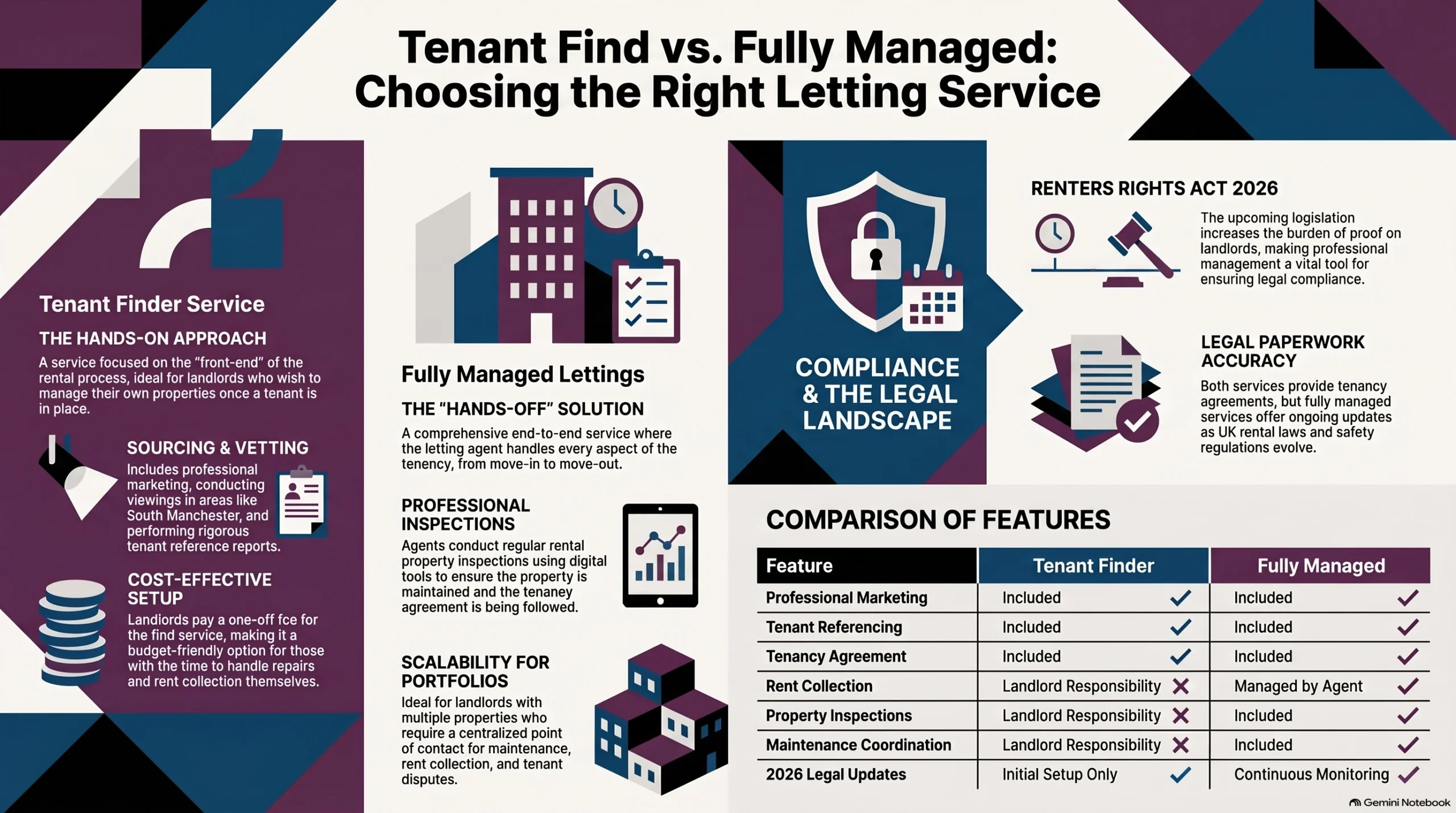
Landlords must understand exactly how responsibilities split across different agency appointment structures before signing terms of business. A tenant finder service and a fully managed contract look similar on paper, yet the practical division of duties differs substantially once the tenancy begins. Choosing the wrong service level can result in unexpected maintenance tasks or accidental legal breaches that undermine rental yields.
The table below provides a side-by-side comparison of essential functions across tenant find and fully managed appointments, highlighting where responsibility rests throughout the tenancy lifecycle. Reviewing each row against your own available time, local knowledge, and appetite for hands-on administration helps clarify which service level actually matches your circumstances as a landlord.
| Operational Area | Tenant Find Service | Fully Managed Service |
|---|---|---|
| Property Marketing & Portals | Included | Included |
| Tenant Referencing & Right to Rent | Included | Included |
| Tenancy Agreement & Statutory Notices | Included at inception | Continuous compliance updates |
| Deposit Registration & Prescribed Info | Agent registers or hands over | Fully registered and protected |
| Rent Collection & Arrears Chasing | Landlord responsibility | Agent automated chasing & reporting |
| Maintenance & 24/7 Call-Outs | Landlord responsibility | Agent triage & contractor allocation |
| Periodic Property Inspections | Landlord responsibility | Agent scheduled visits & reports |
Core Inclusions in Letting Agent Packages
Tenant Sourcing and Advertising Provisions
A professional tenant find package focuses on sourcing suitable applicants through digital portals and structured viewings. Agents market properties on platforms such as Rightmove and Zoopla, coordinate applicant communications, and conduct vetted viewings. This process reduces vacancy lengths whilst ensuring potential renters meet basic baseline affordability criteria before proceeding further.
Effective marketing requires strict adherence to advertising regulations. Letting agents verify that listings display specific rental figures, avoiding banned rental bidding strategies. Once an applicant shows intent, the service conducts comprehensive referencing. This step verifies declared income, employment stability, previous landlord references, and statutory Right to Rent credentials. Delivering these steps quickly maintains rental momentum whilst filtering out high-risk applicants before contracts materialise.
Administrative Onboarding and Legal Documentation
The onboarding phase of a tenant find appointment establishes legal enforceability before handing keys to the tenant. The agent drafts compliant written statements of terms, collects initial funds, and executes contracts. Once signed, the property owner receives copies of all records, assuming direct management of the active household.
Documentation accuracy dictates whether a landlord can enforce possession grounds later. Handover packages must contain the Gas Safety certificate, valid Electrical Installation Condition Report (EICR), Energy Performance Certificate, and current government guides. Agents often manage the initial tenancy deposit administration within an approved statutory scheme. Once the initial paperwork completes, tenant find services typically conclude, transferring all routine tenant communication directly to the investor.
Compliance Responsibilities Under Modern Rental Legislation
Statutory Document Distribution Requirements
Landlords retaining self-management responsibilities assume direct liability for serving mandatory government paperwork throughout the tenancy. Missing statutory document deadlines or failing to distribute updated information sheets can invalidate court claims. Regulators enforce strict civil penalties for procedural administrative oversights, making thorough compliance records vital for property owners.
Under the Renters’ Rights Act 2025, assured shorthold tenancies convert to periodic arrangements. Landlords must issue written statements of terms and statutory explanatory sheets to existing occupants. Failure to provide mandatory information within statutory timeframes risks civil penalties of up to £7,000. Whilst full management packages handle document distribution automatically, let-only clients must execute each update manually without agency intervention.
Possession Frameworks and Ground Notifications
Regaining property possession requires meticulous record-keeping following the statutory abolition of Section 21 no-fault notices. Landlords must now rely exclusively on specific Section 8 grounds, proving legitimate reasons such as serious rent arrears, property sales, or owner occupation. Every claim demands thorough documentary evidence proving full pre-tenancy compliance.
Self-managing property owners must track legal notice periods carefully. Grounds for owner occupation or selling require four months of formal notice and cannot apply during initial tenancy months. Arrears grounds now require three months of cumulative debt alongside four weeks of notice. Without a managing agent maintaining the evidentiary paper trail, landlords face court delays, procedural dismissals, and prolonged vacancy costs.
Did You Know?
Under the Renters’ Rights Act 2025, serving invalid documentation or accepting rent bids above the advertised figure carries civil penalties of up to £7,000, whilst unlicensed HMO operations in Manchester risk local authority fines reaching £30,000.
Financial Upfront Costs Against Ongoing Management Fees
One-Off Placement Fees Versus Monthly Deductions
Tenant find arrangements require a single, upfront payment deducted from the initial rental payment upon tenancy execution. This structure appeals to cost-sensitive owners wanting to preserve recurring monthly cash flow. Conversely, full management charges a continuous commission deducted monthly, reflecting ongoing administration, compliance monitoring, and day-to-day tenant relations.
Upfront tenant find fees typically range from a few weeks’ rent to a fixed sum, covering advertising, referencing, and document creation. This setup allows owners to retain total gross rental income for subsequent months. However, when tenancies turn over frequently, repeating placement fees can rapidly reduce overall yields. Fully managed models distribute costs evenly across years, including re-letting tasks within service tiers or offering discounted remarketing rates.
Hidden Costs of Self-Managing Portfolios
Self-managing property owners often overlook the indirect financial expenses associated with day-to-day property oversight. Travel costs for inspections, independent referencing subscriptions, out-of-hours contractor call-outs, and legal advisory fees accumulate over time. These operational expenses quickly reduce the apparent cost savings achieved by avoiding monthly management commissions.
Time expenditure represents another hidden cost. Answering late-night maintenance calls, chasing delayed rent, and coordinating tradespeople consumes valuable working hours. Furthermore, managing repairs without trade contractor networks usually means paying standard retail call-out rates rather than pre-negotiated agency rates. A single compliance error leading to financial penalties can eradicate several years of management fee savings.
The Railton-Meeks Compliance Audit Tool
Check Your Compliance & Protect Your Portfolio
Maintenance Demands and Contractor Coordination
Emergency Repairs and Hazard Response Standards
Managing maintenance demands immediate responsiveness and legal awareness when addressing property defects. Landlords already owe a general duty under the Homes (Fitness for Human Habitation) Act 2018 to address hazards like damp, mould, and heating failures within a reasonable time. Self-managing owners must maintain accessible, qualified tradespeople ready to resolve emergencies without delay.
Awaab’s Law currently applies only to social housing, setting fixed 24-hour emergency and 10-working-day investigation timescales. The Renters’ Rights Act 2025 gives ministers power to extend the same duties to private lets, with commentators expecting this from 2027 onwards. Many professional agencies are adopting these timescales voluntarily ahead of any formal requirement. Fully managed services use 24/7 reporting hubs and vetted contractor panels to triage complaints immediately. Self-managing investors must coordinate rapid repairs independently, regardless of their own working hours or location.
Periodic Inspections and Property Care
Routine inspections provide essential physical oversight, identifying minor maintenance issues before they become expensive structural defects. Visiting rental properties every six to twelve months allows landlords to monitor occupant care, detect unreported leaks, and verify safety installations. Documenting these visits with clear photographic records preserves deposit claim validity.
Fully managed services standardise inspections through structured digital reporting, assessing ventilation, smoke alarms, and building fabric. Self-managing landlords must arrange and conduct these visits themselves, respecting the tenant’s right to quiet enjoyment by providing proper written notice. Failing to inspect properties regularly risks undetected structural decline and tenant disputes when contracts eventually terminate.
Railton-Meeks offers four landlord service tiers across Manchester and Cheshire
Rent Collection and Arrears Protocol
Rent Tracking Systems and Prompt Payment Safeguards
Consistent cash flow depends on rigorous rent tracking and rapid payment reconciliation. Managing agencies deploy automated accounts software that flags missing transactions instantly, sending automated payment reminders to tenants. Self-managing landlords must check bank accounts manually every month, potentially missing initial payment delays until debts compound.
Early intervention prevents minor cash-flow hiccups from turning into unrecoverable bad debts. Professional management teams contact tenants immediately when payments miss scheduled dates. They establish whether issues stem from technical errors or deeper financial strain. By communicating calmly and promptly, agents often arrange payment plans that resolve arrears quickly. Independent owners frequently delay awkward conversations, allowing rent shortfalls to escalate unchecked.
Arrears Escalation Under Extended Section 8 Rules
Handling persistent non-payment has become more legally challenging due to legislative updates to mandatory possession thresholds. Landlords can no longer serve rapid eviction notices for minor payment disruptions. Professional management provides structured communication logs and payment ledgers, which prove crucial if court proceedings become necessary to recover debt.
Under revised Ground 8 procedures, landlords must wait until arrears reach three full months, up from two months previously. The statutory notice period also spans four weeks rather than two. A managed service initiates formal debt chasing on day two of non-payment, building the robust audit trail required by judges. Self-managed landlords who lack formal accounting ledgers often face adjourned hearings, compounding their financial losses.
Instant Rental & Block Valuation
Get Your Valuation & Know Your Market Value
Suitability by Landlord Experience and Portfolio Scale
Single Property Owners and Local Landlords
A one-off tenant placement often suits experienced, local property owners letting single units. Landlords living near their rental properties can handle viewings, maintenance calls, and periodic check-ups without excessive travel. When owners possess building trade contacts and current legislative knowledge, self-management offers a viable way to maximise monthly net yields.
However, accidental landlords, such as individuals letting inherited homes or former residences, often lack legal awareness. Missing one electrical safety certificate deadline or miscalculating deposit caps can trigger severe financial penalties. For first-time investors, utilising full management provides an operational safety buffer. Experienced single-property owners, by contrast, can leverage tenant find packages to source quality tenants whilst maintaining personal oversight.
Multi-Unit Portfolios and Geographically Remote Investors
Portfolio expansion and geographical distance make full management the standard operational strategy for scaling investors. Coordinating multiple tenancies across different postcodes generates significant administrative overhead. Remote owners cannot inspect roofs, supervise emergency repairs, or attend local council meetings, making dedicated local agents essential for long-term portfolio protection.
Larger portfolios also involve complex tax and reporting obligations, such as digital submission rules for landlords earning over £50,000. Managing agents produce consolidated monthly statements and digital accounting records that integrate directly into financial software. Furthermore, investors holding multiple units across different towns cannot maintain local contractor rosters easily. Professional oversight transforms active property management into a passive, scalable commercial investment.
Regional Considerations for South Manchester Properties
Licensing Enforcement and Article 4 Planning Rules
Letting residential property in South Manchester requires navigating dense municipal planning controls and targeted licensing designations. Manchester City Council enforces strict city-wide Article 4 Directions, removing permitted development rights for shared properties. Landlords operating without proper planning permissions or mandatory licences face severe civil enforcement actions and rent repayment orders.
Selecting a tenant finder service in south Manchester requires checking whether the agency understands these local nuances. The borough runs some of the strictest micro-market licensing rules in Greater Manchester. Selective licensing zones in areas like Levenshulme, Rusholme, and Moss Side require licences for all private rentals. In student hubs like Fallowfield and Withington, houses in multiple occupation must meet strict amenity sizes and Grade D fire safety standards. Professional management shields investors from these £30,000 civil penalty risks.
Targeting Tenant Demographics in Suburban Hubs
South Manchester features varied micro-markets ranging from student corridors to affluent professional districts. High-yield multi-occupancy investments dominate Fallowfield, whereas Didsbury, Chorlton, and SK postcodes demand premium family accommodation. Matching your property standard to local tenant expectations is vital for securing stable, long-term rental income.
Professional lettings packages tailor marketing channels to each specific suburban demographic. High-income corporate tenants in Didsbury or Chorlton expect energy-efficient homes with dedicated workspaces and rapid broadband. Meanwhile, HMO rentals near the Oxford Road hospital corridor require individual room marketing and clear utility structures. Identifying these local demands ensures high application numbers, shorter vacant periods, and market-leading returns across South Manchester portfolios.
HMO Specialist Yield & Tax Calculator
Calculate Your Yield & Offset New Tax Burdens
Final Thoughts
Deciding between a tenant finder service and fully managed lettings depends on your compliance expertise, available time, and proximity to the rental property. A placement-only model reduces upfront fees and leaves day-to-day operations in your hands, making it suitable for experienced owners living nearby. However, managing tenancies independently requires continuous attention to changing statutory duties, prompt repair coordination, and structured rent tracking. As legal standards become more stringent, self-managing landlords must ensure their operational procedures withstand strict scrutiny.
Full property management converts rental assets into passive investments by transferring regulatory risk, emergency maintenance duties, and administrative burdens to professional agents. Portfolio owners, remote investors, and landlords with limited free time gain long-term security from continuous agency oversight. Review your portfolio’s geographical distribution, calculate the true value of your personal time, and choose the service level that safeguards your assets against regulatory disruption.
Frequently Asked Questions
A:
A tenant finder package covers the initial stages of a letting, including professional marketing, viewings, applicant referencing, tenancy agreement drafting, and initial deposit collection. Once the tenant receives the keys, the agency steps back, leaving the landlord to handle rent collection, day-to-day maintenance, periodic inspections, and legal notices. Full management provides continuous agency support throughout the tenancy, handling monthly rent accounting, emergency repairs, contractor management, legal document distribution, and deposit dispute resolution until the tenancy ends.
A:
Yes, landlords can transfer an active tenancy to a fully managed service at any point. The incoming managing agent conducts a comprehensive compliance audit, verifying that the initial deposit is protected, safety certificates are valid, and statutory guides were correctly served. They then notify the tenant of the change in management, redirect monthly rental payments to the agency client account, and assume responsibility for all ongoing maintenance, repairs, inspections, and tenant communications.
A:
The property owner retains ultimate legal responsibility for organising and renewing mandatory safety certificates under a tenant find arrangement. The agent will require valid certificates, such as an Energy Performance Certificate, Gas Safety record (CP12), and Electrical Installation Condition Report (EICR), before completing the move-in. However, once the tenancy begins, the landlord must independently schedule annual gas checks, five-yearly electrical tests, and smoke or carbon monoxide alarm renewals without agency reminders.
A:
Under a let-only or tenant finder agreement, the landlord must handle rent arrears directly. The agency does not monitor monthly bank receipts or issue payment reminders. If payments cease, the landlord must calculate arrears, issue formal warning letters, and serve legal notices under Section 8. Because possession claims require detailed evidence and strict court compliance, self-managing landlords must maintain accurate accounting records or instruct independent solicitors to pursue the debt.
A:
Modern statutory updates, such as the transition to periodic tenancies and the abolition of Section 21 no-fault evictions, significantly increase legal risks for self-managing landlords. Property owners must independently track new possession grounds, issue mandatory government notices within tight windows, and resolve emergency hazards within legally enforceable response times. Procedural mistakes can lead to heavy civil fines of up to £7,000, making continuous compliance awareness essential for those letting without an agent.
