

Property Management and Lettings in South Manchester
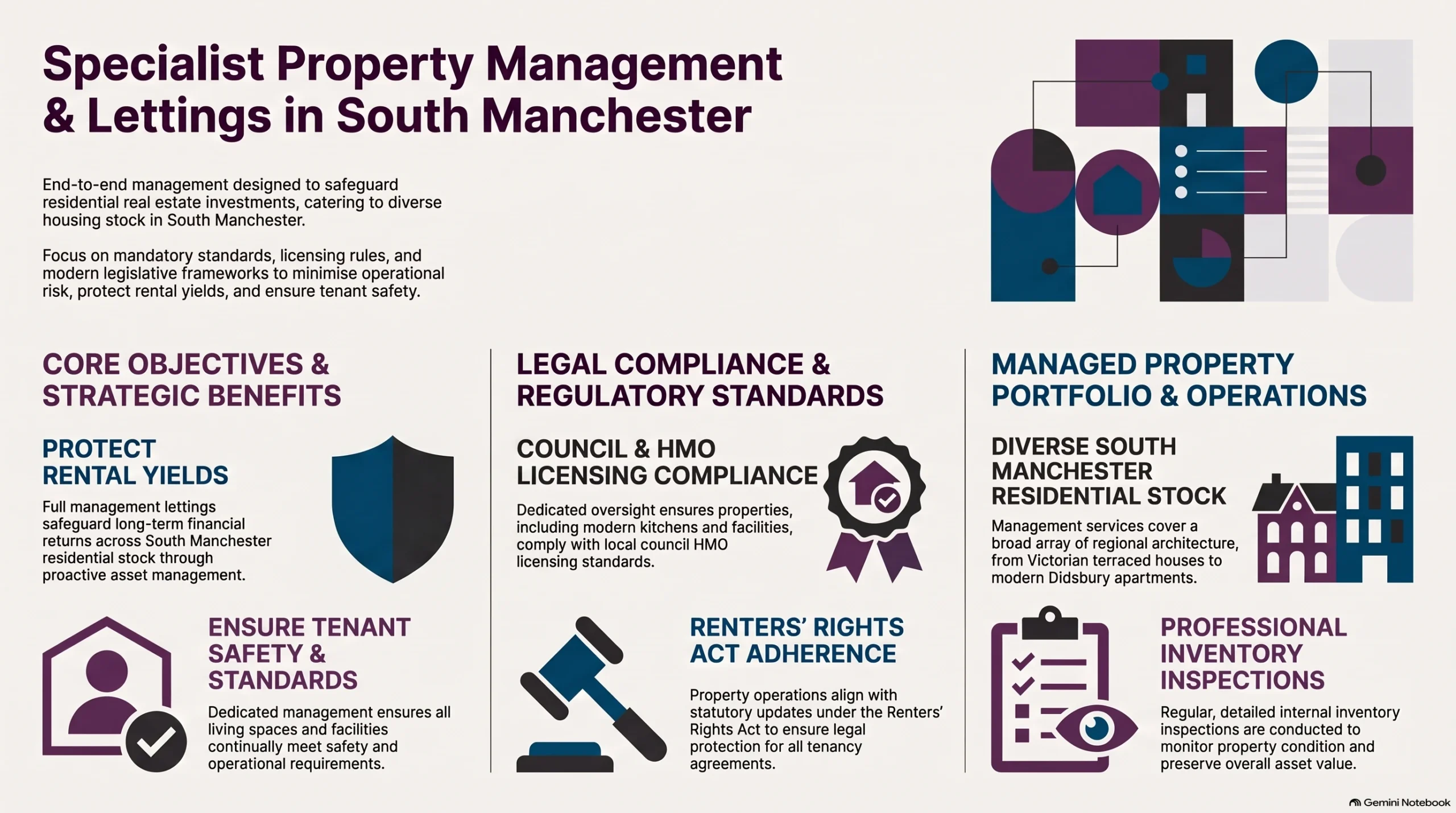
Professional property management and lettings demand strict operational discipline across South Manchester. Victorian conversions sit alongside modern residential developments throughout the region. Landlords encounter major statutory adjustments under the Renters’ Rights Act. In addition, Manchester City Council enforces rigorous HMO licensing schemes. Maintaining dependable rental income requires more than casual rent collection. Robust tenancy agreements, thorough referencing, and proactive maintenance protect residential capital. These operational procedures keep tenancies fully compliant across every month of occupation.
How can property owners insulate residential portfolios against severe licensing penalties whilst sustaining consistent rental yields across competitive districts? Strategic portfolio administration combines practical market insight with meticulous statutory compliance to protect landlords across every urban corridor. Can private landlords afford to risk non-compliance when administrative oversights trigger civil penalties exceeding tens of thousands of pounds?
Key Takeaways
- Full management lettings shield landlords from statutory fines, with dedicated managers enforcing prompt licensing submissions and accurate tenancy documentation.
- Manchester City Council applies a city-wide Article 4 Direction, so converting any dwelling into a shared house needs full planning consent.
- Section 21 abolition creates rolling periodic contracts, making detailed inventories and verifiable evidence critical during disputed Section 8 possession claims.
- Planned preventative maintenance cuts void periods and emergency repair fees, with routine assessments catching damp before hazards trigger enforcement.
- Property management and lettings across South Manchester demand rigorous local vetting, securing qualified long-term tenants in competitive student and professional districts.
South Manchester Rental Metrics and Compliance Standards
South Manchester presents distinct yield profiles and administrative obligations across its primary residential postcodes. Selecting the appropriate management strategy requires an objective analysis of local tenant demographics alongside municipal regulations. The comparative table below outlines prevailing rental yields, tenant demographics, and statutory priorities governing residential operations.
Recognising these geographic disparities ensures that property owners select suitable operational workflows for their specific properties. Suburban corridors like Didsbury offer strong capital stability. Conversely, high-occupancy areas such as Fallowfield demand meticulous licensing supervision. Aligning portfolio management with hyper-local conditions minimises vacancy rates whilst maintaining rigorous regulatory compliance across all assets.
| District and Postcode | Gross Rental Yield | Primary Demographic | Statutory Priority |
|---|---|---|---|
| Fallowfield (M14) | 8.1% – 11.0% | Students and Medical Staff | Mandatory HMO and Article 4 Planning |
| Didsbury (M20) | 4.0% – 5.5% | Established Professionals | Periodic Tenancy Retention and EPC Fabric |
| Chorlton (M21) | 4.2% – 5.2% | Creative and Tech Professionals | Conservation Area Compliance and EPC C |
| Levenshulme (M19) | 5.5% – 7.0% | Young Commuters and Families | Selective Licensing and Heating Safety |
| Hulme (M15) | 6.5% – 8.5% | Graduates and Academics | High-Rise Building Safety Management |
Legislative Adjustments Under the Renters’ Rights Framework
Transition to Assured Periodic Tenancies
Assured Shorthold Tenancies convert into open-ended Assured Periodic Tenancies under the new legislation. This change ends traditional fixed-term tenancy commitments completely. Tenants can terminate their tenancy at any stage by providing two months of formal written notice. Landlords must issue a statutory government information sheet to all existing occupants within specified deadlines.
Existing agreements do not require full redrafting. However, contractual break clauses and fixed-term wording become inoperative automatically. Adapting to this rolling framework means tenancy retention depends directly upon property quality. Landlords must also ensure swift maintenance responses and transparent communications. Failure to serve mandatory written terms exposes landlords to civil penalties of up to £7,000.
Mandatory Grounds Under Section 8 Possession
Evicting tenants without fault via Section 21 is legally abolished under the updated statutory framework. Property owners must now establish specific statutory grounds under Section 8 to regain legal possession. Mandatory grounds provide distinct routes for landlords intending to sell or occupy the residence personally. In addition, rent arrears thresholds have been revised significantly.
For property sales or personal occupation under Grounds 1 and 1A, landlords must serve four months of notice. These specific grounds cannot be initiated during the initial twelve months of any tenancy. Furthermore, the mandatory rent arrears threshold under Ground 8 requires three full months of non-payment. The notice period also doubles to four weeks. Accurate documentation and signed payment schedules form the foundation of successful possession applications.
Municipal Planning and HMO Licensing Requirements
Article 4 Directives and Council Planning Policies
Manchester City Council enforces a borough-wide Article 4 Direction that restricts typical development rights. Property owners cannot convert standard family dwellings into small shared houses under permitted development. Full planning permission is mandatory for shared residences housing as few as three unrelated occupants. These strict planning guidelines apply across all residential postcodes in the city.
Under local planning policy H11, applications for new shared houses face frequent refusals in saturated districts. Refusals occur when shared housing concentration within a 100-metre radius is already elevated. Preserving a Certificate of Lawful Use for pre-existing shared stock is therefore crucial. Losing lawful status can reduce asset value by up to 30 percent. Property investors should conduct rigorous planning audits before completing purchases or reconfiguring tenancy structures.
Three-Tier Licensing and Amenity Standards
Operating a multi-let property in Manchester requires strict adherence to distinct licensing schemes. Properties accommodating five or more people across multiple households need mandatory licences. Furthermore, specific municipal wards enforce selective licensing schemes for all private lettings. Landlords must identify their precise licensing obligations to avoid substantial statutory enforcement action across regional rental portfolios.
Licensing standards demand compliance with strict minimum room sizes across all shared properties. A single adult bedroom requires at least 6.51 square metres. A double adult room requires a minimum of 10.22 square metres. Fire protection regulations require Grade D interlinked smoke alarms, kitchen heat sensors, and FD30 fire doors. Operating without a valid licence exposes landlords to civil penalties reaching £30,000 alongside rent repayment orders.
Did You Know?
Manchester City Council operates a city-wide Article 4 Direction for shared houses. Converting a family home into a shared house of three or more occupants requires full planning consent. Unlicensed operations risk civil penalties of up to £30,000.
Tenant Acquisition and Marketing Excellence
Strategic Pricing Without Rental Bidding
Recent legislation strictly bans rental bidding wars across the private rented sector. Letting agents and landlords cannot solicit or accept offers that exceed advertised rental figures. Properties must display a precise asking price across all advertising portals. Vague terms like offers over or price on application are now illegal.
Accepting voluntary overbidding from applicants triggers severe civil penalties of up to £7,000. This statutory rule eliminates the practice of testing inflated values on open portals. Accurate market valuations driven by granular local metrics guarantee optimal yields without causing protracted marketing voids. Full management lettings provide the detailed comparative data required to set realistic asking rents. Professional pricing attracts high-calibre applicants whilst operating within strict legal boundaries.
Flexible Evening Viewings and Professional Vetting
Conducting evening and weekend viewings captures high-earning professionals across South Manchester. Employed applicants often cannot attend viewing appointments during standard office hours. Accompanied property viewings permit thorough initial screening before formal referencing commences. Comprehensive referencing checks applicant employment records, credit history, and personal identity to verify authentic affordability.
Professional tenant referencing must assess rent-to-income ratios thoroughly rather than relying solely on surface credit scores. In high-demand corridors like Didsbury and Chorlton, matching suitable occupants to properties reduces tenancy turnover substantially. Rigorous pre-tenancy vetting combined with ARLA-standard tenancy documentation protects the owner’s investment from future default. Clear agreements establish unambiguous contractual expectations from the very start of the tenancy.
The Railton-Meeks Compliance Audit Tool
Check Your Compliance & Protect Your Portfolio
Asset Protection Through Active Maintenance
Preventative Property Inspections and Damp Protocols
Scheduled periodic inspections protect residential assets by identifying minor building defects before structural deterioration occurs. Thorough inspection routines incorporate moisture evaluations and ventilation assessments across all living spaces. These regular reviews align directly with statutory Decent Homes Standards. Furthermore, regular physical visits ensure compliance with modern housing health and safety guidelines.
Under extended private-sector damp regulations, landlords must investigate severe moisture hazards within ten to fourteen days. They must also provide a written report promptly to the occupant. Installing humidistat extractors and repairing masonry defects prevents hazardous mould development. Mid-tenancy inspections also maintain open dialogue with tenants. Positive communication encourages longer tenancies and lowers vacant periods across the portfolio.
Reliable Contractor Networks and Direct Triage
Direct maintenance triage resolves basic domestic faults over telephone or video calls. This efficient operational process eliminates unnecessary contractor call-out fees for landlords. When repairs require physical attendance, trusted in-house tradespeople deliver swift service and competitive rates. High-quality workmanship protects residential capital across all property management and lettings.
Relying on pre-vetted trade professionals avoids inflated emergency charges for routine gas, plumbing, and electrical repairs. Pre-tenancy engineering creates indisputable baseline condition records for every room. These records include annual Gas Safety certificates, Electrical Installation Condition Reports, and photographic inventories. High-definition photographic evidence protects deposit deductions against tenancy dispute claims. This systematic approach ensures minor maintenance works do not escalate into costly legal arguments.
Railton-Meeks offers four landlord service tiers across Manchester and Cheshire
Financial Reporting and Account Stewardship
Transparent Landlord Accounting and Digital Records
Clear monthly landlord statements provide detailed visibility over rental receipts, management deductions, and maintenance expenditures. Modern financial software generates structured digital statements that export directly into accounting systems. This seamless integration simplifies mandatory Making Tax Digital reporting for higher-income investors. Transparent financial management preserves pristine records for statutory compliance and portfolio tracking.
Effective stewardship also requires rapid deposit protection within statutory thirty-day windows under government-approved schemes. Serving prescribed information correctly prevents severe financial penalties and keeps deposit claims legally enforceable. Digital statement delivery provides real-time clarity regarding income and property costs. Structured accounting helps owners track net yields accurately across each individual asset. Transparent financial administration ensures seamless annual tax filings and dependable portfolio forecasting.
Rapid Rent Arrears Intervention Systems
Automated arrears tracking flags missed rental payments within twenty-four hours of non-receipt. Experienced property managers contact occupants immediately before debt accumulates into an unmanageable financial liability. Because mandatory Section 8 possession now demands three full months of arrears, prompt intervention remains essential. Swift action mitigates severe financial exposure for private landlords.
Structured arrears procedures combine automated digital reminders with direct telephone conversations to identify why payment stalled. Where appropriate, tailored payment schedules resolve temporary cash-flow problems without court litigation. Maintaining complete rent ledgers and written correspondence provides vital legal evidence if possession notices become necessary. Early engagement protects cash flow whilst preserving positive landlord-tenant relationships whenever possible.
Instant Rental & Block Valuation
Get Your Valuation & Know Your Market Value
Environmental Standards and Energy Retrofitting
Dual-Metric EPC Compliance Targets
Domestic rental properties must achieve an Energy Performance Certificate rating of C by October 2030 across England. The regulatory assessment framework evaluates primary fabric efficiency alongside secondary heating or smart readiness metrics. Upgrading older solid-wall Victorian terraces across South Manchester requires sensible forward planning. Proactive retrofitting safeguards legal letting capability and reduces domestic heating bills.
Securing an EPC rating of C under current assessment rules grants grandfathered compliance for up to ten years. Landlords can lock in statutory protection before new assessment rules take effect. Energy efficiency upgrades also attract quality tenants who prioritise manageable utility bills. Well-insulated rental properties experience lower moisture accumulation and reduced structural maintenance problems. Early investment protects rental income whilst enhancing overall capital appreciation.
Financial Caps and Grant Availability
Statutory cost caps limit landlord expenditure to a maximum of £10,000 inclusive of VAT for each property. When energy improvements exceed this limit without achieving a C rating, landlords can register a ten-year exemption. Qualifying investments completed since late 2025 count directly toward this statutory financial threshold.
Property owners can access public funding schemes to offset major retrofit expenses. The Great British Insulation Scheme subsidises loft and cavity wall installations for lower council tax properties. In addition, the Boiler Upgrade Scheme provides substantial grants for modern air source heat pumps. Strategic guidance helps landlords upgrade their residential assets cost-effectively. Targeted improvements protect cash reserves whilst ensuring total regulatory compliance.
Suburb-Specific Rental Dynamics Across South Manchester
Capital Growth in Didsbury and Chorlton
Didsbury and Chorlton deliver exceptional capital growth and attract affluent professional households across South Manchester. These suburbs benefit from prestigious schools, independent retail, and extensive transport connections. Although gross yields benchmark between 4.0% and 5.5%, these prime postcodes offer outstanding long-term security. Tenant longevity and minimal void periods protect rental returns.
Period properties along West Didsbury’s Burton Road corridor and Chorlton Green demand careful conservation upkeep. Tailoring property management and lettings for South Manchester residential stock requires rigorous referencing to secure respectful occupants. High-earning tenants value well-maintained properties and tend to remain in situ for extended tenancies. Low void rates protect net yields despite higher initial acquisition costs. Professional management maintains property standards and safeguards capital values over time.
High Cash-Flow Markets in Withington and Rusholme
Withington, Fallowfield, and Rusholme offer attractive gross rental yields ranging from 6.8% to 11.0%. Continuous demand from medical professionals and students drives strong cash flow fundamentals throughout these districts. Proximity to the Oxford Road hospital campus ensures year-round occupancy for well-maintained shared residential stock.
Maximising profitability in these lively postcodes requires continuous licensing oversight and prompt maintenance. Grandfathered shared housing assets with established planning documentation represent valuable income-generating investments. Specialist property managers oversee amenity compliance, utility agreements, and annual student turnover cycles. Meticulous operational management insulates landlord margins against rising local costs. Structured oversight protects long-term asset value in competitive urban rental markets.
HMO Specialist Yield & Tax Calculator
Calculate Your Yield & Offset New Tax Burdens
Final Thoughts
Professional property management and lettings in South Manchester demand an integrated approach combining legal precision with local insight. Rental regulations continue to tighten under national legislation and municipal licensing schemes. Managing residential properties successfully requires sustained diligence and structured operational systems. Landlords who modernise tenancy agreements, execute routine property inspections, and maintain transparent financial records will achieve dependable rental growth.
The evolving market rewards property owners who treat rental portfolios as commercial assets requiring active technical oversight. Planned investments in energy efficiency, structural maintenance, and comprehensive documentation create attractive homes for responsible occupants. By maintaining procedural precision across every tenancy, private landlords can protect capital equity and safeguard long-term yields.
Frequently Asked Questions
A:
The abolition of Section 21 removes no-fault evictions across England. All fixed-term agreements convert automatically into open-ended Assured Periodic Tenancies. Landlords seeking possession must cite specific statutory grounds under Section 8. These grounds include selling the property, moving in personally, or dealing with serious rent arrears. Possession claims now require solid documentary evidence, including signed inventories and clear payment records. Accurate notices and detailed compliance records are essential to regain possession through the county court.
A:
Yes, Manchester City Council enforces a city-wide Article 4 Direction. This policy removes permitted development rights for converting family dwellings into small shared houses. Owners must obtain full planning consent before housing three to six unrelated individuals. The council frequently refuses new applications under Policy H11 in areas with high HMO concentrations. Landlords should protect Certificates of Lawful Use for pre-existing shared houses. Losing lawful status can reduce overall property value by up to thirty percent.
A:
Full management lettings provide comprehensive operational support, shielding landlords from legal exposure and daily administrative stress. Specialist letting agents organise statutory safety certifications and perform stringent referencing. They protect deposits within statutory thirty-day windows and manage maintenance triage. Furthermore, professional management provides transparent monthly financial reporting compatible with Making Tax Digital requirements. Scheduled inspections identify damp or structural hazards early. In addition, proactive rent collection prevents serious arrears from accumulating over time.
A:
All domestic private rented properties must achieve an Energy Performance Certificate rating of C by October 2030. For older solid-wall Victorian terraces throughout South Manchester, landlords must plan energy efficiency improvements carefully. Recommended measures include loft insulation, modern heating controls, and upgraded glazing. Expenditure is capped at £10,000 for each property inclusive of VAT. If compliant ratings cannot be achieved within that threshold, owners can register an official ten-year cost cap exemption.
A:
Offering flexible evening and weekend viewings accommodates fully employed professionals and healthcare staff. Many high-calibre applicants cannot attend viewings during standard office hours. Broadening appointment availability expands the pool of qualified applicants and reduces vacant periods significantly. Accompanied evening viewings also enable experienced agents to assess applicant reliability in person. This thorough approach establishes reliable tenancies across competitive suburban corridors like Didsbury and Chorlton.
