

Landlord Exit Strategy Manchester: When Rules Tighten
Formulating an effective landlord exit strategy Manchester property owners can execute with confidence requires a clear evaluation of tightening legislative demands. The Renters’ Rights Act 2025, shifting licensing tiers, and forthcoming energy efficiency standards have compressed margins across Greater Manchester portfolios. Whether operating student lets in Fallowfield or Victorian terraces in Levenshulme, landlords face expanding compliance burdens that erode net returns. A structured exit process enables investors to preserve equity. It also minimises tax liabilities and avoids sudden statutory penalties during asset disposal.
Rising regulatory scrutiny forces owners to weigh orderly individual unit divestment against collective portfolio transactions. Higher mortgage rates and statutory repair obligations further accelerate the need for strategic offloading. How can investors protect their capital gains whilst balancing tenant rights under mandatory possession frameworks? Furthermore, how can they navigate local planning controls and shifting regional market dynamics across the city?
Key Takeaways
- The abolition of Section 21 forces landlords to rely on mandatory Section 8 Ground 1A notices. These notices require four months of statutory notice.
- Disposing of grandfathered Houses in Multiple Occupation across South Manchester demands pristine planning documentation. Missing records can reduce asset values by up to thirty percent.
- Portfolio owners can choose between selling tenanted stock directly to fellow investors. Alternatively, they can orchestrate vacant possession sales for higher owner-occupier market values.
- Forthcoming energy efficiency mandates cap expenditure at ten thousand pounds per dwelling. These rules heavily influence whether landlords should upgrade solid-wall properties or sell immediately.
- Making Tax Digital and corporate structuring shape portfolio disposals. Owners must decide whether selling individual assets or transferring company shares offers better post-tax realisation.
Strategic Comparison: Primary Disposal Routes for Manchester Landlords
Choosing between an individual vacant possession sale and a whole portfolio disposal determines your final timeline and net capital extraction. Each route carries distinct legal obligations under the Renters’ Rights Act 2025. You must also consider transactional frictions across different Manchester postcodes. Evaluating these pathways against your investment timeframe ensures maximum equity preservation. For landlords who want to exit with the tenants staying put, it is possible to sell rental property with the tenancy in place.
Professional landlords often combine multiple disposal methods across diverse property types. High-yield multi-let properties in M14 or M13 frequently attract institutional buyers as going concerns. In contrast, two-bedroom period terraces in Didsbury or Chorlton achieve premium prices from owner-occupiers. Those sales require achieving full vacant possession first.
| Disposal Route | Target Buyer | Typical Timeline | Possession Requirement | Key Legal Friction |
|---|---|---|---|---|
| Vacant Market Sale | Owner-Occupiers | 4-8 Months | Fully Vacant | Ground 1A 4-Month Notice |
| Tenanted Single Let | Private Investors | 3-5 Months | Tenant in Situ | Tenancy Terms Assignment |
| Portfolio Block Sale | Corporate Funds | 2-4 Months | Mixed Tenancies | Commercial Due Diligence |
| Auction Disposal | Cash Buyers | 1-2 Months | Vacant or Let | Accelerated Legal Pack Completion |
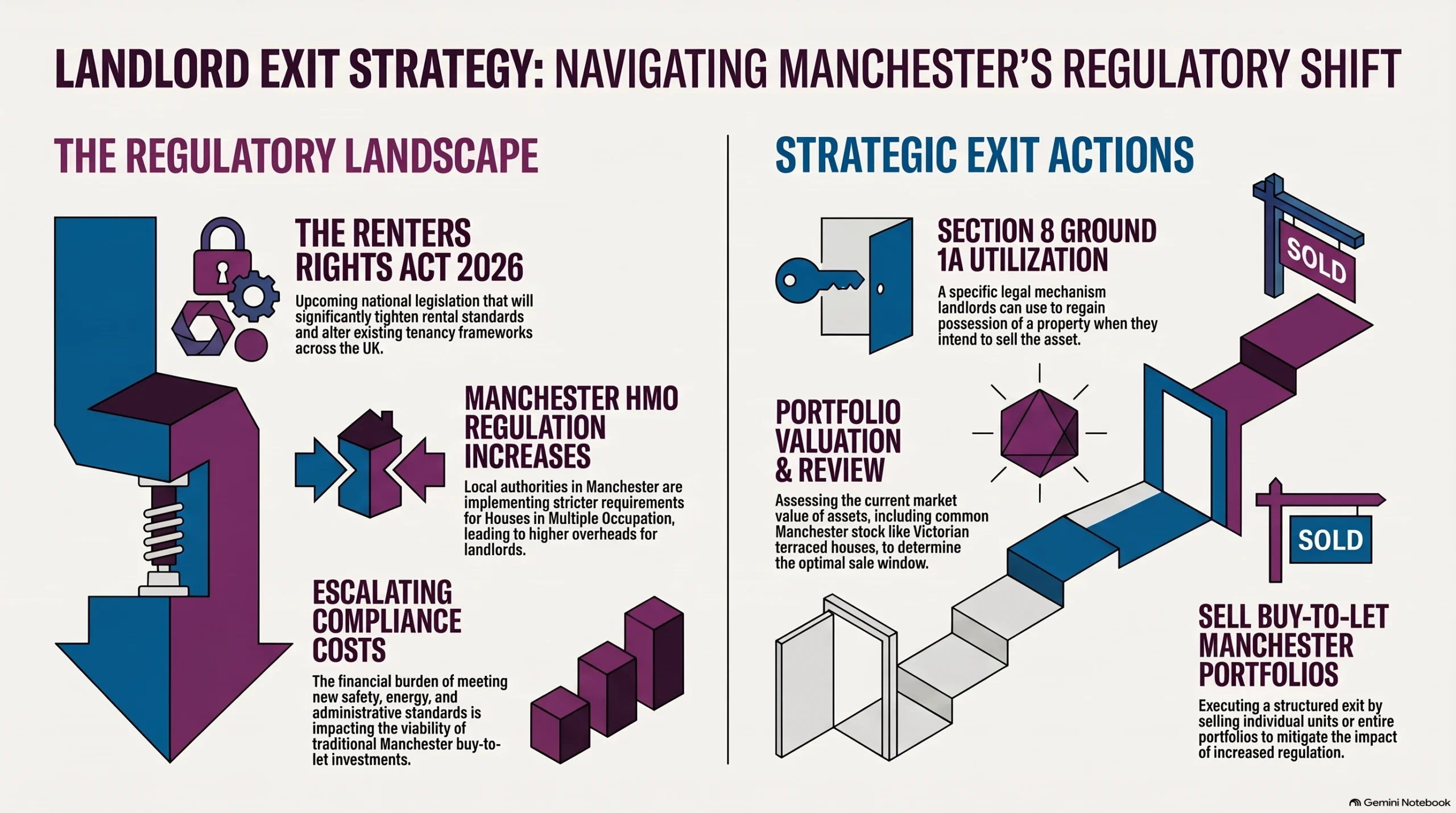
Statutory Triggers Transforming Manchester Rental Portfolios
Possession Grounds Under the Renters’ Rights Act 2025
The abolition of Section 21 on 1 May 2026 fundamentally alters how landlords prepare assets for sale. To sell buy to let Manchester holdings, owners must now serve a mandatory Section 8 Ground 1A notice. This statutory notice requires four full months of advance warning before landlords can initiate court action.
Landlords cannot invoke Ground 1A within the initial twelve months of a tenancy. Furthermore, existing tenancies automatically transition into rolling periodic agreements. This change removes fixed terms and contractual break clauses. If tenants refuse to vacate, owners must attend a full court hearing. Accelerated possession procedures will no longer exist. Landlords must plan disposal timelines well in advance of marketing.
Transitional Deadlines and Pre-May Possession Claims
Landlords serving Section 21 notices on or before 30 April 2026 had to adhere to strict transitional enforcement deadlines. Court proceedings under valid notices had to commence by 31 July 2026. Alternatively, they must begin within six months of service. Missing this cutoff invalidates the notice and blocks repossession under the old rules.
Failing to issue proceedings by the backstop date requires restarting under Ground 1A. That mistake adds at least four months to the disposal roadmap. Legal expenses insurance must cover Section 8 disputes. Court backlogs across Greater Manchester can extend repossession timeframes considerably. Smart portfolio owners audit tenancies promptly to resolve lingering possession issues before selling.
Article 4 Restrictions and South Manchester HMO Disposals
Lawful Use Certification in High-Density Student Enclaves
Manchester City Council enforces a strict city-wide Article 4 Direction across every ward. This directive removes permitted development rights between family dwellings and small shared houses. When preparing an HMO sale in Fallowfield or Withington, a valid Certificate of Lawful Use is essential. It protects existing commercial property asset values.
Under the Council’s adopted HMO policy, planning officers routinely refuse new permissions in areas with high multi-let density. If a vendor cannot prove continuous lawful use, buyers face valuation write-downs of twenty to thirty percent. Institutional buyers require unbroken tenancy agreements, council tax records, and planning approvals. Without this paperwork, sales frequently stall during conveyancing.
Planning Class Distinction Between C4 and Sui Generis Assets
Properties housing seven or more unrelated occupants enter the Sui Generis planning classification rather than standard C4 status. Sui Generis HMOs always demand full planning permission regardless of permitted development rules. A landlord exit strategy when regulation increases must verify that room dimensions and fire standards satisfy heightened council requirements.
Licensing space standards mandate minimum bedroom floorspace of 6.51 square metres for single adults. Double rooms require at least 10.22 square metres. Properties failing planning regularisation risk 12-month probationary licences rather than standard five-year approvals. An unregularised property limits the buyer pool. Sellers must often offer discounts or complete costly alterations before listing.
Did You Know?
Manchester City Council operates a city-wide Article 4 Direction. It removes permitted development rights for small HMO conversions across every ward. Failing to provide a Certificate of Lawful Use during a sale can depress property values by up to 30%.
Vacant Possession Versus Tenanted Portfolio Divestment
Owner-Occupier Demand in Prime South Manchester Suburbs
Selling properties with vacant possession unlocks access to the high-demand owner-occupier market across desirable South Manchester suburbs. Suburbs like Didsbury, Chorlton, and Bowdon command premium prices from homebuyers. However, achieving vacant possession requires serving four months of statutory notice. Landlords must also manage prolonged unlet void periods before completing a sale.
In prime postcodes like M20, period terraces often sell within weeks of listing. Vacant possession yields the highest net return despite council tax liability and lost rent. Owners must budget for utility bills, light cosmetic improvements, and mortgage payments during marketing. For unencumbered suburban stock, this disposal route remains the benchmark for maximising capital extraction.
Institutional Transactions for Tenanted Rental Portfolios
Selling tenanted properties to institutional investors avoids costly void periods and maintains continuous cash flow throughout conveyancing. This method proves particularly effective for high-yielding shared houses in Rusholme, Hulme, and Levenshulme. Buyers evaluate these acquisitions primarily on net operating yields, tenant payment histories, and statutory property licensing compliance.
Portfolio transfers require meticulous compilation of tenant documentation. Landlords must show proof of deposit protection within statutory thirty-day windows alongside signed prescribed information. Acquirers conduct thorough due diligence on rent ledgers, electrical certificates, and inventory reports. Packaging properties cleanly as operating assets attracts corporate buyers who complete transactions without tenant disruption.
The Railton-Meeks Compliance Audit Tool
Check Your Compliance & Protect Your Portfolio
Energy Standards and Retrofit Capital Expenditure Caps
EPC Grade C Mandate and Legacy Window Provisions
Rules under the Warm Homes Plan require every rented home across England to reach EPC C by 1 October 2030. Landlords who secure an EPC C rating under current metrics before October 2029 receive legacy compliance status. This grandfathering protects certificates for their full ten-year validity period across tenancies.
For older Victorian solid-wall housing in M14 or M19, reaching Grade C demands substantial capital expenditure. Typical upgrades require external wall insulation, heat pumps, and double glazing. If retrofit costs exceed projected rental returns, early disposal prevents unrecoverable capital losses before new fabric metrics arrive.
Ten Thousand Pound Cost Cap and Statutory Exemptions
Statutory frameworks cap landlord retrofit spending at ten thousand pounds inclusive of VAT per property before granting exemptions. Qualifying energy efficiency improvements completed after October 2025 count toward this financial threshold. Landlords with properties valued under one hundred thousand pounds benefit from a reduced cap of ten percent.
Registering an exemption permits a ten-year letting reprieve if capital expenditure reaches the statutory ceiling. However, prospective buyers heavily discount properties with low energy ratings due to future performance mandates. Selling prior to required capital outlays or accessing grant funding allows landlords to preserve liquidity before exiting.
Railton-Meeks offers four landlord service tiers across Manchester and Cheshire
Tax Governance and Operational Reporting Burdens
Mandatory Digital Bookkeeping Under MTD Frameworks
From 6 April 2026, landlords earning gross rental income above fifty thousand pounds must keep digital records. They must submit quarterly summaries to HMRC. This administrative requirement adds operational overhead for unincorporated property owners. Failing to use compatible accounting software invites statutory civil penalties and rising accountancy costs.
Submitting four quarterly updates followed by a final declaration removes the simplicity of annual self-assessment returns. Many private landlords who manage their own properties view this digital obligation as an administrative burden. Establishing an exit timetable before quarterly reporting cycles commence avoids complex operational restructures and software overhead.
Capital Gains Tax and Corporate Restructuring Realities
Disposing of rental property held in personal names triggers immediate Capital Gains Tax obligations payable within sixty days of completion. Landlords operating through limited companies can consider selling corporate shares rather than property titles. Share transactions frequently offer substantial Stamp Duty savings for prospective corporate purchasers.
Unincorporated landlords face higher effective tax rates and cannot fully deduct mortgage interest under Section 24 rules. When planning a phased portfolio wind-down, spreading disposals across tax years utilises annual allowances efficiently. Professional tax advice ensures sellers offset historic capital losses and optimise net proceeds upon final settlement.
Instant Rental & Block Valuation
Get Your Valuation & Know Your Market Value
Regional Market Nuances Shaping Portfolio Divestment
Yield Trends and Buyer Appetites in Core Urban Districts
City centre apartments in M1, M2, and Salford Quays offer robust liquidity. However, they suffer yield compression from escalating annual service charges. High-rise blocks also face rigorous oversight under the Building Safety Act 2022. Landlords divesting urban flats must demonstrate transparent digital safety data to satisfy prospective institutional buyers.
Service charges averaging well over one thousand pounds annually erode net yields on modern city centre apartments. Conversely, regeneration corridors like Victoria North and Old Trafford attract investors seeking long-term capital appreciation. Disposing of urban units requires clear evidence of building compliance, completed cladding remediation, and up-to-date EWS1 certification for mortgage lenders.
Suburban Resilience Across High-Equity Cheshire Corridors
Affluent commuter belts including Wilmslow, Alderley Edge, and Hale present high capital values and lower gross yields. Properties in these districts appeal strongly to high-net-worth buyers and relocating corporate executives. Disposals focus on pristine presentation and meticulous maintenance records rather than aggressive cash yields.
Detached family homes in SK9 and WA15 maintain strong transactional liquidity due to excellent local school catchments. In these high-value enclaves, properties sell rapidly if priced accurately. Disposals proceed smoothly when owners present comprehensive documentation confirming regularised alterations, historic building permissions, and full statutory compliance. Our guide to the benefits of ARLA property management goes into this in more detail.
Orderly Execution of a Managed Portfolio Exit
Pre-Sale Compliance Auditing and Risk Mitigation
Executing a clean property sale requires an exhaustive pre-marketing compliance audit across all tenancy files and safety certifications. Landlords must assemble valid Gas Safety records, Electrical Installation Condition Reports, and Energy Performance Certificates. Ensuring deposit protection documents remain completely flawless eliminates potential financial penalties and conveyancing delays during sales.
Under the Renters’ Rights Act 2025, non-compliance with statutory notifications carries civil penalties of up to seven thousand pounds. Acquirers’ solicitors scrutinise compliance histories rigorously. Resolving minor repairs, clearing maintenance backlogs, and certifying fire doors prior to listing removes buyer leverage. This preparation prevents aggressive post-survey price negotiations.
Phased Disposals Versus Bulk Auction Disposals
Landlords must decide whether to liquidate property holdings simultaneously through specialised auctions or execute a phased private treaty wind-down. Phased sales maximise gross receipts by targeting individual market niches over several years. Bulk auctions provide rapid contractual certainty within twenty-eight days at somewhat discounted valuations.
A phased strategy enables landlords to absorb capital gains tax liabilities over successive financial years. It also allows capital reallocation into lower-maintenance alternative investments. Conversely, bulk auctions eliminate prolonged void risks, compliance headaches, and repeated professional marketing fees. Evaluating debt exposure, mortgage redemption charges, and retirement horizons determines the optimal disposal velocity.
HMO Specialist Yield & Tax Calculator
Calculate Your Yield & Offset New Tax Burdens
Final Thoughts
Developing a robust landlord exit strategy Manchester property owners can implement is no longer a speculative exercise. Increasing regulatory oversight, stringent HMO licensing enforcement, and mandatory energy retrofit deadlines make unmanaged portfolio holdings increasingly vulnerable. Whether selling individual vacant units to families or offloading blocks to corporate buyers, success relies on thorough documentation and planning.
Strategic exits protect decades of accumulated equity from statutory fines and market shifts. Landlords who audit their portfolios proactively, secure lawful use certificates, and navigate possession frameworks systematically will achieve superior capital realisation. As Greater Manchester continues to professionalise, an orderly departure remains the most reliable safeguard for private property capital.
Frequently Asked Questions
A:
Since 1 May 2026, landlords wishing to sell an occupied home must serve a mandatory Section 8 Ground 1A notice. This statutory notice requires a four-month notice period. Landlords cannot serve it during the first twelve months of a tenancy. You must prove a genuine intention to sell on the open market. If tenants do not vacate upon expiry, you must issue court possession proceedings. The accelerated possession procedure will no longer be available for these sales.
A:
Selling an HMO without a Certificate of Lawful Use is possible but involves substantial financial risk. Manchester City Council enforces a strict city-wide Article 4 Direction. Consequently, shared houses cannot rely on permitted development rights. Without formal documentation proving established lawful use, prospective buyers face enforcement action. Mortgage lenders frequently refuse financing on uncertified properties. As a result, sellers often must accept cash offers at discounts of twenty to thirty percent below standard market valuations.
A:
Under the Warm Homes Plan, the statutory spending cap for energy improvements is ten thousand pounds inclusive of VAT per rental dwelling. Qualifying improvements completed from October 2025 onwards count toward this threshold. If a property fails to achieve EPC C after spending this maximum sum, the landlord can register an official exemption. This exemption lasts for ten years. For properties valued under one hundred thousand pounds, the expenditure cap drops to ten percent of property value.
A:
From 6 April 2026, landlords earning gross rental income above fifty thousand pounds must keep digital records. They must submit quarterly summaries to HMRC. This obligation introduces ongoing software expenses and complex bookkeeping routines. Landlords planning to sell buy to let Manchester properties often time their disposals before these deadlines. An early sale avoids the need to set up digital reporting systems. This strategy proves particularly attractive when winding down personally held, unincorporated property portfolios.
A:
Profitability depends on property location, tenant status, and your target buyers. Selling individual units with vacant possession to owner-occupiers typically yields the highest price. This is especially true in high-demand areas like Didsbury or Chorlton. However, this route involves rental voids and four-month statutory notice periods. Selling an entire tenanted portfolio directly to another investor provides uninterrupted rental income and fast completion. Nonetheless, portfolio buyers usually expect a bulk purchase discount reflecting prevailing investment yields.
