

ARLA Property Management: Benefits for Manchester Landlords
Operating as a private landlord in Greater Manchester requires strict adherence to statutory standards. Selecting ARLA property management ensures your assets remain compliant with shifting tenancy legislation. Professional accreditation provides property owners with genuine operational transparency. It also delivers verified financial security and methodical oversight across every stage of the rental lifecycle. Accredited professionals help mitigate serious legal exposures. These exposures could otherwise trigger severe civil financial penalties from local councils. Professional management protects both your rental yields and long-term capital assets.
Statutory adjustments are transforming possession procedures and building safety rules across the regional private rented sector. Managing rental properties without formal accreditation carries substantial commercial risk for private landlords. Operational changes demand higher standards of care. How can property investors secure accredited asset stewardship across competitive rental markets like Manchester?
Key Takeaways
- Instructing an accredited agency guarantees that your rental revenue remains ring-fenced under mandatory client money protection schemes. This protection eliminates catastrophic financial loss for landlords.
- Independent redress scheme membership ensures landlords and tenants receive impartial dispute resolution through government-approved ombudsman services. This avoids the excessive costs of formal court hearings.
- Accredited letting agents hold specialist training in Manchester City Council Article 4 controls, mandatory HMO licensing and statutory tenant safety requirements.
- Verified letting practices shield landlords from civil penalties reaching thirty thousand pounds through meticulous record-keeping and proactive safety inspections.
- Rigorous accounting and regular independent audits deliver full taxation transparency whilst protecting tenancy deposits and client balance disbursements across expanding portfolios.
Regulatory Protection and Professional Standards Overview
Professional property oversight separates accredited practitioners from unregulated market operators through statutory compliance safeguards and formal qualifications. The rental market across Greater Manchester demands technical precision. This precision prevents administrative oversights from turning into costly tribunal hearings or severe local council enforcement actions.
The comparative matrix below outlines key operational differences between an accredited property practice and an unregulated agency. It illustrates the exact layers of institutional security established to protect your private capital. These standards also defend rental yields and tenancy documentation.
| Regulatory Component | Unregulated Operator | ARLA Qualified Agent |
|---|---|---|
| Client Accounting | Unverified accounts | Independently audited client accounts |
| Financial Loss Safeguard | No statutory cover | Client Money Protection policy backed |
| Dispute Resolution | Discretionary or absent | Mandatory independent redress scheme |
| Staff Competency | No formal testing | Propertymark formal qualification framework |
| Legislative Preparedness | Reactive tracking | Proactive statutory audit protocols |
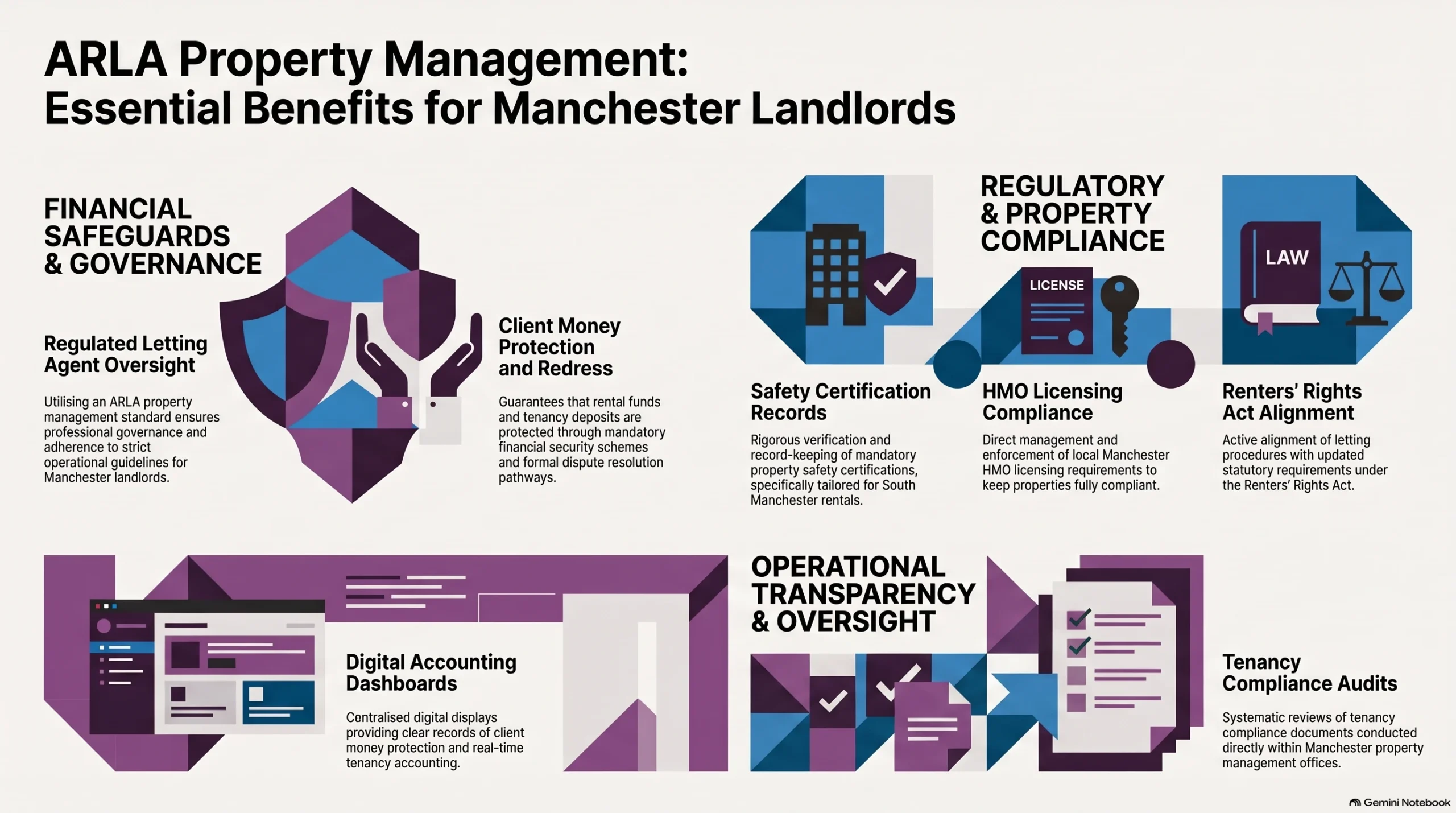
Financial Safeguards and Fiduciary Accountability
Protection of Landlord Funds and Client Accounts
Accredited letting practices must hold client balances within designated, segregated bank accounts. These accounts undergo regular independent accounting reviews. This stringent financial barrier ensures rental revenue and tenant deposits are never co-mingled with agency operational capital. Consequently, landlords avoid severe solvency risks.
The regulatory rules established by Propertymark demand continuous reconciliations and annual certified accountant inspections. For property owners in Manchester and Didsbury, this oversight confirms that every transaction remains traceable. From gross rental collection to contractor disbursements, funds remain secure and accessible without operational disruption.
Client Money Protection and Redress Scheme Integration
Working alongside a regulated letting agent gives property investors direct security through compulsory client money protection and redress mechanisms. These frameworks guarantee complete financial compensation if agency funds are misappropriated. Furthermore, statutory redress membership provides an objective adjudicator for tenancy management disputes.
Landlords possess guaranteed access to formal dispute procedures via the Property Redress Scheme or The Property Ombudsman. These independent ombudsman bodies enforce legally binding resolutions. As a result, disputes resolve swiftly without the protracted delays and high legal expenses associated with county court litigation.
Possession Procedures and Legislative Transition
Abolition of No-Fault Evictions Under Statutory Reforms
The national legislative landscape removes traditional Section 21 possession notices in favour of revised Section 8 grounds. Professional agents prepare property owners for this procedural transformation. They secure the exact documentary evidence required by county courts to validate future repossession applications successfully.
Under revised frameworks, landlords cannot rely on expedited possession procedures. Property managers must demonstrate flawless tenancy management to regain control of a property. This standard requires serving statutory tenancy guides on schedule. Managers must also maintain unblemished digital paper trails from day one of the tenancy.
Mandatory Ground 8 and Arrears Recovery Mechanics
Possession claims for persistent rent default require landlords to navigate expanded mandatory rent arrears thresholds under Section 8. An accredited property manager implements systematic credit control protocols. These managers identify missed payments within twenty-four hours to prevent arrears balances from exceeding critical statutory recovery limits.
Under revised rules, mandatory rent arrears notice requirements double from two weeks to four weeks. Additionally, arrears thresholds rise to three full months. Certified property managers deploy automated payment alerts and consistent communication logs. These proactive measures ensure landlords retain the robust legal foundation required for successful court claims.
Did You Know?
Manchester City Council operates a city-wide Article 4 Direction that removes permitted development rights. Converting a standard family dwelling into an HMO for three or more occupants therefore requires full planning permission. This applies regardless of licensing status.
Manchester HMO Licensing and Planning Controls
Article 4 Directions Across Local Postcodes
Manchester City Council enforces a comprehensive Article 4 Direction that restricts the standard conversion of family residences into shared rental housing. Professional letting agents audit historical tenancy records and local council filings. This process ensures existing multi-occupancy assets retain their vital Lawful Use Certificates without interruption.
In high-density rental districts like Fallowfield and Withington, planning authorities strictly enforce Policy H11. They frequently reject applications where student density exceeds local thresholds. Qualified managers ensure lawful status documentation is meticulously preserved. This diligence prevents landlords from suffering an immediate twenty to thirty percent impairment in asset capital value.
Amenity Standards and Fire Safety Compliance
Manchester HMO properties must comply with rigorous local amenity standards and Grade D interlinked fire detection mandates. Certified property managers conduct detailed room measurements and technical safety audits. They ensure bedrooms surpass statutory minimum thresholds of 6.51 square metres for single occupants and 10.22 square metres for doubles.
Council licensing officers conduct aggressive property inspections across South Manchester. Management teams ensure that FD30-rated fire doors with self-closing devices guard all bedrooms. Kitchen heat detectors must link directly to communal sounders. Meeting these structural standards prevents civil financial penalties that can climb to thirty thousand pounds per property.
The Railton-Meeks Compliance Audit Tool
Check Your Compliance & Protect Your Portfolio
Proactive Asset Maintenance and Risk Mitigation
Planned Preventative Maintenance Strategies
Deploying planned preventative maintenance shields property investors from expensive out-of-hours contractor call-outs and structural failures. Qualified property managers conduct thorough routine inspections. They identify degraded roof coverings, gutter blockages, and failing heating components early. This timely intervention prevents minor building defects from transforming into severe habitability disputes.
Managers schedule certified tradespeople for regular maintenance sweeps to keep properties in optimal commercial condition. In areas with older Victorian housing stock like Chorlton and Levenshulme, this disciplined approach preserves capital values. It also prevents moisture ingress and ensures rental properties consistently appeal to high-calibre professional occupants.
Awaab’s Law and Moisture Control Standards
The statutory expansion of Awaab’s Law into the private rental market imposes binding timetables on moisture, damp, and mould rectification. Accredited agents implement rigorous ventilation assessments during routine property visits. They initiate professional investigations within fourteen days and address emergency hazards within twenty-four hours.
Property managers fit humidistat-controlled mechanical ventilation units across rental kitchens and bathrooms to prevent indoor condensation. Comprehensive documentation of every inspection and moisture meter reading provides landlords with absolute evidentiary defence. This robust record protects owners against local authority enforcement action or retaliatory compensation claims.
Railton-Meeks offers four landlord service tiers across Manchester and Cheshire
Decarbonisation and Energy Efficiency Standards
Warm Homes Plan and Retrofit Roadmaps
National directives require all private rental properties in England and Wales to achieve an EPC rating of C by October 2030. Accredited property managers create tailored energy transition strategies. They advise landlords on qualifying retrofit options before statutory grace windows close. Professional oversight protects capital investment effectively.
Securing a valid EPC Band C rating prior to October 2029 locks in regulatory compliance for ten years under legacy rules. Professional managers help clients target cost-effective measures, such as enhanced cavity insulation. They ensure capital upgrades sit safely within the statutory ten thousand pound investment expenditure cap.
Ventilation Protocols and Heating System Upgrades
Meeting evolving fabric efficiency standards requires modernising traditional heating equipment alongside passive ventilation measures. Certified letting professionals oversee technical evaluations of legacy gas appliances. They recommend high-efficiency heating systems or air-source heat pump retrofits. These upgrades can often utilise available government grant funding mechanisms.
In conservation zones across Didsbury Village, Castlefield, and Bowdon, improving energy performance requires careful coordination with planning guidelines. Professional management teams supervise double-glazing replacements, internal wall insulation, and smart heating controls. These measures maintain heritage aesthetics whilst dramatically lowering operational running costs for tenants.
Instant Rental & Block Valuation
Get Your Valuation & Know Your Market Value
Rental Advertising Integrity and Tenancy Onboarding
Statutory Bans on Tenant Bidding Wars
Recent tenancy legislation bans the practice of inviting, encouraging, or accepting rental offers above the published marketing figure. Accredited agents implement precise valuation techniques to list properties at open-market value. This pricing accuracy ensures landlords attract strong demand without breaching new marketing prohibitions.
Letting listings cannot display speculative phrases such as offers over or price on application. Accepting rent above the advertised price triggers civil fines of up to seven thousand pounds. Consequently, professional agents enforce strict transaction checks across portal listings to ensure total marketing legality.
Digital Inventories and Statutory Deposit Safeguards
Granular tenancy onboarding requires high-definition photographic and video inventory records combined with verified Right to Rent authentication. Professional management teams document every fixture, fitting, and structural surface thoroughly. They complete these inspections before handing keys to incoming occupants, establishing an undisputed baseline of property condition.
Comprehensive digital condition reports represent a landlord’s sole reliable mechanism for claiming deposit deductions at tenancy conclusion. Regulated managers register security deposits with authorised tenancy deposit schemes within statutory thirty-day timeframes. They also serve required prescribed information packages to prevent costly financial sanctions.
Financial Reporting and Digital Tax Alignment
Making Tax Digital Preparation for Landlords
National digital tax initiatives require property investors with gross rental incomes exceeding statutory thresholds to submit quarterly accounting updates. Accredited managing agents deploy digital property platforms that record all cash flows accurately. These platforms produce itemised financial statements ready for immediate accounting export and review.
Eliminating paper files in favour of digital reporting reduces year-end accountancy overheads for landlords. Fully reconciled digital ledgers track contractor repair invoices and safety certification costs. This methodical tracking ensures property owners capture every allowable revenue expense whilst remaining completely aligned with government reporting frameworks.
Service Charge and Block Management Oversight
Overseeing leasehold properties requires strict compliance with statutory service charge accounting codes and transparent reserve fund management. Regulated block managers hold all development reserve accounts in designated trust structures. This disciplined arrangement provides leaseholders with itemised expenditure breakdowns. It also guarantees independently auditable financial accounts for complete peace of mind.
Managers enforce strict eighteen-month notification rules for incurred operational costs. This process ensures building maintenance charges remain legally recoverable from leaseholders. Regulated agents manage communal utility supply contracts and coordinate fire door inspections under the Building Safety Act. These systematic measures maintain structural compliance whilst protecting net rental yields.
HMO Specialist Yield & Tax Calculator
Calculate Your Yield & Offset New Tax Burdens
Final Thoughts
Choosing accredited ARLA property management provides private landlords with institutional security in an increasingly complex legislative environment. Dedicated client money protection safeguards your rental capital. Furthermore, professional licensing audits protect HMO portfolios across Greater Manchester. Qualified property managers implement planned asset maintenance, robust digital records, and proactive regulatory strategies. These actions consistently protect both rental yields and underlying capital values.
Unregulated letting practices expose property owners to severe administrative disruption and financial penalties. The private rented sector continues to undergo significant statutory reform. Embracing certified, transparent, and legally rigorous asset stewardship ensures your portfolio navigates upcoming statutory deadlines smoothly. Ultimately, professional management delivers resilient long-term financial performance.
Frequently Asked Questions
A:
Client Money Protection is a mandatory statutory safeguard for accredited letting agents. It reimburses landlords and tenants if an agency misappropriates client balances or enters insolvency. This policy guarantees that your gross rental revenue and maintenance funds remain ring-fenced in dedicated accounts. If agency balances are lost or stolen, the scheme provides financial compensation up to statutory limits. Consequently, your investment revenue remains secure regardless of agency trading difficulties.
A:
Accredited agents maintain structured digital distribution systems to serve required documents on time. These include government information sheets and written terms of occupation served within statutory deadlines. Serving these mandatory notices correctly protects landlords from civil penalties of up to seven thousand pounds. Furthermore, flawless notice delivery preserves your legal right to rely on Section 8 possession grounds. Automated tracking confirms the exact date and method of document receipt for future legal protection.
A:
Licensing concerns property safety, tenant amenities, and fire precautions under Housing Act legislation. Conversely, planning permission governs the legal use of land under town planning rules. Manchester City Council enforces a city-wide Article 4 Direction removing permitted development rights. Therefore, landlords must obtain planning approval or a Certificate of Lawful Use in addition to a property licence. Operating without proper planning status can trigger heavy enforcement notices and reduce asset capital values by thirty percent.
A:
Landlords must review existing Energy Performance Certificates and identify necessary fabric improvements. These upgrades help lift lower property ratings up to Band C before October 2030. Achieving a Band C rating prior to October 2029 grants a ten-year legacy compliance window under national rules. In addition, qualifying investment expenses remain capped at ten thousand pounds per property. Accredited agents coordinate energy surveys and help landlords access subsidised insulation grants to minimise direct out-of-pocket costs.
A:
Tenancy legislation strictly prohibits marketing properties with ambiguous terms like offers over. Landlords and managing agents cannot invite prospective tenants to bid against each other. Regulated agents must publish an explicit rental figure across all advertising channels. Furthermore, agents cannot legally encourage or accept any tenancy application above the listed price. Accepting higher offers triggers severe civil penalties of up to seven thousand pounds, making accurate pricing essential for regulatory compliance.
