

Tenant Find and Management Services for Landlords
Selecting the right service model dictates how much time, risk, and manual labour you retain when renting out residential property. Professional letting agents divide their support into distinct tiers, ranging from marketing assistance to comprehensive asset oversight. Evaluating tenant find and management services for landlords ensures your rental property delivers consistent income without statutory penalty exposure. Each option alters your day-to-day duties, operational expenditure, and statutory compliance exposure across the United Kingdom private rental sector.
Every landlord must carefully evaluate their personal capacity, legal knowledge, and geographical proximity before signing an agency agreement. Misjudging these ongoing operational demands creates serious compliance vulnerabilities, financial inefficiencies, and unnecessary administrative strain for private property owners. Which letting service package provides the precise operational balance, long-term reassurance, and legal security your residential portfolio requires?
Key Takeaways
- Tenant find packages conclude once tenancy contracts are signed, leaving ongoing statutory duties, rent collection, and maintenance entirely to the property owner.
- Full property management transfers day-to-day operations, including routine inspections, emergency maintenance triage, compliance tracking, and rent collection, to an appointed letting agency.
- The Renters’ Rights Act 2025 abolishes fixed terms, making robust tenant vetting and legally compliant written statements critical for every landlord.
- Financial compliance requires strict adherence to deposit protection rules, timely rent reconciliation, and preparation for digital tax reporting deadlines across property portfolios.
- Landlords must weigh agency commission costs against the legal exposure of handling tenancy disputes, possession grounds, and repair timelines independently.
Core Differences Across Letting Agency Service Packages
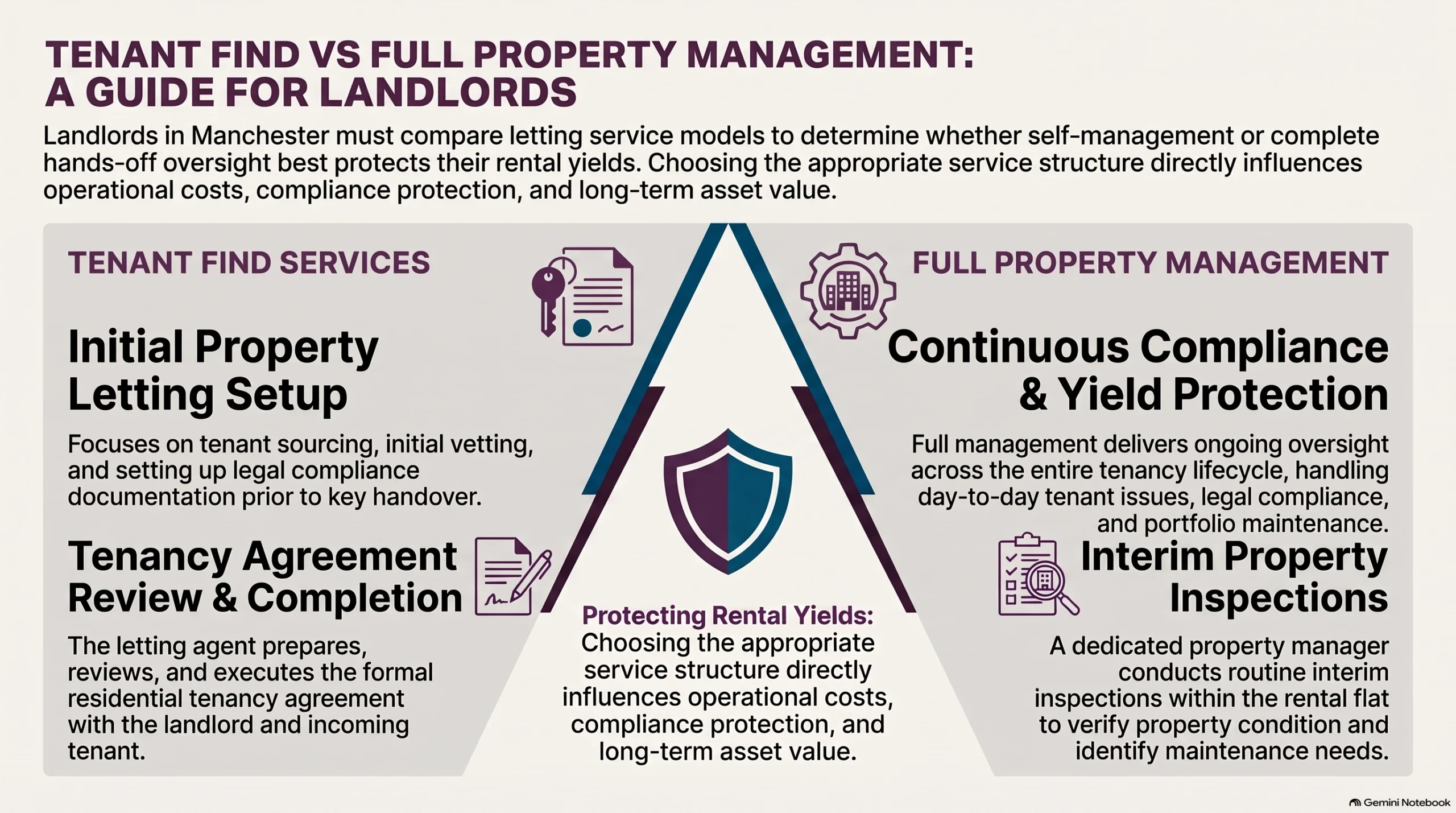
Letting service packages divide the operational lifecycle of a tenancy into distinct phases of administrative and practical responsibility. A tenant find service concentrates on the pre-tenancy onboarding stage. Full management encompasses active operational governance throughout the entire occupation period, protecting both asset value and statutory compliance.
The boundary between these models determines who responds to maintenance emergencies, tracks evolving housing legislation, and enforces financial obligations. Reviewing task distribution across individual service tiers helps residential landlords align operational support with their investment strategy, personal commitments, and available time.
| Tenancy Responsibility | Tenant Find Only | Full Property Management |
|---|---|---|
| Property Marketing and Viewings | Included | Included |
| Referencing and Right to Rent Checks | Included | Included |
| Tenancy Agreement and Initial Paperwork | Included | Included |
| Deposit Protection and Prescribed Information | Varies by Agent | Included |
| Rent Collection and Arrears Recovery | Landlord Responsibility | Included |
| Maintenance Coordination and Emergency Repairs | Landlord Responsibility | Included |
| Routine Inspections and Compliance Audits | Landlord Responsibility | Included |
Initial Marketing and Sourcing Quality Tenants
Property Promotion and Portal Distribution
Professional property promotion involves creating comprehensive property listings and distributing them across major property portals to maximise qualified exposure. Letting agents use accurate market rent benchmarks and professional digital photography to position rental assets effectively. This targeted exposure attracts high-calibre applicants whilst establishing an auditable trail of pre-let compliance across online advertising platforms.
Under the Renters’ Rights Act 2025, rental bidding bans prevent agents from marketing properties with vague pricing structures like “offers over”. Advertised figures must represent the firm asking rent, making strategic initial valuation essential. For landlords in Manchester, micro-market pricing nuances between suburban areas like Didsbury and urban city quarters determine initial enquiry volume.
Tenant Vetting and Referencing Protocols
Comprehensive tenant vetting examines credit histories, verified employment income, landlord references, and statutory Right to Rent credentials. This rigorous process occurs before committing to a contract. Rigorous assessment of rent-to-income ratios ensures that applicants can meet their commitments without facing financial overextension. A structured onboarding process filters out applicants with unverified documentation early.
Detailed verification protects landlords from prospective rent defaults. Tenant find services conduct these checks thoroughly before handing the completed documentation over to the property owner. Full management providers maintain these vetting files continuously. They update records whenever permitted occupants change or statutory verification renewals fall due.
Tenancy Formation and Legal Documentation
Statutory Statements and Tenancy Agreements
Tenancy formation requires drafting compliant written statements of terms that replace outdated Assured Shorthold Tenancy agreements with assured periodic structures. These legal documents must reflect modern statutory provisions, omitting obsolete fixed terms or non-compliant break clauses. Clear contractual definitions protect landlords from administrative challenges or regulatory civil penalties that arise from defective paperwork.
Statutory compliance mandates serving government information guides and prescribed housing sheets alongside the written terms. Failure to deliver these mandatory notices within specified statutory windows exposes landlords to civil penalties reaching up to £7,000. Managing this documentation accurately at the outset shields the tenancy from administrative invalidation during future legal proceedings.
Deposit Protection and Statutory Prescribed Information
Deposit protection laws require registering tenant funds with a government-approved custodial or insurance-backed deposit scheme within thirty days of receipt. Landlords must also serve the scheme leaflet and completed Prescribed Information certificate directly on the tenant. Missing these mandatory timelines incurs financial penalties of up to three times the deposit amount.
When choosing between tenant find only vs full property management, landlords must verify who handles this registration. Tenant find agreements often register the initial deposit before transferring account administration to the landlord. Fully managed services retain account governance, handling statutory transfer notices and processing deductions at checkout through formal scheme adjudication.
Did You Know?
The Renters’ Rights Act 2025 requires every private landlord in England to register on the Private Rented Sector Database. Membership of the new PRS Landlord Ombudsman scheme is also mandatory. Letting a property without valid registration carries civil penalties of up to £7,000. Serious or repeated breaches can attract penalties of up to £40,000 or prosecution.
Ongoing Rent Collection and Financial Oversight
Rent Processing and Accounting Statements
Rent collection services automate monthly billing, monitor payment receipts, and issue structured accounting statements for property investors. Letting agents track funds using dedicated software, ensuring that net income arrives swiftly into client bank accounts. Detailed digital statements provide clear records that integrate directly into modern accounting platforms and annual tax returns.
HMRC Making Tax Digital requirements mandate digital record-keeping and quarterly reporting for unincorporated landlords meeting specific income thresholds. Full property management services provide structured end-of-year summaries and categorised expense schedules. Landlords managing rent collection independently must maintain these detailed reconciliations manually. They must record bank entries and invoices for every property transaction.
Rent Arrears Recovery and Payment Tracking
Proactive rent chasing protocols identify overdue payments immediately, issuing formal notices and establishing structured repayment schedules before arrears accumulate significantly. Automated chasing systems flag unpaid balances within twenty-four hours of a missed due date. This prompt intervention prevents minor cash-flow hiccups from escalating into chronic, unmanageable tenancy debt.
The mandatory rent arrears possession threshold under Ground 8 requires three months of arrears instead of two. In addition, the notice period doubles from two weeks to four weeks. Full management teams resolve payment issues swiftly through proactive communication. This approach avoids the prolonged court timetables that self-managing landlords often encounter.
The Railton-Meeks Compliance Audit Tool
Check Your Compliance & Protect Your Portfolio
Property Maintenance and Repairs Coordination
Routine Maintenance and Repair Triage
Effective maintenance triage resolves non-urgent repairs efficiently whilst preventing unnecessary contractor call-outs for basic household issues. Property managers assess incoming maintenance reports via video or phone diagnostics, identifying blown fuses or isolated valve issues remotely. When physical repairs become necessary, vetted trade contractors carry out the required work under clear pre-approved cost caps.
Tenant find arrangements leave maintenance management entirely in the hands of the landlord once keys are handed over. Property owners must build an independent network of certified gas engineers, electricians, and general builders. Full management packages remove this friction by deploying established contractor networks, securing preferred rates and ensuring timely resolutions.
Emergency Repairs and Awaab’s Law Timeframes
Awaab’s Law mandates legally enforceable response timelines for severe property hazards like persistent damp, mould, and heating failure. Landlords must initiate emergency repairs within twenty-four hours of notice. Furthermore, they must investigate significant damp hazards within ten to fourteen days. Failing to meet these statutory deadlines leads to formal enforcement and compensation claims.
Round-the-clock emergency cover protects landlords against regulatory breaches when catastrophic leaks or heating breakdowns occur outside normal business hours. Fully managed services operate continuous out-of-hours response desks to dispatch emergency contractors swiftly. Landlords using let-only services must answer tenant emergency calls personally, managing immediate contractor dispatches regardless of other commitments.
Railton-Meeks offers four landlord service tiers across Manchester and Cheshire
Statutory Safety Standards and Property Inspections
Statutory Safety Certificates and Compliance Records
Letting compliance requires maintaining Gas Safety Certificates, Electrical Installation Condition Reports, and Energy Performance Certificates without lapse. Each safety document carries independent inspection cycles, mandatory testing standards, and distribution requirements. Digital compliance logs ensure landlords can present proof of safety instantly whenever local authorities request formal audit records.
Statutory standards are heavily enforced across high-density private rented sectors. HMO properties face particularly rigorous oversight of fire door integrity and interlinked alarms. Selective licensing schemes active across regional boroughs also demand verified safety certifications upon application. Full management includes active tracking to renew critical safety certificates before they expire.
Scheduled Interim Property Inspections
Interim property inspections provide vital photographic records of condition, verifying lease compliance and catching minor maintenance defects early. Conducted at regular intervals, these visits review ventilation practices, check for unauthorised occupants, and assess general care. The resulting written report establishes an objective paper trail that monitors ongoing asset condition.
These scheduled visits play a critical role in defending deposit deductions at the conclusion of a tenancy. Independent inspection reports produced by managing agents carry substantial evidentiary weight during formal deposit adjudication. Landlords who self-manage under tenant find arrangements must organise and document these periodic inspections personally whilst respecting quiet enjoyment rights.
Instant Rental & Block Valuation
Get Your Valuation & Know Your Market Value
Tenancy Termination and Possession Frameworks
Possession Notices Under Section 8
Regaining possession requires serving formal notices under specific Section 8 grounds, following the abolition of Section 21 no-fault evictions. Landlords must prove statutory grounds, such as intent to sell the property, family occupation, or serious arrears. Strict evidential burdens require meticulous paperwork to support every single court application.
Managing agents understand the precise evidentiary requirements needed to sustain a contested possession hearing under the reformed grounds. They gather communications, rent ledgers, and inspection logs into compliant court bundles. Self-managing landlords navigating tenancy terminations must master these procedural rules independently or face dismissal of their claims in county court.
Check-out Inventories and Deposit Dispute Resolution
The tenancy checkout process compares the final property state against the baseline photographic inventory compiled prior to tenant move-in. Professional check-out reports distinguish between legitimate fair wear and tear and actionable property damage. Clear documentation provides the primary defence against protracted disputes when claiming funds from protected tenant deposits.
Letting agents handle checkout negotiations directly, liaising between parties to agree on fair repair deductions amicably. If an agreement cannot be reached, the managing agent prepares the formal evidence pack for submission to scheme adjudicators. Tenant find clients must undertake checkout assessments and resolve deposit disagreements without external professional backing. Our guide to tenant finder versus fully managed lettings goes into this in more detail.
Package Selection for Your Letting Strategy
Personal Time Commitment and Geography
Choosing the correct service tier depends on your geographic proximity, professional availability, and appetite for hands-on administration. Managing tenancies independently demands flexible working hours to handle tenant phone calls, coordinate repairs, and conduct property inspections. Landlords residing far from their investments generally find full management an operational necessity rather than a luxury.
Portfolio scale also influences this decision. Managing a single residential unit alongside full-time employment requires disciplined organisation. Running multiple properties without an agent quickly turns into an intensive second career. Evaluating personal time commitments against agency management fees clarifies which operational model makes sound financial sense.
Cost Structures Against Regulatory Risk
Tenant find fees represent a one-off procurement cost per tenancy. Conversely, full management operates on a continuous monthly percentage deduction. Whilst let-only arrangements appear cheaper initially, unexpected compliance mistakes or void periods quickly eliminate paper savings. Professional management acts as practical insurance against costly and avoidable regulatory errors.
For accidental landlords or those managing high-liability assets like student lets and HMOs, full management provides peace of mind. Experienced letting agencies maintain internal systems that insulate property owners from administrative oversights. Balancing immediate management deductions against long-term asset security helps owners identify the service model that supports their financial objectives.
HMO Specialist Yield & Tax Calculator
Calculate Your Yield & Offset New Tax Burdens
Final Thoughts
Evaluating tenant find and management services for landlords requires an honest appraisal of your legal understanding, time, and investment strategy. The private rental sector continues to evolve towards stricter operational compliance, shorter response deadlines, and rigorous tenant rights. Handing over key duties to professional letting specialists shields your capital whilst preserving operational efficiency across the tenancy lifecycle.
Whether you choose a let-only procurement service or continuous full management, establishing transparent agreements remains paramount. Landlords who invest in sound administrative systems, reliable maintenance, and compliance audits will achieve sustainable rental yields. This disciplined approach ensures steady asset appreciation throughout your property investment journey.
Frequently Asked Questions
A:
A tenant find service concludes once the tenancy agreement is signed and keys are handed over to the tenant. The letting agent markets the property, conducts viewings, runs references, and drafts paperwork. However, all ongoing operational tasks fall directly to the landlord. Full property management covers the entire tenancy lifecycle. The agent handles rent collection, emergency repairs, periodic inspections, compliance renewals, and possession procedures continuously.
A:
Yes, landlords can appoint a letting agent to take over ongoing management of an existing tenancy at any point. The agent conducts an onboarding audit, reviewing tenancy agreements, safety certificates, and deposit paperwork. They also inspect the property to establish a clear baseline condition report. Furthermore, the agency notifies tenants of the management change and redirects all ongoing rental payments to their dedicated client account.
A:
Under a tenant find service, the property owner remains entirely responsible for all maintenance once the tenancy begins. The tenant contacts the landlord directly when issues occur, regardless of the time of day. The landlord must diagnose the fault, arrange contractor access, and settle invoices. Letting agents have no contractual duty to oversee repairs under a basic tenant find instruction.
A:
The abolition of Section 21 requires self-managing landlords to master specific Section 8 possession grounds. They must also maintain flawless documentary evidence at all times. In addition, landlords must issue mandatory government information sheets, observe rental bidding bans, and meet strict repair timescales. Non-compliance exposes self-managing owners to civil penalties of up to £7,000 for procedural breaches across their property portfolio.
A:
Agency management fees, tenant procurement charges, and professional inventory costs are allowable revenue expenses for UK tax purposes. Landlords can deduct these ongoing operational expenses from their gross rental income when calculating taxable rental profits. However, individual tax liabilities depend heavily on property ownership structures and income tax brackets. Landlords should always consult a qualified accountant to ensure full compliance with current HMRC guidelines.
