

Renters' Rights Act: What Landlords Must Do Now.
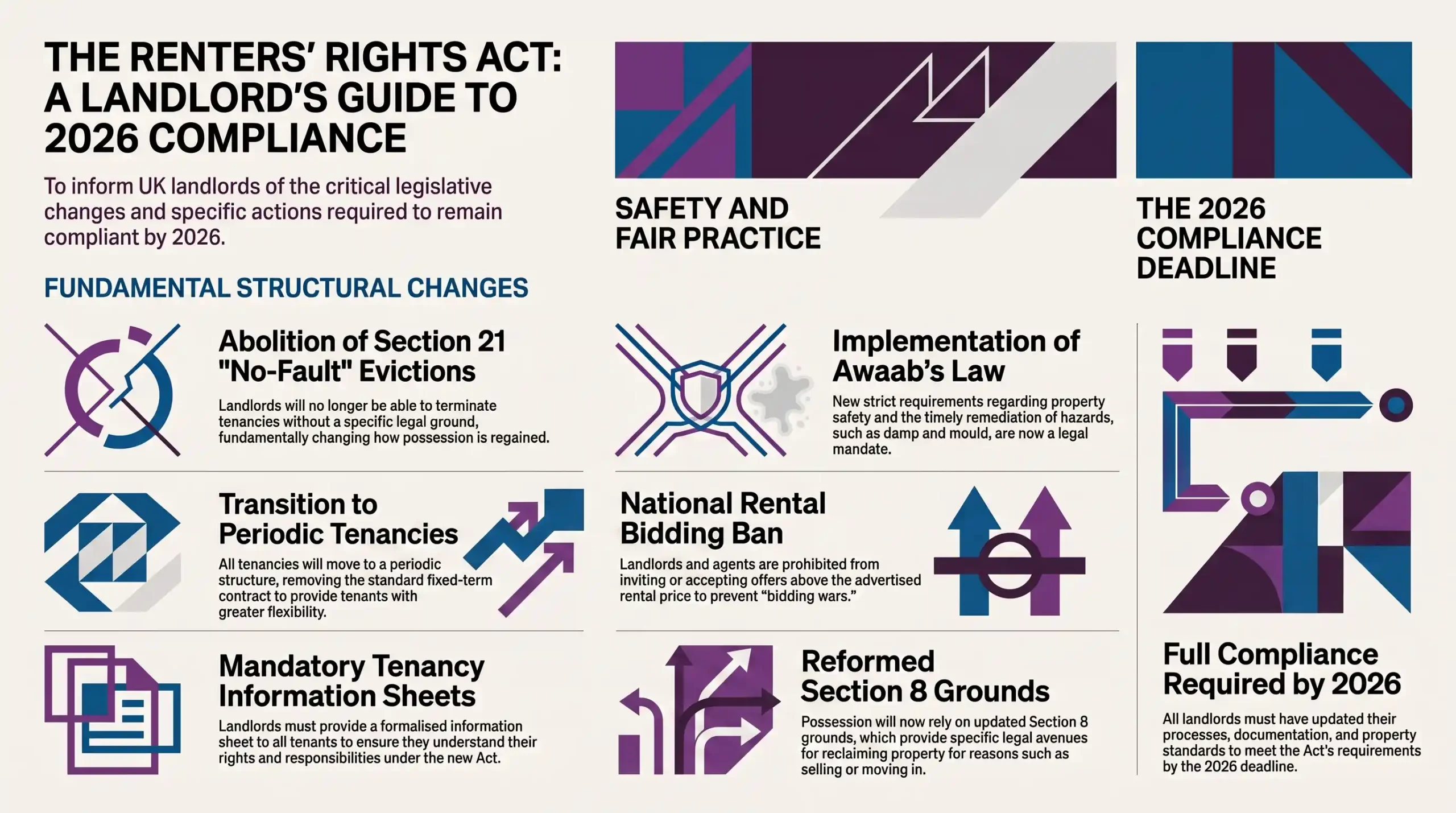
The implementation of the Renters’ Rights Act on 1 May 2026 marks the most profound restructuring of private rented sector law in forty years. Fixed-term Assured Shorthold Tenancies are now entirely obsolete across England. Landlords must operate under rolling periodic agreements whilst facing strict new statutory standards. Achieving complete Renters’ Rights Act compliance requires immediate operational adjustments to notice protocols, property upkeep, and tenant disclosures. Failure to adapt leaves property owners exposed to severe financial penalties and invalid possession claims.
Navigating this new statutory landscape requires clear understanding of statutory possession grounds, bidding bans, and housing safety timescales. Traditional management practices no longer shield investors from civil fines or regulatory enforcement. Property owners must evaluate their existing processes to ensure full legal alignment. How can landlords adapt their daily operations to remain fully compliant under the new framework?
Key Takeaways
- Section 21 no-fault evictions are officially abolished, forcing landlords to use expanded Section 8 mandatory grounds for all future property repossessions.
- All existing Assured Shorthold Tenancies converted automatically into rolling periodic tenancies on 1 May 2026 without requiring rewritten tenancy legal contracts.
- Landlords must serve the statutory Government Information Sheet to all current tenants by 31 May 2026 or face severe civil financial penalties.
- Accepting rental bids above advertised prices is strictly illegal and triggers statutory civil fines up to seven thousand pounds per infraction.
- Awaab’s Law forces private landlords to investigate serious property hazards within fourteen days and begin emergency repairs within twenty-four statutory operational hours.
Immediate Shifts in Possession Law and Section 21 Abolition
The total abolition of Section 21 no-fault evictions fundamentally alters how landlords regain possession of residential property. Court claims can no longer rely on simple written notices without legal justification. Every property recovery now requires proving a specific statutory ground before a judge.
Handling Existing Section 21 Notices
Section 21 notices served on or before 30 April 2026 remain legally enforceable during a brief transitional window. Landlords relying on legacy notices must issue court proceedings by 31 July 2026 or six months from service, whichever falls earlier. Missing this hard cutoff invalidates the notice permanently.
Once the backstop date passes, any pending possession action under the accelerated route expires. Landlords must then restart the process using the updated Section 8 mechanism. Maintaining accurate service records is critical for claims initiated before the deadline.
Transitioning to Mandatory Section 8 Possession Grounds
With Accelerated Possession eliminated, property owners must rely exclusively on reformed Section 8 grounds. Mandatory Ground 1 for personal occupation and Ground 1A for property sales both require four months of notice. Neither ground can be invoked during the initial twelve months of an original tenancy agreement.
Evicting for rent arrears under Ground 8 now requires three full months of arrears instead of two. The statutory notice period for arrears has also doubled from two weeks to four weeks. Landlords must ensure meticulous rent tracking systems flag arrears instantly to manage this extended timeline.
Transitioning to Assured Periodic Tenancies Across All Portfolios
On 1 May 2026, fixed-term Assured Shorthold Tenancies were completely phased out. All existing agreements converted automatically into assured periodic tenancies rolling from month to month. Landlords do not need to issue brand-new contracts to existing occupants, as the statutory conversion occurs by operation of law. However, legacy contract clauses regarding fixed end dates, break clauses, or compulsory renewal fees are now legally void.
Every periodic tenancy landlord must adapt to a system where tenants hold the right to terminate agreements at any point by providing two months’ written notice. Landlords can no longer lock tenants into six-month or twelve-month fixed terms. Rent increases are also strictly limited to once per year via the formal Section 13 notice process, matching prevailing open-market levels.
To maintain portfolio stability under rolling terms, property owners must focus heavily on tenant retention and pre-tenancy vetting. Rigorous affordability assessments ensure tenants can maintain long-term commitments without rent stress. Meticulous photographic inventories and comprehensive move-in logs are essential to protect deposits when tenants decide to give notice. In practice, we find that portfolios run with this discipline experience far fewer disputed deductions at the end of a tenancy.
Did You Know?
Under the Renters’ Rights Act, accepting or inviting rental offers above the advertised price triggers civil penalties of up to £7,000 per violation, enforced directly by local housing authorities.
Mandatory Tenant Notifications and Statutory Information Sheets
Compliance during the post-May 2026 transition is defined by strict documentary duties. Local housing authorities possess extended powers to issue civil penalties for failure to serve required statutory notices. The table below outlines key documentation requirements, service windows, and statutory non-compliance consequences under rental compliance 2026 standards.
| Document Type | Target Recipient | Statutory Deadline | Non-Compliance Penalty |
|---|---|---|---|
| Government Information Sheet | All existing tenants prior to 1 May 2026 | 31 May 2026 | Civil fine up to £7,000 and blocked Section 8 notices |
| Written Statement of Terms | New tenancies starting after 1 May 2026 | Prior to tenancy start date | Civil fine up to £7,000 and tribunal compensation orders |
| Section 13 Rent Increase Notice | Periodic tenants undergoing annual review | Minimum 2 months before rate change | Invalidated rent increase; tribunal reassessment |
| Prescribed Deposit Information | All new deposit-paying tenancies | Within 30 days of receipt | Fine up to 3x deposit amount; blocked possession |
Serving the Government Information Sheet by 31 May 2026 is an absolute legal priority. This official publication explains tenant rights under the new legislative framework. Landlords must retain audit-ready proof of delivery, such as recorded digital delivery or signed postal confirmations, to defeat any future non-compliance claims.
The Railton-Meeks Compliance Audit Tool
Check Your Compliance & Protect Your Portfolio
Banning Rental Bidding Wars and Setting Advertised Rents
The private rented sector now operates under a strict ban on rental bidding wars. Landlords and letting agents are legally forbidden from encouraging or accepting offers that exceed the public advertised price. Key rules governing property marketing and price transparency include:
- Fixed Price Advertising: All rental adverts must state a clear, fixed price. Terms like “offers over” or “price on application” are illegal.
- Bidding Rejection Duty: Landlords cannot accept higher rental offers, even if a prospective tenant offers extra money voluntarily.
- Enforcement Penalties: Accepting a bid above the advertised figure carries a mandatory civil penalty of up to £7,000 per violation.
- Universal Application: Marketing rules apply equally to private individual landlords, corporate portfolio owners, and commercial letting agents.
Pricing strategy must now rely on precise local market valuations before listing properties publicly. Setting rent too high risks prolonged void periods, whilst setting it too low prevents securing true market value. Accurate upfront valuation is essential to maximise income legally.
Railton-Meeks offers four landlord service tiers across Manchester and Cheshire
Enforcing Awaab’s Law and the Decent Homes Standard
The extension of Awaab’s Law into the private rented sector establishes legal timeframes for resolving severe property defects. Landlords must maintain active maintenance protocols to protect occupant health and safety.
Emergency Repairs and Initial Hazard Inspections
Awaab’s Law establishes strict statutory timelines for addressing severe property hazards within the private rented sector. Emergency defects presenting immediate health risks require active repairs within twenty-four hours. Less critical hazards demand an inspection within fourteen days, followed by a formal written report provided to tenants within three days.
Property owners must establish reliable contractor networks capable of immediate emergency callouts. Uninhabitable conditions caused by heating failure, major electrical faults, or structural damage must be resolved without delay. Documentation detailing response times must be recorded in the building management log.
Executing Damp and Mould Prevention Protocols
Preventing damp and mould requires proactive structural maintenance alongside modern ventilation standards across all rental properties. Property managers must conduct periodic inspections to assess moisture levels, mechanical extractors, and thermal performance. Ignoring recurring damp reports leaves landlords vulnerable to direct civil enforcement under Category 1 hazard standards.
Upgrading mechanical extraction in kitchens and bathrooms is now an essential compliance measure. Where structural issues cause persistent condensation, installing continuous trickle ventilation or positive input ventilation systems prevents hazard escalation. Landlords must address root causes swiftly rather than blaming tenant lifestyle choices.
Instant Rental & Block Valuation
Get Your Valuation & Know Your Market Value
Student HMO Management Under Ground 4A
Houses in Multiple Occupation (HMOs) face unique operational demands under rolling periodic tenancies. The student accommodation market relies on strict annual cycles to ensure full occupancy for each academic year.
Retaining Academic Cycle Possession for Shared Houses
Ground 4A offers a specialised possession pathway designed specifically for student Houses in Multiple Occupation. Landlords can recover possession to align with the academic cycle, provided notice expires between 1 June and 30 September. This ground protects student housing stock by ensuring properties remain available for incoming annual cohorts.
To utilise Ground 4A successfully, landlords must serve explicit written notice before the tenancy begins stating that this ground may be relied upon. The property must also be occupied by full-time higher education students. Failing to issue correct pre-tenancy notices blocks access to this essential possession ground.
Maintaining compliance across multi-let properties also requires adherence to local authority licensing rules. Planning controls, such as Article 4 Directions, operate alongside structural safety requirements like FD30 fire doors and interlinked Grade D alarm systems. Rigorous oversight protects high-yielding shared housing investments from severe regulatory fines.
HMO Specialist Yield & Tax Calculator
Calculate Your Yield & Offset New Tax Burdens
Final Thoughts
Achieving total Renters’ Rights Act compliance is now an operational requirement for every private residential landlord. The end of no-fault evictions, the shift to rolling periodic tenancies, and strict limits on rental bidding demand a structured approach to asset management. Landlords who modernise their documentation, maintenance tracking, and notice procedures will safeguard their investments whilst maintaining stable rental yields. When managing compliance across a portfolio, we find that structured systems consistently outperform reactive, case-by-case handling.
Property owners should review their existing systems immediately to identify potential compliance gaps. Updating tenant communication channels, auditing safety inspection logs, and establishing clear lines for emergency repairs ensures seamless transition under the current legal framework. Professionalised management strategies remain the most effective tool to preserve asset value and protect long-term financial performance.
Readers interested in this topic should also read “The Renters’ Rights Act: A Manchester Landlord’s Guide“.
Frequently Asked Questions
A:
On 1 May 2026, all existing Assured Shorthold Tenancies automatically converted into assured periodic tenancies. Landlords do not need to rewrite or re-issue existing tenancy contracts to facilitate this change. However, any legacy fixed-term provisions, break clauses, or rent review mechanisms within existing contracts become legally inoperative. Tenants can end their tenancy at any point by providing two months' written notice. Landlords wishing to recover possession must use formal Section 8 statutory grounds.
A:
Under the revised Section 8 framework, the mandatory threshold for rent arrears eviction under Ground 8 increases from two months to three months of outstanding rent. Additionally, the mandatory statutory notice period required before issuing court proceedings doubles from two weeks to four weeks. Landlords must demonstrate that three full months of arrears exist both at the time of serving notice and at the hearing date. Automated tracking systems are vital to flag payment delays immediately and prevent persistent arrears from accumulating.
A:
Failing to serve the mandatory Government Information Sheet to existing tenants by 31 May 2026 constitutes a statutory breach. Local housing authorities hold power to impose civil financial penalties of up to seven thousand pounds for non-compliance. Furthermore, landlords who fail to fulfill statutory notification duties are barred from serving valid Section 8 notices to regain possession. Providing documented evidence of delivery, such as digital recorded transmission or signed receipts, is essential to protect against enforcement action.
A:
Yes, a periodic tenancy landlord can regain possession to sell a property using mandatory Ground 1A under Section 8. However, specific legal restrictions apply. Landlords must give tenants four full months of statutory notice, and this ground cannot be used during the first twelve months of an initial tenancy. Furthermore, property owners cannot re-let or re-advertise the property for rent within twelve months of relying on Ground 1A, preventing misuse of the sales ground.
A:
The rental bidding ban strictly requires landlords and letting agents to state a firm rental figure on all public marketing. Marketing properties with open-ended terms such as offers over or price on application is now illegal. Furthermore, landlords cannot request, encourage, or accept any offer above the advertised price. Even if a prospective tenant voluntarily offers a higher rent to secure the property, accepting it constitutes a legal breach subject to a seven thousand pound civil penalty.
About The Author
Tara Meeks MARLA - Managing Director & Founder, Railton-Meeks Property Management
HMO licensing · Compliance strategy · Renters’ Rights Act 2026 · Building Safety Act 2022 · Property acquisition · Refurbishment & development · Block management · South Manchester investment.
Tara Meeks is the founder and Managing Director of Railton-Meeks Property Management Limited, a Didsbury-based agency she established in 2006 to manage her own residential investment portfolio. With over 20 years’ experience as a landlord, developer, and ARLA-qualified letting professional, Tara leads the agency’s “Compliance & Yield Guardian” strategy across South Manchester and Cheshire.
Tara’s career in property began in the mid-1990s, long before she formalised the agency that bears her name. Having personally navigated the practical realities of buy-to-let acquisition, HMO conversion, refurbishment, tenant vetting, and full-cycle property development, she founded Railton-Meeks as a vehicle to bring that landlord-side perspective to other Manchester investors. The agency has grown organically through referral, with a significant portion of original 2006 clients still on the books today.
As a Member of ARLA Propertymark (MARLA), Tara holds the industry’s recognised qualification for residential lettings and property management, and the agency operates under Propertymark’s Client Money Protection scheme. Her professional focus in 2026 is the Renters’ Rights Act transition — particularly the May 2026 periodic-tenancy switch and the abolition of Section 21 — and the operational shift this demands from landlords accustomed to the old AST framework.
Tara is responsible for client onboarding, portfolio strategy, HMO licensing applications under Manchester City Council’s Article 4 directions, and the agency’s relationships with Resident Management Companies and Freeholders requiring Building Safety Act 2022 compliance. She is also active in property acquisition advisory, having helped numerous landlords source, refurbish, and stabilise income-producing assets across the M14, M19, M20, and M21 postcodes.
She remains, above all, a working landlord. The vision she set out at founding — “to keep Railton-Meeks as a small family business, ensuring personal attention and exceeding clients’ expectations” — is the operating principle of the agency twenty years on.
Credentials
- ARLA Propertymark Member (MARLA)
- Director, Railton-Meeks Property Management Limited (Companies House 08242540)
- 20+ years’ active landlord experience
- HMO, Article 4, and Sui Generis licensing specialist
- Property acquisition and refurbishment advisor
