
EICR for Landlords: What It Is and When You Need One.
Ensuring electrical safety across rental properties is a critical legal obligation for property owners across the North West. As an EICR landlord Manchester compliance requirement, property owners must maintain strict adherence to statutory safety standards to protect occupants from fire and electrocution hazards. Under the Electrical Safety Standards in the Private Rented Sector Regulations 2020, landlords must ensure every electrical installation is tested at fixed intervals. Failure to secure valid documentation risks severe civil enforcement penalties from local authority housing enforcement teams.
Navigating inspection obligations requires an understanding of testing scopes, failure codes, and compulsory repair timelines. Landlords often struggle to distinguish between routine maintenance, mandatory remedial actions, and service requirements for new tenancies. Are you aware of the exact statutory timeframes and compliance standards required to keep your residential portfolio legally protected?
Key Takeaways
- Landlords in England must obtain a valid inspection report every five years to ensure complete electrical safety compliance across private tenancies.
- Qualified electrical engineers assess installations against national standards, assigning specific fault codes to identify hazardous defects or non-compliant wiring setups.
- Mandatory remedial works for identified Code C1 or Code C2 defects must be fully completed within twenty-eight days of the inspection date.
- Copy documentation must be served to existing tenants within thirty days and provided to prospective renters prior to their initial occupation.
- Failure to comply with statutory electrical safety standards exposes property owners to financial civil penalties reaching up to thirty thousand pounds.
Legal Requirements and Compliance Timelines for Landlords
Statutory electrical safety regulations impose strict operational deadlines on residential property owners across England. Meeting these legal obligations requires structured oversight of inspection intervals, remedial action periods, and tenant document distribution schedules to avoid severe administrative penalties from municipal housing enforcement officers.
The table below details the essential compliance thresholds, regulatory timeframes, and statutory actions required under current private rented sector safety laws. Landlords must incorporate these core requirements into their standard property management workflows to maintain full legal compliance across all domestic lets.
| Compliance Element | Statutory Requirement | Legal Deadline |
|---|---|---|
| Inspection Frequency | Mandatory testing of fixed electrical installations | Every 5 years |
| Remedial Action Period | Rectification of C1, C2, or FI defects | Within 28 days |
| Tenant Document Service | Provide report copy to existing occupiers | Within 30 days |
| New Tenancy Compliance | Serve report to incoming tenants before move-in | Prior to tenancy |
| Local Authority Submission | Supply report to council upon written demand | Within 7 days |
Electrical Safety Rules Landlords Must Follow
The Private Rented Sector Safety Regulations 2020
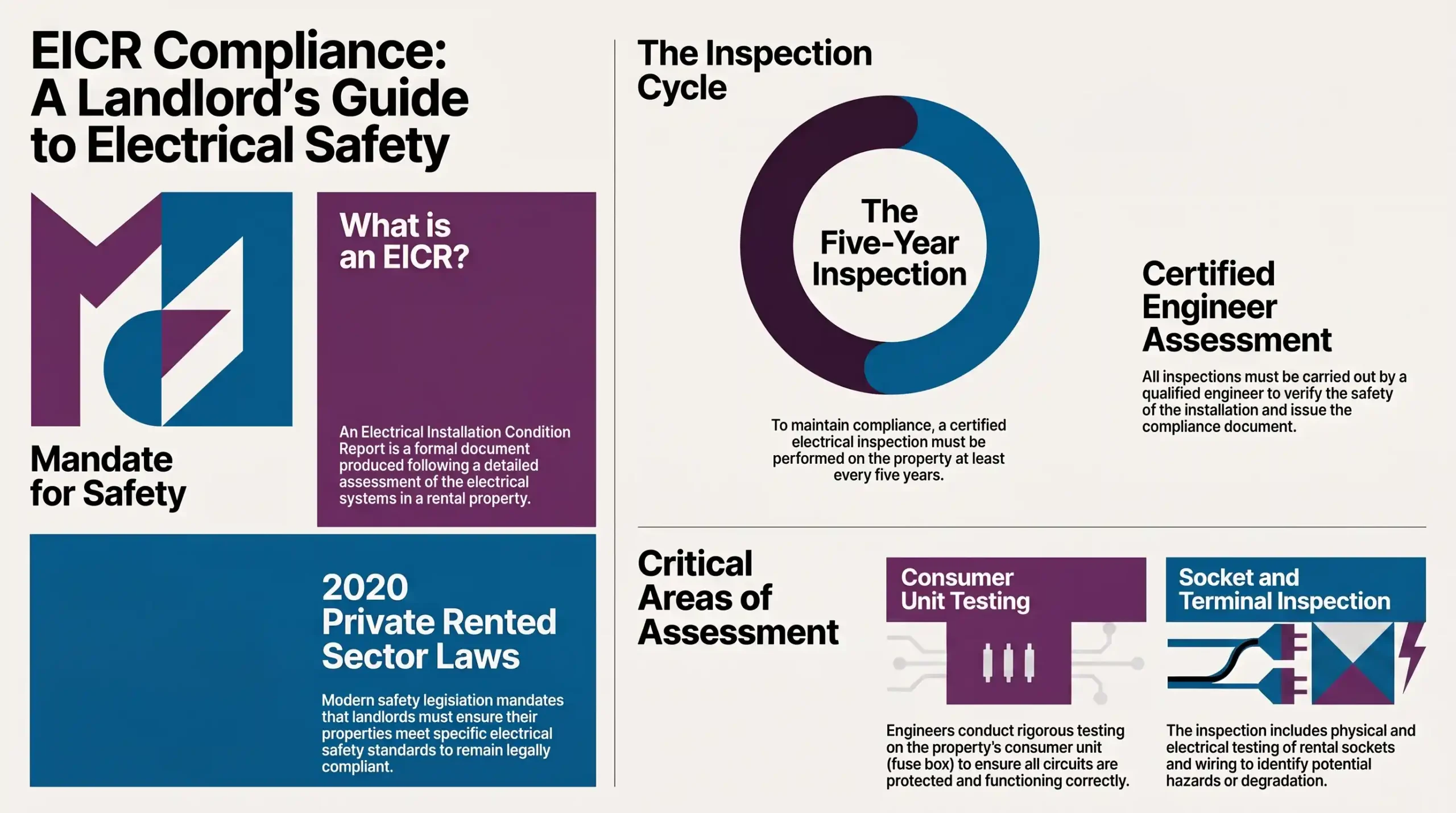
The Electrical Safety Standards in the Private Rented Sector Regulations 2020 established mandatory testing across domestic lettings. Landlords must ensure electrical installations are inspected by qualified engineers. Compliance requires continuous maintenance of safety standards throughout every tenancy, ensuring fixed wiring and fixed electrical equipment remain entirely safe.
These regulations apply across the private rented sector, encompassing single-family lets, professional houses in multiple occupation, and luxury flat conversions. Local housing authorities enforce these measures under civil penalty powers. Non-compliance enables councils to issue administrative fines up to £30,000 per breach, making structured compliance management vital for property investors.
What an Electrical Installation Condition Report Covers
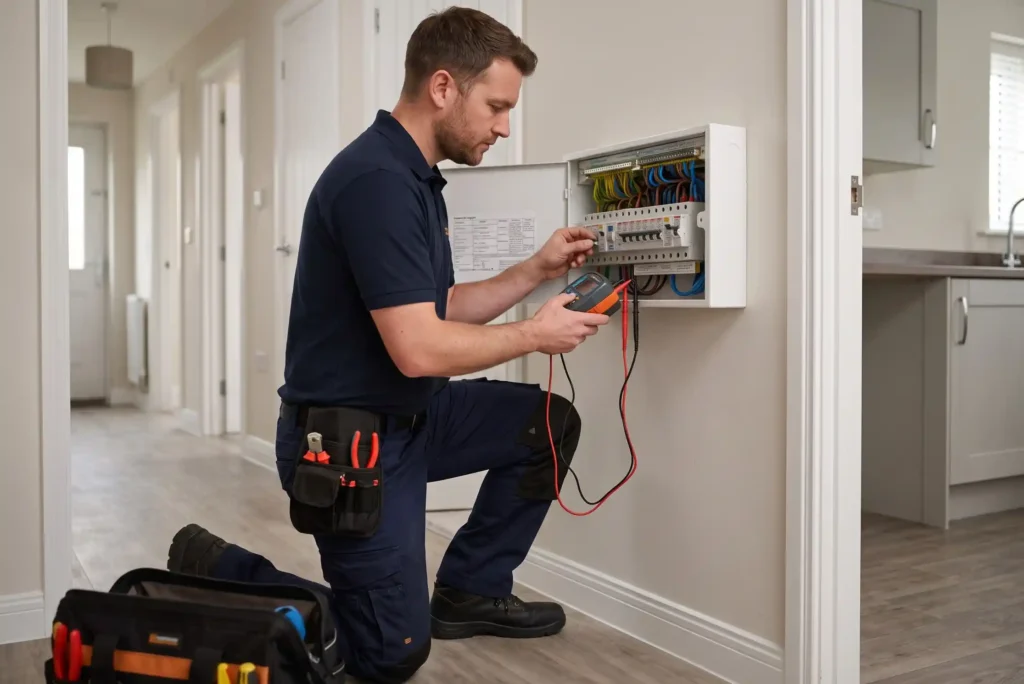
An electrical installation condition report evaluates the permanent electrical infrastructure within a domestic property. Qualified inspectors test consumer units, protective earthing, fixed wiring, switches, sockets, and integrated light fittings. Separate portable appliance testing verifies operational safety for tenants, since this assessment excludes portable appliances.
The assessment determines whether the installation satisfies BS 7671 safety standards. Engineers conduct visual examinations and dead testing to detect latent faults, thermal damage, or deteriorating insulation within concealed wiring. Identifying these vulnerabilities early prevents electrical fires, equipment damage, and dangerous shock hazards across private domestic tenancies.
Did You Know?
Local housing authorities in England have statutory powers to issue civil penalties of up to £30,000 against landlords who fail to comply with electrical safety standards, and councils can arrange urgent remedial works directly at the property owner’s expense.
The Five-Year Inspection Cycle and Triggers
Standard Five-Year Testing Intervals
A five year electrical inspection represents the maximum legal interval between formal property assessments for private rentals. Landlords must arrange comprehensive testing before the existing certificate expires. Maintaining an uninterrupted testing log proves ongoing legal compliance, ensuring that property owners remain fully protected against statutory enforcement action by local authorities.
Although five years is the statutory maximum, inspecting engineers can recommend shorter inspection periods if an installation shows signs of age or rapid degradation. High-occupancy properties, such as student HMOs in Fallowfield or Rusholme, often experience heavy usage. Landlords must adhere to the specific re-inspection frequency stated on the latest safety report.
Tenancy Changes and Intermediate Safety Checks
Changes in tenancy require immediate administrative reviews of existing safety documentation before new occupants move in. Incoming tenants must receive a copy of the current report prior to moving into the property. Whilst a new report is not legally required for every turnover, visual checks confirm no unrecorded alterations occurred.
Best practice involves conducting a visual electrical check during turnover inspections between tenancies. Property managers inspect socket faceplates, light fittings, and consumer units for physical damage caused by departing occupants. Addressing visible defects immediately prevents minor tenant damage from escalating into severe safety breaches or electrical faults.
The Railton-Meeks Compliance Audit Tool
Check Your Compliance & Protect Your Portfolio
Classification Codes and Safety Evaluation
Immediate Hazards and Dangerous Defect Codes
Inspectors assign standardised fault codes to identify specific hazards discovered during testing procedures. Code C1 indicates immediate danger, requiring the inspector to make the installation safe before leaving the property. Code C2 identifies potentially dangerous conditions that demand urgent remedial repair to prevent serious injury or electrical fire risks.
A C1 classification signifies exposed live conductors or uninsulated components that present imminent shock hazards. Engineers often isolate the affected circuit immediately to eliminate danger. Receiving either a C1 or C2 classification results in an overall report outcome of ‘unsatisfactory’, triggering mandatory landlord obligations to complete repairs within statutory timeframes.
Further Investigation and Improvement Recommendations
Code FI signifies that further investigation must take place without delay to complete the safety assessment. Code C3 indicates that engineers recommend improvements to enhance system safety, though the installation remains legally compliant. Understanding these distinctions helps landlords prioritise maintenance expenditure and address hidden system vulnerabilities effectively.
An FI rating renders the report ‘unsatisfactory’ until the requested investigation takes place. Landlords must arrange for a competent electrician to examine the flagged components to determine their safety status. In contrast, C3 codes do not breach statutory regulations, though addressing them modernises older wiring and reduces long-term maintenance costs.
Railton-Meeks offers four landlord service tiers across Manchester and Cheshire
Mandatory Remedial Actions and Timeframes
The Twenty-Eight Day Statutory Repair Window
Landlords must complete all required remedial works within twenty-eight days of receiving an unsatisfactory inspection report. Alternatively, repairs must occur within any shorter timeframe explicitly specified by the testing engineer. Fast execution prevents regulatory breaches and protects tenants from active electrical hazards within their home.
Securing qualified trade resources promptly is essential to meeting this statutory window. Once remedial works conclude, the electrician issues written confirmation certifying that the installation meets required safety standards. Landlords must retain this written confirmation alongside the original inspection report to demonstrate full legal compliance.
Written Confirmation and Local Authority Reporting
Written confirmation of completed repairs must be served to existing tenants and the local housing authority within twenty-eight days. Landlords must submit documentation showing that a qualified electrician has rectified all C1, C2, and FI defects. Failure to provide this evidence to the council risks triggering formal enforcement proceedings.
If a local authority suspects non-compliance, it can issue a formal remedial notice requiring action within twenty-one days. Should a landlord fail to comply with this notice, the council possesses statutory powers to arrange remedial works directly. The local authority then recovers all incurred costs from the landlord alongside civil penalties.
Service Obligations and Tenant Distribution Rules
Mandatory Timelines for Serving Reports
Landlords must supply a copy of the completed safety report to existing tenants within thirty days of the inspection date. When new tenancies commence, incoming renters must receive the document prior to moving in. Prospective tenants requesting a copy must receive documentation in writing within twenty-eight days of their request.
Digital distribution provides a reliable, verifiable mechanism for serving required safety records. Sending PDF documents via email with delivery receipts creates an audit trail that satisfies council scrutiny. Maintaining digital compliance archives ensures property managers can instantly prove document service during licensing applications or local authority compliance audits.
Local Authority Enforcement Demands
Local housing authorities can demand copies of current safety reports as part of routine enforcement monitoring or licensing checks. Landlords must submit the requested documentation in writing within seven days of receiving a formal request. Prompt response times demonstrate proactive management and protect owners from administrative non-compliance fines.
This seven-day deadline is strictly enforced by municipal housing enforcement teams across Manchester. Having centralised, digital storage for all safety certificates ensures instantaneous compliance with council demands. Landlords who fail to provide valid documentation within seven days face heightened regulatory scrutiny and potential civil enforcement action.
Instant Rental & Block Valuation
Get Your Valuation & Know Your Market Value
Specialist Standards for HMOs and Complex Blocks
Enhanced Safety Criteria for Multi-Occupancy Houses
Houses in multiple occupation face heightened electrical safety scrutiny under local council licensing frameworks. High occupant density increases demand on electrical circuits, requiring robust consumer units with comprehensive residual current device protection. Landlords must ensure all communal area wiring and integrated emergency lighting systems remain fully operational at all times.
In locations like Withington, Fallowfield, and Rusholme, HMO licensing conditions explicitly mandate valid safety certificates. Manchester City Council inspects amenity ratios, interlinked Grade D fire alarm systems, and consumer unit safety during licence renewals. Non-compliance jeopardises licensing approval, potentially reducing an asset’s operation to a single household let.
Communal Infrastructure in Residential Blocks
Freeholders and management companies must maintain fixed electrical installations across communal spaces in apartment blocks. Testing covers shared hallway lighting, emergency egress illumination, passenger lifts, and automated access gates. Compliance with safety standards across common parts protects residents and satisfies freeholder legal duties under health and safety legislation.
Under the Building Safety Act 2022, maintaining detailed safety data forms part of the required digital record for residential buildings. Electrical inspection records for shared areas must be stored securely to prove continuous oversight. Proactive block management prevents unexpected electrical outages and ensures communal facilities remain completely safe for leaseholders and tenants.
Competent Electricians and Compliance Record-Keeping
Qualifications and Professional Accreditation Scheme Standards
A qualified electrician holding current professional accreditation must perform electrical testing. Inspectors should belong to recognised scheme providers such as NICEIC, NAPIT, or ELECSA. Verifying an engineer’s credentials ensures the inspector possesses adequate professional indemnity insurance and technical expertise to conduct thorough installation testing.
Landlords are legally responsible for verifying the competence of their chosen electrical contractor. Unqualified inspectors may issue invalid reports that local authorities will reject during licensing audits or compliance checks. Working with accredited professionals ensures that testing methodology, fault coding, and certification meet national statutory standards.
Digital Archiving and Compliance Audit Trails
Retaining historical safety reports creates a complete compliance audit trail throughout a property’s operational life. Landlords must keep current reports until the next inspection occurs, providing copies to subsequent inspectors. Maintaining detailed records simplifies statutory reporting, protects property asset values, and provides clear legal defence against tenant safety disputes.
Cloud-based property management systems store compliance certificates securely alongside tenancy records and maintenance logs. Automated reminders alert property managers several months before five-year certificates expire, ensuring seamless renewal scheduling. Structured record-keeping prevents compliance gaps, safeguarding rental income and maintaining high operational standards across private portfolios.
HMO Specialist Yield & Tax Calculator
Calculate Your Yield & Offset New Tax Burdens
Final Thoughts
Maintaining electrical safety compliance is an essential responsibility for every residential property investor across the private rented sector. Securing an EICR landlord Manchester certificate ensures that fixed wiring systems satisfy national safety standards, protecting tenants whilst shielding property owners from costly civil penalties. Structured inspection schedules, prompt defect rectification, and meticulous record keeping form the foundation of professional portfolio management.
Proactive maintenance and robust record-keeping systems prevent administrative delays during tenancy changes or local authority audits. Landlords who prioritise electrical safety create high-quality, sustainable rental homes that attract reliable long-term occupants. Regularly reviewing your portfolio’s certification status ensures continuous compliance and protects long-term property values.
Frequently Asked Questions
A:
An Electrical Installation Condition Report evaluates the fixed wiring, consumer unit, sockets, and permanent electrical infrastructure within a property. In contrast, Portable Appliance Testing checks moveable electrical items that plug into wall sockets, such as fridges, microwaves, or kettles. Whilst an EICR is a statutory requirement every five years under private rented sector regulations, PAT testing applies specifically to landlord-supplied appliances to ensure complete electrical safety for tenants.
A:
The duration of an electrical safety inspection depends on property size, circuit complexity, and installation age. A typical two-bedroom apartment generally takes between two and three hours, whereas larger HMO properties or older domestic houses with multiple consumer units may require four hours or more. During the assessment, the electrician will temporarily isolate power to conduct dead testing on fixed circuits, so tenants should be informed in advance.
A:
If an inspection reveals C1, C2, or FI fault codes, the overall report outcome is marked as unsatisfactory. Landlords must arrange for a qualified electrician to carry out mandatory remedial repairs within twenty-eight days, or sooner if specified by the engineer. Once the work is complete, the landlord receives written confirmation of compliance, which must be served to existing tenants and the local housing authority within twenty-eight days.
A:
A new report is not legally required for every tenancy change, provided the current certificate remains within its valid five-year lifecycle and no major electrical modifications have occurred. However, landlords must supply a copy of the existing valid report to incoming tenants before they occupy the property. Conducting a visual inspection during tenancy handovers is recommended to verify that sockets and fittings remain undamaged between occupations.
A:
Consumable items like light bulbs and loose tenant-owned appliances are excluded from the formal installation assessment. The inspection focuses strictly on fixed electrical infrastructure, including consumer units, concealed wiring, switches, light fittings, and socket outlets. Landlords should ensure that light fittings have working bulbs during testing so that circuits can be fully energised and evaluated correctly by the inspecting engineer.
About The Author
Tara Meeks MARLA - Managing Director & Founder, Railton-Meeks Property Management
HMO licensing · Compliance strategy · Renters’ Rights Act 2026 · Building Safety Act 2022 · Property acquisition · Refurbishment & development · Block management · South Manchester investment.
Tara Meeks is the founder and Managing Director of Railton-Meeks Property Management Limited, a Didsbury-based agency she established in 2006 to manage her own residential investment portfolio. With over 20 years’ experience as a landlord, developer, and ARLA-qualified letting professional, Tara leads the agency’s “Compliance & Yield Guardian” strategy across South Manchester and Cheshire.
Tara’s career in property began in the mid-1990s, long before she formalised the agency that bears her name. Having personally navigated the practical realities of buy-to-let acquisition, HMO conversion, refurbishment, tenant vetting, and full-cycle property development, she founded Railton-Meeks as a vehicle to bring that landlord-side perspective to other Manchester investors. The agency has grown organically through referral, with a significant portion of original 2006 clients still on the books today.
As a Member of ARLA Propertymark (MARLA), Tara holds the industry’s recognised qualification for residential lettings and property management, and the agency operates under Propertymark’s Client Money Protection scheme. Her professional focus in 2026 is the Renters’ Rights Act transition — particularly the May 2026 periodic-tenancy switch and the abolition of Section 21 — and the operational shift this demands from landlords accustomed to the old AST framework.
Tara is responsible for client onboarding, portfolio strategy, HMO licensing applications under Manchester City Council’s Article 4 directions, and the agency’s relationships with Resident Management Companies and Freeholders requiring Building Safety Act 2022 compliance. She is also active in property acquisition advisory, having helped numerous landlords source, refurbish, and stabilise income-producing assets across the M14, M19, M20, and M21 postcodes.
She remains, above all, a working landlord. The vision she set out at founding — “to keep Railton-Meeks as a small family business, ensuring personal attention and exceeding clients’ expectations” — is the operating principle of the agency twenty years on.
Credentials
- ARLA Propertymark Member (MARLA)
- Director, Railton-Meeks Property Management Limited (Companies House 08242540)
- 20+ years’ active landlord experience
- HMO, Article 4, and Sui Generis licensing specialist
- Property acquisition and refurbishment advisor
