
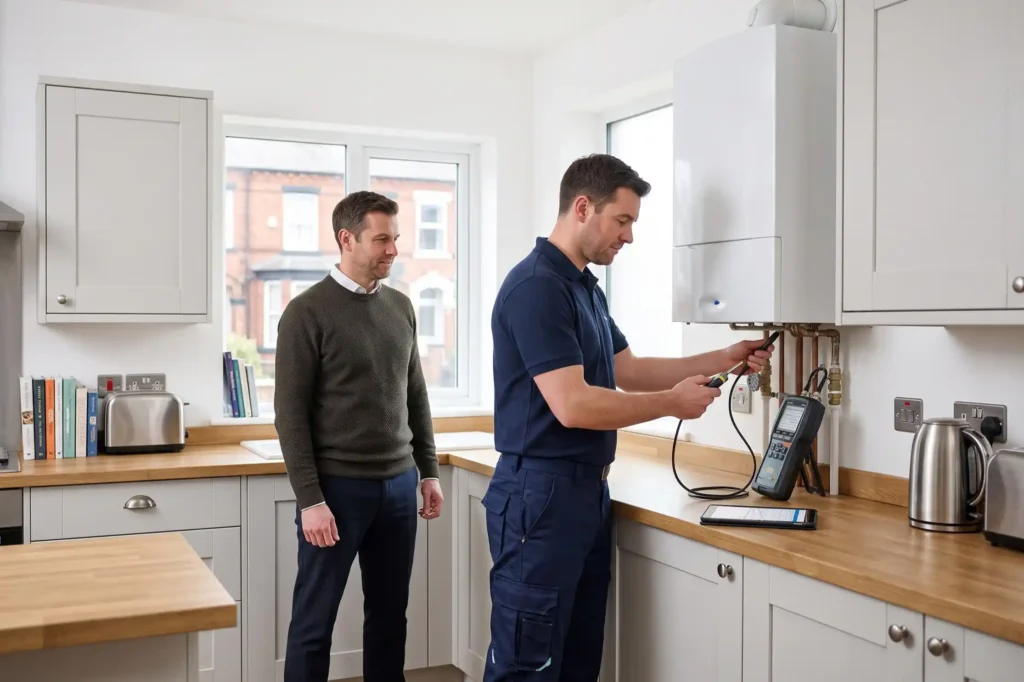
Gas Safety Certificates: Manchester Landlord Duties.
A gas safety certificate landlord duty applies to every residential property let in the UK. Landlords must keep gas appliances, fittings, and flues safe for tenants. In Manchester’s busy rental market, this duty protects tenant welfare. It also shields your investment from serious regulatory action.
Many landlords struggle with statutory timescales, engineer checks, and record-keeping. Failing these duties risks safety hazards, fines, or prosecution. What exactly must Manchester landlords do to meet full gas safety compliance?
Key Takeaways
- The Gas Safety Regulations 1998 require residential landlords to conduct annual safety checks on all gas appliances and flues provided within rental accommodation.
- All official inspection records must be completed by a qualified engineer who holds active registration with the Gas Safe Register for residential properties.
- Landlords must serve a valid copy of the safety check record to existing tenants within twenty-eight days and to new tenants before occupancy.
- Property owners must retain every gas safety check record for at least two years from the exact date the check was completed.
- Non-compliance with statutory gas safety duties carries unlimited financial fines, invalidates property insurance, and risks potential custodial sentences for serious statutory breaches.
Statutory Gas Safety Duties for Landlords
Gas Safety Installation and Use Regulations 1998
The Gas Safety (Installation and Use) Regulations 1998 set the core legal framework for private rented housing in England. Every residential landlord must ensure gas appliances, fittings, and flues remain safe. This duty applies throughout the tenancy. It covers all equipment supplied as part of the letting.
This legislation applies to all domestic properties let under residential tenancies. Landlords carry full legal liability for equipment supplied with the let. Appliances that tenants bring into the property themselves fall outside this duty.
Landlord Duties for Gas Equipment and Flues
Landlords must arrange an annual gas safety check for every appliance and flue in their rental properties. This duty keeps heating systems, gas fires, and hot water units operating safely. Regular checks prevent dangerous carbon monoxide leaks. They also protect tenants from fire risks linked to faulty equipment.
The duty extends to all pipework and flues connected to gas appliances. Landlords must carry out ongoing preventative maintenance. Prompt repairs protect structural safety and keep the property compliant with health and safety standards.
Scope and Details of the Gas Safety Inspection
Core Components Covered in the Inspection
A gas safety inspection checks the mechanical condition and operating safety of every connected appliance, flue, and section of pipework. The engineer tests operating pressures, gas tightness, and flame failure devices. These checks confirm that combustion fumes vent safely outside the building. They also confirm ventilation is adequate throughout the property.
Engineers visually inspect pipework for damage or corrosion. They run pressure drop tests to confirm there is zero gas escape in the supply line. Any appliance that fails these checks receives an immediate safety classification, such as Immediately Dangerous or At Risk.
CP12 Certification and Technical Documentation Details
The official record produced after an inspection is widely known as a CP12 certificate rental property document. It lists the location of every checked appliance, the results of each safety test, and any defects found. It also confirms whether each item meets statutory compliance standards.
The paperwork includes the engineer’s name, Gas Safe registration number, signature, and date of testing. It also shows the landlord’s details and the exact address of the let property.
Did You Know?
Under the Gas Safety (Installation and Use) Regulations 1998, landlords may carry out the annual check up to two months before the current certificate expires. The original expiry date stays unchanged, whilst preserving continuous statutory coverage.
Engineer Verification and Professional Standards
Gas Safe Register Qualifications and Competency
Gas safety checks must be carried out only by engineers registered with the Gas Safe Register. It is a criminal offence for unregistered tradespeople to inspect, service, or repair gas equipment in rental properties. This rule applies across the United Kingdom without exception.
Gas Safe registration replaced the former CORGI scheme. Engineers must pass regular technical assessments for each equipment category they work on. A domestic engineer may not hold certification for commercial boilers or complex multi-occupancy flues.
Verifying Engineer Credentials Prior to Works
Landlords should verify an engineer’s registration before commissioning an annual gas safety check. Checking the engineer’s Gas Safe ID card confirms active registration, verified photo identity, and specific work categories. These categories include domestic boilers, gas fires, and pipework safety checks.
Verification can be completed online via the Gas Safe Register website or by phone through their helpline. Keeping proof of this check strengthens a landlord’s compliance record if local housing enforcement teams request evidence.
The Railton-Meeks Compliance Audit Tool
Check Your Compliance & Protect Your Portfolio
Record Retention and Renewal Management
Statutory Two-Year Record Retention Rules
The law requires residential landlords to keep every completed gas safety record for at least two years. These records provide clear proof of ongoing compliance. They also demonstrate continuous safety management if local authorities or safety regulators carry out a formal audit.
Digital storage of certificates is legally acceptable, provided the records stay legible and easy to access. An organised digital audit trail allows fast retrieval for new tenants or during legal proceedings.
Maintenance Renewal Dates and the Flexible Window
Landlords may carry out annual gas safety checks up to two months before the current certificate expires. This flexible window preserves the original anniversary date for future checks. Property owners can schedule maintenance early without losing any statutory coverage for the property.
This flexibility helps landlords avoid late renewals caused by contractor scheduling conflicts or tenant access delays. Working within this two-month window keeps continuous protection across multi-property portfolios.
Railton-Meeks offers four landlord service tiers across Manchester and Cheshire
Tenant Information and Serving Obligations
Mandatory Timescales for Distributing Certificates
Landlords must serve a copy of the completed safety record to existing tenants within twenty-eight days of the inspection. Incoming tenants must receive a valid copy of the current certificate before they take possession. This applies to every new tenancy without exception.
Serving these documents promptly is a critical administrative step. Landlords should keep written proof of service, such as signed tenant acknowledgements or digital delivery receipts, to demonstrate full statutory compliance.
Handling Access Refusals and Maintenance Disputes
When a tenant refuses entry for a safety inspection, the landlord must show they took reasonable steps to gain access. Reasonable steps include repeated written requests, an explanation of the safety reasons, flexible appointment offers, and detailed records of every contact attempt.
Landlords cannot force entry into an occupied home without a court order. A documented trail of repeated correspondence protects landlords from prosecution, since it proves they made genuine, persistent attempts to meet their legal duties.
Instant Rental & Block Valuation
Get Your Valuation & Know Your Market Value
Penalties and Legal Consequences for Non-Compliance
Enforcement Action by the Health and Safety Executive
Failure to meet statutory gas safety duties is a serious criminal offence enforced by the Health and Safety Executive. Regulators can issue prohibition notices, impose unlimited fines, or bring criminal prosecutions. These penalties apply to landlords who put tenant lives at risk through safety neglect.
In severe cases involving fatal carbon monoxide poisoning or gas explosions, landlord negligence can lead to a custodial sentence under corporate manslaughter or gross negligence manslaughter law. Non-compliance also invalidates building insurance policies.
Impact on Possession Rights and Eviction Notices
Failing to provide tenants with a valid gas safety certificate before their tenancy starts restricts a landlord’s ability to recover possession. Under statutory rules, invalid service of safety paperwork can prevent landlords from serving legal possession notices. Full compliance must be restored first.
Court decisions confirm that gas safety records must be issued correctly at the start of a tenancy. Failure to provide this paperwork before move-in creates legal barriers that complicate eviction claims.
Local Compliance Considerations for Manchester Landlords
Multi-Occupancy Properties and Licensing Standards
Houses in Multiple Occupation in Manchester face strict scrutiny over gas safety and fire prevention standards. Manchester City Council requires valid gas certificates before granting an HMO licence. This applies across high-density student areas like Fallowfield and professional corridors such as Didsbury.
Licensing schemes across Manchester postcodes, including Selective Licensing zones in Rusholme and Moss Side, enforce rigorous safety inspections. Breaching licensing terms can lead to civil penalties of up to £30,000 imposed by the local authority.
Integrating Gas Audits with Portfolio Stewardship
Integrating annual gas inspections into wider property management workflows helps ensure compliance certificates never lapse across a growing portfolio. Pairing gas safety checks with electrical tests, energy performance reviews, and routine inspections builds robust operational oversight for every residential unit under management.
Proactive asset management prevents emergency call-outs and protects net yields. Centralised digital tracking helps property owners manage certification schedules smoothly, avoiding void periods and maintaining strong tenant retention.
HMO Specialist Yield & Tax Calculator
Calculate Your Yield & Offset New Tax Burdens
Final Thoughts
Maintaining an up-to-date gas safety certificate landlord record is an essential duty for every rental property owner. Qualified engineers must inspect appliances, flues, and pipework every year. This safeguards occupants from serious hazards and protects your investment against legal action.
Establishing a systematic compliance routine ensures every property meets statutory standards well before renewal deadlines. Careful documentation and proactive risk management build a solid foundation for long-term letting success.
Frequently Asked Questions
A:
Landlords must arrange a gas safety check every twelve months for all gas appliances, flues, and fittings provided for tenant use. A Gas Safe registered engineer must carry out the check. Landlords can use flexible renewal rules and complete checks up to two calendar months before the certificate expires. This does not change the original expiry date. It gives landlords time to manage property access and contractor scheduling.
A:
Only engineers registered with the Gas Safe Register may inspect, service, or repair gas installations in rental accommodation. Landlords must check that the contractor holds a valid Gas Safe ID card. This card shows photo identification and specific qualifications for domestic gas equipment. Using an unregistered worker is a criminal offence. It also invalidates insurance cover and risks enforcement action by the Health and Safety Executive.
A:
Landlords must give existing tenants a valid copy of the gas safety check record within twenty-eight days of the inspection date. Incoming tenants must receive a copy of the current certificate before they take possession of the property. Landlords should keep proof of service for every document provided. Failure to serve valid safety paperwork before occupancy can restrict a landlord's legal rights when seeking possession through legal notices.
A:
Landlords must retain copies of every gas safety check record for at least two years from the date of inspection. These historical records provide clear evidence of continuous maintenance. This matters if local housing authorities or health and safety officers inspect the property portfolio. Digital records are fully accepted by regulatory bodies, provided they stay clear, legible, and easily accessible during legal or licensing audits.
A:
When a tenant refuses access, the landlord must show they took all reasonable steps to carry out the inspection. This means sending written communications that explain the statutory safety obligations. It also means offering flexible appointment times and keeping accurate records of every contact attempt. Landlords cannot force entry into an occupied home without a court order. A clear paper trail of reasonable actions protects landlords from regulatory penalties if enforcement authorities investigate delayed checks.
