
Awaab's Law: What Landlords Must Do About Damp.
Awaab’s Law damp mould rules now extend into the private rented sector. This marks a fundamental shift in statutory property management across England. Landlords must adhere to strict, legally enforceable timelines when tenants report severe moisture, condensation, or structural dampness. Failing to address these hazards swiftly exposes property owners to civil penalties, enforcement notices, and direct litigation. Property owners must understand their exact duties to protect tenant health and safeguard portfolio assets.
These obligations require a practical framework. Landlords need to identify reportable hazards, carry out structural assessments, and execute timely remedial works. Property owners in areas with older housing stock face distinct technical challenges when managing condensation and rising damp. What specific statutory duties do landlords face, and how can property owners maintain compliance across legacy housing portfolios?
Key Takeaways
- Awaab’s Law forces private landlords to investigate reported damp and mould hazards within statutory timeframes and issue written inspection findings to tenants promptly.
- Emergency repairs for hazards posing imminent risk must commence within twenty-four hours, whilst non-emergency damp investigation reports require completion within fourteen days.
- Failing to remedy identified damp risks exposes property owners to county court litigation, rent repayment orders, and financial civil penalties from local authorities.
- The decent homes private rental standard mandates that all domestic properties remain completely free from severe Category 1 housing health and safety hazards.
- Landlords managing Victorian properties must implement passive background ventilation, humidistat extraction units, and proactive moisture audits to ensure ongoing compliance.
Statutory Damp and Mould Compliance Timeframes
Awaab’s Law establishes legally binding response periods for addressing atmospheric hazards within residential letting properties. Landlords must categorise reported damp and mould issues according to their severity. This determines the exact statutory timeframe for physical inspection, tenant reporting, and remedial building works.
Adhering to these hazard repair timeframes ensures that rental properties meet housing safety standards whilst shielding landlords from regulatory enforcement. The table below outlines the core statutory deadlines and inspection mandates. It also sets out the operational duties required under current private rented sector safety legislation across England.
| Hazard Category | Mandated Response Timeframe | Required Statutory Action |
|---|---|---|
| Emergency Hazard (Imminent Health/Safety Risk) | 24 Hours | Begin emergency repairs or mitigation works to eliminate immediate danger to occupants. |
| Significant Damp / Mould Hazard | 14 Calendar Days | Conduct full technical investigation and produce a written inspection report for the tenant. |
| Written Investigation Report Delivery | 3 Business Days | Provide the tenant with written findings, proposed action plan, and repair schedules post-inspection. |
| Remedial Repair Execution | 7 Calendar Days | Commence physical structural or mechanical repairs after issuing the formal investigation report. |
Awaab’s Law: Legislative Background and Scope
Legislative Origins and Extension to Private Lets
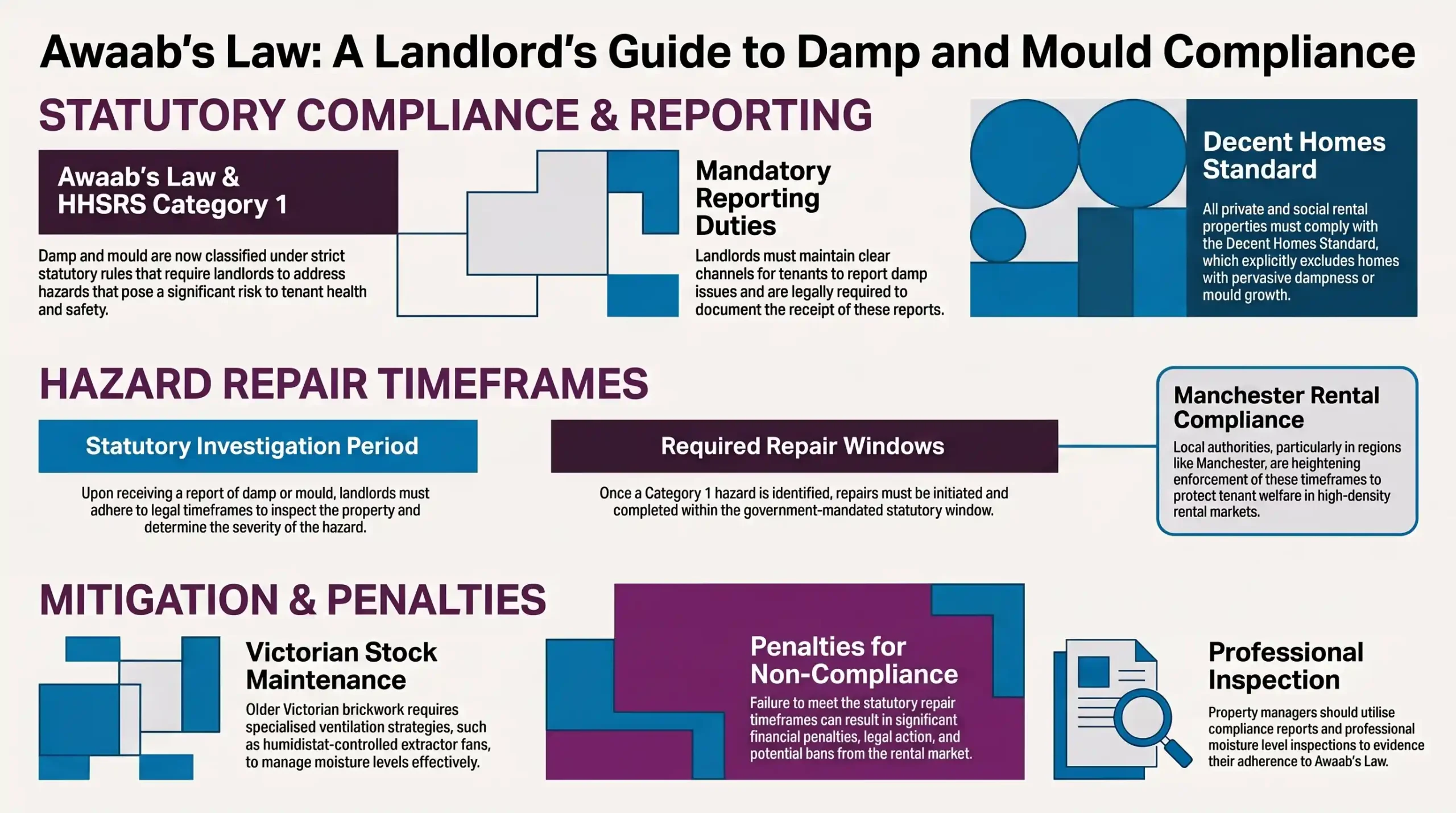
Awaab’s Law originated within the social housing sector following the tragic death of Awaab Ishak due to severe mould exposure. Legislation extended these strict moisture management duties into the decent homes private rental framework. This established mandatory response times and formal inspection duties for all private property owners across England.
The extension ensures that private tenants enjoy identical statutory protections regarding dampness and atmospheric hazards as social housing residents. Property owners can no longer dismiss recurring dampness as mere tenant lifestyle choices or simple condensation. Landlords must now treat every written or verbal notification of indoor moisture as a potential breach of statutory health standards. This triggers immediate administrative and technical workflows.
Housing Health and Safety Rating System Alignment
The enforcement framework relies heavily on the Housing Health and Safety Rating System to grade damp and mould hazards. Local authorities inspect residential properties using this risk-assessment tool. They categorise environmental deficiencies into severe Category 1 hazards or less critical Category 2 issues that require prompt corrective action.
When an inspection reveals a Category 1 hazard, the local housing authority has a statutory duty to act. Officers may issue formal Improvement Notices or Hazard Awareness Notices under the Housing Act 2004. A sound grasp of HHSRS scoring helps landlords identify structural defects, thermal bridging, and inadequate ventilation systems. This allows action before council inspectors intervene with formal enforcement proceedings.
Did You Know?
Under the Housing Health and Safety Rating System (HHSRS), Category 1 damp and mould hazards represent severe health threats, legally requiring local housing authorities to issue improvement notices or enforcement actions against non-compliant landlords.
Reportable Damp and Mould Hazards
Distinguishing Surface Condensation from Structural Moisture
Accurate hazard identification requires distinguishing between lifestyle-induced surface condensation and underlying structural water ingress. Condensation forms when moist interior air hits cold surfaces. Rising or penetrating damp is different. It stems from failed damp-proof courses, leaking pipes, damaged roof tiles, or porous brickwork requiring structural remediation.
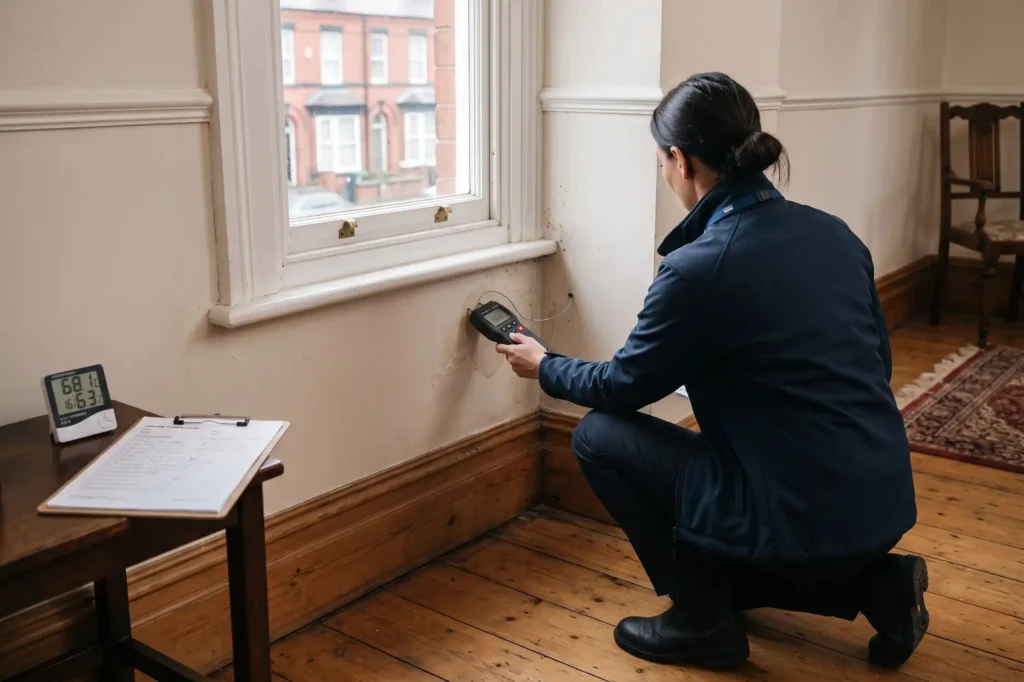
Landlords cannot assume condensation is entirely the occupant’s fault. Inadequate heating infrastructure, single-glazed window units, or unvented drying areas create conditions where condensation is unavoidable regardless of tenant behaviour. Professional damp surveys use electronic moisture meters, thermal imaging cameras, and hygrometers to trace exact moisture sources accurately.
Category 1 Hazard Definitions Under HHSRS
A Category 1 hazard exists when mould growth or dampness poses a serious threat to occupant health, particularly vulnerable individuals with respiratory conditions. Extensive black mould growth in living areas, persistent damp spreading across bedrooms, or saturated insulation creates an immediate statutory violation demanding urgent intervention.
Health risks associated with mould spores include asthma exacerbation, severe allergic reactions, and lower respiratory infections. Vulnerable occupants, such as young children or elderly residents, elevate the severity rating during an inspection. Landlords must treat widespread fungal spores as structural hazards rather than cosmetic annoyances.
The Railton-Meeks Compliance Audit Tool
Check Your Compliance & Protect Your Portfolio
Landlord Obligations Upon Receiving Tenant Complaints
Initial Complaint Logging and Communication Protocols
Upon receiving a tenant complaint regarding indoor dampness or fungal growth, landlords must log the notification immediately within a formal record system. Property managers must acknowledge receipt of the report in writing within specified statutory windows. This should detail planned inspection arrangements and provide preliminary guidance to affected occupants.
Clear communication prevents misunderstandings and demonstrates regulatory compliance. Landlords should maintain digital records of all correspondence, including timestamped emails, text messages, and photographic evidence provided by tenants. Establishing clear communication channels ensures landlords meet strict administrative timelines mandated under national housing standards.
Formal Investigation and Written Reporting Mandates
Landlords must conduct a physical investigation of reported damp hazards within fourteen calendar days of complaint receipt. Following the inspection, the landlord must issue a comprehensive written report to the tenant within three business days. This report must explain identified root causes and detail proposed remedial schedules.
The written report serves as a binding legal document outlining corrective measures. It must specify whether building repairs, ventilation installations, or structural treatments are required. If temporary tenant rehousing is necessary due to extensive remediation works, the landlord must detail suitable alternative accommodation arrangements within this formal document.
Railton-Meeks offers four landlord service tiers across Manchester and Cheshire
Enforceable Hazard Repair Timeframes
Emergency Response Within Twenty-Four Hours
When damp or mould hazards pose an imminent danger to tenant safety or severe health risks, emergency response protocols apply immediately. Landlords must initiate emergency repairs within twenty-four hours. This covers isolating water leaks, addressing total heating system failures in winter, or managing severe, expanding black mould outbreaks.
Emergency action focuses on removing immediate danger rather than completing full structural refurbishments. Operatives must contain active plumbing leaks, deploy temporary dehumidifiers, or restore space heating within the initial twenty-four-hour window. Documenting emergency contractor call-outs provides essential evidence should local authorities review response adequacy.
Standard Remediation Schedules and Works Execution
For standard damp hazards, landlords must commence physical building repairs within seven days of issuing the investigation report. Works must proceed without unnecessary delay. Contractors must resolve ventilation defects, repair damaged rainwater goods, or inject chemical damp-proof courses to eliminate the underlying moisture source permanently.
Adhering to these strict hazard repair timeframes requires established contractor relationships and proactive supply chain management. Property managers should maintain pre-agreed service level agreements with qualified building tradespeople. Completing works within statutory deadlines protects landlords from regulatory intervention, whilst preserving long-term structural integrity.
Legal Consequences of Regulatory Non-Compliance
Financial Penalties and Local Authority Enforcement
Failing to comply with statutory repair timeframes exposes private landlords to severe enforcement actions from local council housing teams. Authorities possess power to issue Civil Penalty Notices up to £30,000 for housing breaches. They may also serve formal Improvement Notices, or perform emergency remedial works and charge costs directly to owners.
Local housing departments maintain proactive inspection regimes, particularly across designated selective licensing areas. Non-compliance can also result in landlords losing their “fit and proper person” status, preventing them from holding HMO licences or operating multi-occupancy properties. Penalty notices are registered publicly, causing significant reputational damage to property businesses.
Tenant Compensation Claims and Rent Repayment Orders
Tenants possess direct legal remedies through county court action when landlords breach statutory duties regarding property fitness. Courts can order property owners to pay substantial compensation for personal injury, damaged belongings, and prolonged distress. First-tier Tribunals may separately issue Rent Repayment Orders covering up to twelve months’ rent.
Legal disrepair claims carry significant financial liabilities, as losing landlords must cover tenant legal costs alongside court-ordered compensation. Under Section 9A of the Landlord and Tenant Act 1985, properties must remain fit for human habitation throughout the tenancy. Courts view unaddressed fungal growth as a primary indicator of structural unfitness.
Instant Rental & Block Valuation
Get Your Valuation & Know Your Market Value
Decent Homes Standard in the Private Rental Sector
Minimum Property Standards and Statutory Cleanliness
The application of the decent homes private rental framework requires properties to meet strict physical standards, remain free from serious hazards, and provide modern facilities. Dwellings must maintain structural stability, effective weatherproofing, and hygienic surface conditions. This ensures atmospheric moisture does not compromise resident health or safety.
Compliance requires proactive maintenance strategies rather than reactive repairs. Landlords must routinely inspect structural elements including roof coverings, masonry pointing, flashings, and window seals. Ensuring the building envelope remains fully watertight eliminates external moisture sources, forming the foundation of statutory compliance under updated private sector rules.
Excess Cold Integration and Thermal Efficiency Targets
Decent home requirements link damp control directly with thermal performance, recognising that cold properties exacerbate internal condensation risks. Landlords must eliminate Excess Cold hazards by installing efficient heating systems, upgrading cavity or loft insulation, and ensuring properties meet minimum energy performance certificate standards before letting.
Properties achieving low EPC ratings suffer higher rates of condensation due to cold interior wall surfaces. Improving insulation reduces thermal bridging where warm, humid air condenses into moisture droplets. Landlords upgrading heating infrastructure and wall insulation concurrently address Excess Cold and damp hazards, creating healthy, compliant rental environments.
Practical Damp Management in Older Victorian Stock
Mechanical Ventilation Upgrades and Continuous Extraction
Managing dampness in older Victorian terraced homes across South Manchester requires upgrading passive ventilation to high-performance mechanical extraction systems. Installing continuous-running, humidistat-controlled extractor fans in kitchens and bathrooms automatically adjusts fan speed based on ambient relative humidity. This prevents moisture buildup without tenant intervention.
Traditional Victorian properties were designed to breathe through suspended timber floors, open chimneys, and single-glazed sashes. Modern energetic retrofits often seal these natural pathways, trapping moisture inside solid-brick structures. Fitting decentralised Mechanical Extract Ventilation (dMEV) units ensures constant trickle air movement, preventing indoor humidity from reaching levels where mould spores thrive.
Structural Damp Isolation and Fabric Maintenance
Victorian properties across areas like Fallowfield, Didsbury, and Rusholme frequently require targeted fabric repairs to resolve rising and penetrating dampness. Landlords must maintain sub-floor air bricks, re-point degraded lime mortar joints, clear choked rainwater gutters, and install modern damp-proof membranes where original slate barriers have perished.
Using impermeable modern cement plasters on solid Victorian walls often traps moisture behind internal surfaces, driving damp upward into timber joists. Retrofitting legacy housing stock demands breathable lime renders, clear cavity perimeters, and specialised damp isolation treatments. Conducting regular six-month property audits identifies external structural deterioration early, preserving both asset value and statutory compliance.
HMO Specialist Yield & Tax Calculator
Calculate Your Yield & Offset New Tax Burdens
Final Thoughts
Complying with statutory Awaab’s Law damp mould requirements is essential for all residential landlords operating in the private rented sector. By understanding hazard classifications, adhering to strict inspection timeframes, and executing necessary repairs promptly, property owners maintain healthy homes whilst safeguarding their investments against costly council enforcement actions.
Proactive environmental management remains the most effective strategy for preserving housing stock and ensuring tenant safety. Establishing routine property inspections, installing continuous ventilation systems, and acting immediately upon tenant reports ensures full regulatory compliance across single lets and multi-occupancy portfolios alike.
Frequently Asked Questions
A:
Landlords must conduct an initial investigation of reported damp hazards within fourteen calendar days of notification. Following the inspection, property owners must issue a formal written investigation report to the tenant within three business days, setting out the identified causes and the proposed remedial schedule. If the damp issue represents an emergency hazard posing imminent safety risks, physical response and repair initiation must begin within twenty-four hours, regardless of the standard fourteen-day investigation window that would otherwise apply to non-urgent cases.
A:
Emergency hazards include severe water ingress caused by burst pipes or structural collapses, total heating system failures during freezing weather, or rapidly expanding black mould outbreaks covering extensive living spaces. Any moisture issue that severely impacts electrical safety or creates immediate health risks for vulnerable occupants triggers the mandatory twenty-four-hour emergency repair window. Landlords should keep a record of contractor call-out times, as this evidence may be requested if a local authority later reviews the adequacy of the response.
A:
Landlords cannot dismiss condensation simply as a tenant lifestyle issue. Property owners are legally obligated to provide adequate heating facilities, proper wall insulation, and functioning mechanical ventilation throughout the let property. If a dwelling lacks continuous extraction fans or suffers from severe thermal bridging, the property itself fails statutory standards, regardless of how occupants dry clothes or ventilate individual rooms within the home.
A:
Non-compliant landlords face local authority Civil Penalty Notices of up to £30,000, statutory Improvement Notices, or emergency council works charged directly to the property owner. Tenants can also pursue county court claims for disrepair compensation, legal costs, and First-tier Tribunal Rent Repayment Orders covering up to twelve months of paid rent. Repeated breaches can additionally jeopardise a landlord's fit and proper person status under selective licensing rules.
A:
Victorian homes require a combination of mechanical ventilation and fabric maintenance. Landlords should fit continuous humidistat-controlled extractor fans in kitchens and bathrooms, unblock sub-floor air vents, and repair exterior lime mortar pointing where it has degraded over time. Installing breathable internal wall insulation and ensuring rainwater gutters function correctly prevents external moisture from penetrating solid brick structures and driving damp upward into internal timber elements.
