

Professional Property Management & Rental Solutions
The UK private rented sector is undergoing its most significant transformation in decades, driven by the Renters’ Rights Act 2026. Success requires professional property management integrated with complete rental solutions and tenant maintenance support. These three pillars form the foundation for legislative compliance and asset protection in the new regulatory environment.
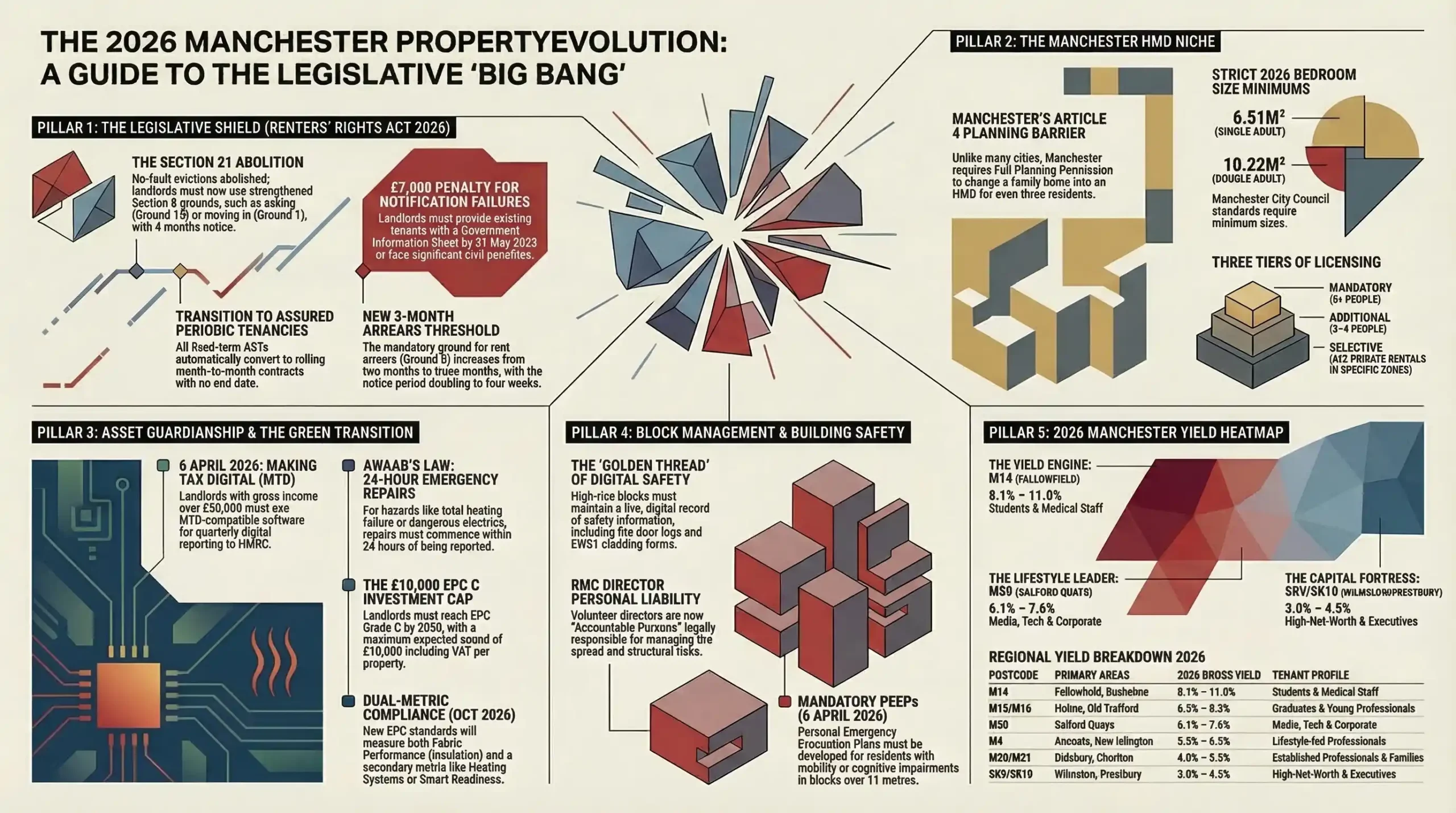
Landlords across Manchester and Cheshire face a bifurcated market where high yields balance against increasingly complex regulatory burdens. From the abolition of Section 21 to the mandatory EPC C transition by 2030, success demands active stewardship. How can you future-proof your portfolio against the upcoming legislative shifts?
Key Takeaways
- Section 21 “no-fault” evictions are abolished on 1 May 2026.
- All tenancies convert to Assured Periodic terms with no fixed end dates.
- HMOs in Manchester require specific planning permission under Article 4.
- The EPC C mandate for all private rentals is set for 1 October 2030.
- Awaab’s Law introduces strict 24-hour response times for emergency repairs.
Safeguard Portfolios Against The 2026 Legislative Shift
Navigate The Abolition Of Section 21
The abolition of Section 21 on 1 May 2026 ends the era of no-fault evictions. Landlords must now provide specific mandatory grounds for possession under an expanded Section 8 framework. Property owners must issue court proceedings for any pre-May notices by 31 July 2026. Otherwise, notices expire and the new framework applies.
Professional property management becomes the primary shield for investors in this high-stakes environment. Regaining possession now depends entirely on the quality of evidence. This includes rent arrears, anti-social behaviour, or the intent to sell the property. Landlords must move away from the “accelerated possession” route. The court system demands meticulous record-keeping and robust legal justification for every claim.
Transition To Assured Periodic Tenancies
Assured Shorthold Tenancies automatically convert into Assured Periodic Tenancies from May 2026. This removes fixed-term end dates. Tenants can vacate with two months’ notice at any time. A complete review of existing contracts is essential. Break clauses and fixed-term wording become legally inoperative under the new framework.
This “rolling” system changes the fundamental rhythm of the rental market. Student-heavy areas like Fallowfield and Withington face particular challenges. Landlords must adapt to a model where tenant retention depends on accommodation quality. Contractual lock-in no longer applies. Complete rental solutions now demand a deeper focus on tenant satisfaction. This prevents the high costs of frequent, unplanned void periods that disrupt annual yield targets.
| Requirement Type | Deadline / Threshold | 2026 Compliance Action |
|---|---|---|
| Section 21 Backstop | 31 July 2026 | Final date to initiate court proceedings for pre-May notices. |
| Government Info Sheet | 31 May 2026 | Mandatory document distribution to all existing tenants. |
| Making Tax Digital | 6 April 2026 | Digital quarterly reporting for gross income over £50,000. |
| Tenancy Deposit Cap | 1 May 2026 | Maximum deposit reduced to five weeks’ rent (previously six). |
| Rent Bidding Ban | 1 May 2026 | Illegal to request, encourage, or accept rent above advertised price. |
Prepare For The EPC C Mandate
Achieve The October 2030 Threshold
Every private rented home in England and Wales must reach an EPC rating of C by 1 October 2030. This applies to both new and existing tenancies. The previous phased approach has been scrapped. This creates a “Big Bang” deadline that affects all rental stock simultaneously.
Strategic professional property management involves conducting a “Green Audit” now to identify at-risk properties. Achieving EPC C in older Victorian stock requires external wall insulation or heat pump installations. These properties are common in Didsbury and Chorlton. Landlords should aim to reach the target before October 2029. This locks in “Legacy Compliance” for ten years. It shields portfolios from further metric changes that may occur after the 2030 deadline.
Utilise Investment Caps And Government Grants
The government has introduced a £10,000 investment cap per property to reach the EPC C standard. This protects landlords from uncapped costs whilst driving building fabric improvements. Properties that cannot reach the required rating after £10,000 spend qualify for a ten-year exemption. The works must be verified and the spend documented accurately.
Accessing the £15 billion Warm Homes Plan is essential for bridging the funding gap. Properties in lower Council Tax bands qualify for the Great British Insulation Scheme. Professional managers match properties with available grants for loft and cavity wall insulation. This ensures energy efficiency upgrades do not cannibalise annual yield. The proactive approach keeps portfolios attractive to the modern, eco-conscious tenant market.
Orchestrate Proactive Property Repairs
Adhere To Awaab’s Law Timeframes
Awaab’s Law mandates strict, legally enforceable timeframes for addressing hazards like damp and mould. Emergency repairs deemed life-threatening require a 24-hour start time. Landlords must investigate significant hazards within 14 days. A written report must reach the tenant within three days of that investigation.
Managing these tight windows requires a highly responsive maintenance engine. Professional property management utilises in-house triage. Minor issues are resolved via video call. Trusted tradespeople deploy for physical inspections immediately. High-speed response is bolstered by tenant maintenance support. Ventilation audits and moisture assessments occur during every six-month inspection. This prevents damp from becoming a structural or legal liability.
Prioritise Planned Preventative Maintenance
Planned Preventative Maintenance (PPM) identifies potential failures before they become emergency call-outs. Examples include a boiler nearing its end of life or a slipped roof tile. This forward-thinking approach reduces long-term ownership costs. It avoids the “emergency premium” charged by contractors for out-of-hours work. Minor issues are prevented from escalating into major damage.
Maintaining consistent work volumes for a core group of trusted tradespeople secures competitive rates. Essential compliance tasks include Gas Safety (CP12) and EICR testing. This structured approach to complete rental solutions ensures safety certificates never lapse. Properties remain maintained to the “Decent Homes Standard.” Well-maintained properties attract higher-quality tenants. They reduce the most significant cost to any landlord: the void period.
Analyse Manchester Yield Heatmaps
Target High-Intensity Yield Zones
Manchester’s rental market is bifurcated between high-yield student zones and premium lifestyle hubs. In M14, gross yields can reach 11.0%. Ancoats and Didsbury offer premium lifestyle positioning. Fallowfield and Rusholme face a 15,000-bed shortfall in student accommodation. This creates intense demand for existing licensed HMO stock under Article 4 restrictions.
Successful investment in 2026 relies on matching property types to specific micro-market performance data. M14 offers the highest cash flow. Salford Quays (M50) provides robust 6.1% – 7.6% yields. The professional tenant base from MediaCityUK drives high earnings. Professional management teams use street-by-street intelligence. This advises landlords on where to acquire assets that balance immediate income with long-term capital preservation.
Evaluate Capital Preservation Hubs
Didsbury, Chorlton, and the Cheshire “Golden Triangle” remain primary destinations for capital preservation. Areas include Wilmslow, Alderley Edge, and Prestbury. Yields typically sit between 3.0% and 5.5%. High-net-worth individuals and established families value school catchments and lifestyle amenities. Tenancy durations are much longer with lower turnover costs compared to city centres.
In these premium postcodes, the focus shifts toward asset stewardship and meticulous tenant vetting. The Renters’ Rights Act 2026 makes professional referencing even more critical. The “Rent-to-Income” ratio must be carefully assessed to ensure long-term affordability. For high-value residences in Bowdon or Hale, the management strategy prioritises maintenance of period features. High-spec security systems ensure the asset’s prestige is maintained for future resale.
Audit Portfolios For Legal Compliance
Prepare The May 2026 Checklist
A comprehensive audit of all existing notices and tenancies must be performed by March 2026. This includes deciding if a final Section 21 notice is required before the 30 April cutoff. Digital systems must be prepared to distribute the mandatory Government Information Sheet. All tenants must receive this between 1 May and 31 May 2026.
Professional property management provides the administrative framework to handle these “Big Bang” requirements without error. Failure to provide the written statement of terms can result in civil penalties. Required government notifications carry penalties of up to £7,000 per breach. Centralising compliance documentation ensures every “Right to Rent” check is current. Gas Safety records and deposit protection certificates must be up to date and legally served. This shields the owner from regulatory risk.
Review Insurance And Legal Expenses
The removal of the “Accelerated Possession” route makes Section 8 court processes the standard for regaining property. All Legal Expenses Insurance (LEI) policies require review. Landlords must ensure coverage is updated to reflect the new 2026 court framework. Financial protection against costs of proving mandatory grounds in contested hearings is essential.
Complete rental solutions must include a review of rent guarantee products and liability cover. The Building Safety Regulator and local councils increase enforcement of HMO standards. Awaab’s Law enforcement is intensifying. Professional indemnity and robust legal support are non-negotiable. This holistic approach to risk management ensures landlords’ financial interests remain fortified. Protection extends against unforeseen legal costs and tenant defaults.
Did You Know?
Under the Renters’ Rights Act 2026, Ground 4A is a specific mandatory ground for possession designed for the student market. It applies in areas like Fallowfield. Landlords can regain possession of a student HMO to align with the next academic cycle. The notice must expire between 1 June and 30 September. It must have been specified in the original tenancy terms.
Summary of Property Management Essentials
The transition to the 2026 regulatory framework requires a fundamental shift in how landlords approach professional property management. Integrating street-level market intelligence with rigorous adherence to the Building Safety Act is essential. The Renters’ Rights Act transforms legislative challenges into opportunities. Property owners can achieve portfolio professionalisation and long-term yield stability.
Ultimately, success depends on the quality of tenant maintenance support and the precision of the management engine. As the “Big Bang” implementation of May 2026 approaches, those who adopt a proactive, data-driven approach will thrive. A more regulated, yet resilient, private rented sector awaits. Start optimising your portfolio today to ensure readiness for the new era of UK letting.
Frequently Asked Questions
A:
On 1 May 2026, all existing Assured Shorthold Tenancies automatically convert into Assured Periodic Tenancies. You do not need to rewrite your contracts. However, any "fixed-term" or "break clause" wording will become legally inoperative. Tenants will then be able to end the tenancy at any time by giving two months' notice. You will no longer be able to use Section 21 to end the agreement.
A:
Yes, the 2026 legislation introduces a strict "Bidding Ban." Properties must be advertised with a specific rental figure. It is illegal for a landlord or agent to ask for, encourage, or even accept an offer higher than that advertised price. Accepting a voluntary higher offer from a tenant can result in a civil penalty of up to £7,000.
A:
The Golden Thread is a mandatory digital record of a building's safety information required under the Building Safety Act 2022. It must be a live, "single source of truth" containing all architectural, fire safety, and structural data. This ensures that the Building Safety Regulator and the Fire Service have immediate access to accurate information. The record covers the building's safety risks and management history.
A:
Awaab's Law requires landlords to investigate hazards like damp and mould within 14 days. A written report to the tenant must follow within 3 days of that investigation. If a hazard is deemed an "emergency," such as a total heating failure in winter, repairs must commence within 24 hours. Failure to meet these legally enforceable timeframes can lead to significant legal liability and council enforcement.
A:
Every private rented home in England and Wales must reach an EPC rating of C by 1 October 2030. The previous phased approach has been scrapped. This deadline applies to both new tenancies and existing ones. There is a £10,000 investment cap per property. Any qualifying energy improvements made from October 2025 onwards count toward this financial limit.