

Full Management Letting Service: Inclusions And Fees
Operating a private rented property demands technical precision, active oversight, and rigorous statutory compliance. A full management letting service lets owners delegate daily duties to dedicated professionals. That delegation protects both asset value and monthly rental yield. From marketing vacancies to executing tenancy agreements, an all-inclusive service removes constant operational friction. The right property professional oversees physical maintenance and preserves regulatory paperwork. That discipline protects consistent cash flow across single tenancies and multi-unit portfolios.
Major legislative change has reshaped tenancy structures and possession grounds across the UK private rented sector. Passive management models no longer offer adequate protection to investors. Landlords now need comprehensive operational support to defend income and reduce legal exposure. Are your rental properties fully insulated against modern compliance risks and prolonged arrears?
Key Takeaways
- A comprehensive letting service shields owners from daily operational demands whilst maintaining strict compliance across the private rented sector.
- Rigorous tenant onboarding combines digital inventories, verified affordability checks, and statutory document distribution to secure tenancies from the outset.
- Rapid arrears protocols trigger corrective contact within twenty-four hours, preventing debt from reaching statutory possession thresholds.
- Bi-annual photographic inspections identify emerging damp, maintenance hazards, and tenancy breaches before minor defects escalate into costly repairs.
- Transparent fee structures align agency incentives with landlord income and produce clean records for digital tax reporting.
Core Components of Comprehensive Letting Solutions
Modern property management rests on a clear division of operational responsibility. Professional oversight ensures every statutory milestone is met across the tenancy lifecycle. In practice, we find this discipline protects capital investment and rental yield across each residential asset class. It also removes the administrative pressure that self-managing landlords absorb week after week.
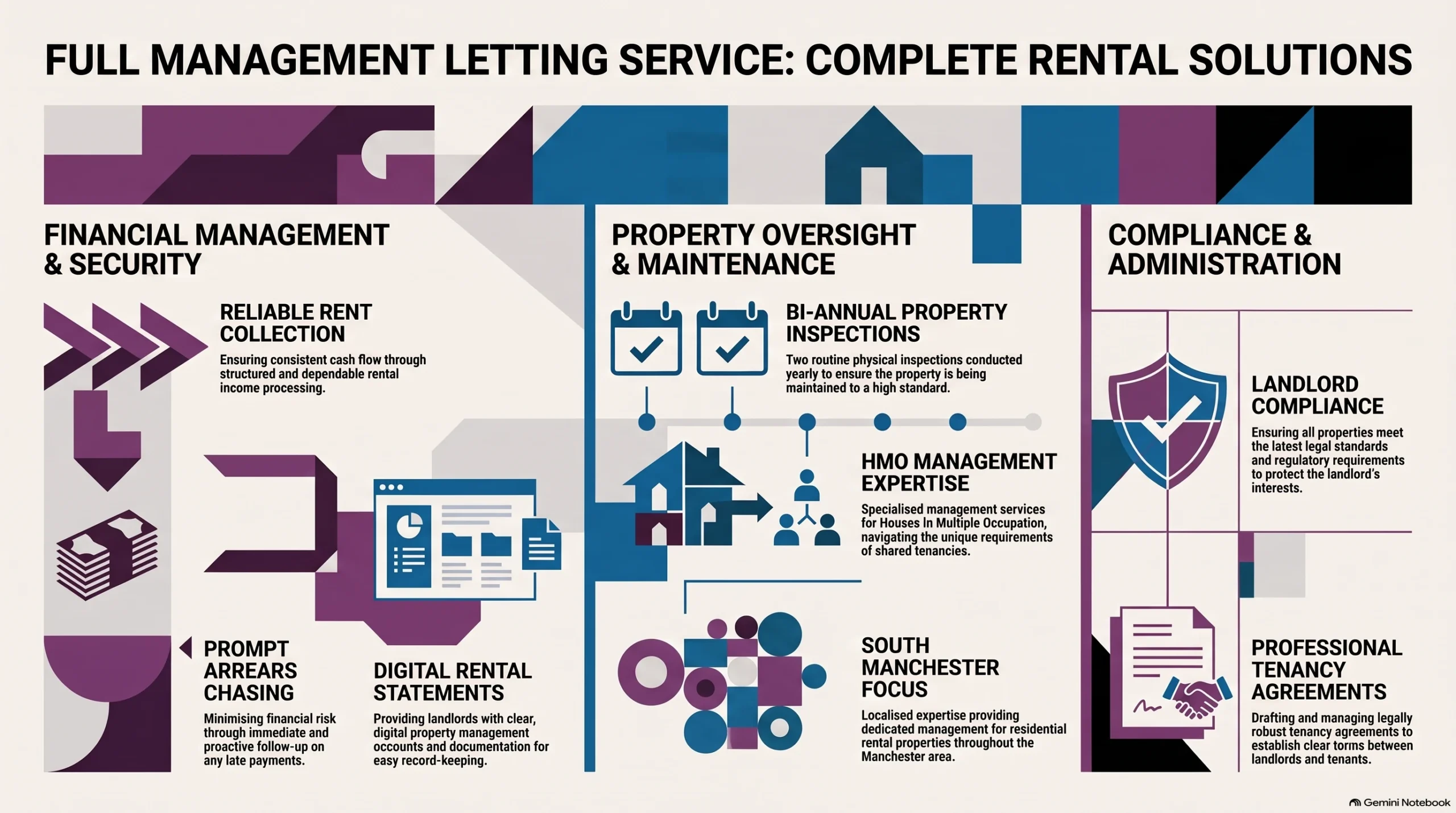
The matrix below sets out standard inclusions within professional agency agreements. It compares core administrative duties against basic tenant-find arrangements. The contrast shows the operational protections delivered to owners of single tenancies and larger regional portfolios. Landlords can use it to judge where a managed service earns its fee.
| Service Feature | Tenant-Find Only | Full Management Service |
|---|---|---|
| Tenant Vetting and Right to Rent | Included | Included |
| Photographic Inventory Creation | Optional Extra | Included as Standard |
| Rent Collection and Daily Monitoring | Excluded | Included as Standard |
| Arrears Chasing Within 24 Hours | Excluded | Included as Standard |
| Bi-Annual Property Inspections | Excluded | Included as Standard |
| Statutory Certification Renewals | Excluded | Included as Standard |
| Deposit Dispute Resolution | Excluded | Included as Standard |
Pre-Tenancy Onboarding and Tenant Placement
Tenant Referencing and Identity Audits
Comprehensive tenant vetting forms the bedrock of asset protection before any keys change hands. Referencing protocols test applicant income stability, credit history, previous landlord conduct, and statutory Right to Rent credentials. This check confirms affordability ratios. It also filters out high-risk applicants well before contracts are drafted.
Professional agencies examine employment contracts, bank statements, and credit files. That evidence confirms long-term payment capability. Assessing rent-to-income ratios ensures incoming tenants meet their commitments comfortably. Meticulous identity audits also prevent illegal sub-letting. Structured vetting establishes reliable tenancies from day one, lowers future dispute risk, and protects consistent rental returns.
Digital Photographic Inventories and Check-In Procedures
High-definition photographic inventories create indisputable baseline evidence of condition before occupation begins. A detailed schedule of condition captures every room, fixture, and appliance with clear descriptions and date-stamped imagery. This objective digital record prevents contentious deposit disputes. It also supplies vital legal protection at the end of the tenancy.
An agent runs a structured handover and walks the incoming tenant through the schedule of condition. The agent records utility meter readings, verifies them, and notifies suppliers alongside the local council. Clear documentation separates fair wear and tear from tenant damage. Thorough check-in procedures remove ambiguity and set mutual expectations on property standards.
Financial Administration and Yield Protection
Rent Collection and Daily Payment Monitoring
Automated payment tracking registers rental receipts daily and flags missed or short payments at once. Reliable financial processing reconciles tenant payments immediately. Net funds then route to landlords with clear, itemised monthly statements. This active oversight preserves cash flow and simplifies portfolio accounting across the financial year.
Financial clarity sits at the centre of complete rental solutions, particularly as tax authorities move landlords towards digital record-keeping. Digital statements catalogue rental income, allowable maintenance deductions, and management charges. These ledgers export cleanly into modern accounting software. Transparent administration relieves owners of manual bookkeeping. It also delivers verified audit trails for annual tax returns.
Arrears Recovery and Statutory Possession Thresholds
Proactive rent collection depends on swift intervention whenever a payment fails to clear on the due date. A full management letting service including arrears chasing and two inspections yearly triggers default notifications within twenty-four hours. Fast contact resolves banking oversights before debt builds into an unmanageable crisis.
Early arrears management now matters more than ever under current tenancy legislation. The mandatory possession ground requires three months of cumulative unpaid rent before formal eviction proceedings can begin. Letting managers log every payment reminder, telephone call, and repayment agreement. From experience across the sector, that structured correspondence becomes essential legal proof when possession proceedings prove unavoidable.
Did You Know?
Under the Renters’ Rights Act 2025, the mandatory rent arrears ground requires three full months of arrears. The notice period landlords must serve also rises from two weeks to four weeks.
Property Maintenance and Contractor Coordination
Triage Workflows for Urgent and Routine Repairs
Structured maintenance triage separates genuine emergencies from standard repairs and prevents unnecessary out-of-hours call-out charges. Experienced managers guide tenants through basic diagnostic checks by phone or video before any contractor is dispatched. This operational filter resolves simple faults such as tripped circuit breakers without spending landlord funds.
When professional intervention is necessary, the agent instructs trusted, vetted tradespeople to complete the work efficiently. Pre-agreed expenditure limits let managers resolve urgent issues promptly. Major capital works still require landlord approval. Vetted contractors deliver competitive pricing, sound workmanship, and valid liability insurance, which preserves the physical fabric of the property.
Statutory Safety Certifications and Compliance Calendars
Mandatory safety regulations demand strict compliance with renewal deadlines for gas, electrical, and energy efficiency standards. Letting agents run automated compliance calendars covering annual Gas Safety Certificates and five-year Electrical Installation Condition Reports. Energy Performance Certificates sit on the same schedule, so inspections happen before existing certification expires.
A lapsed safety certificate creates severe legal exposure. It can void landlord insurance and trigger heavy civil penalties. Dedicated property managers book inspections well in advance and liaise directly with tenants over access. Digital copies of every safety document sit in one system. That gives immediate access whenever council officers, auditors, or courts request evidence.
The Railton-Meeks Compliance Audit Tool
Check Your Compliance & Protect Your Portfolio
Routine Inspections and Property Condition Audits
Bi-Annual Photographic Condition Inspections
Regular mid-term audits reveal unreported maintenance issues and show how well tenants are caring for the property. Two detailed photographic inspections each year let agents monitor decorative condition, appliance cleanliness, and structural integrity. The resulting report alerts landlords to preventative work long before minor defects worsen into expensive repairs.
Inspections also confirm adherence to tenancy conditions. They surface issues such as unapproved pets, smoking, or unauthorised sub-letting. Visual surveys cover external brickwork, guttering, and window seals to catch weather damage early. Recording condition at six-month intervals builds a transparent historical record. That record protects asset value and informs future capital investment.
Damp, Mould, and Environmental Hazard Audits
Dedicated moisture assessments reduce mould risk and maintain safe living conditions under strict environmental standards. Inspecting managers test ventilation efficiency, identify cold bridging, and review tenant heating habits during routine visits. Prompt corrective measures resolve the underlying damp source before structural deterioration sets in or tenant health suffers.
Enforceable property standards require landlords to investigate reported damp and moisture hazards within strict statutory timeframes. Property managers verify that extractor fans, trickle vents, and heating systems work at full capacity. Practical ventilation guidance for occupants reduces condensation. These structured audits protect landlords from enforcement notices and preserve tenant satisfaction.
Railton-Meeks offers four landlord service tiers across Manchester and Cheshire
Tenancy Renewals, Rent Reviews, and Vacancy Oversight
Contract Revisions and Statutory Tenant Notifications
Periodic tenancy administration demands precise adherence to statutory notice procedures and mandatory information distribution. Property managers issue government guides and written statement terms within the required timeframes, which avoids punitive civil fines. Professional oversight keeps every tenancy contract aligned with modern periodic rental rules across the whole portfolio.
The end of fixed-term agreements means tenancies roll month to month. That shift requires continuous administrative attention. Letting managers keep an open dialogue with tenants and track long-term occupancy plans. When a tenant serves notice, agents begin re-marketing immediately. Proactive communication minimises costly void periods and keeps the asset producing income.
Market Rent Assessments and Formal Price Adjustments
Annual rental reviews keep property revenue in step with broader economic conditions and local market values. Letting agents track comparable data across postcodes to benchmark achievable rent levels for existing stock. Every adjustment then follows formal statutory notice procedures, which secures absolute legal compliance and removes any risk of challenge.
Legislation prohibits informal rental increases and arbitrary pricing changes. Structured statutory notices must give tenants a formal notice period. Property managers build rent adjustment proposals on recent local evidence. This data-driven approach justifies the revision and reduces tenant friction. Systematic increases protect long-term gross yields from inflationary pressure.
Instant Rental & Block Valuation
Get Your Valuation & Know Your Market Value
Specialist HMO Compliance and Licensing Oversight
Houses in Multiple Occupation Mandatory Standards
Shared multi-tenant accommodation requires heightened supervision of communal amenities, waste management, and space standards. Managed HMO properties must meet strict room-size thresholds, fire compartmentation rules, and amenity ratios under housing regulations. Professional managers run regular communal inspections to hold these standards steady across complex shared environments throughout the year.
Specialist HMO stock needs commercial-grade fire alarms, FD30 fire doors, and escape routes free from obstruction. Letting managers keep weekly or monthly safety testing logs that evidence active oversight. Managing refuse storage and recycling prevents external clutter that attracts council scrutiny. This operational discipline prevents substantial civil penalties on high-density assets.
Local Authority Planning Restrictions and Licensing Schemes
Municipal licensing frameworks demand careful alignment between planning law and local council property licences. Agents establish whether an asset needs a Mandatory HMO licence, Additional licensing, or Selective licensing within a given postcode. Managing each renewal protects landlords from substantial fines and rent repayment orders across the portfolio.
In areas covered by Article 4 directions, converting a property into a shared home requires formal planning approval. Managing agents secure and maintain Certificates of Lawful Use to evidence established planning rights. Retaining planning and licensing paperwork preserves asset value. Professional agencies absorb the regulatory complexity inherent in shared accommodation.
Full Management Fee Structures and Inclusions
Commission Percentages and Operational Deductions
Management fees usually take the form of a set percentage of monthly collected rent. That model aligns agency performance directly with landlord cash flow. The commission covers daily administration, rent collection, repair handling, and tenant communication. Agents earn only on rent actually received, so commercial interests stay aligned with the owner.
Landlords should examine management agreements to see which duties fall inside the headline commission rate. Standard charges normally cover day-to-day oversight and rent administration. Complex legal notices often carry separate tariffs. Clarifying the fee schedule before signing secures full financial transparency and stops unexpected overheads from eroding net yield.
Avoidable Costs of Self-Management Versus Agency Inclusions
Direct property management exposes self-managing landlords to significant legal, operational, and administrative liability. A missed certification deadline can trigger civil fines running into thousands of pounds. Improper deposit registration and flawed statutory notices carry the same exposure. Professional agency fees represent a predictable, tax-deductible cost that mitigates those regulatory errors.
Running an investment property alone also consumes personal time on out-of-hours emergencies, contractor disputes, and compliance paperwork. Professional agencies use established contractor networks to secure preferential trade rates. Fees are offset by reduced void periods, prompt rent collection, and expert defence against legal disputes. The net return usually improves.
HMO Specialist Yield & Tax Calculator
Calculate Your Yield & Offset New Tax Burdens
Final Thoughts
A full management letting service gives property owners operational security, regulatory protection, and reliable revenue delivery. Statutory requirements across the UK private rented sector grow more complex each year. Professional letting agents shield landlords from severe financial and legal liability. From pre-tenancy referencing to proactive arrears intervention, dedicated management safeguards capital value.
Successful property investment rests on systematic maintenance, disciplined rent collection, and meticulous compliance. Landlords who replace ad-hoc administration with structured agency management position their portfolios for steady yield growth. Experienced property specialists keep residential investments resilient, profitable, and ready for the next legislative shift.
Frequently Asked Questions
A:
A let-only service ends once the tenancy agreement is signed and the initial funds are collected. The landlord then carries all ongoing maintenance, compliance checks, and rent collection. A full management service provides continuous support across the whole tenancy. The managing agent oversees daily repairs and tracks incoming payments. The agent also conducts bi-annual inspections, handles statutory renewals, and deals with tenant communications directly.
A:
A professional letting agent monitors payment arrivals daily. Contact begins within twenty-four hours of a missed due date. Early intervention identifies technical banking problems or temporary cash-flow issues before debt escalates. The agent sends structured notifications, logs all correspondence, and attempts direct contact with the tenant. This immediate action resolves arrears swiftly and prevents debt from reaching the statutory threshold where formal possession notices become necessary.
A:
Yes. Professional letting and management fees are allowable business expenses incurred in running a rental property. Landlords can deduct management commissions, inventory costs, and safety inspection charges from gross rental earnings. Those deductions apply when calculating net taxable property profits. Retaining itemised monthly agency statements simplifies self-assessment reporting. It also meets modern digital tax submission requirements and cuts administrative effort at year-end.
A:
Property managers run dedicated emergency contact channels for tenants outside standard working hours. Experienced staff triage each incoming call to judge whether the issue is a genuine emergency. Uncontrolled water leaks and complete heating failure both qualify. The manager gives initial mitigation advice first. On-call contractors are then deployed under agreed expenditure authorisations, which secures the property and prevents unnecessary call-out fees.
A:
Bi-annual photographic inspections identify preventative maintenance needs, decorative deterioration, and emerging structural defects. Catching these early stops minor issues becoming expensive repairs. The visits also evaluate environmental hazards, check ventilation systems, and record any sign of condensation or damp. That work aligns with strict property condition standards. Detailed inspection reports document tenant compliance with tenancy terms and provide evidence if deposit disputes arise.
