

Deposit Protection For Landlords: What You Must Know
Deposit protection for landlords is not an administrative afterthought. It is a statutory duty with a fixed deadline and a fixed penalty. Get it wrong and a tenant can claim compensation worth three times the money you hold. Get it right and you keep a clean route to possession and a defensible claim for damage.
Most breaches are not deliberate. They happen in the first month of a tenancy, when paperwork moves faster than process. So what does full compliance look like now, and how do you build a deposit file that survives an adjudicator?
Key Takeaways
- Landlords must protect every tenancy deposit in a government-approved scheme within thirty calendar days of receiving the money from the tenant.
- Prescribed information must reach every tenant and relevant person within the same thirty-day window, alongside the scheme leaflet and certificate.
- Courts must award compensation of one to three times the deposit where a landlord breaches the protection or information duties.
- Since Section 21 was abolished, an unprotected deposit now blocks most Section 8 possession orders until the breach is remedied.
- Deposit dispute resolution is free, evidence-led and binding, so dated inventories and check-out reports decide almost every contested deduction.
Approved Deposit Schemes Operating in England
Three providers hold government approval to protect tenancy deposits in England. Each offers a custodial option and an insured option. The choice affects your cash flow and your administration. It does not affect the statutory protection itself. All three deliver the same free adjudication service to landlords and tenants alike.
A custodial scheme takes the money and holds it free of charge until the tenancy ends. An insured scheme leaves the funds with you or your agent in return for a fee. In practice, we find custodial suits landlords who want zero handling risk. Insured suits those working cash across a portfolio.
| Scheme Provider | Options Offered | Holding Cost | Free Adjudication |
|---|---|---|---|
| Deposit Protection Service (DPS) | Custodial and insured | Custodial free, insured fee applies | Yes |
| mydeposits | Custodial and insured | Custodial free, insured fee applies | Yes |
| Tenancy Deposit Scheme (TDS) | Custodial and insured | Custodial free, insured fee applies | Yes |
Statutory Deadlines for Protecting a Tenancy Deposit
The Thirty Day Protection Window
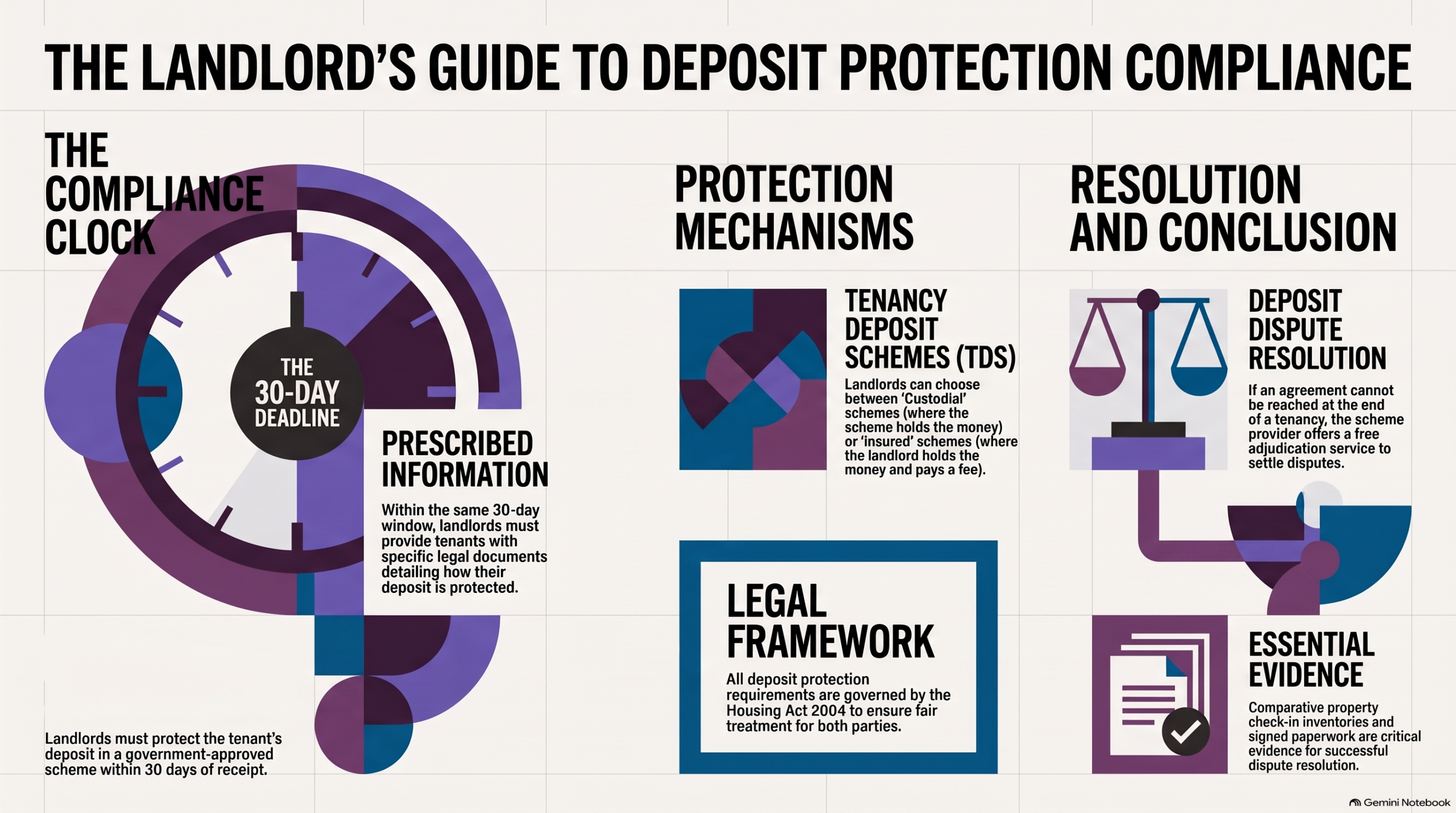
Every deposit taken for an assured tenancy in England must sit inside an approved scheme within thirty calendar days. The clock starts on the day the money reaches you or your agent. It does not start on the tenancy commencement date. Weekends and bank holidays count towards the thirty days.
Instalments cause most avoidable breaches. The timer begins the moment any part of the deposit lands, and each further payment triggers its own thirty-day duty. Protect the first payment on receipt, then top up the registration as further sums arrive. A dated receipt log makes this straightforward to evidence later.
Custodial and Insured Scheme Structures
A custodial scheme transfers the deposit to the provider, who holds it without charge for the whole tenancy. An insured scheme lets you retain the cash in a separate account and pay a protection fee instead. Both models carry identical statutory weight. Neither offers any advantage at adjudication.
Insured protection demands tighter internal discipline. You are holding tenant money, so it must never mix with rent income or maintenance floats. From experience across the sector, landlords with more than three tenancies gain little from insured schemes unless they already run segregated client accounting.
Prescribed Information and Correct Service
Documents the Prescribed Information Must Include
Protecting the money is only half the duty. You must also serve the prescribed information on every tenant and on any relevant person who paid part of the deposit. Service must happen inside the same thirty-day window. Partial service fails the test just as completely as no service at all.
The required content is set by the Housing Act 2004. It covers the scheme administrator name, address and contact details, the scheme leaflet, the property address and the deposit amount, the landlord and tenant contact details, the circumstances in which deductions may be made, and a signed landlord certificate confirming the information is accurate.
Proof of Service and Landlord Records
Courts decide these cases on documents, not recollection. Obtain a signed and dated acknowledgement from each tenant at check-in. Where tenants sign electronically, keep the audit trail showing the timestamp and the address served. Store the scheme certificate beside it in the same tenancy file.
A relevant person is anyone who paid the deposit on the tenant’s behalf, typically a parent or a guarantor. They must be served too. In the student market across Fallowfield and Withington, guarantor payments are routine, and missed guarantor service is one of the more common compliance gaps we correct.
Did You Know?
Under section 214 of the Housing Act 2004, the county court has no discretion to award nothing. Where a landlord fails to protect a deposit or serve the prescribed information in time, the court must order the landlord to pay the tenant between one and three times the deposit amount.
Penalties for Deposit Protection Failures
Compensation Awards Under Section 214
A tenant may apply to the county court where the deposit was never protected, protected late, or where the prescribed information never arrived. The court must order repayment of the deposit or its transfer into a custodial scheme within fourteen days. It must also award financial compensation on top.
The award sits between one and three times the deposit. Judges weigh culpability, so a single late registration by an otherwise organised landlord usually attracts an award near the lower end. Repeat failures and unprotected money held for years attract the maximum. Returning the deposit voluntarily does not extinguish the claim.
Possession Claims After Section 21 Abolition
Section 21 was abolished on 1 May 2026, and assured shorthold tenancies converted to assured periodic tenancies. Deposit compliance still gates possession. A court cannot make a possession order under Section 8 unless the deposit is protected and the prescribed information served, with anti-social behaviour grounds the narrow exception.
The practical consequence is severe. A rent arrears claim under Ground 8 can fail at the door on a deposit technicality that predates the arrears by years. Remedy the breach before you serve notice. That means protecting the money or returning it in full, then documenting the correction.
The Railton-Meeks Compliance Audit Tool
Check Your Compliance & Protect Your Portfolio
Deposit Caps and Prohibited Payments
Five and Six Week Deposit Caps
The Tenant Fees Act 2019 caps what you can take. Where the annual rent is under fifty thousand pounds, the maximum deposit is five weeks’ rent. Where annual rent reaches or exceeds fifty thousand pounds, the cap rises to six weeks’ rent. Anything above these figures is a prohibited payment.
Calculate the cap from the annual rent, then divide by fifty-two and multiply by five. Rounding upwards creates a breach. Local authorities can issue financial penalties of up to five thousand pounds for a first prohibited payment offence, and the sum must be repaid before a possession notice can be served.
Holding Deposits Under the Tenant Fees Act 2019
A holding deposit is a different instrument and sits outside scheme protection entirely. It reserves a property whilst referencing runs, and it is capped at one week’s rent. You may hold it for fifteen days unless both parties agree a longer deadline in writing.
Once the tenancy proceeds, the holding deposit must be refunded or credited against the first rent payment or the security deposit. Written tenant consent is needed before crediting it. Keep holding deposits in a separate ledger so they are never registered with a scheme in error.
Railton-Meeks offers four landlord service tiers across Manchester and Cheshire
Inventory Evidence That Withstands Scrutiny
Check-In Reports and Digital Inventories
Without Section 21, the quality of your evidence is the only thing protecting the deposit against damage claims. A check-in inventory must record the condition of every room, fixture and appliance in writing, supported by dated photographs. Meter readings and key numbers belong in the same document.
High-definition photographic and video inventories now set the standard. Capture wide shots for context and close shots for defects. The tenant should sign the report, or be given seven days to comment before it becomes the agreed baseline. An unsigned inventory carries far less weight at adjudication.
Check-Out Comparison Reports
A check-out report only works if it mirrors the check-in document line by line. Adjudicators compare the two directly. Where the check-out uses different room names, different ordering or vaguer descriptions, the comparison breaks down and the benefit of the doubt passes to the tenant.
Photograph the same angles you used at check-in. Record dates on every image and keep the original files rather than compressed copies. Add contractor invoices and quotations promptly. Adjudicators want to see the cost you actually incurred, not an estimate prepared after the claim was lodged.
Instant Rental & Block Valuation
Get Your Valuation & Know Your Market Value
Fair Wear and Tear Versus Chargeable Damage
The Betterment Principle Applied to Claims
Fair wear and tear covers the gradual decline that any reasonable occupation causes. It is never chargeable. Damage means harm beyond ordinary use, such as burns, permanent staining or breakage. Adjudicators apply the betterment principle, so you cannot return a worn item to new condition at tenant expense.
The length of the tenancy matters. A four-year let will show more legitimate deterioration than a six-month one, and adjudicators adjust their expectations accordingly. Occupancy levels count too. A five-bedroom shared house will not be judged against the standard applied to a single professional flat.
Apportionment by Expected Lifespan
Adjudicators price claims by remaining useful life. Take a carpet installed three years before a two-year tenancy, with an expected lifespan of five years. If the tenant ruins it, the carpet had already reached the end of that lifespan. The recoverable sum is minimal, whatever the replacement quote says.
Apply the same arithmetic before you submit a claim. Record the purchase date and cost of significant items when you buy them. Cleaning is the exception, since a property returned dirtier than it started can be charged at the actual cost of putting it right.
Deposit Dispute Resolution Step by Step
How Scheme Adjudication Works
Deposit dispute resolution is a free alternative to court, run by the scheme that holds the money. An independent adjudicator reads the paperwork submitted by both sides. There is no site visit and no hearing. Both parties must agree to use the service, and the resulting decision binds everyone.
The sequence is fixed. The landlord raises an itemised claim through the scheme portal. The tenant responds, agreeing or contesting each line. The landlord uploads evidence. The adjudicator reviews the file, then the scheme issues a written decision and releases the money accordingly.
Evidence Bundles Adjudicators Accept
Present each deduction as a separate claim with its own evidence. Attach the check-in entry, the check-out entry, the dated photographs and the invoice for that item alone. A single undifferentiated bundle of receipts invites the adjudicator to reject the lot and return the funds to the tenant.
Claim only what you can prove and price honestly. Adjudicators notice inflated figures and treat the remaining claims with more scepticism as a result. Undisputed sums should be released to the tenant early, which narrows the dispute and demonstrates good faith on the record.
HMO Specialist Yield & Tax Calculator
Calculate Your Yield & Offset New Tax Burdens
Final Thoughts
Deposit protection for landlords rewards process over effort. Thirty days, an approved scheme, complete prescribed information and signed proof of service. Those four steps remove the largest single source of avoidable landlord liability, and they take less than an hour per tenancy when the workflow is set up properly.
The evidence side deserves the same discipline. Build the inventory as though a stranger will read it in two years, because that is exactly what happens. Standardised paperwork at the start of a tenancy decides how much of the deposit you keep at the end.
Frequently Asked Questions
A:
Missing the deadline breaches the Housing Act 2004. The tenant can apply to the county court, which must order you to repay the deposit or place it in a custodial scheme within fourteen days. The court must also award the tenant compensation of between one and three times the deposit. Protecting the money late does not undo the breach. You also cannot obtain a possession order under most Section 8 grounds until the position is put right.
A:
Yes, instalments are permitted, but the compliance deadlines do not soften. The thirty-day timer starts when any part of the deposit is received, not when the final instalment arrives. Each payment must reach an approved scheme within thirty days of receipt, and the prescribed information must be updated to reflect the revised total. Keep a dated payment log. Instalment arrangements are a frequent source of accidental breaches because the registered figure drifts out of step with the sum actually held.
A:
No. Holding deposits fall under the Tenant Fees Act 2019 rather than the deposit protection scheme rules. A holding deposit is capped at one week's rent and reserves a property whilst referencing takes place. You may retain it for a maximum of fifteen days unless a longer deadline is agreed in writing. Once the tenancy begins, the money must be refunded or credited towards the first rent payment or the security deposit, with the tenant's written consent.
A:
Adjudicators assess the age of the item, its original quality, its expected lifespan and the length of the tenancy. They apply anti-betterment principles, so you cannot charge a tenant for replacing a worn item with a new one. The claim must show negligence or damage beyond ordinary use. Photographic evidence, a professional check-in inventory and a matching check-out report carry the most weight. Without a comparable baseline, adjudicators routinely return the disputed sum to the tenant.
A:
The Tenant Fees Act 2019 caps deposits by annual rent. Where the total annual rent is below fifty thousand pounds, the maximum is five weeks' rent. Where annual rent equals or exceeds fifty thousand pounds, the cap rises to six weeks' rent. Taking more is a prohibited payment. Local authorities can impose a financial penalty of up to five thousand pounds for a first offence, and the excess must be repaid before you can serve a valid possession notice.
