

Tenant Find Service for Manchester Landlords
A tenant find service secures qualified occupants without tying an owner into ongoing management fees. Letting a home in Manchester involves far more than portal photographs. Statutory compliance, precise screening and accurate paperwork decide whether a tenancy holds up. Landlords who handle repairs themselves still need absolute precision at the onboarding stage.
The Renters’ Rights Act reshaped landlord obligations across England on 1 May 2026. Self-managing investors now face closer legal scrutiny before keys change hands. How can an owner run a fully compliant letting process whilst keeping daily control of the property?
Key Takeaways
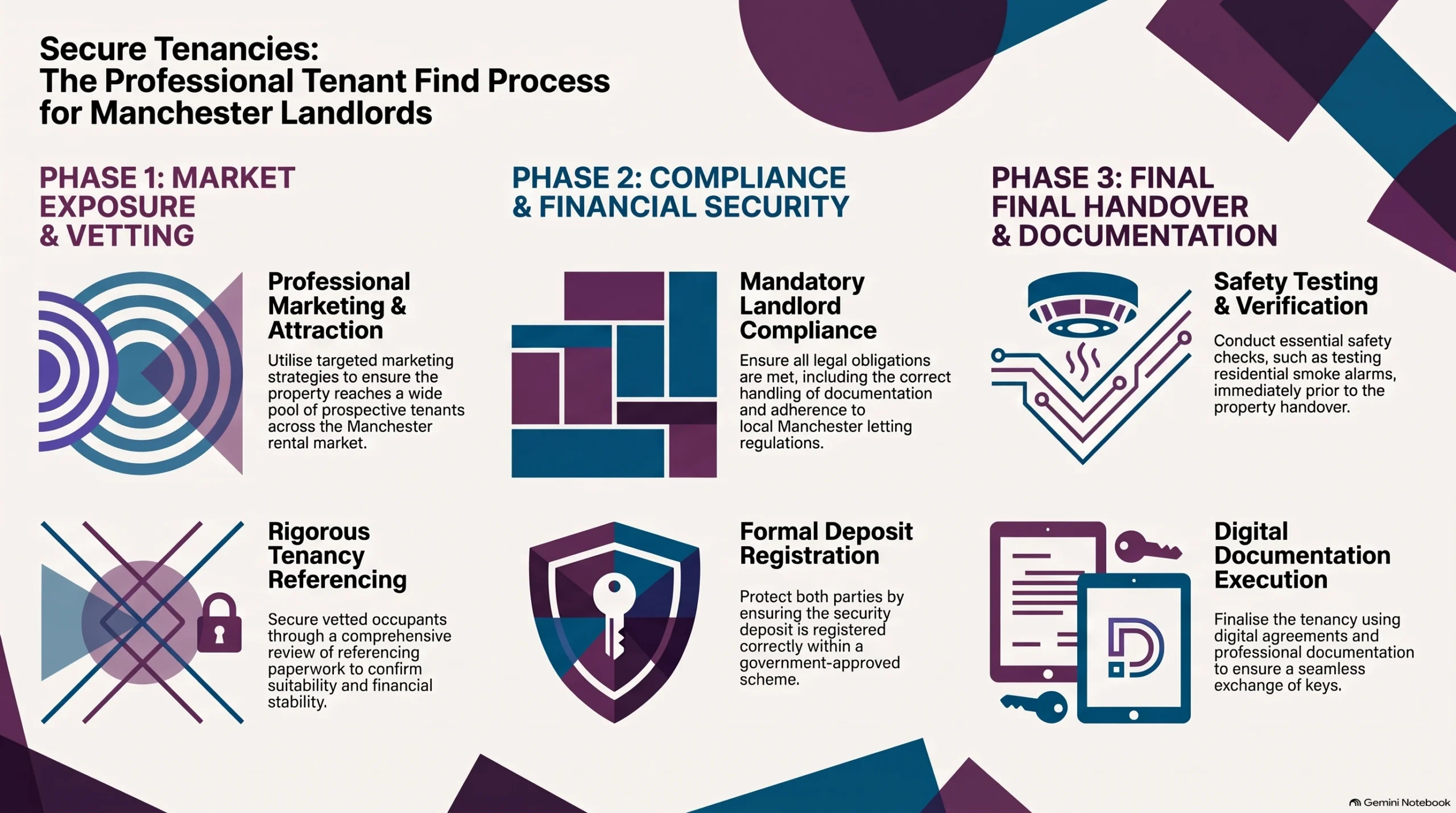
- A tenant find service handles advertising, occupant vetting, certification checks and compliant agreements before day-to-day management returns to the owner.
- The Renters’ Rights Act abolished no-fault evictions, making affordability checks and background referencing the primary line of legal defence for landlords.
- Accepting rental bids above the advertised figure is prohibited, exposing landlords and letting agents to civil penalties reaching seven thousand pounds.
- Tenancy deposits require registration within thirty days, alongside prescribed information, to prevent court penalties and protect future possession rights.
- Manchester owners keep complete control over repairs whilst securing administrative precision during the critical initial onboarding phase of each tenancy.
Core Letting Models for Manchester Rental Properties
Independent landlords weigh upfront agency support against continuous oversight when bringing a home to market. Duties differ sharply between tenant find agreements, rent collection arrangements and fully managed contracts. The tier chosen shapes margins, time commitment and statutory liability. In practice, most self-managing owners want expert support only at the start of a tenancy.
Comparing each model clarifies which duties stay with the owner. It also shows which tasks transfer to the agent. The matrix below sets out operational responsibility across the three service tiers used most widely across Greater Manchester. Read it against your own availability before committing to a contract.
| Operational Responsibility | Tenant Find Only | Rent Collection | Fully Managed |
|---|---|---|---|
| Portal Marketing and Viewings | Agent | Agent | Agent |
| Tenant Vetting and Right to Rent | Agent | Agent | Agent |
| Tenancy Agreement and Compliance Packs | Agent | Agent | Agent |
| Deposit Protection and Prescribed Information | Agent or Landlord | Agent | Agent |
| Monthly Rent Processing and Arrears Tracking | Landlord | Agent | Agent |
| Routine Property Inspections and Maintenance | Landlord | Landlord | Agent |
Accurate Property Valuation and Advertising Rules
Rental Pricing Benchmarks Across Manchester Micro-Markets
Setting the monthly rent demands granular analysis of local district supply. Broad regional averages mislead owners. Gross yields vary widely across Greater Manchester. Suburban enclaves such as Didsbury sit near four percent. Student corridors such as Fallowfield can exceed eight percent. Accurate pricing therefore starts at street level, not city level.
Pricing too high extends void periods and erodes annual returns immediately. Underpricing depresses net yield across a tenancy that may now run indefinitely. Professional valuations examine street-by-street comparables, Metrolink access and local demand drivers. From experience across the sector, a correctly set baseline rent attracts stronger applicants within days.
Compliance With the Statutory Rental Bidding Ban
Property advertisements must state one clear monthly rental figure. Landlords and letting agents cannot solicit, encourage or accept offers above that published price. The restriction applies to every marketing channel. It also applies to informal conversations at viewings. Compliance begins at the moment the listing goes live.
An applicant may volunteer a higher monthly amount to secure the property. Accepting that offer still breaches the law. Civil penalties reach £7,000 for each breach. Adverts placed under a tenant find service manchester for landlords must avoid vague wording. Phrases such as offers in excess of or price on application are no longer safe.
Comprehensive Occupant Screening and Identity Verification
Income Ratios and Employment Referencing
Vetting prospective renters demands robust financial assessment. Affordability must hold for the full duration of an open-ended tenancy. Industry practice expects gross household income of at least thirty times the monthly rent. Some referencing providers apply a slightly higher multiple. Either way, the applicant must evidence that income rather than simply state it.
Referencing teams verify employment through payroll contacts, audited accounts or open banking platforms. They also check credit files for County Court Judgments, bankruptcies and repayment plans. In practice, we find undisclosed debt is the single most common referencing failure. Rigorous profiling confirms genuine financial resilience and reduces the risk of arrears.
Right to Rent Checks and Evidential Record Keeping
Landlords must confirm that every adult occupier holds immigration status permitting residence in the United Kingdom. Checks require original identity documents inspected in person. A digital share code processed through the Home Office portal is equally valid. The check must take place before the tenancy begins, not afterwards.
Copies of verified documents must be retained securely with the date of the check. The owner keeps those records for the tenancy plus one further year. Handing keys to an unverified occupier can trigger civil penalties of £5,000 per occupier for a first breach. A tenant find service verifies every adult before possession passes.
Did You Know?
Assured shorthold tenancies were abolished in England on 1 May 2026. Every existing agreement converted automatically to an assured periodic tenancy on that date. Landlords can no longer create a new fixed-term assured tenancy.
Mandatory Pre-Tenancy Safety Certifications
Energy Performance Certificates and Electrical Inspections
Rental homes require a valid Energy Performance Certificate before marketing begins. They also require a current Electrical Installation Condition Report. Fixed installations must be inspected by a qualified engineer every five years. The report covers consumer units, sockets, circuits and wiring throughout the dwelling. Both documents must be in place before viewings start.
A satisfactory inspection confirms the installation is safe for continued domestic use. Remedial notices require action within twenty-eight days. Landlords should also track the national trajectory toward a minimum Energy Performance Certificate rating of band C by 2030. Planning upgrades early protects lettability and avoids rushed capital spending later.
Gas Safety Certificates and Smoke Alarm Testing
Properties with gas appliances require an annual Landlord Gas Safety Record. Only a Gas Safe registered engineer can produce it. The inspection covers the boiler, flues and every connected appliance. It confirms there is no risk of carbon monoxide accumulation. The certificate must reach the tenant before occupation begins.
Smoke alarms must be fitted on every storey containing living accommodation. Any room with a fixed combustion appliance also needs a carbon monoxide alarm. Testing every alarm on move-in day creates documented evidence that the equipment works. That record carries real weight if a dispute arises later.
The Railton-Meeks Compliance Audit Tool
Check Your Compliance & Protect Your Portfolio
Tenancy Documentation Under the New Periodic Regime
Periodic Agreements Under the Renters’ Rights Act
Fixed-term assured shorthold tenancies no longer exist in England. Every private tenancy is now an assured periodic tenancy. It rolls month to month from the first day. Agreements cannot impose a minimum term, a binding fixed duration or a mandatory break clause. Any such clause is unenforceable.
Tenants may end the tenancy at any point by serving two months’ written notice. Landlords must provide a written statement of terms before the tenancy starts. Modern agreements should set out tenant responsibilities for property care clearly. They must do so without breaching consumer protection rules on unfair terms.
Mandatory Possession Grounds Under Section Eight
Section 21 no-fault eviction has gone. Regaining possession now requires a specific statutory ground under Section 8. Mandatory grounds allow a landlord to recover the property in order to sell it. They also allow recovery where the landlord or a close family member intends to move in.
Both grounds require four months’ written notice. Neither can be used within the first twelve months of the tenancy. Ground 8 covers serious rent arrears and requires three full months of outstanding rent. That ground carries four weeks’ notice. Clear documentation from day one makes any later claim far easier to evidence.
Railton-Meeks offers four landlord service tiers across Manchester and Cheshire
Deposit Protection and Administrative Deadlines
Custodial and Insured Scheme Registration
Deposits taken from private tenants must be registered with a government-authorised scheme. Registration must happen within thirty days of receipt. Deposits are capped at five weeks’ rent where the annual rent is below fifty thousand pounds. A six-week cap applies above that threshold. The threshold turns on annual rent, not monthly rent.
Custodial schemes hold the money directly and charge nothing for the service. Insured schemes let the landlord retain the funds against a premium. Missing the thirty-day window blocks certain possession notices. It also exposes the owner to court-ordered compensation. Diarising the deadline on the day of receipt prevents the error entirely.
Serving Prescribed Information to Tenants
Registering the money satisfies only half of the statutory duty. Landlords must also serve formal Prescribed Information. The scheme’s official explanatory leaflet accompanies it. Both must reach the tenant and any relevant third party, such as a guarantor or a relative who paid the deposit.
The documentation sets out the deposit amount, the property address and the scheme contact details. It also explains how the scheme handles end-of-tenancy deductions. Late service or missing clauses allow a tenant to claim one to three times the deposit through the county court. Complete procedural adherence prevents costly awards.
Instant Rental & Block Valuation
Get Your Valuation & Know Your Market Value
Property Condition Inventories and Key Handover
Photographic Schedules of Property Condition
A detailed condition schedule compiled before occupancy is the only valid baseline for deposit deductions. The report records the operational state, cleanliness and cosmetic condition of fixtures, fittings and surfaces. It should cover every room. Meter readings and key numbers belong in the same document.
High-resolution photography and date-stamped video remove ambiguity later. Adjudicators need clear comparative evidence before awarding compensation for damage or poor cleaning. Without a thorough move-in inventory, a landlord has no realistic claim. In practice, disputes are won or lost on the quality of that first record.
Compliant Document Distribution at Handover
Key release requires an organised handover so that every mandatory document reaches the incoming occupier. Tenants must receive the current government guide on renting in England. The guide must be the latest published edition. An outdated version does not satisfy the requirement and creates avoidable risk.
Owners must also issue the Energy Performance Certificate, the Gas Safety Record, the Electrical Installation Condition Report and the signed inventory. Owners should obtain written or digital acknowledgement of receipt for each item. That evidence protects the owner against later claims of non-compliance. Handover then closes the onboarding phase cleanly.
Local Manchester Licensing and Council Standards
Article 4 Restrictions and Mandatory HMO Licensing
Manchester City Council operates a city-wide Article 4 Direction. It removes permitted development rights for conversions into small shared houses. An owner cannot convert a dwelling into a shared home for three or more unrelated occupants without planning permission. The restriction applies across the whole local authority area.
Mandatory HMO licensing applies to properties housing five or more occupants from two or more households. In Rusholme, Withington and Fallowfield, officers inspect room sizes, fire containment and waste storage closely. Operating without a required licence exposes an owner to a civil penalty of up to £30,000. Prosecution remains an alternative route for the council.
Selective Licensing Designations Across Suburbs
Selective licensing applies in targeted residential areas of the city. It covers ordinary private lettings to a single household, not just shared houses. Designations have historically covered parts of Levenshulme, Moss Side and Rusholme. Schemes run for fixed periods and change, so owners must check the current designation.
Letting a standard family home without a required selective licence is a criminal offence. Owners using a tenant find Manchester service should confirm the designation before the listing goes live. Checking first ensures marketing, safety installations and the tenancy agreement all meet the local threshold from the first day.
HMO Specialist Yield & Tax Calculator
Calculate Your Yield & Offset New Tax Burdens
Final Thoughts
Securing reliable occupants depends on disciplined execution. Valuation, compliance checks, referencing and statutory document service all carry weight. A structured tenant find service lets self-managing Manchester landlords meet those obligations with confidence. Delegating the intensive upfront phase removes administrative risk and starts the tenancy on sound legal footing.
Regulatory obligations across Greater Manchester continue to develop under the new national framework. Thorough preparation before handover remains the most dependable way to protect net yield. Expert onboarding combined with hands-on daily management gives an investor control, statutory safety and steady cash flow.
Frequently Asked Questions
A:
An introductory service focuses on securing and legally onboarding a qualified tenant. It covers professional marketing across the main property portals and accompanied viewings. The agent verifies Right to Rent status and carries out credit and employment referencing. The agent prepares compliant tenancy documentation, gathers safety certificates and coordinates the move-in inventory. After handover, day-to-day maintenance and rent collection return to the property owner.
A:
Abolishing Section 21 removed no-fault eviction and converted every tenancy into a rolling periodic contract. A landlord can no longer regain possession without proving a specific statutory ground under Section 8. That change makes tenant selection the decisive stage of the process. Robust referencing, evidenced affordability assessment and a thorough move-in inventory are now the main safeguards. They protect the owner against prolonged arrears, anti-social behaviour and disputed property damage.
A:
A landlord who fails to protect a deposit within thirty days faces serious consequences. The county court can order repayment of the deposit to the tenant. It can also award compensation of between one and three times the original sum. The same penalty applies where the landlord serves prescribed information late or incorrectly. Incorrect handling also restricts the landlord's ability to rely on certain possession notices until the landlord remedies the breach.
A:
No. The law bans rental bidding across England. Every advertised property must display one specific monthly rental figure. Neither the agent nor the landlord may solicit, encourage or accept a bid above that published rate. The ban still applies where an applicant volunteers a higher figure without prompting. Accepting the extra rent breaches the law and can trigger a civil penalty of up to £7,000 for each individual breach.
A:
Tenants must receive the current government guide to renting in England before they collect the keys. A valid Energy Performance Certificate and a current Electrical Installation Condition Report are also required. Any property with gas appliances needs an in-date Landlord Gas Safety Record. Prescribed Information confirming the deposit registration must follow within thirty days of receiving the money. Owners should also keep written acknowledgement of every item.
