

Short Term Let Insurance: What Landlords Miss
Most property owners discover the gap in their cover only after a claim is refused. Standard residential landlord policies are written for assured tenancies under continuous occupation. They exclude commercial activity and paying visitors almost without exception. Dedicated short term let insurance matters because short-stay guests carry risks that ordinary landlord products will not accept. Without hospitality cover, a single fire or liability claim falls entirely on you.
Operating without bespoke protection exposes the building, the furnishings and your personal balance sheet. Transient guests cause damage. They injure themselves on stairs and in bathrooms. They breach mortgage conditions and headlease covenants without ever knowing it. Underwriters then walk away from the loss. So does landlord insurance cover paying guests when serious structural damage occurs?
Key Takeaways
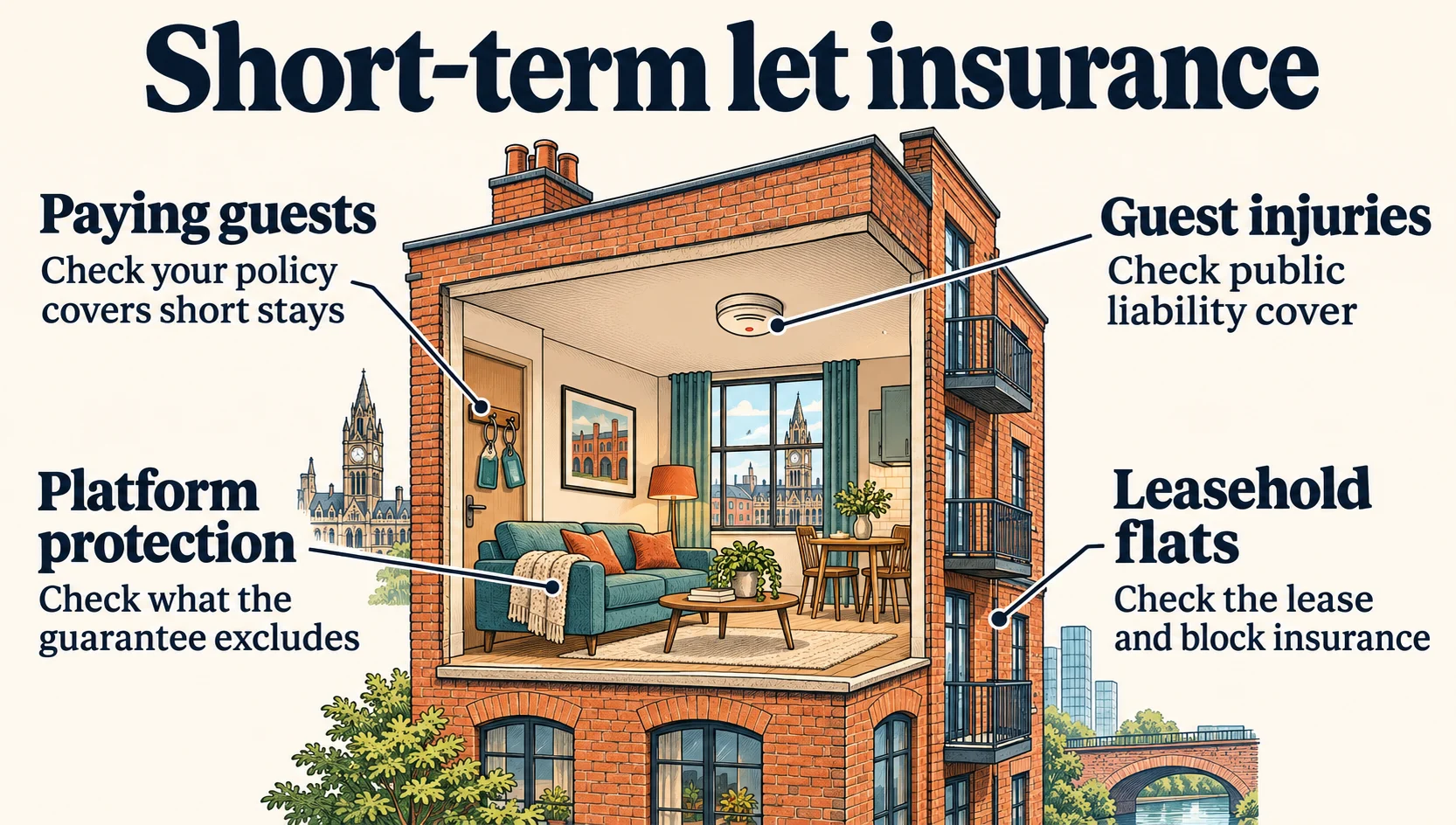
- Standard residential landlord policies exclude short-stay paying guests, leaving owners uninsured when claims arise during an unapproved holiday let.
- Commercial guest accommodation cover provides public liability indemnity against legal and medical compensation claims brought by injured transient visitors.
- Platform host guarantees are discretionary marketing schemes rather than regulated insurance contracts, so they offer no enforceable protection for major losses.
- An undeclared holiday rental inside a leasehold block can invalidate the freeholder’s communal buildings policy and trigger forfeiture proceedings.
- Insurers assess guest vetting, occupancy limits, interlinked smoke alarms and booking channels before issuing a valid short-term let policy.
Policy Comparison: Residential Versus Short-Stay Cover
Choosing the correct policy starts with how UK insurers classify occupation. Underwriters price risk on continuous occupancy, tenant vetting and turnover frequency. A residential policy assumes long tenancies where occupants care for the property over months. Short-stay units see constant turnover instead. That turnover changes the risk profile, so it demands separate underwriting terms.
Mismatched cover almost always surfaces during a serious incident, when the insurer repudiates the claim. Specialist providers split their products into residential, holiday let and commercial tiers. The table below sets basic residential cover against a specialist short-let policy across the operational risks that matter most to hosts.
| Cover Feature | Residential Landlord Policy | Specialist Short-Let Policy |
|---|---|---|
| Cover FeaturePaying Guest Damage | Residential Landlord PolicyExcluded under standard terms | Specialist Short-Let PolicyCovered up to policy limits |
| Cover FeaturePublic Liability | Residential Landlord PolicyUsually restricted to AST tenants | Specialist Short-Let Policy£2m to £5m commercial indemnity |
| Cover FeatureMalicious Damage by Guests | Residential Landlord PolicyExcluded or severely capped | Specialist Short-Let PolicyIncluded subject to policy terms |
| Cover FeatureUnoccupied Periods | Residential Landlord PolicyVoid after 30 consecutive days | Specialist Short-Let PolicyFlexible periods between guests |
| Cover FeatureLoss of Rent | Residential Landlord PolicyBased on the tenancy rent | Specialist Short-Let PolicyBased on verified booking records |
Rental Accommodation Policy Classes
Residential Tenancies Versus Holiday Letting
Residential landlord insurance covers long lets granted under assured shorthold tenancies. Underwriters assume stable occupation, formal referencing and predictable maintenance. Introducing short-stay paying guests into a property insured on that basis changes the risk entirely. Insurers treat the change as unnotified and material. They then decline claims arising from the guest stay.
Long tenancies give occupants a settled interest in the home. Holidaymakers stay a few nights at most. They use unfamiliar heating, appliances and plumbing, often carelessly. In practice, we find turnover is the real driver of accidental loss. That is precisely why residential wordings exclude leisure visitors.
Commercial Serviced Accommodation Cover
Commercial guest accommodation cover treats the property as a trading hospitality business. It reaches well beyond buildings and contents. The tier adds business interruption, employers’ liability for cleaning and turnover staff, and commercial public liability. It also tolerates higher occupancy and irregular bookings taken across several platforms.
Serviced apartments and high-yield units need that contractual certainty. A standard holiday let policy may suit seasonal bookings with occasional personal use. Regular commercial turnover does not fit those wordings. Owners running units across Manchester or Cheshire should confirm the insurer has underwritten the operating model as a business.
Public Liability and Guest Exposure
Legal Duty of Care Toward Paying Guests
Public liability insurance responds when a paying guest or their visitor suffers injury or death at the property. Fee-paying occupation raises your duty under the Occupiers’ Liability Act 1957. Without adequate indemnity, the compensation award lands on you personally. Defence costs follow close behind it.
Slips on wet bathroom tiles, falls on stairs and burns from faulty appliances are the common claims. Injured guests pursue medical costs, rehabilitation and lost future earnings. A single severe injury claim can exceed several hundred thousand pounds. An uninsured operator rarely survives one.
Standard Liability Cover Levels in Manchester
Professional serviced accommodation operators across Greater Manchester generally carry £2m to £5m of commercial public liability. Corporate booking partners and relocation agents often make £5m a contractual condition. Carrying the higher limit keeps the property viable for business travellers as well as weekend leisure guests.
High-density city blocks and high-value suburbs such as Didsbury and Bowdon present different exposures. Insurers look at footfall, communal access and amenities like hot tubs. From experience across the sector, a £5m limit signals credibility to booking agents. It also shields the owner from a catastrophic personal judgment.
Did You Know?
England’s mandatory register for short-term and holiday lets is confirmed to commence in March 2027. It is created under section 228 of the Levelling Up and Regeneration Act 2023, and every qualifying property must hold a registration record.
Accidental and Malicious Damage Realities
Damage Risks From Transient Occupancy
Short-stay visitors treat furnishings, electronics and fixtures with far less care than long-term tenants. Spilled wine on hardwood, scorched worktops and cracked sanitaryware are routine weekend outcomes. Specialist short term let insurance covers that accidental damage. It also responds to deliberate acts by unruly guests and unvetted parties.
Standard home and landlord policies exclude damage caused by anyone invited onto the premises. Insurers class guest access as permitted entry rather than forced entry. Without an explicit malicious damage clause for guest use, you fund the repairs yourself. A proper policy sets out the excess and the claims procedure in writing.
Platform Host Guarantees Versus Insurance Contracts
Booking platform damage programmes are discretionary schemes rather than regulated insurance contracts under UK law. Platforms settle reimbursement requests under their own terms of service. They keep full authority to approve, reduce or refuse a payment. Relying on an airbnb insurance UK guarantee leaves you exposed when the platform declines.
These schemes commonly demand police reports, tight submission windows and evidence hosts cannot realistically produce. They also exclude wear and tear, structural defects and liability involving communal areas. Commercial managers treat them as a goodwill backstop. Real protection comes from an independently underwritten contract with ombudsman recourse.
The Railton-Meeks Compliance Audit Tool
Check Your Compliance & Protect Your Portfolio
Loss of Rent and Cancellation Protection
Revenue Disruption From Insured Events
Loss of rent cover reimburses gross income when an insured event makes the property uninhabitable. An electrical fire or a burst pipe can close a unit for months. Reinstatement works rarely finish quickly. A dedicated policy pays the projected earnings, calculated from verified historical booking records.
Units in Manchester city centre and Salford Quays earn most of their margin in peak months. A long closure wipes out the trading year. Mortgage payments, service charges and utility contracts all continue throughout. Indexed loss of rent provisions prevent a forced sale during a lengthy reinstatement programme.
Booking Cancellations and Business Interruption
Guest cancellation cover protects income when outside events stop travellers completing a booked stay. Policies draw a sharp line between ordinary booking fluctuation and genuine operational interruption. Owners should test whether a cancellation rider adds real financial utility. Often it simply duplicates the platform’s own cancellation terms.
Most experienced operators manage routine dropouts through strict cancellation settings rather than claims. Policy excesses usually exceed the value of one lost weekend booking. The useful cover is business interruption. That triggers on regional transport failure, localised flooding or statutory restrictions. Read the definitions before paying for the rider.
Railton-Meeks offers four landlord service tiers across Manchester and Cheshire
Buildings Insurance in Leasehold Developments
Block Policy Invalidation Risks
An undeclared short let inside a leasehold block can invalidate the freeholder’s communal buildings policy. Block cover is underwritten on conventional residential occupancy across the whole development. Unnotified commercial guest use breaches that condition. If a fire starts in the short-let flat, the insurer may repudiate the building claim.
Leaseholders share a collective interest in valid structural cover. When an insurer uncovers unapproved short letting during a claim investigation, every resident feels it. A refused payout for structural loss leaves innocent co-owners facing large service charge levies. Block managing agents therefore police the issue closely.
Lease Covenants and Freeholder Enforcement
Residential long leases across central Manchester routinely prohibit business use, nuisance and tenancies shorter than six months. Breaching those covenants threatens the building insurance. It also allows the freeholder to serve notice under section 146 of the Law of Property Act 1925. Persistent breach can end in forfeiture.
Freeholders and resident management companies monitor entry logs, noise complaints and key safes. Managing agents carrying duties under the Building Safety Act 2022 enforce covenants firmly to protect communal cover. Check the lease before buying a short-let policy. Insuring an operation the lease forbids achieves nothing.
Instant Rental & Block Valuation
Get Your Valuation & Know Your Market Value
Insurer Underwriting Criteria and Operational Checks
Occupancy Caps and Minimum Stay Requirements
Insurers set operational limits by asking about maximum guest numbers and minimum stay length. Headcounts are capped because overcrowding raises fire escape and water damage risk. Accepting a booking above the declared occupancy breaches a policy condition. That breach gives the underwriter grounds to void the claim.
Underwriters also examine minimum night settings. One-night weekend bookings attract unauthorised parties and damage, so they price badly. Many specialist insurers improve terms for a two or three night minimum. Aligning house rules with the insurer’s risk appetite keeps cover live and reduces the annual premium.
Guest Vetting and Statutory Alarms
Underwriters want evidence of how guests are vetted and how fire is detected. They expect identity verification, working contact numbers and enforced house rules. Properties must also meet the Regulatory Reform (Fire Safety) Order 2005. That means a written fire risk assessment and interlinked smoke detection throughout the unit.
Safety compliance is a condition precedent to liability rather than a recommendation. Grade D interlinked alarms belong in living areas and circulation space, with heat detectors in kitchens. Insurers request the certificates after an incident. If the equipment fell below standard, the payout is refused and the loss stays with you.
HMO Specialist Yield & Tax Calculator
Calculate Your Yield & Offset New Tax Burdens
Disclosure Duties and Policy Validity
Online Cover Pitfalls and Material Information
Buying an airbnb insurance UK policy online without declaring mortgage and lease conditions creates false security. The Insurance Act 2015 requires a fair presentation of the risk. You must disclose every material circumstance known to you. Concealing the operating reality gives the insurer lawful grounds to avoid the policy.
Many owners tick property use boxes without checking their legal position first. If the mortgage prohibits short letting, or the headlease bans trade, the declaration is a misrepresentation. Insurers treat that as material non-disclosure. At claim stage they simply return the premium and avoid the policy from inception.
Finance, Tenure and Insurance Alignment
Genuine compliance means finance, tenure and insurance all agree with each other. Standard buy-to-let mortgages forbid transient letting without written lender consent. Residential leases usually mirror that restriction exactly. Lawful operation therefore requires lender consent, lease compliance and a transparent presentation of the facts to the underwriter.
Properties across Greater Manchester should hold a clean evidential chain covering regulatory status. Local authorities will gain far better visibility once England’s short-term let register commences in March 2027. Data sharing will expose undeclared operations. Aligning practice now protects the asset against forfeiture, repossession and uninsurable loss.
Railton-Meeks Landlord Assistance
Final Thoughts
Compliant short term let insurance is an operational requirement rather than an optional upgrade. Standard residential cover and platform marketing promises leave capital exposed to fire, liability and structural loss. Every host needs to see the line between a residential tenancy and commercial hospitality before taking the first booking.
Professional management keeps verified insurance, valid safety certification and leasehold compliance in place together. Regulation is tightening across planning, registration and building safety. Operators who document their position will continue trading on insurable terms. Those who do not will discover, at the worst moment, that the cover was never there.
Frequently Asked Questions
A:
No. Standard residential landlord insurance excludes short-stay paying guests and holidaymakers. These policies are written for assured tenancies, where occupants live in the property continuously under a formal agreement. Taking paying guests without an endorsement turns the activity into commercial hospitality. Insurers treat that as an unnotified material change in risk. They can then repudiate claims for fire, escape of water or accidental damage arising during the stay. Arrange a specialist policy before the first booking.
A:
Carry between £2m and £5m of commercial public liability. Once fee-paying guests enter the property, occupiers' liability law imposes a heightened duty of care on you. Slips, falls, structural failures and electrical faults all cause serious injury. Claims then cover medical costs, rehabilitation and lost earnings. Corporate booking agents and relocation platforms frequently require £5m of verified cover before confirming executive bookings. The higher limit costs little more and removes a real personal exposure.
A:
No. Platform host damage programmes are discretionary schemes rather than regulated insurance contracts. They sit outside Financial Conduct Authority regulation, so no independent ombudsman hears a dispute. The platform decides whether to approve, reduce or refuse your request under its own terms. Claim windows are short and evidence requirements are strict. Wider exposures, such as communal block damage and third-party injury, fall outside the scheme entirely. Independent commercial insurance remains essential.
A:
Yes. An undeclared short let can invalidate the communal buildings policy held by your freeholder or resident management company. Block cover is priced on conventional residential occupancy. Introducing transient commercial visitors breaches the underwriting basis. If a kitchen fire starts in your unit, the insurer may refuse the whole claim. That leaves you and your neighbouring leaseholders facing collective structural costs. Notify the freeholder and check the lease before letting short-term.
A:
Insurers make statutory fire and safety compliance an express condition of cover. Under the Regulatory Reform (Fire Safety) Order 2005 you need a written fire risk assessment. You also need Grade D interlinked smoke alarms in living areas, with heat detectors in kitchens. Add an annual gas safety record and a five-yearly electrical installation condition report. Clear escape signage and tested carbon monoxide alarms complete the file. Keep every certificate available for the claims handler.
