
Fire Risk Assessment Holiday Let Requirements
Operating a short-term rental in England places owners under a strict statutory regime. This differs fundamentally from an ordinary private tenancy. A documented fire risk assessment holiday let owners can stand behind is now a mandatory legal duty. Every property taking short-stay visitors must have its physical risks evaluated, recorded and actively managed. Owners who ignore these duties face enforcement notices, heavy fines and closure of their guest accommodation.
Many operators assume domestic fire precautions suffice for short-stay visitors. Commercial standards apply the moment paying guests arrive. Knowing which detection systems to install protects lives and investment alike. Are you certain your holiday accommodation meets the statutory standards now enforced across Greater Manchester?
Key Takeaways
- Paying guest accommodation falls under commercial fire legislation, so a recorded written risk assessment is mandatory for every English holiday let.
- The designated responsible person keeps statutory accountability, so an owner cannot transfer ultimate legal liability to an appointed managing agent.
- Standard battery smoke alarms fail compliance, because escape routes need interlinked detection and kitchens need a dedicated heat alarm.
- Manchester period conversions need careful review of escape windows, since traditional panelled doors rarely deliver thirty minutes of fire resistance.
- Fire documentation belongs inside one property compliance register alongside current gas safety, electrical condition and energy performance records.
Core Fire Compliance Duties for Holiday Accommodation
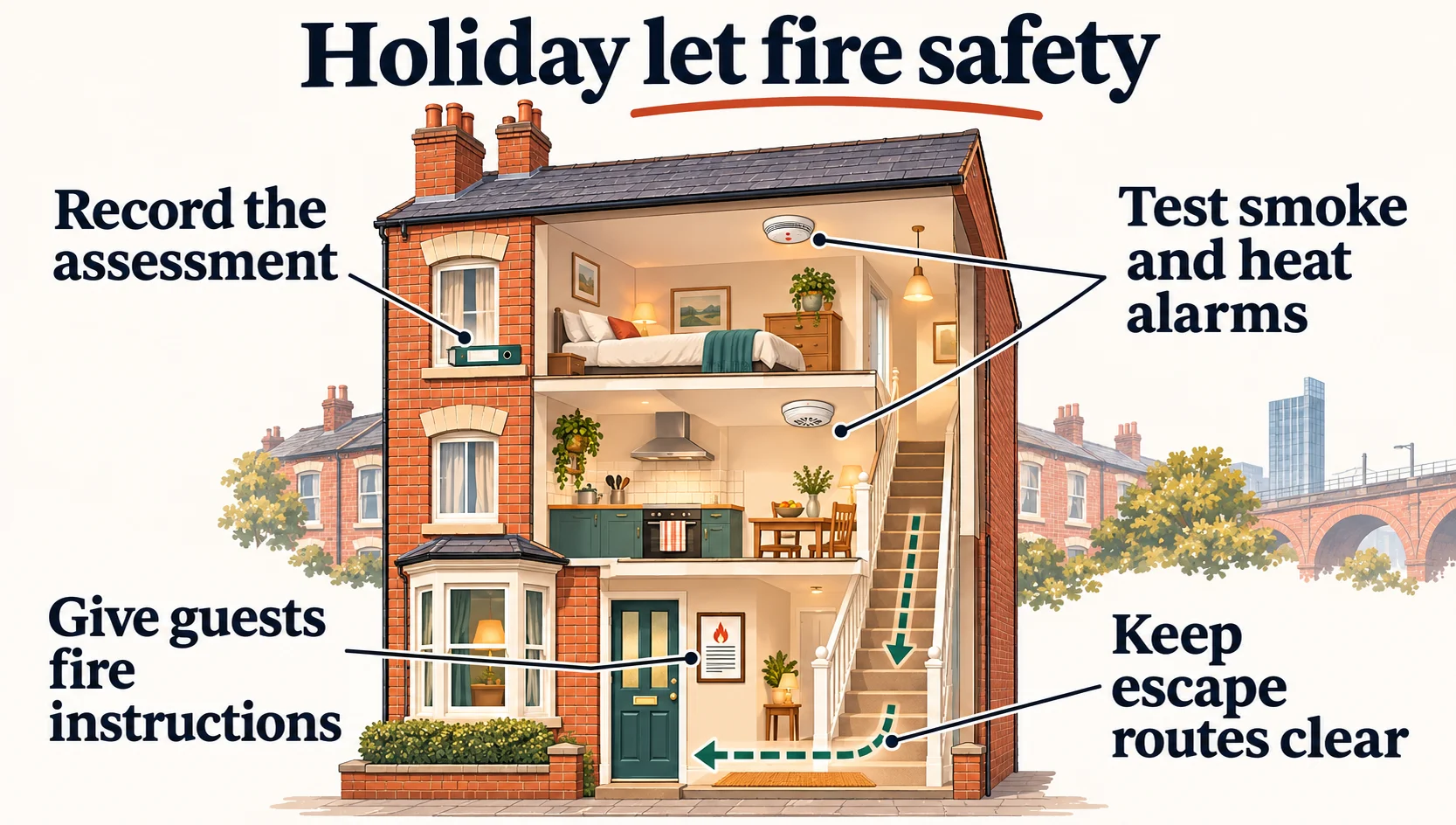
Fire legislation treats short-term guest accommodation as commercial premises. Holiday let owners must put structured fire precautions in place. These measures protect occupants who have no familiarity with the building layout. The table below sets out the core fire safety duties. It also shows the regulatory threshold and the physical measures each duty demands.
Meeting these statutory obligations takes continuous operational oversight. Enforcement officers inspect guest properties, so physical evidence matters as much as intent. Each element of your safety strategy must work with the others. A joined-up approach protects visitors, secures your business insurance and withstands local authority scrutiny.
| Safety Area | Statutory Requirement | Standard Application |
|---|---|---|
| Safety AreaRisk Assessment | Statutory RequirementRegulatory Reform (Fire Safety) Order 2005 | Standard ApplicationWritten assessment recorded in full for paying guests |
| Safety AreaSmoke Detection | Statutory RequirementCommercial grade detection standard | Standard ApplicationInterlinked optical alarms in circulation and living areas |
| Safety AreaHeat Alarms | Statutory RequirementKitchen area fire safety standard | Standard ApplicationDedicated heat detector linked to the primary system |
| Safety AreaCarbon Monoxide | Statutory RequirementCombustion appliance safety rules | Standard ApplicationBS EN 50291 detectors near fuel-burning appliances |
| Safety AreaInternal Doors | Statutory RequirementFD30 compartmentation standard | Standard ApplicationThirty-minute fire resistance with self-closing devices |
| Safety AreaGuest Guidance | Statutory RequirementClear evacuation communication | Standard ApplicationProminent written exit notices and emergency contacts |
Responsible Person Duties Under Fire Safety Law
Fire Safety Order Scope for Paying Guests
The Regulatory Reform (Fire Safety) Order 2005 applies directly to holiday lets, guest houses and serviced accommodation. Residential housing legislation governs assured tenancies. The Fire Safety Order paying guest accommodation framework is different. It treats any property housing temporary visitors as commercial premises, demanding rigorous risk control.
This distinction matters. Paying guests lack the familiarity that permanent residents build over time. Strangers sleeping in an unfamiliar layout react slowly to alarms. They struggle to find exit routes in heavy smoke. Local fire and rescue authorities enforce these standards through unannounced inspections. In practice, we find that officers look first at the written record.
Non-Delegable Owner Accountability
The property owner remains the legally designated responsible person under fire safety law. You may instruct a professional agent or a specialist assessor to run inspections and fit equipment. The statutory accountability for guest safety still sits with you. No contract removes it.
A competent managing agent protects your investment. Technicians work to exact technical standards and record what they do. The courts still hold the responsible person strictly accountable for breaches. Owners across Greater Manchester should confirm that their representative understands these legal boundaries. Enforcing authorities always examine the owner’s own oversight.
Written Fire Risk Assessment Content Requirements
Ignition Sources and Hazard Identification
A valid assessment identifies every source of heat and fuel inside the holiday let. Kitchen appliances, portable heaters, wood-burning stoves, charging devices and distribution boards are the primary ignition points. Each one needs systematic evaluation and periodic servicing. Keep all of them clear of combustible materials.
Section 156 of the Building Safety Act 2022 took effect on 1 October 2023. Since that date, every responsible person must record the fire risk assessment in full. The old exemption for businesses with fewer than five employees has gone. Assessors must document fixed heating systems, portable electrical items and stored cleaning chemicals. Removing unnecessary hazards at source cuts the chance of an emergency during a guest stay.
Escape Routes and Guest Safety Guidance
Escape routes must give an unobstructed, protected path from every sleeping area to external safety. Corridors, stairwells and exits stay free of storage, luggage and combustible furnishings. Fit rechargeable torches or illuminated units wherever natural light cannot show the way. Final exit doors must open without a key.
Documenting these routes inside the written assessment lets you brief guests accurately on arrival. Place a concise safety notice in the entrance hall. It should name the primary exit route, the assembly point and emergency contact numbers. Clear guidance helps visitors leave calmly. Nobody should be hunting for keys in dense smoke.
Did You Know?
Fire safety offences carry criminal penalties under Article 32 of the Regulatory Reform (Fire Safety) Order 2005. On conviction in the Crown Court, a responsible person faces an unlimited fine, up to two years in prison, or both. Magistrates’ court fines have also been unlimited since March 2015.
Smoke and Heat Detection Standards for Short Lets
Interlinked Smoke and Heat Alarm Networks
Modern airbnb smoke alarm requirements call for interlinked detection across all circulation spaces and high-risk rooms. One detector senses smoke in a hallway or living area. Every alarm in the building then sounds together. Sleeping guests on upper floors receive warning at the same moment.
Standalone battery alarms no longer meet the standard for holiday accommodation. Systems need hardwired or sealed long-life units, linked by cable or radio frequency. Optical smoke alarms belong in hallways, landings and lounges. Heat alarms belong in kitchens, where cooking fumes trigger nuisance activations. Test every device between bookings and log the result.
Carbon Monoxide Alarm Placement Rules
Carbon monoxide alarms are required in every room holding a fixed combustion appliance. That includes gas boilers, log burners, open fireplaces and oil heaters. Position each detector one to three metres horizontally from the appliance. Mount it at ceiling height, or above door level on a wall.
Gas hobs and cookers sit outside the specific alarm duty. Fitting detection nearby remains sound practice. Devices must meet British Standard BS EN 50291 and carry an audible self-test function. Check each unit between reservations. A routine test confirms the alarm is powered, undamaged and still within its service life.
The Railton-Meeks Compliance Audit Tool
Check Your Compliance & Protect Your Portfolio
Fire Doors and Traditional Layouts in Manchester Period Stock
FD30 Fire Door Standards and Installation
Manchester period properties in Didsbury, Chorlton and Withington bring particular structural fire problems. Original Victorian hollow-core and thin four-panel timber doors resist fire for only a few minutes. Certified FD30 doors are therefore essential along escape routes. Age alone never excuses weak compartmentation.
An FD30 door holds fire and smoke for thirty minutes. That rating depends on intumescent strips and cold smoke seals fitted correctly. Kitchen doors and doors onto internal staircases need overhead self-closing devices. Compartmentation must hold throughout an evacuation. Inspections should confirm that perimeter gaps stay within four millimetres.
Escape Windows and Secondary Exits
An escape window gives a secondary exit from lower storeys when a stairwell fills with smoke. The openable area must measure at least 0.33 square metres. Minimum width and height are both 450 millimetres. The cill should sit no higher than 1100 millimetres above floor level.
Original timber sash windows in Victorian terraces and Edwardian villas often stick. Restrictive security locks also prevent a full opening. Guests must be able to open any escape window without keys or tools. Test each one during changeover. Where that proves impossible, a protected internal staircase becomes mandatory.
Railton-Meeks offers four landlord service tiers across Manchester and Cheshire
Communal Fire Strategies in Purpose-Built Blocks
Stay-Put and Simultaneous Evacuation Policies
Purpose-built apartment blocks follow an evacuation policy set by the principal accountable person or freeholder. Hosts must tell guests which policy applies. A block may operate a stay-put strategy or a simultaneous evacuation procedure. Guests then know exactly how to act when communal alarms sound.
Stay-put policies depend on robust compartmentation between flats. Occupants remain inside unless fire breaks out in their own unit. Guests unfamiliar with multi-storey developments often panic at a distant alarm. Clear signage inside the entrance door explains the policy. That single notice prevents dangerous confusion during an alert.
Communal Access and Flat Entrance Doors
A flat entrance door onto a communal corridor forms a critical fire separation barrier. The door must deliver thirty minutes of fire resistance. Intumescent seals need to be intact and unpainted. An active self-closer must pull the door fully into its frame rebate.
Shared building assessments regularly flag damaged or propped-open flat entrance doors. Inspectors treat them as major hazards. Communal escape corridors must also stay clear of guest luggage, bicycles and rubbish. Owners in managed buildings should read the communal guidelines alongside their own assessment. Alignment between the two documents matters during an audit.
Instant Rental & Block Valuation
Get Your Valuation & Know Your Market Value
Record Keeping Protocols and Regulatory Audits
Evidential Compliance Audit Trails
A complete fire risk assessment holiday let file protects hosts during a formal regulatory audit. Record testing dates for smoke alarms, carbon monoxide detectors, emergency lighting and extinguishers. Log every visual door inspection. Note each remedial action and the date it was completed.
Enforcing authorities want evidence that procedures operate in practice. Paper declarations alone carry little weight. Signed testing logs completed during changeover cleaning demonstrate consistent stewardship. A well-maintained log also helps after an incident or a guest complaint. It shows due diligence under the Fire Safety Order.
Review Intervals and Material Change Triggers
Fire risk assessments need review at least once a year. A material change to the property triggers an earlier review. Extra guest beds, altered partition walls and new high-demand appliances all count. Reconfiguring how a room is used invalidates the existing assessment immediately.
Manchester fire safety officers routinely ask to see the current assessment during a compliance visit. An owner who cannot produce an updated written record risks formal enforcement. Officers can also issue a prohibition notice that stops guest lettings at once. Regular reviews keep your measures aligned with national short-stay standards as they tighten.
HMO Specialist Yield & Tax Calculator
Calculate Your Yield & Offset New Tax Burdens
Fire Records Inside Master Compliance Registers
Fire Safety and Mandatory Safety Certificates
Fire documentation forms one part of a wider statutory compliance structure. Your written assessment must sit alongside the annual Gas Safety Record. It must also align with the five-yearly Electrical Installation Condition Report. A valid Energy Performance Certificate belongs in the same file.
Handling safety tasks as isolated events creates dangerous operational gaps. An electrical fault found during routine testing changes the fire risk profile until repaired. Linking these documents means remedial work in one area triggers a review in another. Whilst each certificate has its own cycle, they all describe a single building.
Digital Compliance Registers for Portfolios
Multiple regulatory duties call for a structured digital compliance register per property. Each duty takes its own entry. That entry tracks current status, attached verification documents and the scheduled expiry date. Certification lapses become visible well before they turn into statutory breaches.
A centralised register streamlines administration and gives full transparency during an inspection. Technical records, certificates and inspection dates stay synchronised in one place. Owners gain visibility across an entire portfolio. The same register provides proof of compliance for insurers, mortgage lenders and platform verification teams.
Railton-Meeks Landlord Assistance
Final Thoughts
A compliant short-term rental demands continuous attention to guest safety and statutory property standards. A rigorous fire risk assessment holiday let document gives you the operational foundation. It safeguards visitors and shields the business from regulatory penalties. Professional management keeps every physical precaution and every record at the required standard.
National standards continue to tighten across England. Operators who stay ahead of each regulatory shift will separate themselves from casual hosts. Durable fire protection, interlinked alarm infrastructure and regular audits protect both capital and guests. Strong compliance preserves asset value and keeps the accommodation trading without interruption.
Frequently Asked Questions
A:
Yes. The Regulatory Reform (Fire Safety) Order 2005 treats accommodation let to paying guests as commercial premises. Section 156 of the Building Safety Act 2022 took effect on 1 October 2023. Since then, every responsible person must record the assessment in full, whatever the size of the property. No small-premises exemption remains. The assessment must identify ignition sources and set out escape routes. It must also confirm detection coverage and the emergency information given to guests.
A:
Holiday accommodation needs an interlinked alarm system. When one detector activates, every alarm in the building sounds. Standalone battery units do not meet the commercial standard. Fit optical smoke alarms in circulation areas, living spaces and any bedroom where the assessment identifies risk. Install a dedicated heat alarm in the kitchen. A fixed combustion appliance also requires a compliant carbon monoxide alarm. That includes a boiler, a log burner or an open fire.
A:
No. The statutory duty of the designated responsible person sits with the property owner. The Fire Safety Order does not permit delegation of that duty. An owner may contract a competent managing agent or professional assessor. That person can inspect the property, install equipment and draft the assessment. Legal accountability still remains with the owner if a breach or an incident occurs. Owners should therefore satisfy themselves that any agent works to rigorous compliance standards.
A:
Review the assessment formally at least once every twelve months. Review it immediately after any significant physical change to the property. Material changes include altered internal layouts, replaced furniture, extra guest beds, new high-demand electrical appliances and modified escape windows. Hosts should also carry out visual inspections and alarm tests at each changeover. Those checks confirm that detectors, emergency torches and self-closing fire doors still work as intended.
A:
Yes. A holiday let inside a purpose-built block must follow the overall building fire strategy. The freeholder or accountable person sets that strategy. Hosts must tell guests whether the building operates a stay-put policy or simultaneous evacuation. Visitors have no familiarity with the layout. The flat entrance door must be an inspected FD30 fire door. It needs functioning smoke seals and an effective self-closer so compartmentation holds if fire breaks out.
