

Residential Property Management For Manchester Landlords
Effective residential property management protects rental income and keeps portfolios compliant across Manchester’s private rented sector. Managing residential assets in the city demands strict legal compliance, proactive maintenance, and strategic financial oversight. With significant legislative reforms taking effect in 2026, property owners must adapt quickly to protect asset values.
Landlords often struggle to balance local licensing requirements with tenant management. Possession law keeps changing across flats, houses, and multi-occupancy homes. How can Manchester landlords build a strategy that safeguards returns whilst ensuring full statutory compliance?
Key Takeaways
- Residential property management focuses on housing tenancies, distinguishing it from commercial oversight, facilities management, and corporate lease operations.
- The Renters Rights Act 2025 replaces fixed-term tenancies with periodic agreements and abolishes Section 21 possession notices across England.
- Manchester City Council enforces city-wide Article 4 planning directions alongside mandatory and selective licensing frameworks for multi-occupancy properties.
- Full management services deliver complete legal protection, professional tenant vetting, automated rent chasing, and scheduled preventative asset maintenance.
- Energy standards require residential rental properties to achieve an EPC rating of C or higher by October 2030.
Licensing Categories And Planning Controls In Manchester
Operating rental property in Manchester means navigating several overlapping licensing regimes alongside a city-wide Article 4 planning direction. Manchester City Council applies mandatory, additional, and selective licensing depending on occupancy type and postcode. Planning consent separately governs any conversion from a family home into a house in multiple occupation.
The table below sets out the four main compliance categories Manchester landlords encounter. It shows the threshold that triggers each one and the enforcement risk attached to non-compliance. Reviewing this against your own portfolio composition highlights exactly where licensing or planning exposure sits.
| Licence Category | Property Threshold | Key Regulatory Focus | Enforcement Mechanism |
|---|---|---|---|
| Mandatory HMO Licence | 5+ residents from 2+ households | Fire door ratings, interlinked alarms, room size standards | City-wide enforcement with fines up to £40,000 |
| Additional HMO Licence | 3 or 4 residents from 2+ households | Check local council criteria in surrounding boroughs | Civil penalty notices and rent repayment orders |
| Selective Licensing | All private rentals in designated zones | Management standards, safety certificates, anti-social behaviour | Targeted inspections in zones like Rusholme and Moss Side |
| Article 4 Planning | C3 family home to C4 HMO conversion | Density mapping within 100 metres under Policy H11 | Refusal of lawful use and enforcement notices |
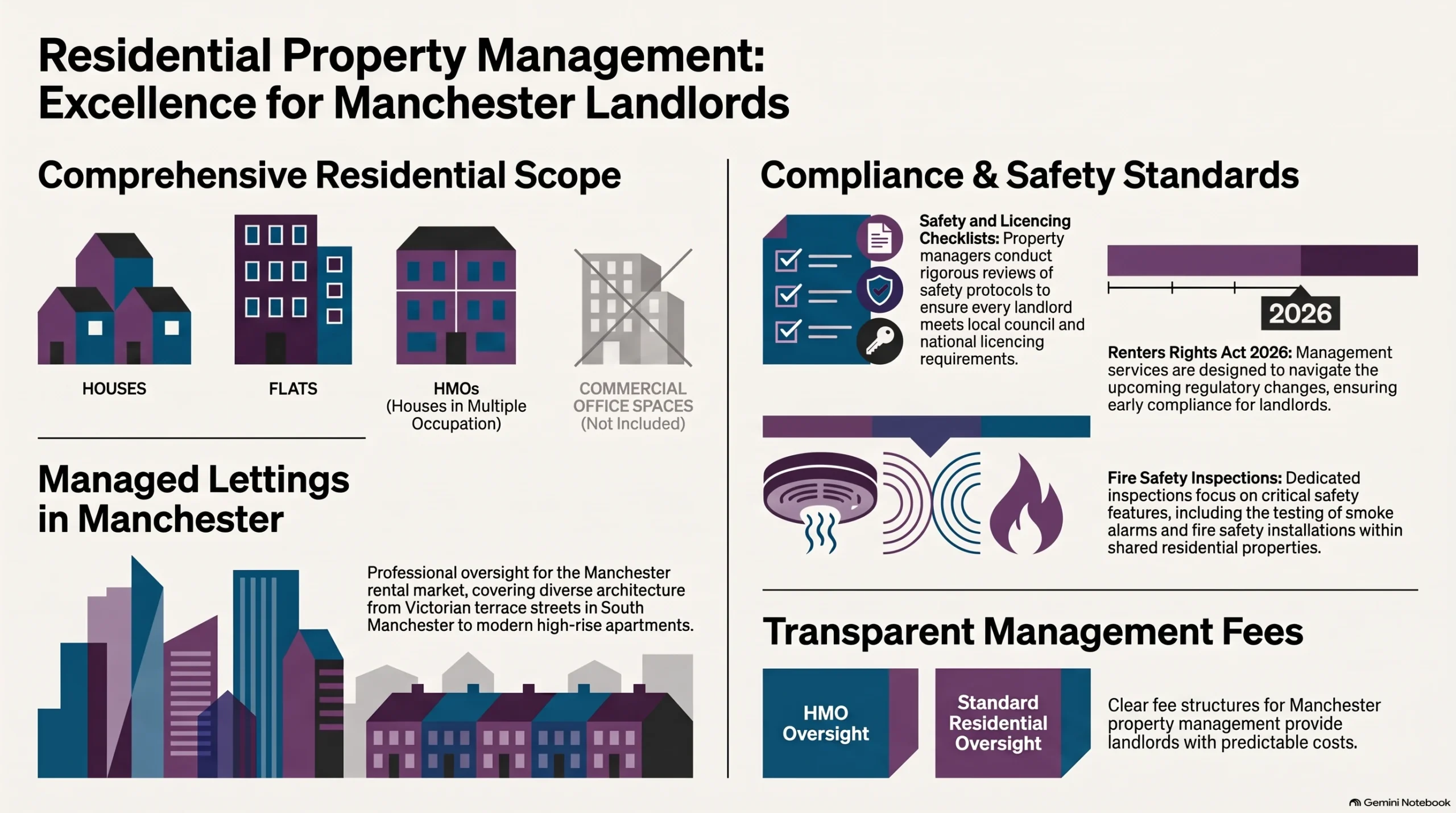
Residential Management Compared With Commercial Oversight
Domestic Habitability And Tenant Security Obligations
Residential property management for houses, flats, and HMOs centres on domestic habitability, tenant security, and statutory housing law. It covers tenancy transitions, deposit protection, and the day-to-day living conditions private renters depend on. Commercial facilities management instead deals with corporate leases, business rates, and workplace maintenance, governed by entirely separate rules.
Commercial leases often place internal repair obligations onto corporate tenants under full repairing terms, shifting liability away from the landlord. Residential landlords cannot pass on these obligations. They remain strictly liable for structural safety, sanitation, heating systems, and electrical installations throughout the tenancy under statutory housing law.
Continuous Compliance Monitoring Across Property Types
Managing residential assets requires continuous monitoring of housing regulations, safety certifications, and tenant communications. Individual houses, converted blocks of flats, and multi-occupancy student or professional homes each carry distinct local authority codes. Professional agency oversight keeps every property type inside those rules without gaps forming between inspections.
Protecting financial performance depends on this continuity. A missed gas safety renewal or an expired EICR can halt a tenancy or trigger enforcement action within weeks. Structured compliance calendars, shared across a managing agent’s full portfolio, catch renewal dates before they lapse. This protects long-term asset equity.
Section 21 Abolition And Statutory Possession Grounds
Assured Periodic Tenancies Under The Renters Rights Act
The Renters Rights Act abolishes Section 21 no-fault evictions, converting every fixed-term Assured Shorthold Tenancy into a periodic agreement. Landlords can no longer serve no-fault notices to end a tenancy. Instead, property owners must rely on specific statutory grounds under Section 8, each with its own evidence and notice requirements.
Tenants can terminate a periodic tenancy at any time by serving two months’ written notice. Landlords must adjust operational systems to handle fluid occupancy patterns. Every statutory notice and written statement of terms must still be served correctly before a new tenancy begins. The shorter turnaround changes nothing here.
Mandatory Notifications And Rental Bidding Restrictions
New regulations require landlords to give existing tenants a formal government information sheet explaining their statutory rights. Rental adverts must also state a single fixed asking price. Requesting, encouraging, or accepting offers above that price is illegal. Civil penalties of up to £7,000 apply to landlords or agents.
Compliance audits are vital to prevent financial sanctions of this kind. Agency systems distribute required documentation digitally and track every legal notice served. Accurate, timestamped records across each tenancy file give landlords a clear evidence trail if a dispute ever reaches court.
Did You Know?
In Manchester, converting a family home into a small HMO for three or more residents requires full planning permission under a city-wide Article 4 Direction. Operating without correct permission can incur civil penalties up to £40,000.
Protecting Lawful Use Status And HMO Asset Value
Mandatory, Additional, And Selective Licence Thresholds
Mandatory HMO licensing applies to properties housing five or more people from two or more separate households. Manchester also enforces additional licensing for smaller shared properties of three or four sharers. Selective licensing applies across designated zones such as Rusholme and Moss Side. Operating unlicensed carries fines up to £40,000.
Each licence category carries distinct conditions covering fire door ratings, interlinked alarms, and minimum room sizes. Local housing officers inspect licensed properties periodically to confirm ongoing compliance. Landlords managing mixed portfolios across several licensing zones need a clear tracking system to avoid missing a renewal deadline.
Article 4 Conversions And Long-Term Valuation Risk
Converting a C3 family home into a C4 HMO requires full planning permission under Manchester’s city-wide Article 4 Direction. Permitted development rights simply do not apply. Policy H11 maps existing HMO density within 100 metres of any proposed conversion, and high-concentration streets face automatic refusal.
Maintaining proof of historical lawful use protects portfolio value at the point of sale or refinance. Lenders and buyers scrutinise planning status closely during due diligence. Losing grandfathered C4 status can reduce a property’s valuation by up to 30%. Documentation matters as much as the licence itself.
The Railton-Meeks Compliance Audit Tool
Check Your Compliance & Protect Your Portfolio
Managed Lettings Screening And Preventative Maintenance
Tenant Screening And Financial Stewardship
Professional tenant vetting extends beyond basic credit checks into detailed rent-to-income ratios and employment stability. Fully managed services track rent payments automatically, flagging delays within twenty-four hours. Fast notification stops arrears escalating toward the three-month threshold needed to bring a Section 8 claim under current rules.
Managing agents handle statutory deposit protection within thirty days of receipt, serving prescribed information alongside a photographic inventory. Digital financial statements consolidate income and expenditure automatically. This gives landlords a running record that simplifies year-end reconciliation and keeps arrears visible before they become unrecoverable.
Preventative Maintenance And Contractor Triage
Proactive maintenance prioritises planned repairs over emergency call-outs. Experienced property managers triage reported issues before deploying a tradesperson, separating routine wear from genuine safety hazards. Addressing minor faults promptly prevents structural deterioration and lowers repair costs. It also keeps the property inside statutory housing standards throughout the tenancy.
In-house contractor networks and structured inspection routines shorten response times whenever repairs are needed. Routine visits also incorporate moisture assessments to catch damp before it spreads. High-definition video inventories document conditions before and after each tenancy, protecting deposits during end-of-tenancy disputes.
Railton-Meeks offers four landlord service tiers across Manchester and Cheshire
Energy Performance And Fire Safety Compliance
EPC Targets And Housing Hazard Timelines
Residential rental properties must reach an Energy Performance Certificate rating of C or higher by October 2030. Fabric-first improvements such as loft and cavity wall insulation support that target. Awaab’s Law adds a separate hazard timeline. Emergency repairs for total heating breakdown or dangerous electrical faults must commence within 24 hours of being reported. Our guide to what full property management includes goes into this in more detail.
Landlords must also investigate significant damp or mould issues within 14 days. A written inspection report must reach tenants within three days of that visit. Planning retrofit works around existing tenancy cycles avoids unnecessary void periods whilst spreading capital expenditure across several years.
Gas, Electrical, And Fire Door Certification
Annual Gas Safety certification and five-year Electrical Installation Condition Reports must run without gaps across every let property. Tenancy length makes no difference. Licensed HMOs carry extra fire safety obligations on top of these baseline checks. This reflects the higher occupancy risk inside shared accommodation and communal escape routes.
Licensed HMOs require Grade D interlinked smoke alarms, kitchen heat detectors, and FD30-rated fire doors fitted with certified self-closing devices. Schemes such as the Great British Insulation Scheme help fund thermal upgrades. This protects net rental margins whilst properties work toward the 2030 EPC deadline.
Instant Rental & Block Valuation
Get Your Valuation & Know Your Market Value
Financial Administration And Tax Reporting Obligations
Deposit Protection And Prescribed Information Deadlines
Statutory deposit protection must be completed within thirty days of receiving a tenant’s deposit. Prescribed information must also set out where the funds sit and how disputes get resolved. Missing this window removes a landlord’s ability to serve certain possession notices. It can also trigger a compensation claim of up to three times the deposit.
Photographic and video inventories taken at check-in give adjudicators the evidence needed to resolve dilapidation disputes fairly. Landlords who skip this step routinely lose deduction claims at the deposit scheme stage. The actual condition the property was returned in makes no difference.
Making Tax Digital Reporting Thresholds
Making Tax Digital requires quarterly electronic submissions to HM Revenue and Customs once rental income exceeds statutory reporting thresholds. That threshold currently sits at £50,000 annually for individual landlords. Digital accounting platforms log rental income and allowable expenses automatically, replacing the annual spreadsheet reconciliation many landlords previously relied on.
Deductible repairs, safety certification costs, and management fees must sit under compliant accounting classifications throughout the year. Clear digital records also help lenders assess refinancing applications quickly, since portfolio cash flow becomes visible without requesting further paperwork. There is more on full management inclusions and fees in a separate guide.
Postcode Dynamics And Strategic Asset Returns
High-Yield Student Corridors And HMO Hubs
Postcodes like M14, covering Fallowfield and Rusholme, generate gross rental yields between 7.5% and 9.5%. Strong student demand drives that return. Multi-occupancy assets in these corridors require intensive administrative oversight and strict HMO licensing compliance. Proactive maintenance routines protect that yield through each academic cycle.
With new Article 4 planning consents restricted across M14 and M20, existing licensed HMOs represent genuinely protected assets. Upgrading interiors and installing high-speed internet helps self-contained multi-let houses stand out. Purpose-built student accommodation competes hard for the same tenants.
Professional Suburbs And Capital Preservation Zones
Suburban enclaves such as Didsbury, Chorlton, and Cheadle deliver modest gross yields between 4.0% and 5.5%. In return, they offer superior tenant stability and stronger capital growth. Professional couples and families in these postcodes tend to stay longer. This meaningfully reduces turnover and void costs across a typical holding period.
High-end Cheshire postcodes such as Wilmslow and Hale prioritise long-term wealth preservation over headline yield. Executive homes and luxury apartments demand discreet, high-touch management. This protects period features, maintains smart home infrastructure, and retains high-earning tenants over multi-year tenancies.
HMO Specialist Yield & Tax Calculator
Calculate Your Yield & Offset New Tax Burdens
Final Thoughts
Navigating Manchester’s private rented sector now requires a structured, professional approach to residential property management. Licensing rules keep tightening and possession grounds keep shifting. Successful ownership now depends on rigorous legal compliance, accurate market pricing, and proactive asset maintenance.
Property owners who put structured management protocols in place now will be well positioned. Further statutory deadlines are still to come. Thorough tenant vetting, preventative maintenance, and clear compliance tracking together build a portfolio resilient enough to weather further legislative change.
Frequently Asked Questions
A:
Residential property management focuses specifically on private housing tenancies, individual dwellings, flats, and HMOs. It involves statutory housing regulations, tenant safety compliance, deposit protection, periodic tenancy rules, and habitability standards. In contrast, commercial management handles business properties, retail spaces, and office blocks. It operates under commercial lease agreements, corporate tenant obligations, business rates, and facilities management frameworks that do not apply to domestic residential lettings.
A:
Existing Assured Shorthold Tenancies convert automatically into periodic tenancies under statutory legislative reforms. Landlords do not need to rewrite current contracts, but any fixed-term clauses or break options become legally inoperative. Tenancies roll month-to-month from conversion, with tenants able to leave by serving two months' written notice. Landlords seeking possession must serve valid statutory notices under updated Section 8 grounds rather than using Section 21 notices.
A:
In Manchester, converting a family home into a small HMO for three to six occupants requires full planning permission. This follows from a city-wide Article 4 Direction. Permitted development rights do not apply. Planning applications are assessed under local policies like Policy H11. This restricts new HMO conversions in areas with high multi-occupancy concentrations. Operating an HMO without correct planning permission can lead to enforcement notices and civil penalties up to £40,000.
A:
Private rental properties in England and Wales must reach an Energy Performance Certificate rating of C or higher by October 2030. Landlords must invest in fabric-first energy improvements, such as loft insulation, cavity wall insulation, efficient heating systems, or solar panels. Financial expenditure caps exist to protect landlords from unreasonable retrofitting costs. Properties must still meet these standards or register a valid statutory exemption to remain on the rental market legally.
A:
Before letting a residential property, landlords must provide a valid annual Gas Safety Certificate for gas appliances. A five-year Electrical Installation Condition Report and an Energy Performance Certificate are also required. Landlords must also complete a written risk assessment for Legionella and fit working smoke alarms on every storey. Licensed HMO properties face additional requirements. These include fire risk assessments, interlinked smoke alarm systems, heat detectors, and certified self-closing fire doors across high-risk rooms.
