

Section 24 Landlords: Sell, Incorporate or Hold?
Higher-rate taxpayers across Manchester and Cheshire face mounting pressure as mortgage rates and regulatory standards rise together. Since the phased removal of full mortgage interest deductions, section 24 landlords have seen effective tax liabilities surge regardless of operational cash flow. Individual ownership often means paying income tax on profits that never reach a personal bank account. As a result, portfolio owners are now deciding whether to retain assets, restructure holdings or exit the private rented sector entirely.
Choosing between retaining debt-laden properties, transferring ownership to a company or executing a structured sale requires rigorous financial analysis. Each pathway carries distinct legal, financing and taxation consequences under current legislation. With statutory compliance tightening and capital gains rules strictly enforced, which route offers the most viable future for your mortgaged buy-to-let portfolio?
Key Takeaways
- Section 24 restricts mortgage finance relief to a twenty per cent basic-rate tax credit, eroding margins for individual higher-rate residential landlords.
- Holding mortgaged property individually calls for lower borrowing, annual Section 13 rent reviews, or rebalancing beneficial ownership between spouses to use lower tax bands.
- Transferring property to a company triggers Stamp Duty Land Tax and Capital Gains Tax at market value unless specific statutory reliefs apply.
- Selling buy-to-let property incurs Capital Gains Tax at eighteen or twenty-four per cent, reported and paid within sixty days of completion.
- Selling tenanted property to an investor avoids voids and notice delays, and the existing assured periodic tenancy simply continues.
Core Strategic Pathways for Mortgaged Property Portfolios
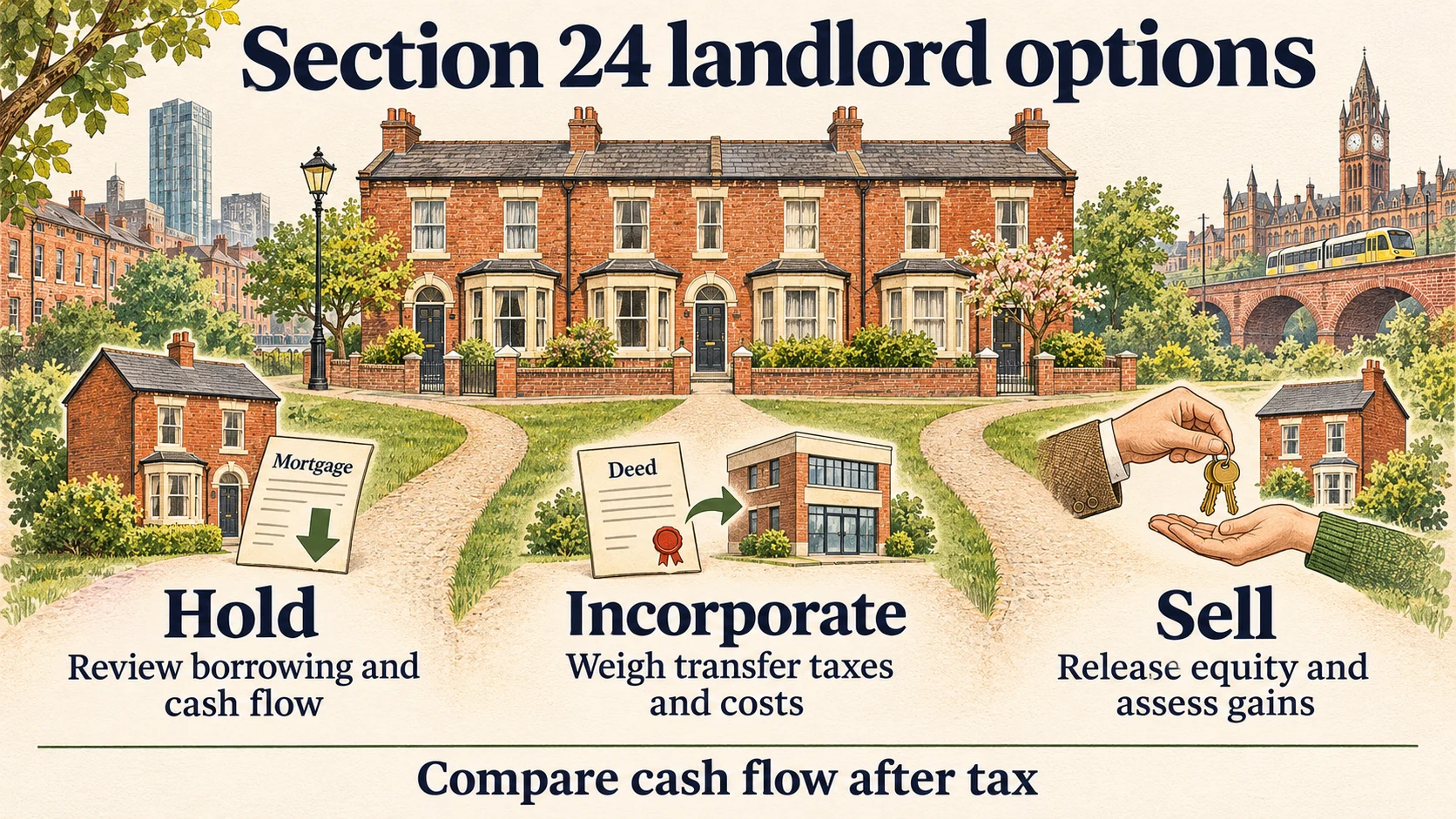
Landlords holding mortgaged residential investments face three distinct choices under the current fiscal regime. Retaining property means managing debt levels and rental growth directly. Transferring property into a company offers full interest deductibility but triggers substantial transaction taxes. Disposing of property crystallises capital gains whilst releasing capital. The comparison below sets out the core triggers and outcomes of each pathway.
The right pathway depends on your investment horizon, current borrowing and personal income tax position. A strategy that protects one investor may generate severe tax costs for another. Weighing transaction costs against ongoing tax relief shows whether holding, incorporating or selling delivers the strongest net return. Take professional tax and legal advice before committing to any structural change.
| Strategic Route | Primary Tax or Cost Trigger | Core Practical Outcome |
|---|---|---|
| Strategic RouteHold Individually | Primary Tax or Cost Trigger20% basic-rate finance cost tax credit | Core Practical OutcomeRetain direct ownership; manage taxable income through rent reviews and debt reduction |
| Strategic RouteIncorporate | Primary Tax or Cost TriggerMarket value SDLT and Capital Gains Tax | Core Practical OutcomeGain full mortgage interest deduction inside a company subject to corporation tax |
| Strategic RouteDispose of Asset | Primary Tax or Cost Trigger18% or 24% residential Capital Gains Tax | Core Practical OutcomeRelease equity and eliminate financing costs; report and pay tax within 60 days |
How Section 24 Finance Cost Relief Works
Restricted Mortgage Interest Relief
Section 24 of the Finance (No. 2) Act 2015 stops individual landlords deducting mortgage interest from rental income. The same restriction applies to other finance costs, such as arrangement fees. HMRC instead taxes rental income minus allowable non-finance expenses. The landlord then receives a basic-rate tax credit worth twenty per cent of the finance costs.
This mechanism hits higher-rate and additional-rate taxpayers hardest. HMRC measures taxable profit before interest, so the figure overstates real economic profit. That inflated figure can push a basic-rate earner into the forty per cent band. The twenty per cent credit only partly offsets the resulting liability. HMRC also caps the credit at the lowest of finance costs, property profits or adjusted total income. Landlords therefore pay income tax on money already paid to their lenders.
A Profitable Rental with a Real Tax Bill
A property can produce positive cash flow yet still leave an investor with an unsustainable tax bill. Consider a higher-rate taxpayer receiving £18,000 in gross annual rent. Mortgage interest costs £10,000 and allowable maintenance costs £2,000. The actual cash profit is £6,000 before any income tax.
With the section 24 tax credit explained, taxable property profit is £16,000, being £18,000 rent minus £2,000 maintenance. Assuming all of that profit falls within the higher-rate band, the preliminary liability is £6,400. HMRC then applies a twenty per cent credit on the £10,000 interest, which reduces the bill by £2,000. The final tax due is £4,400. The landlord keeps just £1,600 of a £6,000 operating surplus. Finance cost restrictions can therefore wipe out most of the real cash yield.
Individual Ownership and Debt Reduction
Capital Repayment and Mortgage Restructuring
Retaining mortgaged property in personal names requires a deliberate plan to reduce finance exposure. Landlords who hold typically pay down capital balances or restructure borrowing. Lower loan-to-value ratios cut annual interest charges directly. This narrows the gap between higher-rate tax and the basic-rate credit.
Deleveraging restores operating margins over time. Using surplus cash from other sources to repay principal reduces the finance charges caught by Section 24. The approach needs available capital, but it also protects the portfolio against interest rate volatility. In practice, investors with substantial equity often find that selective capital repayments keep individual ownership viable without transaction costs.
Rent Reviews and Spousal Transfers
Landlords who hold can increase rents once a year using a statutory Section 13 notice under the Housing Act 1988. Married couples and civil partners can also rebalance beneficial ownership. Shifting rental income to a spouse in a lower tax band reduces higher-rate exposure across the household.
Since 1 May 2026, a Section 13 notice on Form 4A must give the tenant at least two months’ notice. Aligning rents with open-market levels expands cash flow to absorb higher tax charges. For spouses living together, HMRC taxes jointly held rental income 50:50 by default. Couples holding unequal beneficial shares must declare them on Form 17 for income to follow the real split. Transfers between spouses living together carry no Capital Gains Tax charge.
Did You Know?
From 6 April 2027, separate income tax rates of 22%, 42% and 47% apply to property income in England, Wales and Northern Ireland. Section 24 finance cost relief will then be given at the 22% property basic rate.
Company Incorporation and Asset Transfer
Corporate Ownership and Full Interest Relief
A limited company holding residential property can deduct mortgage interest as an allowable business expense. Corporation tax then applies to net profit rather than personal income tax rates. The company can retain post-tax profit for reinvestment without triggering higher-rate income tax on the shareholders.
When investors transfer property to limited company ownership, the business deducts finance costs in full before calculating taxable profit. Section 24 does not apply at corporate level. For landlords planning to expand, retained earnings accelerate capital accumulation. Corporation tax currently runs from 19% to 25%, depending on profit levels. Extracting profit for personal spending remains subject to dividend tax or PAYE on salary.
Relief Qualification and Business Status Tests
Section 162 Incorporation Relief lets landlords defer Capital Gains Tax by exchanging a property business for company shares. Qualification depends on proving that the letting activity is a genuine business rather than a passive investment. The Ramsay case accepted around twenty hours of weekly management as sufficient activity.
Passive holding operations do not qualify. A landlord relying on fully managed agency contracts with no personal involvement will struggle to meet the business test. Relief also requires the transfer of the whole business, including all its assets other than cash, in exchange for shares. If HMRC rejects a claim, the gain becomes payable immediately. Detailed time logs, operational records and professional verification all support a valid claim.
Landlord Exit Strategies and Options
Upfront Tax Liabilities on Company Transfers
Stamp Duty Land Tax at Market Value
HMRC treats a transfer to a connected company as a sale at open market value. The company pays Stamp Duty Land Tax on that valuation, not on the outstanding mortgage. The higher rates for additional dwellings apply, creating a substantial immediate cash liability for the company.
Section 162 relief does not cover this charge, and the company cannot defer it. Limited exceptions exist for genuine property partnerships, but they demand specialist advice. Otherwise, the company must fund the tax on completion from working capital or new lending. In higher-value parts of South Manchester and Cheshire, the bill on a multi-property transfer can reach tens of thousands of pounds. That single charge can wipe out years of projected Section 24 savings.
Capital Gains Tax Exposure on Transfer
An individual transferring rental property to a company makes a deemed disposal for Capital Gains Tax purposes. Unless Section 162 relief applies, tax falls due on all growth in value since acquisition. This creates an immediate personal tax bill without any sale proceeds to settle it.
Properties bought decades ago often carry large accrued gains. A deemed sale at market value forces tax across all of that historical growth. Where relief is unavailable or contested, the sixty-day reporting and payment rule still applies. Investors must weigh these transfer costs against the expected corporation tax advantages before proceeding.
The Railton-Meeks Compliance Audit Tool
Check Your Compliance & Protect Your Portfolio
Property Disposal and Capital Gains Realisation
Residential Capital Gains Tax Rates
Selling a residential investment property triggers Capital Gains Tax on net gains above the annual exempt amount. For 2026/27, the individual exemption is £3,000. Gains falling within the basic-rate band attract eighteen per cent. Gains above that band attract twenty-four per cent.
HMRC adds chargeable gains to taxable income to decide which rate applies. For higher-rate landlords, almost all of the gain falls at twenty-four per cent. Selling ends ongoing Section 24 losses and mortgage risk. However, it crystallises a substantial tax bill that reduces the capital returned to the owner.
Sixty-Day Reporting and Payment Deadline
UK residents selling residential property have sixty days from completion to report the gain. They must also pay the estimated Capital Gains Tax within that window. Returns go through HMRC’s online Capital Gains Tax on UK property service. Missing the deadline triggers an automatic £100 penalty, plus interest on late tax.
The rule demands quick coordination between conveyancer, accountant and seller. Landlords must establish accurate base costs and verify capital spending on past improvements. They must also deduct selling expenses before submitting figures. Preparing records before exchange avoids late-filing penalties and unexpected cash flow demands. Further penalties apply if the return stays outstanding for six months or more.
Airbnb Alternative for Short Let Management across Manchester and Cheshire
Disposal Routes: Vacant Possession Versus Sitting Tenants
Open Market Sales and Ground 1A Procedures
Vacant possession for an open market sale requires a Section 8 notice under Ground 1A of the Housing Act 1988. This ground requires four months’ notice. Landlords cannot use it during the first twelve months of a tenancy. Mortgage costs continue to run throughout any resulting void.
Vacant sales reach owner-occupiers, which may lift headline prices in family neighbourhoods. However, the vendor keeps paying the mortgage, council tax and utilities throughout notice, marketing and conveyancing. If a tenant does not leave, the landlord must seek a possession order through the courts. A collapsed chain extends the void and drains cash reserves quickly.
Tenant-in-Situ Sales to Landlord Investors
Selling with tenants in place transfers the landlord’s interest directly to a purchasing investor. The tenancy does not end. The existing assured periodic tenancy continues on identical terms, preserving rental income throughout conveyancing. The buyer simply steps into the seller’s position as landlord on completion.
This route avoids Ground 1A entirely, along with its notice period and any court process. Rent continues to accrue right up to completion. Compliance records, safety certificates and the protected deposit pass to the new owner. The buyer must notify the tenant of the change of landlord under Section 3 of the Landlord and Tenant Act 1985. Until the buyer gives that notice, the seller remains liable for tenancy obligations.
Instant Rental & Block Valuation
Get Your Valuation & Know Your Market Value
Strategic Assessment and Professional Advisory
Portfolio Yield Against Net Post-Tax Cash Flow
The decision to retain, incorporate or sell should rest on net post-tax cash yield, not gross rent. Landlords must model finance costs, maintenance and tax across all three routes. High-yielding areas may absorb Section 24 costs. Lower-yielding assets often generate ongoing personal cash deficits.
A portfolio audit shows which units deliver acceptable post-tax returns. From experience across the sector, high-yielding HMOs and multi-unit blocks often carry enough margin to justify the Section 24 differential. Highly leveraged single lets with modest yields are usually prime candidates for disposal or restructuring. Detailed modelling prevents emotional decisions and directs capital where it performs best.
Independent Legal and Tax Advice Requirements
Tax legislation and property law contain nuances that vary with individual circumstances and existing borrowing. This guide provides general educational context rather than formal financial or tax advice. Every property owner should engage a chartered tax adviser and a qualified solicitor before making structural portfolio changes.
A tax adviser will run bespoke calculations comparing incorporation costs with long-term corporation tax savings. A property solicitor will confirm that any tenancy transfer or corporate restructure complies with current statutory requirements. Lenders must also consent, because personal buy-to-let mortgages cannot simply move into a company. Relying on generalised assumptions can trigger irreversible tax bills.
HMO Specialist Yield & Tax Calculator
Calculate Your Yield & Offset New Tax Burdens
Final Thoughts
For section 24 landlords, the decision calls for a dispassionate review of returns against statutory liabilities. Restricted finance cost relief has fundamentally changed buy-to-let economics for higher-rate taxpayers. Holding requires active deleveraging and disciplined rent management. Incorporation offers corporate tax benefits at the cost of heavy upfront transaction taxes. Selling underperforming assets crystallises gains but permanently ends ongoing losses.
Each investor must weigh personal goals, debt ratios and administrative capacity before choosing a pathway. With residential regulation evolving quickly, passive holding no longer guarantees reliable returns. A comprehensive portfolio review, supported by qualified legal and tax professionals, keeps property wealth secure, compliant and commercially viable for the years ahead.
Railton-Meeks Landlord Assistance
Frequently Asked Questions
A:
Section 24 of the Finance (No. 2) Act 2015 stops individual landlords deducting mortgage interest from rental income. HMRC taxes rental income less non-finance costs, which can push investors into higher tax bands. Landlords then receive a tax credit worth twenty per cent of their finance costs. For higher-rate and additional-rate taxpayers, that credit cannot offset the forty or forty-five per cent tax charged on the same income. The result is thinner margins or outright cash flow deficits.
A:
Transferring buy-to-let property to a limited company triggers Stamp Duty Land Tax and Capital Gains Tax at open market value. The company pays Stamp Duty Land Tax at the higher rates for additional dwellings. The landlord makes a deemed disposal, taxed at eighteen or twenty-four per cent. Section 162 Incorporation Relief can defer the gain. However, it only applies where the landlord runs an active property business rather than a passive investment portfolio.
A:
For 2026/27, residential property gains within the basic-rate band attract Capital Gains Tax at eighteen per cent. Gains above that band attract twenty-four per cent. Each individual has an annual exempt amount of £3,000. Any unused allowance lapses at the end of the tax year. Landlords calculate the net gain after deducting purchase costs, capital improvements and transaction fees. The seller must then report and pay the liability within sixty days of completion.
A:
Landlords selling UK residential property have sixty days from completion to report the disposal. They must pay the estimated Capital Gains Tax within the same window. Returns go through HMRC's online Capital Gains Tax on UK property service. A late return triggers an automatic £100 penalty, with further penalties if it stays outstanding. HMRC also charges interest on unpaid tax until settlement. Preparing base costs and improvement records before exchange makes the deadline far easier to meet.
A:
Yes. Landlords can sell tenanted residential property directly to investor buyers. The sale transfers the landlord's interest, so the tenancy continues on its existing terms and the tenant stays in their home. This route avoids Ground 1A notices under Section 8, removes marketing voids and keeps rent flowing until completion. The buyer must give the tenant written notice of the change of landlord. The seller stays liable for tenancy obligations until the buyer serves that notice.
