

Residential Property Management Services Explained
Professional residential property management services provide essential operational and legal protection for landlords navigating modern letting requirements. Managing private rental homes demands strict adherence to evolving statutory standards, technical building obligations, and comprehensive administrative oversight. Landlords frequently discover that self-management carries substantial regulatory risks and heavy time commitments. By appointing a dedicated management specialist, property investors secure professional oversight for day-to-day tenancy administration, asset maintenance, and financial governance, thereby protecting both rental yield and asset value.
Private renting regulations in England undergo structural reform as statutory possession grounds shift and tenant protections expand. Landlords face critical decisions regarding whether to oversee compliance independently or transfer statutory responsibilities to accredited property managers. What core services should property owners expect from professional management to safeguard their rental investments against statutory penalties and escalating operational liabilities?
Key Takeaways
- Professional property management delivers statutory safety compliance, protecting landlords from significant civil penalties through structured annual gas, electrical, and energy assessments.
- A comprehensive inventory with timestamped photographic evidence provides essential legal protection when resolving deposit adjudications under mandatory custodial protection schemes.
- Scheduled biannual property inspections identify emerging moisture, ventilation, and fabric defects early, helping landlords satisfy strict private rented sector housing standards.
- Modern digital accounting platforms generate quarterly income and expenditure statements that align directly with Making Tax Digital reporting obligations for landlords.
- The abolition of Section 21 evictions requires robust tenancy onboarding, strict rent tracking, and evidence-led documentation to support statutory possession proceedings.
Core Elements of Professional Property Management
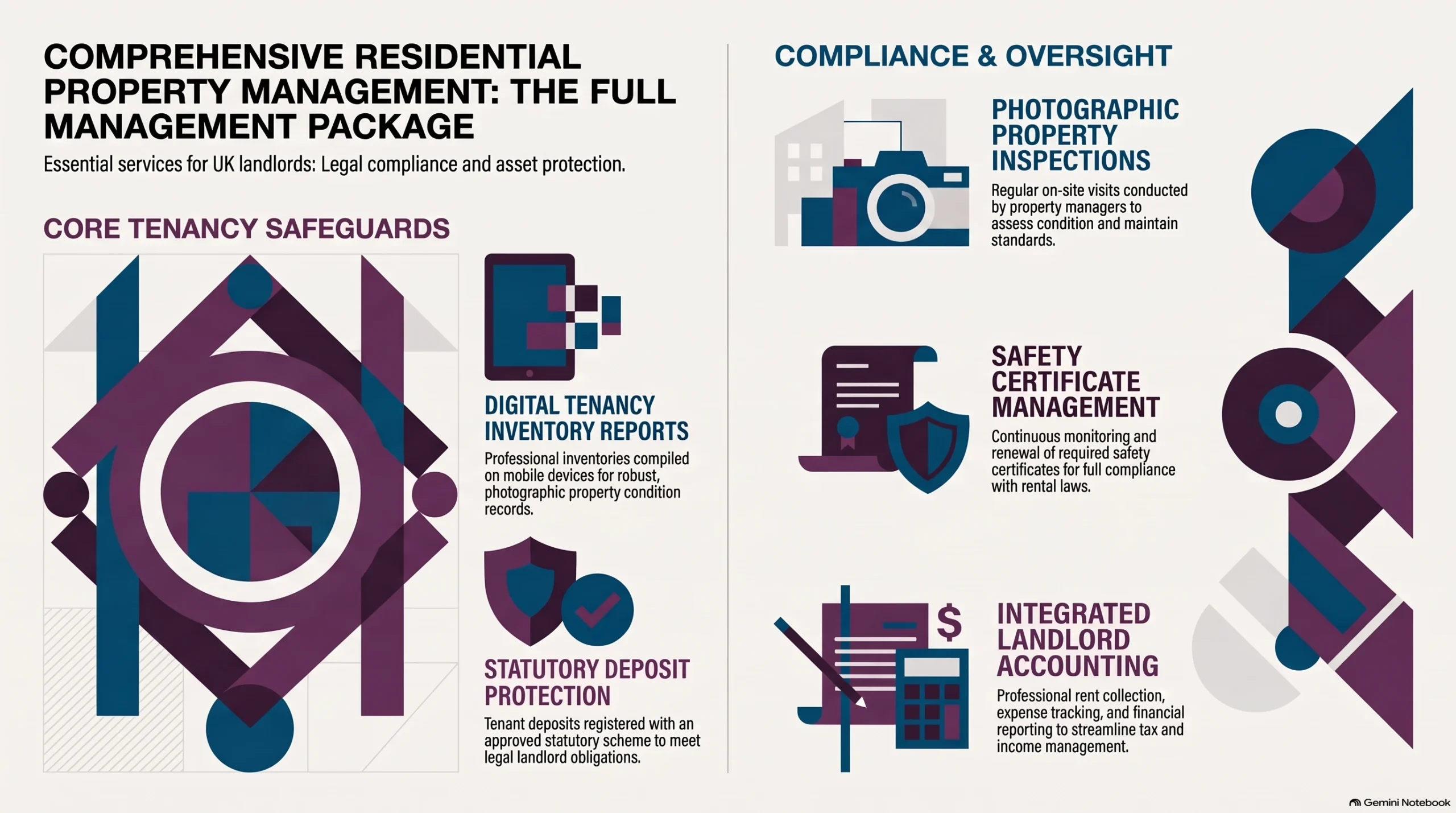
Professional property management encompasses several core operational disciplines designed to eliminate landlord non-compliance whilst protecting net rental yields. Every component serves a specific administrative or statutory function, shifting liability away from individual property owners. Clear operational frameworks ensure that safety certifications, financial accounting, and tenancy events proceed without disruption throughout the rental lifecycle.
Understanding the precise scope of each management tier helps landlords select appropriate operational coverage for their portfolios. The table below outlines key management functions alongside their primary operational objectives and statutory implications across England. These core disciplines form the foundation of professional letting administration.
| Management Function | Core Deliverables | Regulatory or Practical Impact |
|---|---|---|
| Compliance Management | Annual CP12 gas safety, five-year EICRs, valid EPC certificates | Prevents civil penalties and invalid possession claims |
| Inventory & Check-in | Detailed photographic condition reports, meter readings, key logs | Secures deposit deduction claims during dispute resolution |
| Property Inspections | Biannual visits, structural audits, damp and mould checks | Enforces lease terms and satisfies Decent Homes Standards |
| Financial Administration | Rent collection, arrears chasing, MTD-ready digital statements | Ensures statutory tax compliance and protects rental income |
| Tenancy Administration | Tenant vetting, legal notices, tenancy renewal agreements | Eliminates invalid notice risks under rolling periodic tenancies |
Statutory Compliance and Safety Certification
Mandatory Gas and Electrical Standards
Professional residential property management services enforce strict statutory compliance schedules for all critical utility installations within a rental dwelling. Landlords must secure an annual Gas Safety Certificate under the Gas Safety (Installation and Use) Regulations 1998. They must also obtain an Electrical Installation Condition Report every five years.
Qualified property managers schedule testing with accredited Gas Safe engineers and registered electricians before certificates expire. Failing to serve valid certificates to tenants invalidates possession notices and risks local authority prosecution. Professional agents maintain digital compliance logs, preventing certification lapses across complex property portfolios.
Energy Efficiency and Fabric Requirements
Letting agents verify that rental dwellings meet national minimum energy efficiency standards before commencing any marketing activities. A property must possess a valid Energy Performance Certificate rated E or higher under current rules. Managing agents guide property owners through necessary heating and insulation retrofits ahead of the unified 2030 EPC Grade C target.
Under government decarbonisation plans, landlords must plan fabric improvements to insulate lofts, upgrade cavity walls, or replace obsolete boilers. Properties failing to meet statutory standards face marketing bans and substantial council fines. Managing agents audit current certificates to identify cost-effective retrofits within statutory cost caps, safeguarding long-term asset value.
Tenancy Creation and Legal Documentation
Comprehensive Tenant Referencing Protocols
Thorough background assessments ensure prospective occupants possess legitimate residency rights and verifiable financial capability to cover rent. Management teams execute mandatory Right to Rent checks under the Immigration Act 2014 alongside comprehensive credit history reviews. They verify employment contracts, assess rent-to-income ratios, and secure written references from previous landlords.
Rigorous vetting establishes tenancy viability before key handover. In an environment where the Renters’ Rights Act 2025 bans tenant rental bidding, properties must be let at the advertised price without competitive bidding wars. Professional screening identifies stable applicants based on factual affordability, minimising potential default risks and preserving portfolio stability.
Statutory Notices and Rolling Periodic Tenancies
The legislative framework shifts tenancies away from traditional fixed-term assured shortholds toward rolling assured periodic agreements. Under the Renters’ Rights Act 2025, tenancies roll month-to-month from inception, with tenants entitled to give two months’ notice. Property managers draft legally compliant agreements and serve mandatory government information sheets to avoid civil penalties.
The abolition of Section 21 no-fault evictions requires precise reliance on amended Section 8 grounds for possession. Landlords seeking possession to sell, move family in, or address severe arrears must serve specific statutory notices within designated timeframes. Management agents maintain meticulous records of all communications, ensuring legal possession claims remain valid in court.
Did You Know?
Under the Renters’ Rights Act 2025, Section 21 no-fault evictions were abolished on 1 May 2026, converting existing tenancies to periodic agreements and subjecting landlords to civil penalties of up to £7,000 for failing to provide the mandatory government information sheet by 31 May 2026.
Inventory and Schedule of Condition Management
Detailed Photographic and Video Documentation
A comprehensive schedule of condition establishes the baseline state of a rental dwelling prior to tenant occupancy. Professional residential property management services including inventory deposits and inspections rely on high-definition photography and clear written logs. This documentation records every decorative defect, appliance condition, and surface marking before keys change hands.
Without an objective, independent inventory report, landlords cannot prove tenant-induced damage or neglect. Adjudicators dismiss unsupported deduction claims, returning deposits entirely to tenants. Management teams log all fixtures, fittings, and cleanliness standards down to individual skirting boards, producing an incontrovertible visual record that withstands regulatory scrutiny.
Check-In and Check-Out Reconciliation
Formal check-in procedures ensure incoming tenants review, verify, and sign the comprehensive inventory report upon taking occupation. At the tenancy conclusion, managers conduct an identical check-out inspection comparing current condition against the baseline document. This process isolates genuine tenant damage from normal fair wear and tear under statutory tenancy deposit rules.
Fair wear and tear reflects natural deterioration through reasonable everyday usage over time. Managers assess the age, quality, and anticipated lifespan of damaged furnishings before calculating proportional tenant liabilities. By conducting disciplined comparative check-outs, agents negotiate straightforward, fair settlements between parties, avoiding prolonged administrative delays during tenancy turnovers.
The Railton-Meeks Compliance Audit Tool
Check Your Compliance & Protect Your Portfolio
Tenancy Deposit Protection and Dispute Handling
Prescribed Information and Custodial Registration
Landlords must protect tenant security deposits in a government-approved tenancy deposit scheme within thirty days of receipt. Property managers register funds with custodial or insurance-backed providers and serve mandatory Prescribed Information to tenants. Missing this statutory deadline exposes property owners to severe court-ordered penalties equal to three times the deposit amount.
Serving Prescribed Information requires delivering scheme terms, deposit certificates, and clear guidance notes to every tenant and relevant party. Failure to comply restricts the landlord’s statutory rights when seeking possession under Section 8. Professional agencies automate deposit registration, ensuring statutory certificates and compliance notices issue seamlessly within the legal timeframe.
Evidence-Led Deposit Adjudication
Independent dispute resolution services adjudicate contested deposit deductions when landlords and tenants cannot reach mutual financial agreement. Scheme adjudicators require comprehensive supporting evidence before approving any financial deductions for repairs, cleaning, or arrears. Management agents compile contractor invoices, check-out reports, and timestamped communications into structured submissions that satisfy strict adjudicator criteria.
Adjudication panels operate on the legal premise that the deposit remains the tenant’s property until proven otherwise. Vague assertions of property damage or unitemised repair bills face immediate rejection. Experienced property managers present calibrated comparative documentation alongside competitive contractor quotes, securing legitimate reimbursements for genuine repair and cleaning expenses.
Railton-Meeks offers four landlord service tiers across Manchester and Cheshire
Property Maintenance and Periodic Inspections
Biannual Routine Property Inspections
Scheduled property visits conducted twice per year enable agents to evaluate property care and detect structural concerns early. These inspections assess tenant compliance with tenancy terms, verify occupancy levels, and examine ventilation standards. In-person visual checks identify minor leaks or plumbing failures before they escalate into catastrophic internal water damage. Our guide to letting and property management under one agency goes into this in more detail.
Under Awaab’s Law and Decent Homes guidance, private landlords must investigate persistent damp and mould hazards within statutory windows. Periodic visits allow managers to inspect silicone seals, test extractor fans, and spot rising damp promptly. Written reports complete with photographs keep landlords informed whilst demonstrating diligent property supervision.
Planned Preventative Maintenance Strategies
Proactive asset preservation protects capital values whilst preventing expensive out-of-hours emergency repair fees for private landlords. Managing agents implement preventative maintenance schedules covering roofing, guttering, central heating systems, and external drainage networks. Engaging qualified local contractors on established trade rates ensures prompt, cost-effective maintenance without inflated third-party call-out premiums.
Emergency maintenance calls, such as winter boiler breakdowns, erode annual rental yields quickly. Property managers operate dedicated maintenance triage systems to assess urgent issues remotely before dispatching contractors. Routine boiler servicing and gutter clearance minimise structural degradation, ensuring properties remain fully compliant and comfortable for occupants throughout the year.
Instant Rental & Block Valuation
Get Your Valuation & Know Your Market Value
Rent Collection and Financial Governance
Arrears Control and Possession Ground Thresholds
Rigorous financial tracking ensures rental income arrives punctually whilst identifying payment disruptions during the earliest stages of arrears. Modern letting agencies deploy automated payment software that alerts managers immediately when payments stall. Swift intervention allows managers to initiate communication, establish payment agreements, and mitigate escalating rent default risks.
Under the Renters’ Rights Act 2025, the mandatory threshold for possession under Section 8 Ground 8 increases to three full months of rent arrears, accompanied by four weeks’ notice. Landlords cannot afford administrative delays when chasing payments. Professional management teams enforce strict arrears schedules, issuing formal warnings immediately to prevent arrears surpassing critical limits.
Digital Accounting and Making Tax Digital Compliance
The introduction of Making Tax Digital requires landlords with property income over statutory thresholds to maintain digital accounting records. From April 2026, individuals earning above fifty thousand pounds must submit quarterly updates using compatible digital software. Letting agents supply itemised, software-compatible statements that streamline tax reporting and simplify annual self-assessment submissions.
Traditional paper receipts and manual spreadsheets no longer satisfy modern HMRC compliance standards. Digital statements track rental receipts, management deductions, maintenance expenditures, and statutory safety fees automatically. This transparent financial trail integrates directly into accounting software, helping landlords avoid late filing penalties and inaccurate calculations. There is more on property management for landlords in Manchester in a separate guide.
Full Management Packages Versus Let-Only Services
Scope of Full Property Oversight
Choosing a full management package transfers the continuous operational and legislative burdens of letting to professional agents. Whilst let-only services focus purely on marketing and tenancy initiation, comprehensive management provides end-to-end administration throughout the tenancy lifecycle. Dedicated managers handle day-to-day tenant inquiries, emergency call-outs, inspections, and regulatory compliance updates.
Self-managing landlords face around-the-clock operational demands, statutory deadlines, and significant legal penalties if compliance standards slip. Comprehensive management shields investors by acting as the primary point of contact for occupants. By delegating complex tenant relations, maintenance coordination, and legal paperwork, property owners enjoy genuine hands-off passive rental returns.
Operational Protection for Portfolio Landlords
Managing multiple rental units requires systematic administrative oversight to maintain uniform compliance across diverse property types and locations. Professional residential property management services provide portfolio owners with centralised reporting, standardised safety tracking, and reliable contractor access. This structured approach prevents operational bottlenecks as investors expand their residential property holdings.
Multi-property investors face complex regulatory hurdles, including selective licensing schemes and HMO planning controls. Professional management standardises compliance workflows, ensuring timely licence renewals and routine safety inspections across all assets. This consolidated oversight preserves investment yields, mitigates operational vulnerabilities, and sustains healthy asset appreciation across entire property portfolios.
HMO Specialist Yield & Tax Calculator
Calculate Your Yield & Offset New Tax Burdens
Final Thoughts
Professional residential property management services have transitioned from an optional convenience to an indispensable operational shield for rental investors. Complex statutory reforms, heightened tenant protections, and strict environmental targets mean that self-management carries substantial financial and legal exposure. Delegating compliance, inspection regimes, and tenant administration to qualified specialists ensures portfolios remain fully protected against regulatory penalties and protracted tenancy disputes.
The private rented sector continues its shift toward institutional professionalism and increased regulatory scrutiny. Landlords who invest in structured management systems, meticulous digital documentation, and preventative maintenance frameworks will preserve capital growth and healthy yields. Adapting early to statutory standards ensures long-term operational resilience across modern rental property investments.
Frequently Asked Questions
A:
A comprehensive management package covers the entire tenancy lifecycle from pre-tenancy marketing to final deposit reconciliation. Key inclusions comprise tenant referencing, drafting periodic tenancy agreements, serving statutory notices, and protecting deposits within government-approved schemes. Additionally, managers oversee biannual condition inspections, coordinate reactive and planned maintenance, enforce rent collection, and issue digital statements compatible with HMRC reporting standards. This complete oversight shields landlords from direct operational liabilities and ensures strict statutory compliance.
A:
Most professional managing agents conduct routine property inspections twice per year, typically on a six-month cycle. These visits allow agents to verify tenant occupancy, inspect property cleanliness, and evaluate interior fabric conditions. Inspections are essential for detecting early signs of leaks, condensation, and ventilation issues before they develop into hazardous damp or mould problems. Reports accompanied by photographic evidence are provided to landlords to demonstrate compliance with housing fitness standards and insurance policy requirements.
A:
Recent statutory reforms fundamentally restructure tenancy management by abolishing Section 21 no-fault evictions and moving to rolling periodic agreements. Property managers must implement rigorous onboarding procedures and comprehensive evidence gathering to support possession claims under amended Section 8 grounds. Furthermore, landlords must adhere to strict advertising rules that ban rental bidding wars and provide mandatory government information sheets to all existing tenants. Professional oversight ensures notices and tenancy terms remain legally enforceable under current private rented sector legislation.
A:
Retaining funds from a security deposit requires definitive, objective proof that the tenant breached their tenancy agreement and caused measurable financial loss. Managing agents must provide a signed baseline inventory report featuring high-resolution, dated photographs, alongside an equivalent check-out inspection document. Itemised contractor invoices and receipts establishing the reasonable cost of repairs or professional cleaning must also be submitted. Adjudicators evaluate claims strictly against normal fair wear and tear based on the item's age, quality, and expected lifespan.
A:
Making Tax Digital introduces statutory requirements for landlords earning above designated gross income thresholds to maintain digital financial records. From April 2026, qualifying property owners must submit quarterly summary updates of income and allowable expenses to HMRC using compatible digital software. Professional property managers supply fully itemised, digital monthly and annual statements that map directly into standard accounting platforms. This automated record-keeping eliminates manual calculation errors, streamlines tax compliance, and avoids statutory penalties for late or inaccurate returns.
