

Letting And Property Management Under One Agency
Landlords who split tenant sourcing from ongoing administration frequently face operational friction, missed compliance deadlines, and communication breakdowns. Consolidating letting and property management under a single agency ensures complete oversight. It covers initial marketing, daily repairs, and legal compliance under one service. This unified framework protects rental yields whilst removing the operational burdens associated with self-managing private rented sector properties.
When letting services and day-to-day tenancy oversight operate independently, minor repairs and arrears can escalate into costly disputes. Fragmented self-management exposes property owners to strict statutory fines, particularly under changing tenancy regulations. How can a fully integrated agency model safeguard your property investments and eliminate administrative risk?
Key Takeaways
- Single agency management eliminates communication gaps between tenant acquisition teams and day-to-day property maintenance co-ordinators.
- Unified oversight ensures seamless compliance with statutory safety standards, deposit protections, and mandatory tenancy notification deadlines.
- Automated rent tracking systems flag arrears within twenty-four hours to prevent small payment delays from becoming unrecoverable debts.
- In-house maintenance triaging reduces expensive emergency contractor fees through preventative inspections and remote technical support.
- Consolidating services into one agreement streamlines digital recordkeeping required for tax reporting and legal possession claims.
Fragmented Letting Compared With Full Property Management
Landlords choosing between a let-only service and a fully managed agency face a genuine structural decision. It is not simply a fee comparison. The table below sets out how core operational stages differ under each model, from tenant onboarding through to legal compliance. These gaps explain why fragmentation creates avoidable administrative and financial exposure.
Under a fragmented arrangement, the landlord absorbs every task once the tenancy begins. This ranges from chasing rent to tracking certificate renewal dates. An integrated agency retains responsibility throughout the tenancy, applying consistent systems to onboarding, maintenance, rent collection, and compliance. This structural difference is the primary driver of the outcomes shown in the table.
| Operational Stage | Fragmented Let-Only Approach | Integrated Management Model |
|---|---|---|
| Tenant Onboarding | Agent hands over contact details; owner manages move-in logistics. | Agency executes digital referencing, inventory checks, and key release. |
| Maintenance Handling | Landlord triages emergency requests directly at all hours. | In-house property managers coordinate vetted tradespeople continuously. |
| Rent Collection | Landlord monitors personal bank accounts for manual tracking. | Automated accounting flags arrears within twenty-four hours. |
| Legal Compliance | Owner tracks expiring safety certificates manually across portals. | Agency automates safety audits and legal notice distributions. |
Risks of Split Letting and Management Arrangements
Communication Breakdown Between Sourcing and Management Teams
A let-only service ends its involvement once it hands over the keys. The landlord then manages every subsequent interaction with the tenant directly. This gap in continuity means maintenance requests, rent queries, and compliance reminders reach nobody with day-to-day responsibility for the property. Small issues then routinely go unresolved until they escalate.
Fragmented management structures place the full operational burden back onto the landlord once the letting phase concludes. Without dedicated systems, minor tenant queries quickly escalate into operational bottlenecks that consume time landlords rarely have available.
Common Failure Points in Split Management Models
Split management models fail in recognisable, repeatable ways. Handover records between the letting agent and the property owner are frequently incomplete. Rent receipts often go unmonitored until arrears have already grown. Landlords often skip routine inspections too, allowing structural damage to develop unnoticed. A tenant may only raise a formal complaint once a certificate has already lapsed.
Delayed responses to repair requests carry statutory enforcement risk under housing standards legislation. Inconsistent compliance records also weaken a landlord’s position in any deposit protection dispute. Combining letting and property management within a single operational workflow removes these gaps at source.
Full Lifecycle Management Across the Tenancy
Continuity From Marketing Through to Rent Collection
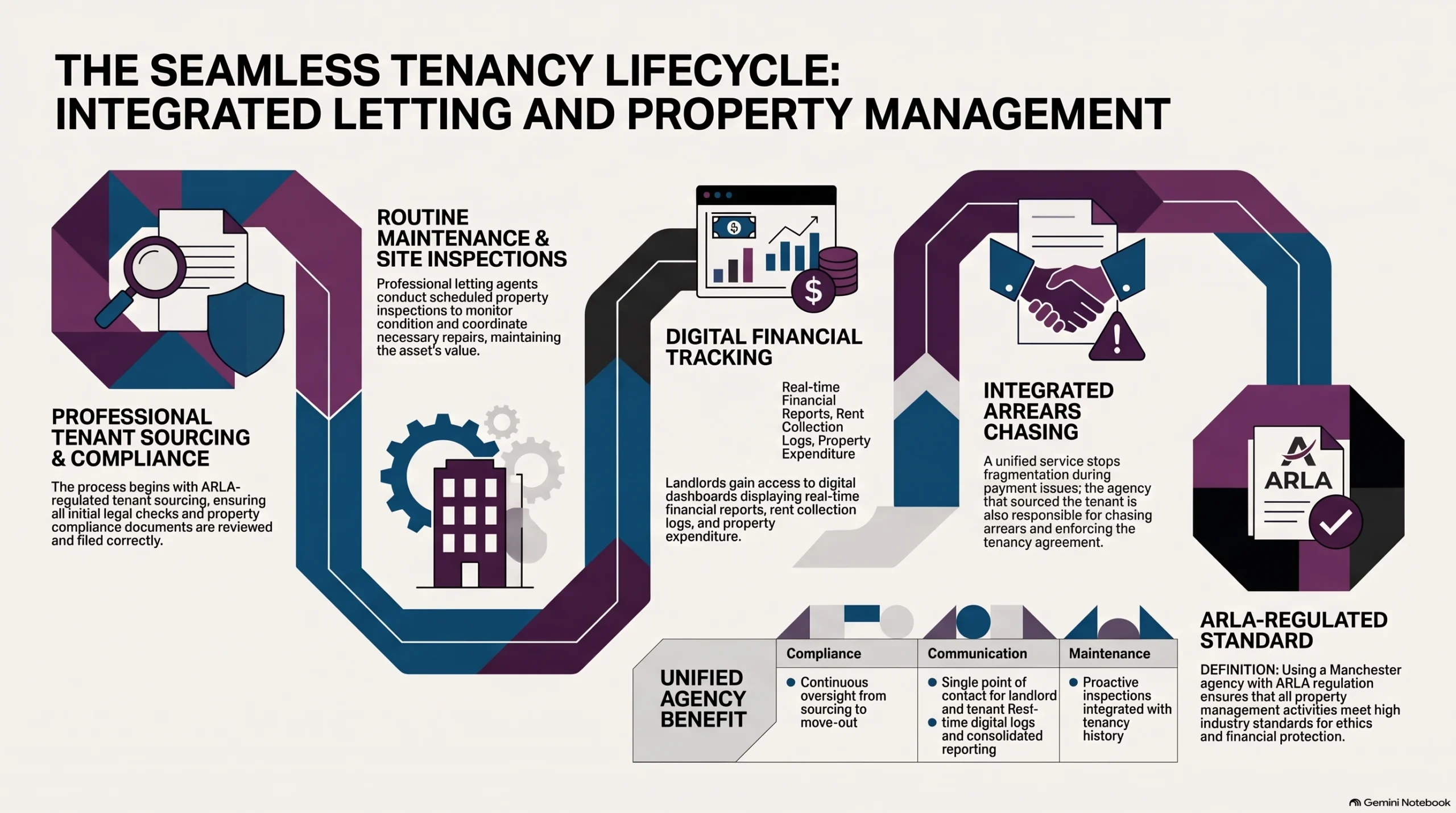
A unified letting agency handles every stage of a tenancy within one continuous operational system. The file is never passed between separate teams. Sourcing suitable occupants is merely the first step in a multi-year investment cycle. Integrating marketing, referencing, tenancy creation, maintenance, and rent collection ensures consistency from the outset.
This continuous oversight protects property asset value whilst maintaining stable rental income across the tenancy term. It also removes the handover point where fragmented models most commonly break down.
Consolidated Reporting and Financial Audit Trails
Adopting integrated lettings and management eliminates the administrative handovers that create risk under a fragmented model. Landlords receive consolidated monthly statements, transparent financial audit trails, and professional representation throughout the tenancy lifecycle. A single, verifiable account of every transaction and communication replaces scattered records.
This consolidated approach gives landlords a clear, single point of reference for tax reporting. It also supports legal possession proceedings where required. Nothing is left to reconstruct from memory or from a previous agent’s partial files.
Did You Know?
Section 16D of the Housing Act 1988 requires landlords to give tenants a written statement of terms and prescribed information. The Renters’ Rights Act 2025 introduced this duty. A landlord who fails to comply can face a civil penalty of up to £7,000.
Statutory Compliance and Regulatory Protections
Statutory Notice Compliance and Tenancy Conversion
Transitioning tenancies onto modern periodic frameworks requires meticulous recordkeeping and the timely delivery of government information sheets. Single agency management ensures that written statements of terms and statutory compliance documents are served correctly before occupancy begins. This closes the window in which procedural errors typically occur under a fragmented arrangement.
This structured documentation safeguards possession rights. It also protects landlords from statutory penalties that follow directly from missed or incorrect notice periods. From experience across the sector, notice errors are among the most common and most avoidable causes of failed possession claims.
Safety Certifications and Environmental Standards
Maintaining valid Gas Safety records, Electrical Installation Condition Reports, and Energy Performance Certificates demands proactive scheduling rather than reactive renewal. An integrated management agency tracks expiry dates automatically and books inspections with certified engineers well ahead of each deadline. This removes the risk of a certificate lapsing unnoticed.
This systematic process ensures uninterrupted safety compliance whilst preventing costly emergency call-out fees or formal enforcement action. The agency renews certificates on schedule, rather than chasing them after the fact.
The Railton-Meeks Compliance Audit Tool
Check Your Compliance & Protect Your Portfolio
Houses in Multiple Occupation and High-Density Portfolios
Licensing Conditions and Article 4 Planning Zones
Managing Houses in Multiple Occupation and high-density urban portfolios demands specialised technical expertise that a let-only service rarely provides. Licensing conditions, fire safety mandates, and planning restrictions create complex operating environments. In competitive rental markets such as South Manchester, licensing regulations must be balanced carefully against tenant retention.
Combining letting and property management under one ARLA-regulated Manchester agency provides the local expertise this balance requires. This covers Article 4 planning zones and mandatory licensing tiers across the city without gaps in oversight.
Fire Safety, Damp, and Ventilation Standards
Professional management teams conduct routine room inspections, monitor waste management compliance, and maintain required fire door assemblies. This is standard practice, not a response to a complaint. Early detection of moisture or ventilation issues prevents damp and mould claims under statutory housing standards before they become disputes.
This rigorous oversight protects asset values and maintains high occupancy rates throughout the academic and professional letting cycles. These cycles shape demand in dense rental markets.
Railton-Meeks offers four landlord service tiers across Manchester and Cheshire
Financial Stewardship and Arrears Prevention
Pre-Tenancy Referencing and Automated Payment Tracking
Consistent rental collection relies on automated tracking systems paired with decisive communication protocols rather than manual bank statement checks. When a tenant payment delay occurs, immediate intervention prevents a minor shortfall from turning into substantial arrears. Pre-tenancy affordability referencing also reduces the likelihood of payment problems arising in the first place. Our guide to property management for landlords in Manchester goes into this in more detail.
Fully managed agencies integrate digital accounting software directly into tenant payment gateways for transparent financial tracking. Delayed transfers are flagged within twenty-four hours rather than at month-end reconciliation.
The Financial Management Framework
A structured financial management framework combines affordability referencing, automated payment tracking, and immediate arrears chasing. This runs alongside digital accounting compatible with Making Tax Digital quarterly reporting. Ring-fenced client accounts safeguard tenant deposits in government-approved schemes throughout the tenancy. This removes any ambiguity over where funds sit at a given time.
This structured workflow reduces default risk. It also ensures property owners maintain accurate financial records for tax authorities, without needing to reconstruct figures manually each year.
Instant Rental & Block Valuation
Get Your Valuation & Know Your Market Value
Tenant Retention and Renewal Management
Renewal Timing and Rent Review Conversations
Tenant retention protects rental income far more reliably than repeated re-letting. Void periods and re-marketing costs erode yield every time a tenancy ends unnecessarily. An integrated agency tracks renewal dates well in advance and opens rent review conversations early. This gives both landlord and tenant time to reach terms.
This proactive approach reduces the number of tenancies that end simply because nobody raised the renewal in time. By then, it is too late to negotiate properly.
Coordinated Tenancy Exits and Deposit Protection
When a tenancy does end, a coordinated exit process protects the landlord’s position on deposit deductions and property condition. Check-out inspections are compared directly against the original inventory. Any dilapidations are documented with evidence sufficient to support a deposit scheme adjudication, should the tenant dispute the assessment.
Re-marketing begins before the outgoing tenant has left, wherever notice periods allow. This keeps void periods as short as the process reasonably permits.
Landlord Reporting and Communication Standards
One Reporting Line and a Fixed Communication Cadence
Landlords who split services often receive fragmented, inconsistent updates from separate parties handling sourcing and management. A single agency model establishes one reporting line and a fixed communication cadence. This gives landlords a predictable point of contact for every query. There is no unclear chain of separate agents and contractors.
This consistency matters most during disputes or urgent repairs. Landlords need a direct answer, not to be passed between departments that do not share records.
Scheduled Statements, Logs, and Compliance Confirmations
Regular statements, maintenance logs, and compliance confirmations give landlords visibility over their property without requiring them to chase for updates. In practice, we find that landlords who receive structured, scheduled reporting raise fewer ad hoc queries. The information they need has usually already reached them before the question occurs to them.
This reporting standard also creates the audit trail landlords rely on at tax time. It supports formal possession proceedings too, where necessary.
HMO Specialist Yield & Tax Calculator
Calculate Your Yield & Offset New Tax Burdens
Final Thoughts
Consolidating letting and property management into a single professional relationship transforms landlord operations. Eliminating fragmented handovers between sourcing agents and self-managed oversight mitigates risk, ensures legal compliance, and protects monthly rental yields. Professional agency management delivers the operational stability required to maintain resilient residential property portfolios.
As statutory standards tighten across the private rented sector, professional oversight provides essential portfolio protection. Unifying tenant selection, daily repairs, and financial administration enables landlords to focus on strategic growth. Full oversight of the portfolio is maintained throughout. Embracing end-to-end agency support ensures long-term asset value in an increasingly complex market.
Frequently Asked Questions
A:
Integrating tenant sourcing with ongoing property management creates a seamless operational workflow. When one professional agency oversees marketing, tenant vetting, maintenance, and compliance, communication breakdowns are eliminated. Landlords avoid administrative gaps that occur when transitioning tenants from letting agents to DIY management. Furthermore, unified oversight ensures consistent legal compliance, accurate digital recordkeeping, and proactive repairs. This protects rental yields and maintains asset condition over long tenancies.
A:
Professional agencies use automated payment tracking systems that flag delayed transfers within twenty-four hours. Managed services issue immediate, polite payment reminders and initiate structured chasing protocols before arrears accumulate. In contrast, self-managing landlords often delay intervention, allowing missed payments to turn into substantial debts. Professional management ensures strict compliance with statutory notice periods and maintains full audit trails. These are essential if formal legal possession proceedings become necessary.
A:
Scheduled inspections act as an early warning system for maintenance issues and compliance breaches. Qualified property managers inspect internal structures, ventilation systems, safety appliances, and overall property condition every six to twelve months. Identifying minor defects early, such as slow plumbing leaks or blocked ventilation, prevents costly structural repairs and damp issues. Inspections also confirm that tenants adhere to contract terms, preserving property value and fostering positive communication between occupants and management.
A:
Residential lettings require ongoing adherence to statutory safety regulations. These include annual Gas Safety checks, five-year electrical inspections, and valid Energy Performance Certificates. A full-management agency maintains digital tracking systems that flag upcoming renewal dates well in advance. Qualified contractors are dispatched automatically to perform required inspections, ensuring certificates never expire. The agency then logs and distributes copies to tenants within statutory timeframes, shielding landlords from severe civil financial penalties.
A:
Yes, existing tenancies can be seamlessly transferred to a professional management agency at any point during the term. The agency conducts a comprehensive compliance audit, verifying deposit protection records, safety certificates, and tenancy agreements. They notify tenants of the administrative change, establish fresh rent collection channels, and assume responsibility for ongoing maintenance requests. This transition eliminates ongoing landlord stress whilst instantly establishing professional compliance oversight for established rental properties.
