

How to Switch Property Management Company as a Landlord
Deciding to switch property management company landlord services is often necessary when communication breaks down or compliance standards slip. Property owners need high service quality to protect rental yields, maintain statutory safety compliance, and preserve capital value. Changing agents might feel complex, but transferring your property management to a new provider requires only a structured approach. It also requires proper contract analysis and organised administrative record handovers.
Many landlords remain trapped with underperforming agencies because they fear tenant disruption or contract penalties. However, switching managing agents is straightforward when managed systematically. Which essential contract checks and handover procedures ensure a smooth management transfer without risking your rental income?
Key Takeaways
- Review your agency contract carefully to confirm required notice periods, early termination fees, and specific breach of contract clauses.
- Inform your current agency in writing to start the handover process and document all communication during the notice period.
- Transfer all essential compliance documents including safety certificates, tenant deposit records, and initial property condition inventories.
- Notify your tenants promptly about the agency switch, outlining new rent payment details and emergency maintenance contact instructions.
- Select a new managing agent capable of preparing your portfolio for recent legislative changes such as the statutory periodic tenancy reforms.
Property Management Handover at a Glance
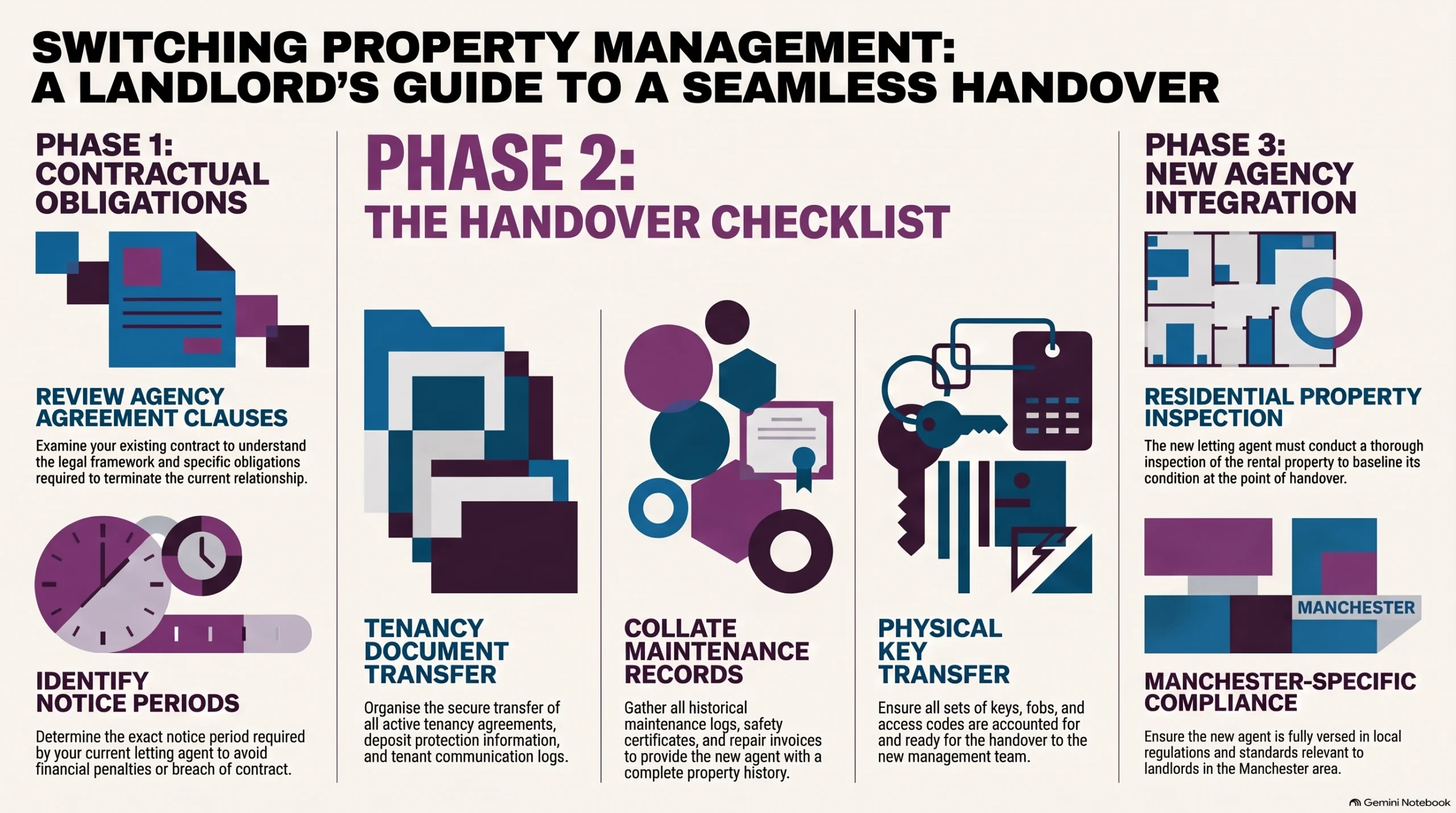
Switching a managing agent involves several sequential stages, each with fixed timeframes and legal obligations. Before contacting a new agency, review your current terms of business, gather compliance documentation, and confirm outstanding tenancy details. The table below summarises the core stages landlords in Manchester and elsewhere in England should expect during a typical handover.
Each stage carries specific risks if handled incorrectly, from invalid deposit protection to lapsed safety certificates. Working through these stages in sequence, rather than attempting them simultaneously, reduces the chance of administrative errors. The table provides a practical reference point before the detailed guidance covered in each section below.
| Handover Stage | Recommended Action |
|---|---|
| Serve written notice | Confirm the notice period and any exit fees before writing to the current agent |
| Transfer compliance documents | Send safety certificates, tenancy agreements, and deposit records within 14 days |
| Notify tenants | Issue a joint written notice at least two weeks before the changeover date |
| Transfer deposit protection | Re-register the deposit and re-serve prescribed information within statutory timeframes |
| Reconcile accounts | Obtain a full rent ledger and update tenant standing order details |
Contract Notice Periods and Terms of Business
Notice Period Requirements
Standard management agreements typically stipulate a notice period of 30 to 90 days. Landlords must submit written notice by registered post or tracked email to create a clear audit trail. Reviewing the contract terms ensures you issue notice correctly without incurring penalties or breaching signed management covenants during transition.
Written notice must explicitly state the final date of management authority. This prevents confusion regarding rent collection and maintenance responsibilities on the handover date. Always request written confirmation of receipt from the agency directors.
Termination Fee Clauses
Some managing contracts include exit charges or fee penalties for early agreement cancellation. Landlords should check for clauses that require ongoing commission payment until existing tenancies expire. If your current agency breached statutory duties or neglected property maintenance, you may have legal grounds to terminate immediately.
Unreasonable exit fees may be challenged under unfair contract terms guidance. Documenting unresolved repair delays or accounting errors strengthens your legal position if disputes arise.
Essential Tenancy Documents and Handover Records
Safety Certificates and Compliance Documentation
Safety certificates form the first priority in any handover, since expired documentation exposes both outgoing and incoming agents to liability. The new managing agent needs the current Gas Safety Record (CP12), a valid EICR, and the EPC. Any Fire Risk Assessment must also transfer before the agent assumes operational control of the property.
Requesting these documents in writing on the day notice is served avoids delays later in the process. If any certificate has lapsed or is due for renewal within the transition window, arrange the inspection before the handover date rather than after it. This way, the incoming agent inherits a fully compliant property file.
Tenancy Agreements and Deposit Protection Records
Original tenancy agreements, including any variations and guarantor documents, must transfer alongside deposit protection records to preserve legal continuity. The incoming agent requires the Prescribed Information, the deposit scheme certificate, and the check-in inventory within fourteen days of taking over management responsibilities. This deadline applies regardless of the property’s tenancy length.
Maintenance history and appliance warranties should follow within thirty days, giving the new agent a working record of past repairs and outstanding issues. Landlords who keep a running file of these documents throughout a tenancy find the handover considerably faster. Those relying on the outgoing agency to compile records retrospectively often wait longer.
Did You Know?
Failing to re-serve prescribed deposit information or update deposit registration details within statutory timeframes following an agency switch can render possession notices invalid. Landlords risk court penalties up to three times the deposit value.
Tenant Communication Protocols During Changeover
Notification Content and Timing
Tenants need formal written notification confirming the exact handover date, the new bank details for rent payments, and updated emergency contact numbers for repairs. Sending this notice too late causes missed payments and confused maintenance requests. It should reach tenants at least two weeks before the changeover takes effect.
How to switch letting agents as a landlord without disrupting occupants comes down largely to the clarity of this single communication. Tenants who understand exactly who to contact, and when, rarely raise queries during the transition itself.
Joint Handover Notices to Tenants
A joint notice, issued with both the outgoing and incoming agency named, reassures tenants. It signals that the change is planned and orderly rather than a sign of dispute. This single communication should confirm the handover date, the new point of contact, and confirm that existing tenancy terms remain unaffected by the switch.
Standing orders need updating before the next rent collection date to prevent accidental arrears landing with the outgoing agent’s account. Establishing a clear single point of contact for the first fortnight after handover resolves most tenant queries before they escalate into disputes.
The Railton-Meeks Compliance Audit Tool
Check Your Compliance & Protect Your Portfolio
Service Performance Audits for Regional Rental Homes
Licensing Compliance and Safety Standards
Managing rental properties across Manchester postcodes requires strict adherence to local licensing rules. Local councils enforce mandatory HMO licensing alongside extensive selective licensing schemes. A competent managing agent handles required electrical safety checks, gas inspection certificates, and official licensing paperwork. Professional oversight protects property owners from severe statutory financial penalties.
In practice, we find that agents unfamiliar with a specific council’s selective licensing scheme are the most common source of missed renewal deadlines. Confirming an agent’s local licensing knowledge before appointment prevents this exposure.
Maintenance Response and Cost Controls
Efficient property maintenance relies on reliable trade networks and clear emergency response protocols. Incoming managing agents should offer structured maintenance triage processes to resolve minor issues without unnecessary contractor callouts. Established agencies maintain transparent repair thresholds, ensuring landlords retain financial oversight whilst keeping rental properties fully compliant and secure.
Ask a prospective agent to set out their contractor approval limit and average repair turnaround time. This gives a clear, comparable measure of service quality before signing a new agreement.
Railton-Meeks offers four landlord service tiers across Manchester and Cheshire
Transfer Protocol for Rent Collection and Deposit Schemes
Deposit Scheme Transfer and Re-registration
Tenancy deposits held in custodial or insured schemes must transfer directly to the incoming agent’s control, with prescribed information re-served to tenants within statutory timeframes. Missing this step risks invalidating any future Section 21 notice, regardless of how well the rest of the handover has been managed. Our guide to choosing a property management company goes into this in more detail.
Custodial scheme transfers are typically administrative, moving account control between agents without touching the funds themselves. Insured scheme deposits require closer attention, since the outgoing agent may hold the funds directly rather than the scheme provider. Written confirmation of transfer is therefore essential.
Rent Ledger Reconciliation and Banking Updates
Detailed accounting statements from the outgoing agent allow landlords to verify outstanding balances, tenant arrears, and any client money still held before final settlement. Requesting a full rent ledger covering at least the preceding twelve months gives both landlord and incoming agent a clear financial starting point.
Updated bank account details should reach tenants at least two weeks before the next rent is due. This reduces the risk of payments landing with the outgoing agency by mistake. Reconciling the final month’s rent split between agencies in writing avoids later disputes over commission or outstanding fees.
Instant Rental & Block Valuation
Get Your Valuation & Know Your Market Value
Legislative Compliance and Property Energy Standards
Tenant Rights Reform Preparedness
Recent legislative shifts have fundamentally changed tenancy structures by replacing traditional fixed period agreements with rolling periodic terms. Managing agents must update administrative workflows to operate under expanded statutory possession grounds. Professional agencies ensure compliance with mandatory tenant notification rules, protecting property owners from severe civil penalties during complex regulatory transitions.
From experience across the sector, agencies differ in how early they prepare for a legislative deadline. Those that update internal processes ahead of the change, rather than after it takes effect, spare landlords the disruption of retrospective compliance work.
Energy Performance and Property Standards
Landlords face tightening environmental regulations requiring rental properties to meet minimum energy performance standards by set statutory deadlines. Experienced management agencies conduct proactive property audits to schedule cost effective insulation and heating upgrades. Upgrading energy efficiency protects future asset values whilst maintaining strong appeal among quality professional tenants.
Requesting a current EPC rating and improvement plan from a prospective agent during appointment discussions is a useful test. It confirms whether they are actively managing this risk across their portfolio, rather than waiting for enforcement action. There is more on fully managed lettings in Manchester in a separate guide.
Insurance and Financial Continuity During the Switch
Insurer Notification Requirements
Buildings and landlord insurers need written notification of a managing agent change. This matters most where the policy names the outgoing agency as the point of contact for claims. Failing to update this detail can delay claims handling at the worst possible moment. An active escape of water or storm damage incident is exactly when speed matters most.
Most insurers only require a short notification letter or online update, but landlords should request written confirmation that the change has been recorded. This step is frequently overlooked because it falls outside the tenancy paperwork most handovers focus on.
Rent Guarantee and Legal Expenses Cover Continuity
Rent guarantee and legal expenses cover, where held, often ties directly to the managing agent administering the tenancy. Continuity therefore depends on informing the insurer promptly. Some policies lapse automatically on a change of managing agent unless the landlord notifies the provider within a fixed number of days.
Checking the policy wording before the switch, rather than after a claim arises, confirms whether cover transfers automatically or requires a fresh application. Landlords with rent guarantee cover in place should treat this check as a standard item on the handover checklist, alongside deposit and certificate transfers.
HMO Specialist Yield & Tax Calculator
Calculate Your Yield & Offset New Tax Burdens
Final Thoughts
Choosing to switch property management company landlord arrangements is a strategic decision that protects your rental income. Landlords execute a seamless agency transfer by auditing contract notice terms and transferring essential compliance documentation. Maintaining clear communication with tenants eliminates administrative friction and avoids unexpected void periods.
As private rented sector regulations become more stringent, partnering with an agile, highly compliant property manager is essential. Proactive management ensures full compliance with evolving safety standards, energy efficiency targets, and statutory tenancy reforms. Investing time in selecting the right agency provides long-term security, consistent rental growth, and complete peace of mind.
Frequently Asked Questions
A:
Yes, landlords can switch managing agents during an active tenancy without ending the contract with their tenants. Existing tenancy agreements remain legally binding and valid throughout the changeover. The primary task involves transferring compliance files, deposit protections, and rent payment arrangements to the new agency. Landlords must check their existing management contract for notice periods and issue formal written termination to their current agent. Informing tenants promptly with new payment instructions ensures uninterrupted rent collection.
A:
The switching process typically takes between 30 and 90 days, depending on the notice period specified in your current management agreement. Administrative preparations, such as collecting compliance records and auditing tenancy files, can begin immediately after serving notice. Incoming managing agents usually coordinate directly with the outgoing agency to transfer keys, safety certificates, and deposit funds. Proper coordination ensures operational control transfers smoothly on the agreed handover date and avoids disruption for property owners or tenants.
A:
Tenant security deposits must be transferred safely between government-approved deposit schemes when changing managing agents. If the deposit is held in a custodial scheme, the outgoing agent transfers account control directly to the incoming agency. For insured deposit schemes, funds are transferred between accounts and re-registered accordingly. Landlords or their new agents must re-serve prescribed deposit information and statutory terms to tenants within 30 days of the transfer. This step maintains full statutory compliance.
A:
Whether an agent can charge exit fees depends on the specific terms of business signed in your management agreement. Some traditional contracts contain early termination fees or clauses requiring commission payments until the current tenancy expires. However, the position changes if the agency has committed a serious breach of contract, such as failing to maintain statutory safety standards or mismanaging rent. In that case, landlords may have grounds to terminate immediately without paying penalty fees. Seeking independent legal advice helps clarify contract enforceability.
A:
Before appointing a new property management provider, landlords should inquire about their fee structures, emergency maintenance triage systems, and local compliance expertise. Ask how they manage regional licensing requirements, periodic inspections, and deposit transfers. It is also worth checking their digital portal capabilities, rent arrears chasing procedures, and how they prepare properties for upcoming legislative reforms. Choosing an agency with robust compliance tracking and proactive communication ensures your rental assets remain protected.
