

HMO Licensing Manchester: Rules and Standards
Operating a shared residential property demands a firm grasp of regulatory standards and tenant safety duties. For landlords in the North West, HMO licensing Manchester represents an exacting regulatory framework. Local housing policy intersects directly with national statutory legislation. Manchester City Council enforces rigorous benchmarks on fire protection, waste disposal, and room proportions. Failing to secure the correct authorisation exposes landlords to substantial financial liabilities. Non-compliant owners face civil penalties, rent repayment orders, and prosecution.
You may let Victorian terraces in Fallowfield or professional house shares near the Oxford Road Corridor. In every case, compliance preserves both asset value and tenant safety. These duties demand operational vigilance from the day you complete on an investment property. Are you fully prepared to meet council standards and protect your rental income against enforcement action?
Key Takeaways
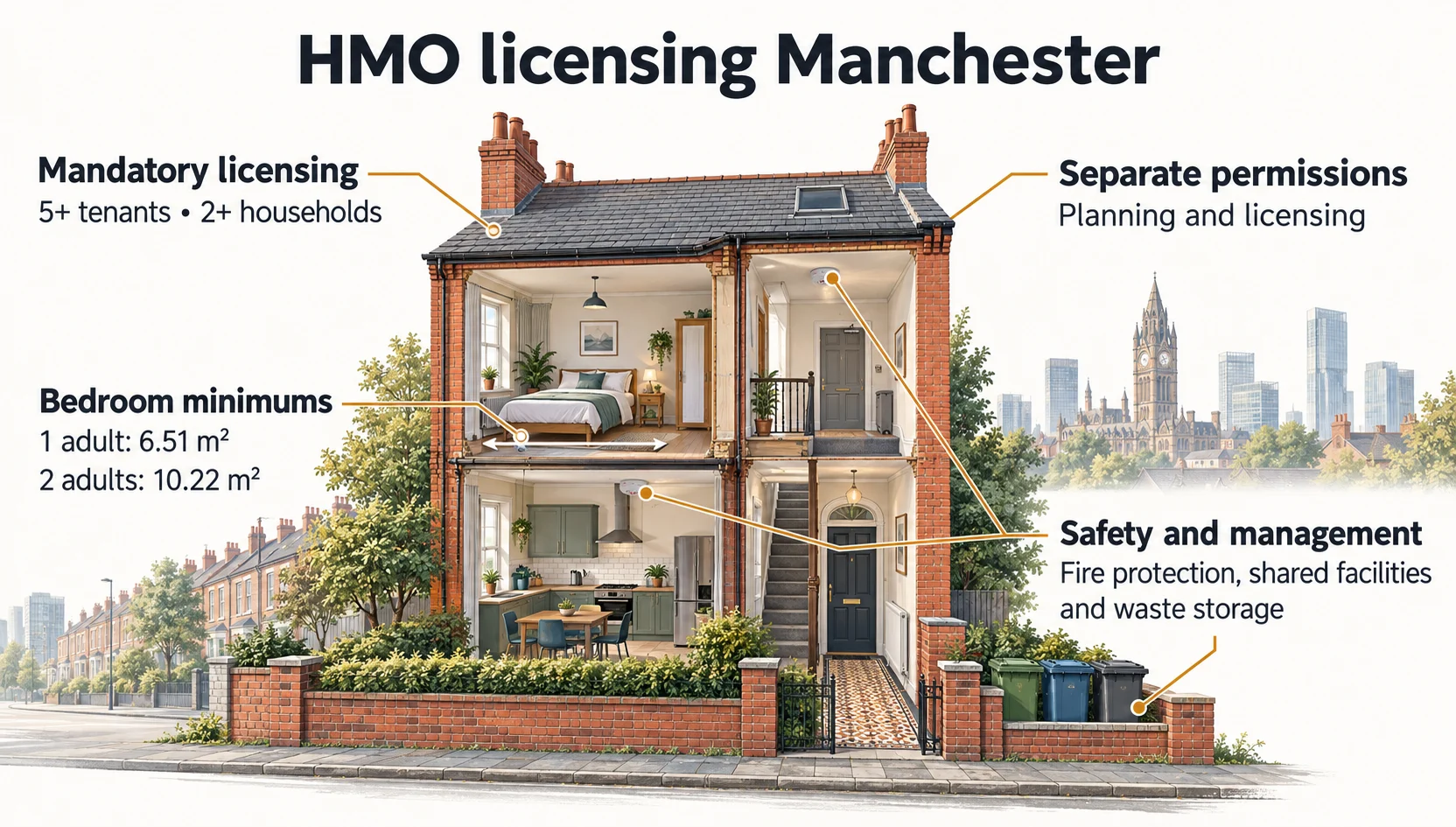
- Manchester properties with five or more tenants from two or more households require a mandatory HMO licence to operate legally across the city.
- The local authority enforces strict room sizes, mandating a minimum of 6.51 square metres for single adults and 10.22 square metres for doubles.
- Planning permission remains independent of property licensing, with city-wide Article 4 Directions removing permitted development rights for small HMO conversions throughout Manchester.
- Operating an unlicensed HMO exposes landlords to civil penalties up to £30,000, prosecution in court, and rent repayment orders covering twelve months.
- Meeting required safety standards entails installing Grade D interlinked fire detection, heat alarms in kitchens, and certified self-closing FD30 fire doors throughout.
Manchester Property Licensing Frameworks at a Glance
Manchester operates a tiered regulatory system to control housing density and protect tenants. The framework lifts living standards across the private rented sector. Licensing duties depend upon occupant counts and household divisions. Geographic location also dictates which council rules apply to a given address.
The table below works as a reference guide for landlords identifying the permissions their holdings need. It covers Manchester City Council rules alongside the position in neighbouring municipal boroughs. Reviewing these thresholds helps you recognise your primary statutory duties and the compliance conditions attached to them.
| Licence Category | Occupancy Threshold | Primary Statutory Focus |
|---|---|---|
| Mandatory HMO Licence | 5 or more people (2+ households) | Applies city-wide. Covers fire containment, amenity ratios, and fit and proper person tests. |
| Selective Licence | All private tenancies in a designated zone | Phase 2 zones in Gorton and Abbey Hey, Harpurhey, and Clayton and Openshaw, running to 30 April 2027. |
| Additional Licensing Scheme | 3 or 4 people (2+ households) | Not currently designated by Manchester City Council. Active in neighbouring boroughs such as Salford. |
| Sui Generis Planning HMO | 7 or more occupants | Full planning consent required alongside mandatory licensing for large properties. |
Thresholds for Property Authorisation
Mandatory National Licensing Criteria
A mandatory HMO licence is legally required across England for shared residential properties. It applies to dwellings occupied by five or more persons forming two or more separate households. This statutory rule applies throughout Manchester regardless of building age. It also applies regardless of property style, provided basic amenities are shared.
Basic amenities include shared kitchens, bathrooms, or communal living rooms. Council officers inspect these houses to assess safety and management capability. Landlords must also pass a fit and proper person test. From experience across the sector, the headcount threshold catches owners out mid-tenancy. One additional occupant can push a four-person let straight over the line.
Local Discretionary and Area Licences
Local authorities hold discretionary powers under the Housing Act 2004 to run an additional licensing scheme for smaller shared homes. Manchester City Council confirms that no such scheme currently operates within its boundary. The council relies instead on selective licensing across designated zones. Neighbouring boroughs take a markedly different approach.
Salford, for instance, licenses smaller HMOs housing three or four occupants. In practice, we find portfolio landlords stumble at borough boundaries. Two properties a few streets apart can sit under separate regimes. Manchester’s selective licensing designations cover parts of Gorton and Abbey Hey, Harpurhey, and Clayton and Openshaw. Those designations run until 30 April 2027. Inside them, even a single-family let requires a council licence.
Planning Restrictions and Article 4 Directions
City-Wide Removal of Permitted Development
Manchester City Council enforces a city-wide Article 4 Direction across every ward. This directive removes automatic permitted development rights for shared house conversions. Converting a family home under Class C3 into a small HMO under Class C4 requires planning approval. You must obtain formal consent before letting rooms to multiple tenants.
Planning permission operates entirely separately from HMO licensing Manchester regimes. Holding a property licence does not grant planning approval. Equally, planning consent does not exempt you from licensing duties. Landlords must satisfy both systems concurrently before tenants move in. When operating in this market, we treat the two consents as separate workstreams from the outset.
Policy H11 and Concentration Restrictions
Planning applications for new shared housing face strict scrutiny under local planning policies. In core rental suburbs like Fallowfield and Withington, the council enforces Policy H11. Planners will refuse applications if the concentration of HMOs within one hundred metres is already elevated. This policy protects local community balance.
Properties operating as shared housing before Article 4 took effect need continuous proof. Landlords should hold a Certificate of Lawful Existing Use. That document evidences historic uninterrupted occupation as a shared dwelling. Losing established lawful use is costly. The property reverts to a single-family dwelling for planning purposes, and the investment case collapses with it.
Did You Know?
Manchester City Council’s Phase 2 selective licensing designations came into force on 1 May 2022 and run until 30 April 2027. They cover roughly 1,300 privately rented homes across four designated areas. The council has committed to inspecting half of all licensed properties within that five-year designation period.
Amenity Standards and Room Dimensions
Statutory Bedroom Size Limits
Manchester City Council enforces mandatory minimum sleeping room dimensions to prevent severe overcrowding in shared properties. A single adult bedroom must provide at least 6.51 square metres of clear floor space. Rooms for two adults require a minimum floor area of 10.22 square metres. These dimensions represent strict legal minimums.
Usable space excludes any floor area where ceiling heights measure under 1.5 metres. That exclusion commonly affects rooms beneath sloping rafters in attic conversions. En-suite bathrooms and built-in cupboards cannot count towards bedroom floor space. The council records the maximum permitted headcount directly on the licence schedule. Measure before you market a room, not afterwards.
Kitchen and Shared Facility Ratios
Shared houses must provide adequate cooking, washing, and dining facilities for all occupants. Council standards specify minimum numbers of cooking rings, ovens, and sinks based on resident numbers. Food storage units and refrigeration space must also match household size. These mandatory amenity ratios prevent unhealthy, overcrowded conditions.
Sanitary provision follows equally strict ratios. A shared house with five residents typically requires a full bathroom with a washbasin, bath or shower, and toilet. A separate additional toilet with handwashing facilities is usually mandatory. Inadequate facilities cut the permitted occupancy figure. In some cases they lead to outright licence refusal.
The Railton-Meeks Compliance Audit Tool
Check Your Compliance & Protect Your Portfolio
Fire Safety Measures and Building Controls
Grade D Fire Detection Standards
Fire safety compliance represents the primary focus of local housing inspections across Manchester. Licensed HMOs require a Grade D, Category LD2 fire alarm system. This system incorporates interlinked mains-powered smoke alarms with battery back-ups along circulation routes. High-risk communal areas like living rooms also require smoke detection.
Kitchens require dedicated interlinked heat alarms to avoid false triggers from normal cooking. When one alarm activates, every unit across the property must sound simultaneously. Landlords must test alarm systems regularly. They must also record maintenance outcomes in an accessible safety logbook. Inspectors ask for that logbook early in a visit.
FD30 Fire Doors and Compartmentation
Passive fire safety measures protect escape routes by containing heat and toxic smoke during emergencies. Manchester standards require certified FD30 fire doors on all kitchen and bedroom doorways leading to escape corridors. These doors must feature intumescent fire strips, smoke seals, and approved overhead self-closing devices.
Landlords must also carry out a written Fire Risk Assessment under national legislation. That document evaluates ignition sources, identifies escape paths, and details fire protection measures. Council inspectors will request the assessment during audits. Incomplete fire documentation can result in immediate licence refusal. We rarely see a clean inspection where the paperwork lags the physical works.
Railton-Meeks offers four landlord service tiers across Manchester and Cheshire
Waste Management and Operational Duties
Refuse Storage and Hard Standing
Inadequate external refuse storage represents a frequent cause of council enforcement across student neighbourhoods. Manchester licence conditions mandate sufficient commercial-grade refuse bins and recycling containers for all occupants. These bins must stand securely on dedicated, level hard standing within property boundaries. Bins must never block pedestrian pavements.
In high-density districts like Fallowfield and Rusholme, street cleanliness receives close scrutiny. Landlords must give written waste collection guidance to new tenants at the start of a tenancy. That guidance sets out local collection schedules and recycling procedures. Failing to control external rubbish is a direct breach of licence conditions.
General Management Regulations Compliance
All shared homes must comply with the Management of Houses in Multiple Occupation (England) Regulations 2006. These regulations place ongoing statutory duties upon property managers. Landlords must keep communal areas clean and ensure all fixtures remain in working order. Utility supplies and fire escape routes require constant maintenance.
Managers must display their direct contact details in a prominent communal area. The display lets tenants and neighbours report maintenance issues or emergencies without delay. Breaching management regulations is an offence of strict liability. Councils can prosecute managers even where the property needs no licence. Intention is irrelevant to the offence.
Instant Rental & Block Valuation
Get Your Valuation & Know Your Market Value
Application Procedures and Renewal Cycles
Initial Application Submissions
Applying for an HMO licence requires assembling extensive compliance documentation before using the council portal. Applicants must provide a valid Landlord Gas Safety Record and an Electrical Installation Condition Report. Portable appliance testing records and an Energy Performance Certificate are also mandatory. Accurate floorplans must detail all room dimensions.
The applicant must pass a fit and proper person check. Council staff verify that the proposed manager holds no unspent convictions for housing offences or fraud. Application fees split into an initial processing fee and a final issue fee. Standard licences run for up to five years. Assemble certificates first; the portal stage is the quick part.
Renewals and Structural Alterations
Landlords must submit renewal applications before their existing licence expires. Letting a shared property during a gap between licences means operating illegally. Unlicensed periods expose owners to heavy fines and statutory rent recovery claims. Renewals require updated safety certificates and confirmation that property layouts remain unchanged.
You must notify the council if you plan internal alterations or change your managing agent. Converting communal areas into bedrooms or altering partition walls requires a formal licence variation. Failure to report alterations breaches licence conditions. Significant layout changes require updated plans and a revised fire risk assessment.
HMO Specialist Yield & Tax Calculator
Calculate Your Yield & Offset New Tax Burdens
Enforcement Actions and Financial Penalties
Civil Penalties and Criminal Prosecution
Operating an unlicensed HMO or breaching licence conditions carries severe legal consequences under housing law. Local housing authorities can issue civil financial penalties of up to £30,000 for each offence. These civil penalties serve as an alternative to court prosecution. Councils actively pursue non-compliant property owners across Manchester.
For serious or repeat offences, the council brings criminal prosecution in the magistrates’ court. Convictions can result in unlimited court fines and a criminal record. A housing conviction prevents landlords from satisfying fit and proper person tests. That failure then jeopardises existing licences in other local authority areas nationwide.
Rent Repayment Orders and Banning Notices
Tenants and local authorities can apply to the First-tier Tribunal for a Rent Repayment Order. Tribunals can order landlords to repay up to twelve months of rent collected during unlicensed periods. These repayments can erase an entire year of rental yield. They represent a major financial hazard for non-compliant landlords.
Unlicensed operation also weakens your position on possession. Section 21 was abolished in England on 1 May 2026, so every claim now rests on a Section 8 ground. For the most serious offences, councils can apply for a Banning Order. Banning Orders prohibit letting or managing residential property anywhere in England. They last a minimum of twelve months.
Railton-Meeks Landlord Assistance
Final Thoughts
Compliant HMO licensing Manchester demands ongoing vigilance and attention to detail. Landlords must understand how national licensing rules interact with local planning restrictions. City-wide Article 4 Directions and strict amenity ratios require continuous oversight. The risk of £30,000 civil penalties underlines why compliance cannot be deferred.
Regulatory scrutiny across Greater Manchester continues to tighten. The Renters’ Rights Act reforms have raised the stakes further for landlords without a valid licence. Upgrading fire detection, checking bedroom sizes, and renewing licences on time protect the investment. Regular inspections and organised record-keeping keep tenants safe and rental income intact.
Frequently Asked Questions
A:
Planning permission governs the lawful use of land and buildings under town planning legislation. An HMO licence regulates property safety, room sizes, and management standards under the Housing Act 2004. In Manchester, landlords must satisfy both systems independently. Holding planning consent does not permit you to let without a licence. Holding an HMO licence does not regularise a planning breach. You need both authorisations before letting your property.
A:
Manchester City Council usually issues standard HMO licences for a maximum of five years. The authority can issue a shorter licence where concerns exist. If inspectors identify planning issues, management problems, or maintenance defects, they may grant a twelve-month licence instead. That temporary period gives landlords time to resolve outstanding matters. Submit your renewal application well before expiry to avoid operating an unlicensed property.
A:
Yes. Manchester City Council enforces a city-wide Article 4 Direction. That directive withdraws permitted development rights across the entire local authority area. In other regions, landlords can convert family homes into small shared properties without formal consent. In Manchester, converting a C3 dwelling into an HMO for three to six occupants requires full planning permission. Applications face strict assessment under Policy H11 to limit local HMO concentrations.
A:
Bedroom doors onto protected escape routes in a Manchester HMO must achieve an FD30 rating. That rating provides thirty minutes of fire and smoke containment during an evacuation. The complete doorset requires intumescent fire strips, cold smoke seals, and a certified overhead self-closing device. Landlords must inspect these doors regularly to confirm the closers work. Damaged hinges, missing seals, or defective latches need immediate repair.
A:
Yes. Exceeding the occupancy figure on your licence is a criminal offence under the Housing Act 2004. Manchester City Council can impose civil financial penalties of up to £30,000 for overcrowding breaches. Alternatively, the authority can prosecute in court, which may result in an unlimited fine. Landlords must inspect regularly and maintain clear tenancy agreements. Verify who actually lives in the property to prevent unauthorised sub-letting.
